
Fossil Butte National Monument Research Quarry program
Kemmerer, Lincoln County, Wyoming. National Monument.
Details

- Where
- Kemmerer, Lincoln County, WY. No street address stated. Directions
- When
- Fridays and Saturdays from June 26, 2026 through August 15, 2026 11 am to 3 pm.
- Season
- Spring: May 1 through Thursday before Memorial Day: open daily 8:00 am - 4:30 pm Summer: Friday before Memorial Day through Labor Day: open daily 8:00 am - 5:30 pm Fall: day after Labor Day through October 31: open daily 8:00 am - 4:30 pm Winter: November 1 through April 30: open Mondays - Saturdays 8:00 am - 4:30 pm.
- Getting there
- Travel 9 miles west of Kemmerer, Wyoming on U.S. Highway 30. There is a highway sign near mile post 44; turn right onto Lincoln County Road 300.
- Fees
- An entrance pass is not required to access Fossil Butte National Monument.
- Hours
- The park is open sunrise to sunset, but be sure to check the visitor center operating hours as they vary with the season.
- Access
- The scenic road is closed during the winter and most of spring.
- Phone
- 307 877-4455
- Managed by
- National Park Service.
- Coordinates
- 41.82447052001953, -110.90763854980469.
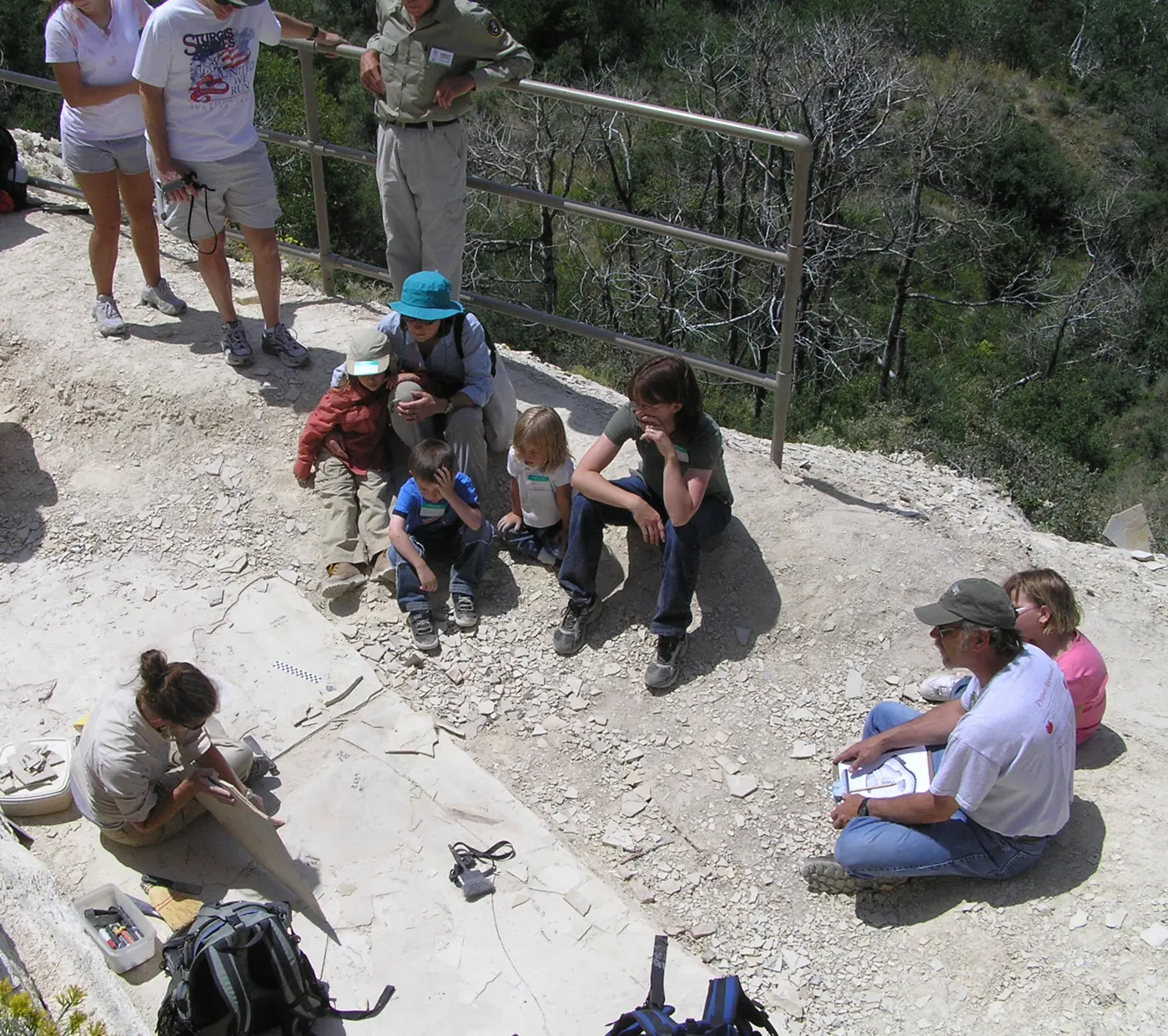
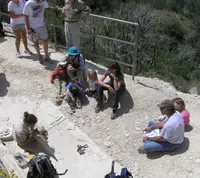
The Research Quarry at Fossil Butte National Monument is reached on foot. The trail runs three-quarters of a mile with more than 300 feet of elevation gain, and the quarry has no shade, no water, and no restrooms. On Fridays and Saturdays in the middle of summer a ranger works there and explains to whoever makes the climb how fossils are found and collected and what the monument’s research is turning up. A Park Service photograph shows a ranger intern standing with visitors at the quarry. The 2026 program ran from June 26 through August 15, from 11 a.m. to 3 p.m., and needed no reservation. The park asks visitors to wear hiking boots and bring plenty of water, sunscreen, and insect repellent. First-time visitors get directions at the visitor center.
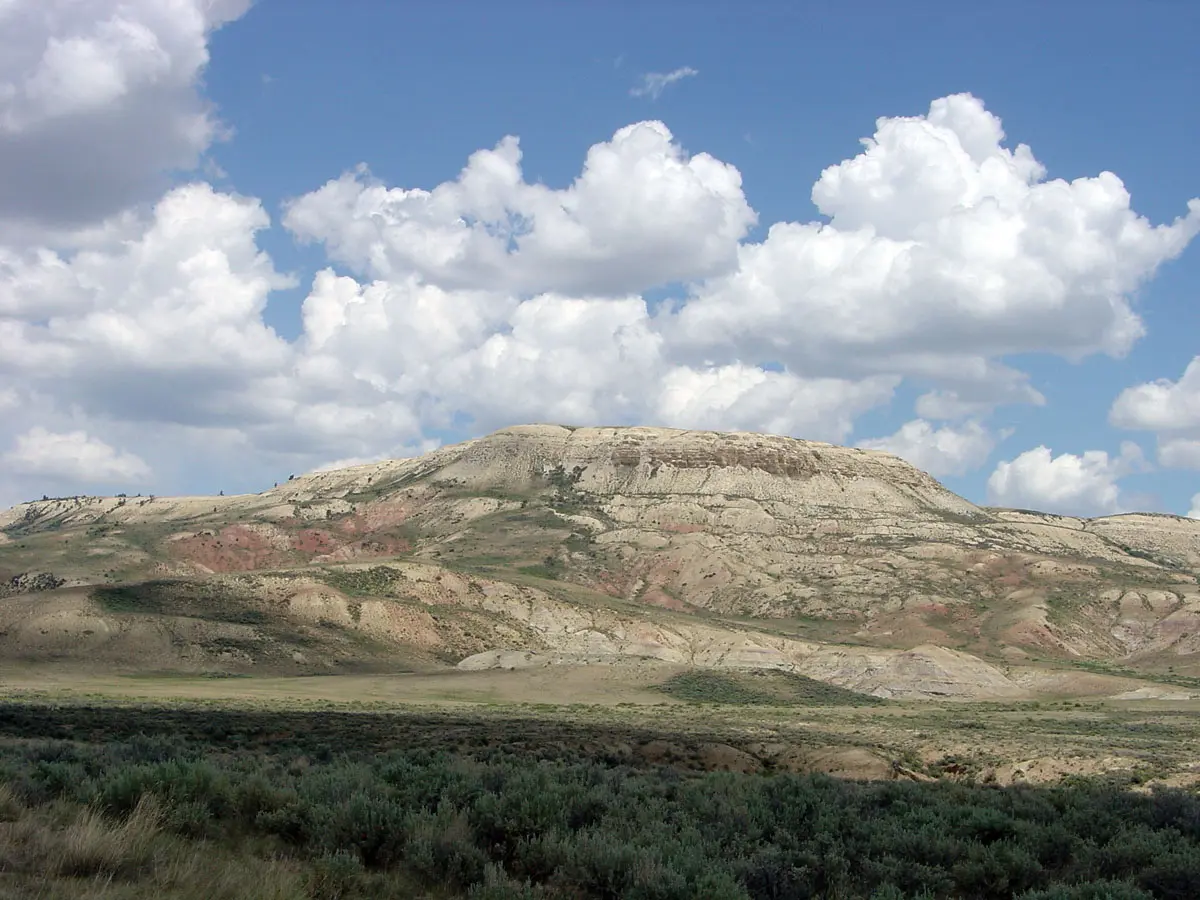
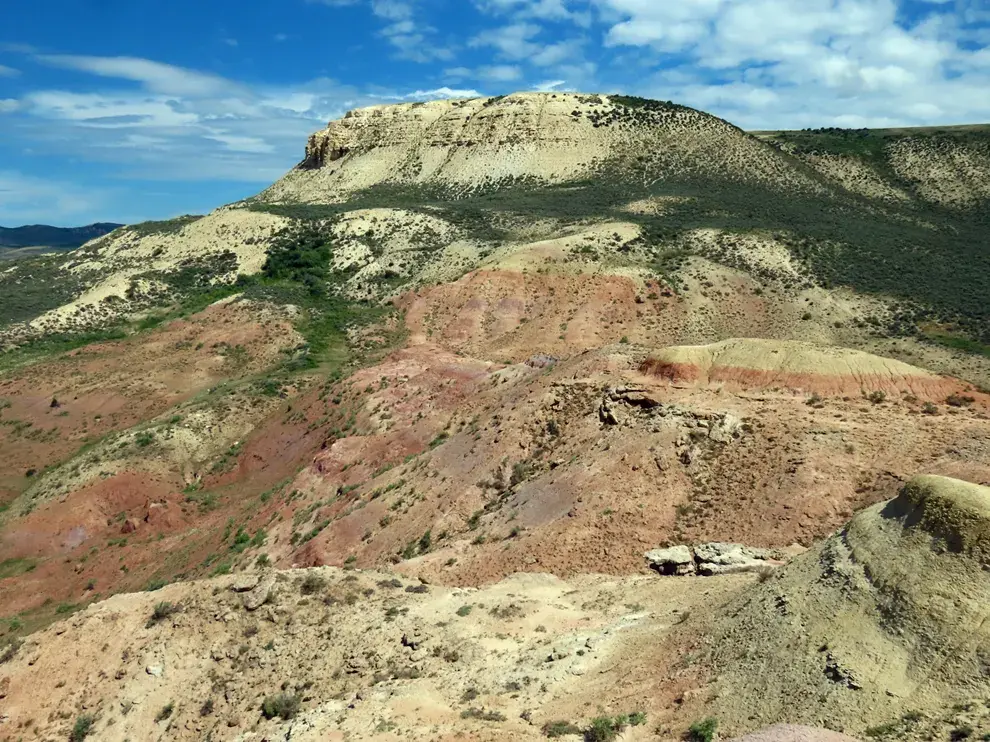
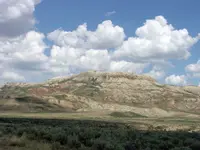
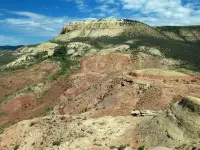
The country around the quarry is high, cold sagebrush steppe in southwest Wyoming. Valleys in Fossil Basin average 6,600 feet and the ridgetops 7,600. Seen from the road, Fossil Butte looks like a butte. The Park Service describes it as a curved ridge with gentle slopes, its fossils held in the top layers. Below the tan ledges lie the red, purple, lavender, and gray beds of the Wasatch Formation. Summer days rarely pass 90 degrees, and summer nights often drop below 50. The Park Service names the pronghorn as the characteristic animal of the grassland that has replaced the old lake.
The quarry’s spreadsheet
The research quarry keeps a ledger. Its published data begin in 1998 and run through 2020; the year 2018 is missing. Each row records the year and a field number, the fossil’s name, its standard length in millimeters, and the percent of the skeleton still articulated. It also records the discoverer, the fossil’s orientation in degrees, and whether it lay on a bedding surface or showed on a broken edge of rock. The last columns give the side the fossil is preserved on, its horizon in centimeters below the bottom of the bottom ash, and a yes or no for whether it was collected. A second table tallies how many of each organism the quarry has produced. Every fossil found and collected stays in the monument’s museum collection for scientific study.
Visitors who want to keep what they dig go elsewhere. Private, commercial quarries in the area let people pay to dig. WyoHistory.org, writing in 2014, describes the largest remaining commercial quarry in the state as one dating from 1943. Carl and Shirley Ulrich run it on state land under a state lease, and the Ulrich family also runs a fossil-preparation business and gallery on land next to the monument. The operation can be seen from the monument’s entrance road. Collecting vertebrate fossils such as fish from public land without a permit is illegal. In 1993 collectors were found to have bulldozed fossil beds on public land near Farson, Wyoming. One Bureau of Land Management geologist compared the scene to “an Air Force bombing range.” Inside the monument, WyoHistory notes, quarries are worked only on a limited basis by staff experts.
Fish in the eighteen-inch layer
What the quarry cuts into is the bottom of Fossil Lake. About 52 million years ago, by the Park Service’s figure, that lake lay in a warm, wet basin with palm trees and crocodile relatives along its shores. The basin had formed when the forces raising the Rocky Mountains bent the crust downward to the west, leaving shallow basins that caught rain and river water. Fossil Lake was the smallest of three, alongside Lake Gosiute and Lake Uinta. The Park Service puts it at around 1,500 square miles at its largest and never more than 100 feet deep. The Wyoming State Geological Survey gives about 2,000 square miles.
The fossil-bearing unit is the Fossil Butte Member of the Green River Formation, the ledge-forming middle third of the escarpments, made mostly of laminated calcite-rich mudstone. Its working layers carry informal names. The sandwich bed is two closely spaced volcanic ashes for bread, with limestone laminations for turkey and kerogen for roast beef. The 18-inch layer averages 18 inches thick and yields the largest and best-preserved fossils. The minifish bed holds more fossils, smaller on average, and the gastropod bed is thick with snails.
The Park Service gives three reasons the lake kept its dead so well. A layer of saltwater lay at the bottom, where the freshwater animals could not live. Very little oxygen reached the lake floor, which also kept scavengers away. A microbial mat of cyanobacteria grew over anything that drifted down onto it, holding the animal in place so it could not break apart and float off as it decayed. WyoHistory and the Intermountain Histories project describe the deep water instead as poisoned with hydrogen sulfide. The lake also left records of mass deaths, dozens of fish killed at once and laid side by side. The proposed causes include algal blooms, swings in salinity or temperature, and hydrogen sulfide stirred up from the bottom. The weight of later layers flattened the bodies. Water carried away some of the material and left carbon, which is why the bones and scales are brown.
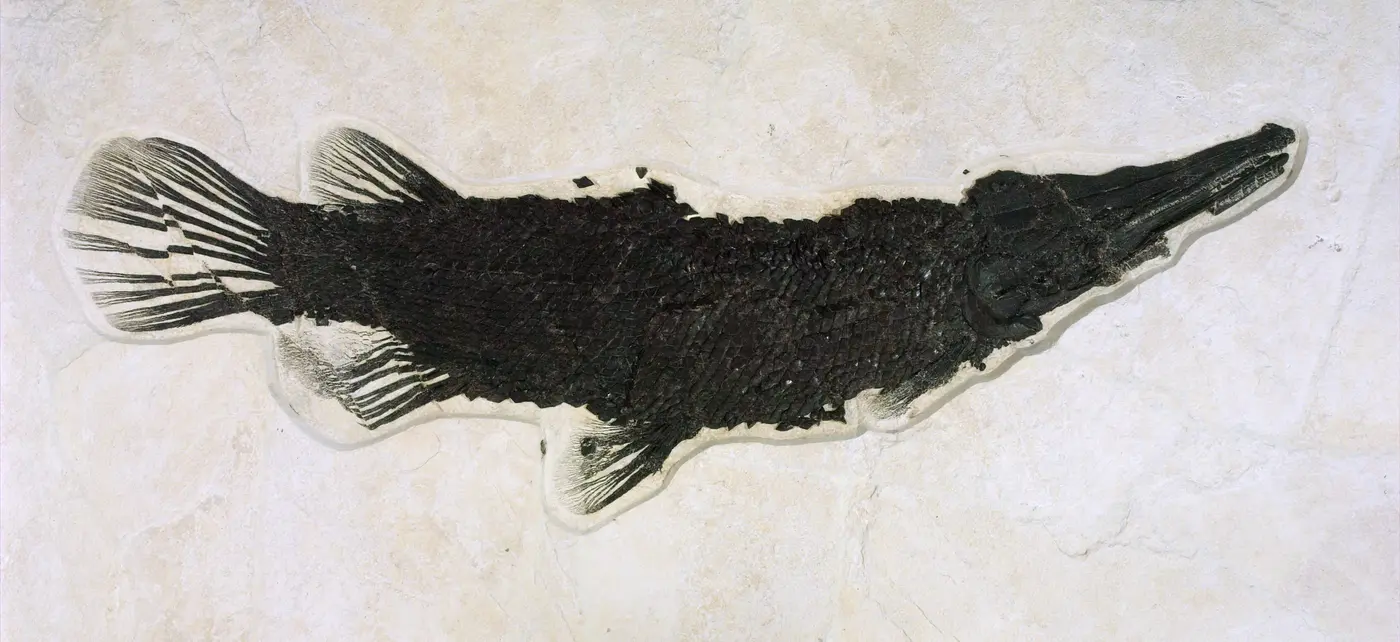
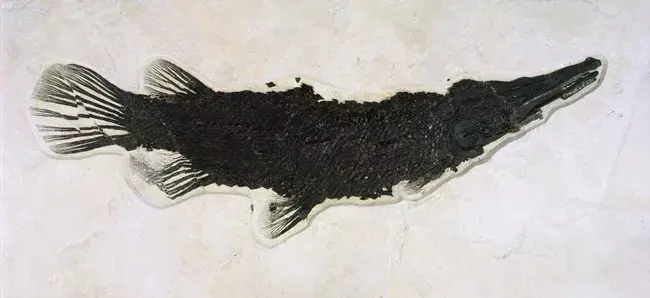
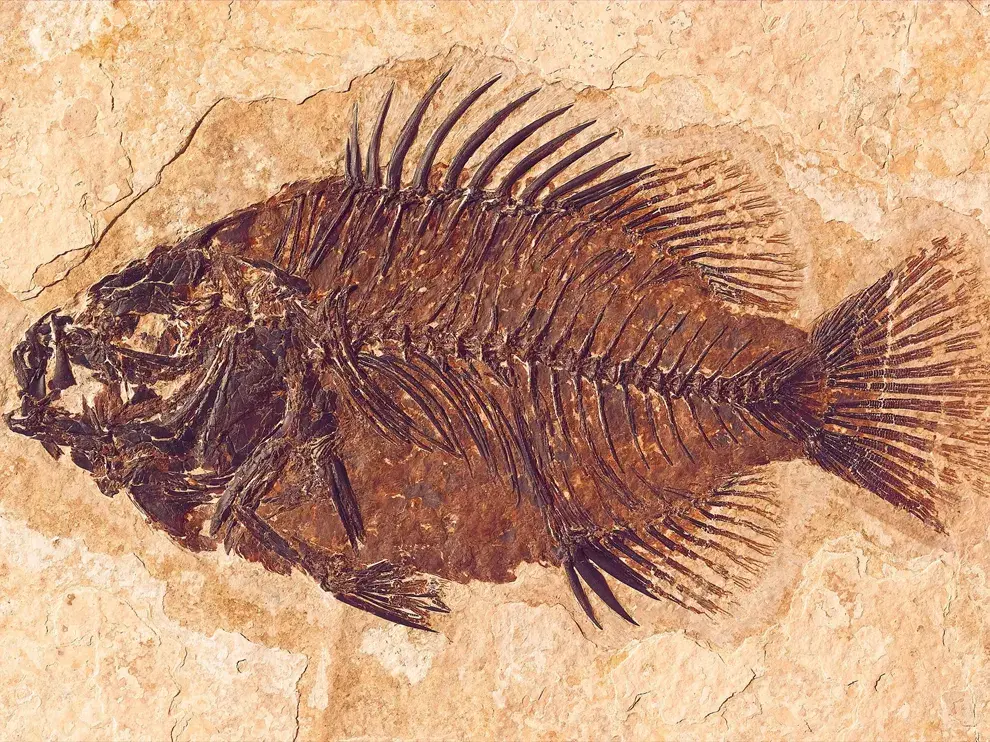
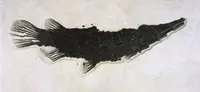
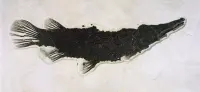
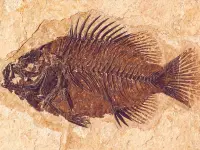
Fish make up most of the finds, with 27 species identified from the member. The commonest is Knightia eocaena, a herring-like fish three to four inches long that swam in schools and ate plankton and algae. It is named for Wilbur C. Knight, the first Wyoming State Geologist, and became the Wyoming State Fossil in 1987. One Park Service photograph shows a Diplomystus with a Knightia in its mouth. The beds have also given up stingrays, gars, turtles, birds, the earliest known species of bat, and, by the Park Service’s count, only two fossil frogs.
None of this shows on the trails, because the fossils lie sealed between horizontal layers of rock and must be split out and prepared. The visitor center holds the prepared specimens, more than eighty on display according to Intermountain Histories, along with a thirteen-minute film. Between Memorial Day and Labor Day, on weekends and some weekdays, a ranger demonstrates fossil preparation, using special tools to take the rock off a specimen. Rangers also give porch talks of 15 to 25 minutes on the fossils and geology. From the visitor center’s back porch the view takes in most of the Chicken Creek watershed, with Cundick Ridge on the northeastern horizon.
From Petrified Fish Cut to Fossil Butte
The first report of fossils from the Green River Formation comes from the 1856 excursion of Dr. John Evans, whose fish were identified and named by the paleontologist Joseph Leidy. In 1868 Union Pacific workers laying track near Green River found fossils in such numbers that they called the place Petrified Fish Cut. Railroad employees passed specimens to Edward Drinker Cope, who described several new species from them. Ferdinand Hayden studied the geology and fossil beds along the line in 1871. The Oregon Short Line, completed beside Fossil Butte in 1881, made the remote butte easier to reach, and quarrying there grew.
In 1897 Robert Lee Craig began quarrying at Fossil Butte. WyoHistory calls him an amateur collector. Craig worked until 1937 as a quarrier and preparer, supplying museums and private collections around the world. Samuel Small and David C. Haddenham joined him in taking museum-quality specimens out of the local stone. WyoHistory reports that preparing a single piece could take up to several hundred hours with a fine-pointed needle. Buyers included museums, private collectors, and people who wanted the slabs for wall decoration and tile.
Haddenham’s A-frame on the Quarry Trail
The Historic Quarry Trail leaves Lincoln County Road 300 about half a mile from U.S. Highway 30. It is a 2.5-mile dirt loop to the south face of Fossil Butte, past a Green River Formation quarry worked in the 1960s, where exhibits describe the geology and the history of collecting. About 1.25 miles along the trail and some 600 feet above its start stands the Haddenham Cabin. It sits on the uppermost of a series of slump benches below the talus slope where specimens were once quarried, at about 7,110 feet, roughly 2,000 feet east of the abandoned quarry.
David C. Haddenham built it about 1918 as a shelter for himself and his family during the quarrying season. It is a crude A-frame twelve feet by eight by seven, set on wood tie beams laid on dirt and sided with vertical boards. A hatch with two metal strap hinges in the west slope of the roof opened for air, and a tin chimney rises from the south side. Inside, corrugated cardboard served as insulation. The cabin has never been modified, and its wood is deteriorated and holed in places.
Haddenham was born in 1881 and, by his own testimony, began quarrying at Fossil Butte in the 1890s. He worked the quarry in summer and spent winters preparing the rough-cut slabs for sale, helped at times by his sons, his grandsons, and his brother George. The trade never made him rich. In the 1930s, while the Great Depression hit the region hard, he reportedly sold a gar to a Paris museum for $500. His specimens also went to museums in Germany, Japan, and the United States. The cabin’s National Register nomination records a darker local reputation as well: an alleged but never proven role in the poisoning death of his sister-in-law, Anna Ritchey, in May 1922. She was known locally as Queen Anne and was the only woman in Wyoming ever convicted of cattle rustling. The account of the poisoning comes through a 1989 interview with Haddenham’s grandson, Robert H. Haddenham of Lander.
Haddenham quarried until his death in 1968. On October 23, 1972, Congress created Fossil Butte National Monument to preserve “outstanding paleontological sites and related geological phenomena,” in the words of the act. The cabin stayed in use into the 1960s, and on December 23, 2003, it was added to the National Register of Historic Places.
Notable Events
- 1856The 1856 excursion of Dr. John Evans provides the first report of fossil collection from the Green River Formation. npshistory.com
- 1860sSignificant study of Green River Formation fossils began after the Union Pacific Railroad cut through the formation near Green River, Wyoming. wyohistory.org
- 1868Workers for the Union Pacific Railroad discovered large amounts of fossil specimens while laying track near Green River Wyoming. They dubbed this area Petrified Fish Cut. npshistory.com
- 1871A scientific study of the geology and fossil deposits near the railroad was undertaken by Ferdinand Hayden (1871), later director of the Geological and Geographical Survey of the Territories. npshistory.com
- 1881The completion of the Oregon Short Line adjacent to Fossil Butte simplified transportation to the remote area and further contributed to the rise of fossil quarrying at Fossil Butte. npshistory.com
- 1890sAccording to his own testimony, David C. Haddenham began quarrying fossils at Fossil Butte in the 1890s and his fossil career continued until his death. npshistory.com
- 1897Amateur collector Robert Craig began quarrying fossils and was soon joined by other commercial and private collectors. wyohistory.org
- 1918The cabin was built by David C. Haddenham ca. 1918 to serve as on-site shelter for himself and his family during their seasonal quarrying work. npshistory.com
- 1930sIn the 1930s, as the Great Depression wreaked economic havoc on the region, Haddenham reportedly sold a gar fish fossil to a Paris museum for $500. npshistory.com
- 1960sClimb Fossil Butte to a Green River Formation quarry worked in the 1960s. Exhibits describe the geology and history of collecting. npshistory.com
- 1972Congress created the monument to preserve outstanding paleontological sites and related geological phenomena. wyohistory.org
- 1987The Knightia, a small schooling fish fossil of the Fossil Butte Member, became the Wyoming State Fossil in 1987. content.govdelivery.com
- 1991An archeological survey of the cabin site was conducted by Midwest Archeological Center (MWAC) on April 12, 1991, to determine if it was eligible for National Register listing as an archeological site under Criteria C. npshistory.com
- 1993Collectors were found to have used bulldozers to illegally excavate fossil beds on public land near Farson, Wyoming. wyohistory.org
- 1998The published Fossil Butte Research Quarry data covers 1998 to 2020, with 2018 missing, for fossils collected in the research quarry within the park. nps.gov
- 2003The Haddenham Cabin on the Quarry Trail in the southeast portion of Fossil Butte National Monument was added to the National Register of Historic Places on December 23, 2003. wyoshpo.wyo.gov
People
- Wilbur C. Knight, First Wyoming State Geologist and University of Wyoming Geological Museum curator, for whom the Fossil Lake fish Knightia is named.
- Dr. John Evans, Geologist who collected some of the first fossil fish from the Green River Formation (1856).
- Dr. Joseph Leidy, Paleontologist who identified the Evans fossils and gave them scientific names.
- Robert Lee Craig, Fossil quarryer and preparer at Fossil Butte who supplied museums and private collections throughout the world (1897-1937).
- Anna Ritchey, Sister-in-law of David C. Haddenham, known locally as Queen Anne and the only woman in Wyoming ever convicted of cattle rustling; subject of the Fossil Butte poisoning lore (May 1922).
- David C. Haddenham, Fossil quarryer at Fossil Butte who built the Haddenham Cabin as an on-site quarry shelter (1881-1968).
- George Haddenham, Brother of David C. Haddenham who variously assisted him in the quarrying work.
- Robert H. Haddenham, Grandson of David C. Haddenham whose 1989 testimony described the poisoning in the Anna Ritchey lore (1989).
- Samuel Small, Early fossil quarryer at Fossil Butte who, with Robert Lee Craig and David C. Haddenham, pioneered the removal of museum quality specimens from the local stone.
- Edward Drinker Cope, Paleontologist who described several new species from fossils supplied by railroad employees.
- Robert Craig, Amateur collector who began quarrying fossils (1897).
Sources
- nps.gov/fobu/planyourvisit/ranger-programs.htm
- nps.gov/fobu/planyourvisit/hours.htm
- nps.gov/fobu/planyourvisit/fees.htm
- nps.gov/fobu/planyourvisit/directions.htm
- nps.gov/fobu/contacts.htm
- npshistory.com/publications/fobu/nr-haddenham-cabin.pdf
- wyoshpo.wyo.gov/index.php/programs/national-register/wyoming-listings/view-full-list/670-haddenham-cabin
- npshistory.com/publications/fobu/index.htm
- intermountainhistories.org/items/show/514
- content.govdelivery.com/accounts/WYSGS/bulletins/3332a84
- nps.gov/fobu/learn/nature/index.htm
- nps.gov/fobu/learn/nature/geology.htm
- wyohistory.org/encyclopedia/fossil-butte-national-monument
- nps.gov/fobu/learn/nature/fossils.htm
- nps.gov/fobu/learn/fossil-butte-research-quarry-data.htm
- nps.gov/fobu/learn/scienceresearch.htm