In Stone Fossils quarry digs
Kemmerer, Lincoln County, Wyoming. Private exclusive quarry.
Details

- Where
- 413 Coral Street, Kemmerer, WY 83101. Directions
- When
- Arrive at the gallery at 3pm; the tour lasts until midnight.
- Season
- Open months are Mid-May, June, July, August, and September.
- Getting there
- Meet at the gallery in Kemmerer, two hours from Salt Lake City; bring your own AWD/4WD vehicle or ride with the tour to the private quarry.
- Fees
- All rock priced by the pound: fossil fish rock $3.00, trilobite rock $2.00.
- Access
- Controlled environment at the Kemmerer shop; suits families with young children, visitors with disabilities, and travelers passing through with a big RV.
- Walk-in or reserve
- Excursion slots fill quickly; book in advance.
- Phone
- (307) 723-0969
- Website
- instonefossils.com
- Managed by
- In Stone Fossils, LLC.
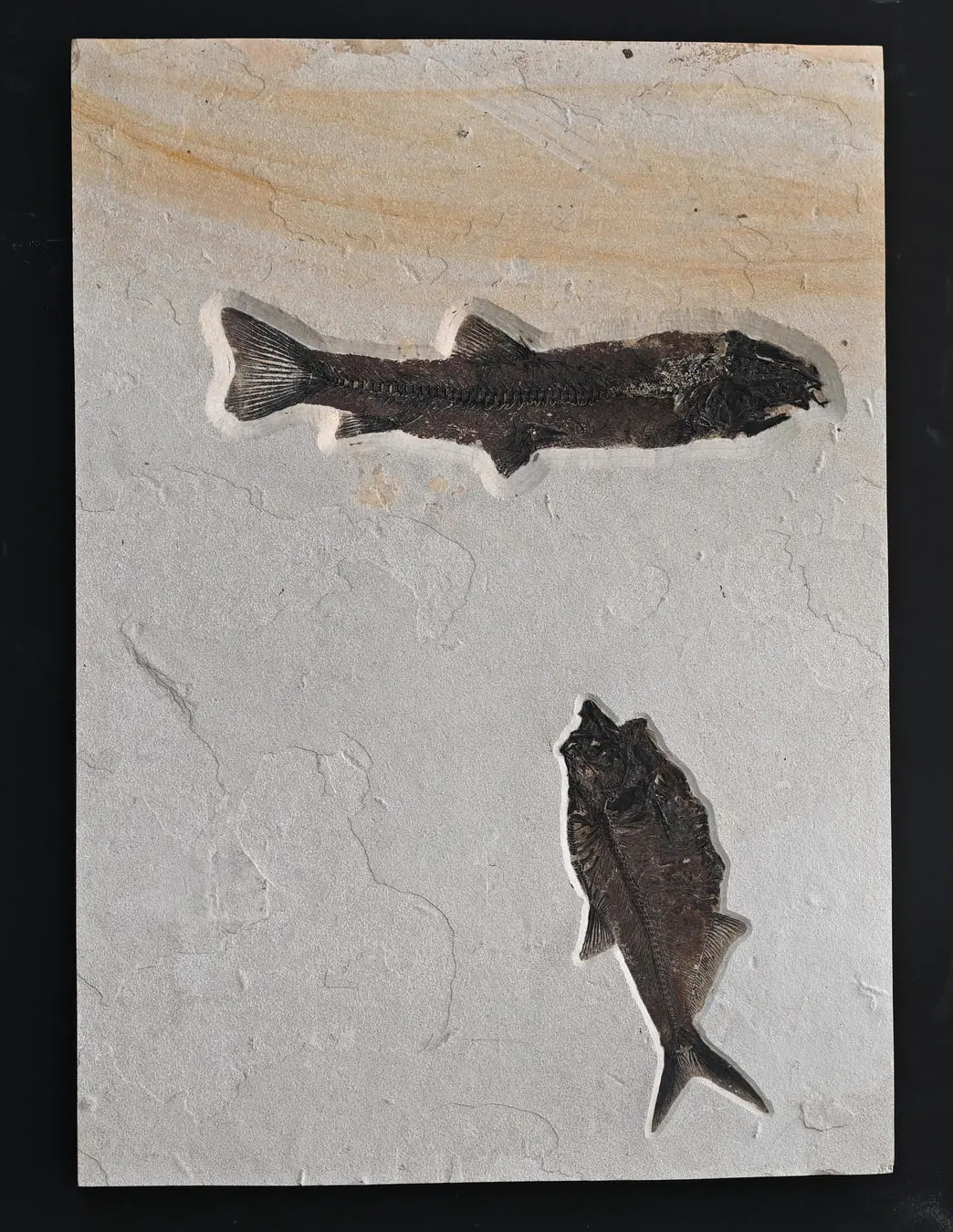
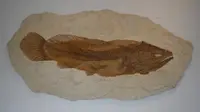
The tours begin indoors, at the In Stone Fossils gallery at 413 Coral Street in downtown Kemmerer. Guests on the flagship night excursion arrive at 3 p.m. to a charcuterie board. The staff walk them past the cases and describe the fish on display, the lake those fish lived in, and the species most likely to turn up in the rock that evening. The shop’s stock reaches well beyond Wyoming. Its listings have included megalodon teeth from South Carolina’s Hawthorn Formation, an ichthyosaur from the Posidonia Shale at Holzmaden, Germany, a Nanotyrannus hand claw from Niobrara County, and a rooted Tyrannosaurus tooth from the Hell Creek Formation priced at $65,000. Closer to home is a large plate of small Knightia from the company’s own quarry, listed “with beautiful reddish-gold toned iron mineral replacement of which our quarry is prized for.”
Rock by the pound
Visitors who will not make the drive can split rock in town. Staff set out slabs at the shop, lend hammers and shims, and show newcomers how to work the rock down. Fossil fish rock sells at $3.00 a pound and trilobite rock at $2.00, and the shop reckons that 40 to 60 pounds lasts an hour and a half to two and a half hours. The shop’s page says the fish and trilobite rock is provided by U-Dig Fossils. The excursion page describes rock brought directly from the company’s quarry. The shop names the families it has in mind: those with young children, those with a member who has a disability, and those passing through in a big RV. Splitting starts in May, before the quarries open, and runs into October as weather permits. Visitors keep almost everything they find, and a few specimens are held back for scientific research.
Thirty miles of dirt to the quarry
The quarry itself lies at the end of 30 miles of dirt roads outside Kemmerer, on private ground facing the Fossil Butte National Monument ridgeline. For the Sunset Paleo Adventure Tour, the party meets at the gallery at 3:30 p.m. Guests can follow in their own all-wheel- or four-wheel-drive vehicles or ride with the crew. At the quarry a geologist and a team of fossil hunters give a short rundown on tools and safety. Then the party digs in the upper split-fish layers, the minifish layers, or the sandwich layers. Bottles are kept filled with Willow Springs water. When the sun drops behind Fossil Butte, the crew serves a field meal. At the end of the evening they cut the finds down for the trip home. According to the tour page, 99.9 percent of what guests find goes home with them. A daytime tour, which the company describes as in preliminary development, adds a sack lunch from the Opera House in town.
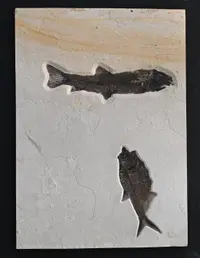
The National Park Service explains the sandwich bed in kitchen terms. Two closely spaced volcanic ashes are the slices of bread. Between them lie alternating laminations of limestone, the turkey, and kerogen, the roast beef. The minifish bed holds more fossils than the others, though they are smaller on average. In these upper beds a slab can split open with a fish already showing.
The night digs go deeper. On the flagship excursion, about three hours in the sandwich beds and split-fish layers serve as a warmup. Guides wrap and box the finds, and the party sits down to dinner in the open, overlooking a valley toward Fossil Butte. The meal is cooked to order, omnivore or vegan, with wine or beer. After sunset the work moves to the 18-inch layer. The Park Service gives its average thickness as, “you guessed it, 18 inches,” and says it yields the formation’s largest and best-preserved fossils. The company’s baseline night-dig page calls it “one of the most challenging layers to explore.” Night temperatures fall to around 50°F. On September 6, 2026, the company’s page announced a night dig in the layer: “Headlamps on, tools ready, and our guests are buzzing with excitement.” The crew photographs the party and flies a drone over the dig.
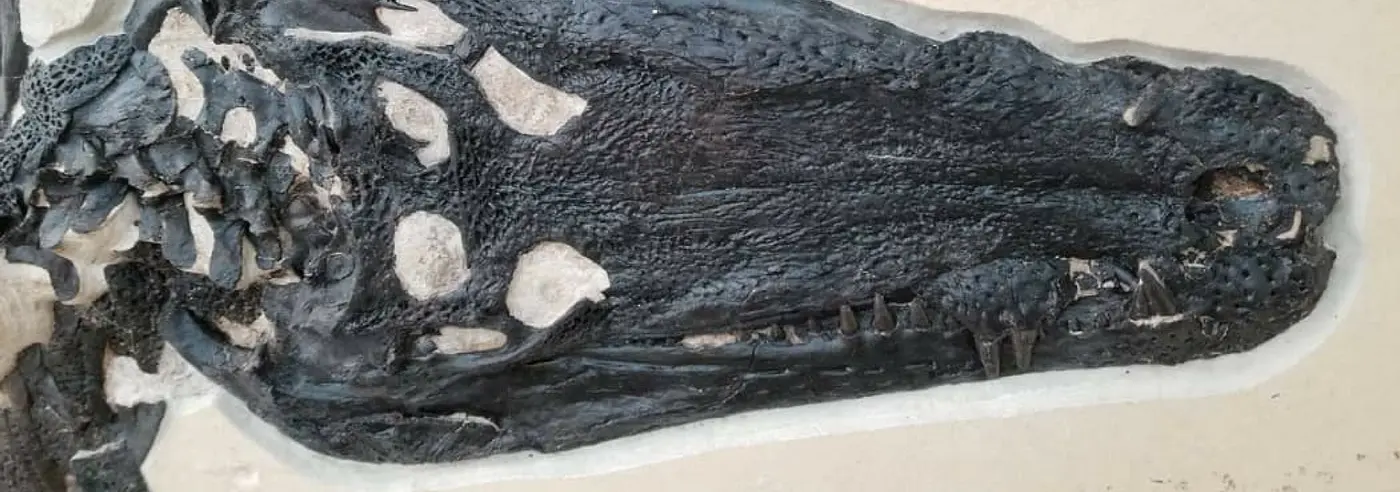
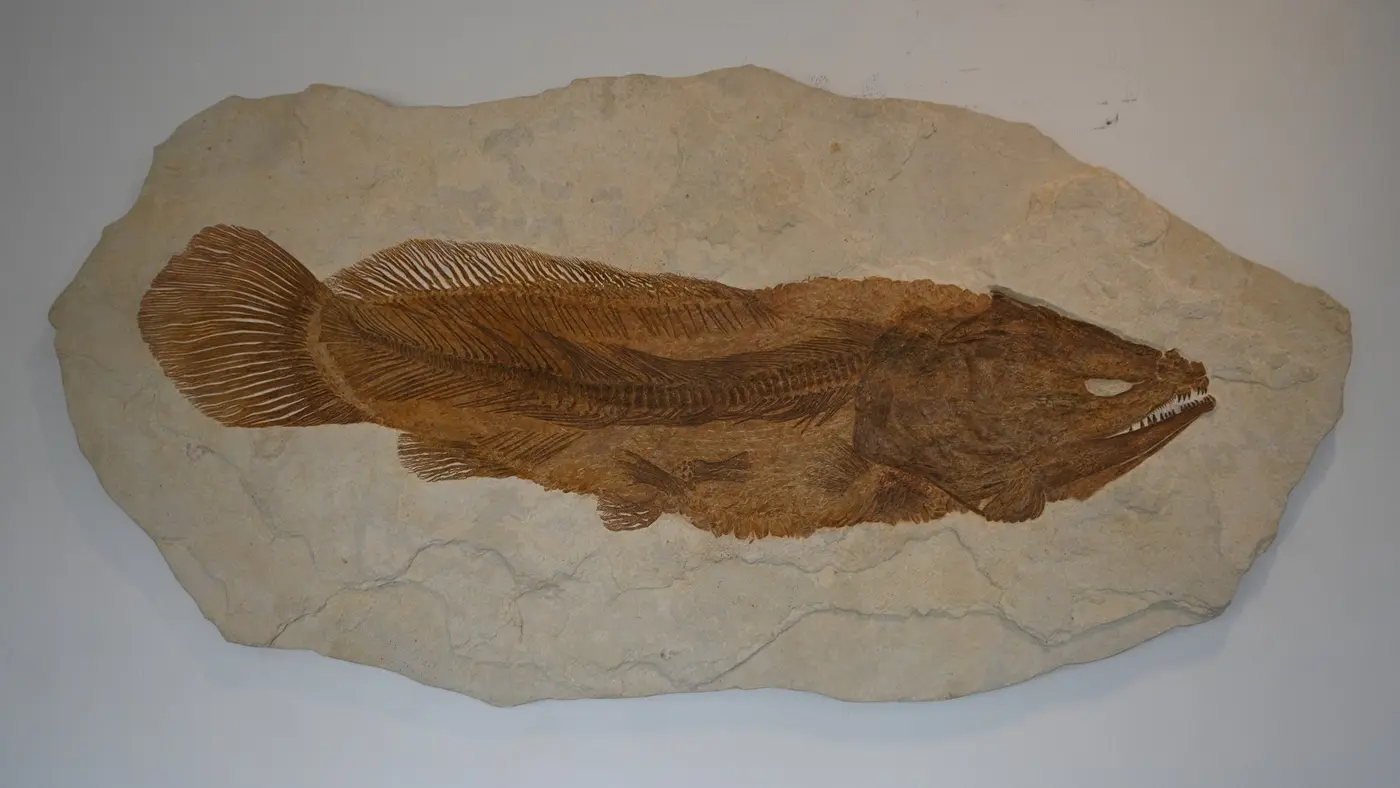
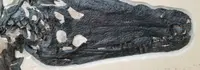
By the company’s count, a typical party of four finds 20 to 50 specimens in a night, among them fish, plants, and insects. Guests keep most of them. That includes gars under 24 inches, paddlefish and Amia under 36 inches, and stingrays. Rare specimens of scientific interest are retained for research. The company credits the 18-inch layer at its quarry with a complete 13-foot crocodile. It also credits the quarry’s mineral replacement with staining the fish a deep earthy red.
Every specimen from the 18-inch layer comes out under a coat of matrix. Back at the shop, preparators remove it using surgical microscopes, pneumatic air scribes, and air abrasives, then seal the stone. A finished plate can be backed with a French cleat to hang flush on a wall. The work usually takes six to twelve months, and large pieces ship in custom wooden crates. Flagship guests also take a four-hour class with the same tools, covering stabilization, matrix removal, and ethical preparation standards. They sleep in bed-and-breakfast-style suites at the remodeled Opera House downtown, four doors from Fossil Fuel Coffee Co.
A lake that kept its dead
The rock comes from the Fossil Butte Member of the Green River Formation, a laminated, calcite-rich mudstone that forms the tan ledges halfway up the flat-topped ridges. Arvid Aase, curator at Fossil Butte National Monument, explained the setting to Smithsonian. Thrust sheets sliding in from the west hollowed out a basin behind the ridge above Kemmerer. Roughly 52 million years ago, Fossil Lake spread across about 1,500 square miles of that basin. The Park Service says the lake was never more than 100 feet deep and that palms grew around it, in a climate much like today’s Gulf Coast.
Low-oxygen water kept scavengers off the lake floor. WyoHistory.org names the cause as hydrogen sulfide. Lime-rich mud then buried the dead fish and flattened them into imprints that show every tooth, rib, and fin. The commonest of these fish, Knightia, is the most abundant vertebrate fossil in the world and the state fossil of Wyoming. The Fossil Basin promotion board’s profile of In Stone gives the fossils’ age as 120 million years. The Park Service, Smithsonian, and the University of Wyoming place the lake at about 50 to 52 million.
From a railroad cut to a salamander
John C. Frémont and Ferdinand V. Hayden knew of the beds, but serious study did not begin until the late 1860s. That was when the Union Pacific cut through the formation near the town of Green River. Railroad employees passed fossils to the paleontologist Edward Drinker Cope, who described several new species from them. In 1897 an amateur collector named Robert Craig began quarrying. Commercial and private collectors soon followed him, and Green River fish went to museums around the world. Congress created Fossil Butte National Monument on October 23, 1972. Many of the quarries on Fossil Ridge started up in the 1980s, renting from the Lewis family, who had homesteaded a ranch there in the 1880s. In 2022 Smithsonian reported that about half a dozen local quarries opened digs to the public, and that most of them kept the “rares.”
In Stone Fossils is family-owned. Its owner is Dean Sherman, and its co-owners are Stacey Sherman and Garey and Lisa Lacey. In 2023 the Fossil Basin board wrote that children and grandchildren help with everything from fossil hunting to customer service. Sherman has found thousands of Green River fossils.
In 2024 an employee, Dave Dilworth, was excavating a new layer in an existing quarry when he uncovered a foot-long salamander. Sherman got the photos, dropped what he was doing, and rushed to the site. “I knew exactly what it was as soon as I got the picture,” he told Cowboy State Daily. “I was like, ‘Oh my gosh, that’s a salamander. That has to be a salamander.’” It was a Paleoamphiuma, only the third ever found. A halo around the bones pointed to preserved skin, which would make it the first Paleoamphiuma found with soft tissue. “In 20 years-plus of digging experience, I’ve never discovered anything even remotely like it,” Sherman said. The quarry sits on land the company leases from the state, so the salamander goes into the state of Wyoming’s repository. An earlier find from a private quarry, a mouse bird described as the first of its kind, was donated to the Field Museum of Natural History in Chicago.
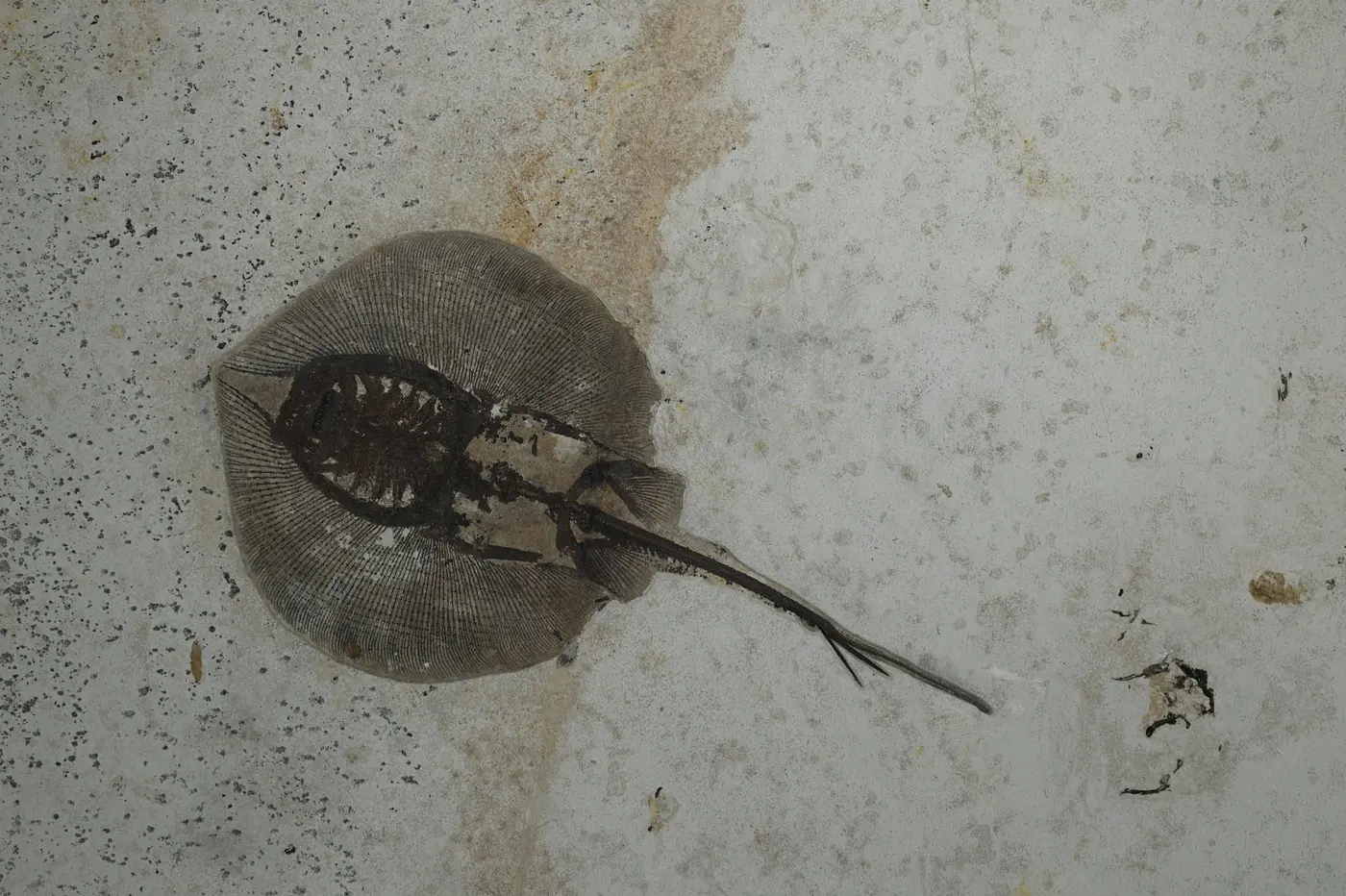
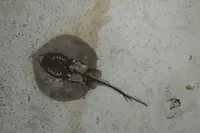
On September 24, 2026, the company’s page reported that Riley, Bree and Kade had split a slab in the Fossil Butte Member and found a stingray. Two days later it posted another stingray from the same member. That specimen had come out of the ground with loose, fragile pieces. The crew soaked it in B-72, a reversible conservation-grade consolidant, to hold it together for the drive into town. The post explained that the treatment can be undone by later preparators if better techniques come along: “we’re just buying this fossil safe passage through time, twice over.”
Notable Events
- 1897An amateur collector named Robert Craig began quarrying fossils in the Green River Formation beds of western Wyoming, and was soon joined by other commercial and private collectors whose specimens went to museums worldwide. wyohistory.org
People
- Dave Dilworth, In Stone Fossils employee who found the Paleoamphiuma salamander fossil while excavating a new layer in an existing quarry.
- Dean Sherman, owner of In Stone Fossils, who has found thousands of fossils from the Green River Formation.
- Garey Lacey, business partner and co-owner of In Stone Fossils.
- Lisa Lacey, business partner and co-owner of In Stone Fossils.
- Stacey Sherman, co-owner of In Stone Fossils.
Sources
- instonefossils.com
- instonefossils.com/pages/contact-us
- instonefossils.com/pages/daytime-tours
- instonefossils.com/pages/baseline-night-dig-excursion
- instonefossils.com/pages/sunset-paleo-adventure-tour
- instonefossils.com/pages/luxury-night-dig-excursion-with-4-hour-master-preparation-class
- instonefossils.com/pages/split-rock-at-our-shop
- smithsonianmag.com/travel/treasures-of-fossil-lake-180980544
- wyohistory.org/encyclopedia/fossil-butte-national-monument
- uwyo.edu/news/2022/08/uws-vietti-leads-student-expedition-into-three-kemmerer-fossil-fish-quarries.html
- fossilbasin.org/2023/04/10/in-stone-fossils
- fossilbasin.org/fossil-digging
- nps.gov/fobu/learn/nature/geology.htm
- kemmerergazette.com/stories/locals-work-on-52-million-year-old-crocodile-fossil,1689
- cowboystatedaily.com/2024/06/01/small-52-million-year-old-salamander-discovered-in-wyoming-kind-of-a-big-deal