American Fossil quarry
Kemmerer, Lincoln County, Wyoming. Private Dig Package; Hiring for August and September.
Details

- Where
- Kemmerer, Lincoln County, WY. No street address stated. Directions
- When
- 8:00 am - 4:00 pm daily.
- Getting there
- From I-80, take Exit 18 at Highway 189 to Kemmerer and proceed north about 36 miles through Diamondville to Kemmerer.
- Fees
- $750.00 / Private Dig Package.
- Access
- Moving an availability time to another day requires 48 hours notice; customers receive a credit if the operator cancels for weather or other unforeseen circumstances; no-shows are charged the full price.
- Walk-in or reserve
- Give 48 hours notice to move availability to another day; operator cancellations receive credit; no-shows are charged full price.
- Phone
- (801) 836-7269
- Website
- americanfossil.com
- Managed by
- Paleoland Holdings.
The last stretch to American Fossil is dirt. Dempsey Road leaves Highway 233 beyond Frontier, at a point where the road narrows between the river and a hill. It runs about eight miles, crosses four cattle guards and comes up onto a plateau. About three miles past the last guard, a large pale boulder and a large white sign mark a left turn onto a well-worn track. The track is rutted for about half a mile, forks, and drops down a hill to the quarry. The operators post these turns themselves and tell visitors not to follow Google Maps or a GPS, which send cars onto an unimproved road. Dogs ride along only as far as the parking area, on a leash.
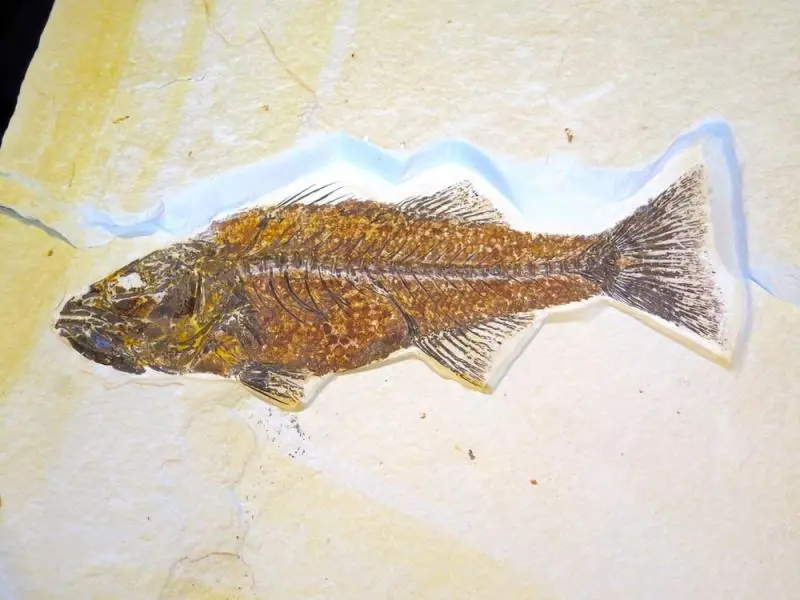
Below the parking area is a field of lake-bottom stone. The quarry is private land in Wyoming’s Green River Formation, and visitors work here with hammer and chisel. They split slabs of rock about 50 million years old and keep whatever turns up inside: fish, plants, and now and then a rarer animal. The quarry supplies the tools. Each dig opens with a briefing, and staff go over safety, technique, and identification on the spot. Free cutting stations stand ready for trimming a slab down to something that will travel home. The digging season runs from the end of May to the middle of September, and walk-ins are taken along with online bookings.
Splitting the slabs
The rock comes to the diggers already broken out. Smithsonian magazine reported in September 2022 that an excavator first clears 40 feet of hilltop overburden. A backhoe then pulls big chunks out of the fossil-rich layers of the cliff face, and the fresh rock weathers in the sun for a day or two, sometimes through several winters. The operators write that they “are not able to control the size of the rock as it comes out of the mountain.” They call the stone a non-renewable resource. Guests are asked to split it as thin as possible and not to smash it or beat on it with a hammer.
The magazine described the method. A digger starts a hairline fracture with the chisel in the middle of an edge, carries it to the corner, and eases the split along rather than forcing it. With luck the slab opens to a face about half an inch thick. Most of what appears is fish, the bones lying like the skeleton picked from a freshly cooked trout. The quarry names Knightia, Diplomystus, and gar among the fish a visitor may take home.
The same article followed an earth science class from Eastern Connecticut State University, which arrived one morning at the start of the summer season. Snow was flurrying and the temperature was in the 30s. It was the last day of a two-week trip through the geology of the Mountain West. A guide handed out geological hammers and chisels with a few tips on safety and species identification and sent the students into the rocks. By mid-morning the field rang with a steady clink-clink-clink. Students sat in the dust with their legs apart, going through the stone.
Dickson Cunningham, who teaches structural geology there, said he had no particular interest in fossils. Then he reached for a rock. “It’s kind of an addiction,” he said. “Like panning for gold. Every rock has promise.” He split one and found a fish divided between the two halves. “It’s hard to stop. I can see how gold rushes start. It’s fossil fever here.” A student, Emily Watling, opened a slab on a Phareodus roughly a foot long. An owner of the quarry put its commercial value at perhaps $1,500, but only after a preparator spent 20 hours at $60 an hour picking off the matrix. Watling carried it home the next day through airport security.
Owners, guides, and the finders-keepers rule
Smithsonian described American Fossil in 2022 as owned by two former educators. The quarry’s own roster now lists three owners. Patrick Hogle owns Paleoland Holdings, which manages the quarry. He worked as a wildlife biologist, taught biology for 12 years, and spent two years as a public school administrator. His stated hope is that some children will leave the quarry excited enough to choose careers in science and engineering. Seth Sorensen owns Fossil Shack and has dug, prepared, and sold fossils for clients around the world. He wrote History’s Aquarium, Head Full of Rocks, and The Utah Story, and teaches as adjunct faculty at Southern Utah University. Jeff Peterson, the newest owner, is an educator turned attorney. The quarry manager, Gib Clement, is a former Navy engineer who worked on ships and submarines. The lead guide, Cooper Williams, is a University of Wyoming student whom the quarry calls a fish expert.
The quarry calls itself the first in the world to let diggers keep every fossil they find. Smithsonian reported that most other quarries in the district keep the “rares” for themselves, while American Fossil’s staff strongly encourage guests to sell or donate scientifically valuable specimens to a museum. There is one limit. Any single fossil valued over $100,000 carries a 50 percent premium that goes to the landowner. A private party of up to ten gets about two cubic yards of the quarry’s premium layers to work through at its own pace. By its own account the quarry has produced thousands of rare fossils, among them one of only two three-toed horses ever found. Sorensen, his biography says, helped excavate one of those two.
Donations have gone out from here. From July 18 to 21, 2021, Laura Vietti of the University of Wyoming Geological Museum took students through four Kemmerer quarries. On the last day, at American Fossil, the group turned up a swimming trace fossil, and Hogle gave it to the university’s research collection. “The trace fossil is a curved line in the rock from where the bottom tip of the tail dragged in the sediment as it was swimming,” Vietti said. Such traces are rare, she explained, “because they are very faint and, often, aren’t preserved or recognized.”
Two bats below the Tri-ash
Before it was American Fossil, the site was known as the Thompson Ranch South Quarry, or the (South) Dempsey Quarry. On August 16, 2017, Terry Rickords found an articulated bat skeleton there, skull and jaws included. It lay about 1.15 meters below the Tri-ash layer, in the sandwich beds of the Fossil Butte Member. The National Park Service explains the name of those beds: two closely spaced volcanic ashes, the “slices of bread,” enclose alternating laminations of limestone, “turkey,” and kerogen, “roast beef.”
That skeleton and a second one from the same quarry became the basis of a paper in PLOS One on April 12, 2023. It named a new species, Icaronycteris gunnelli. The authors noted that Fossil Lake deposits had produced nearly 30 bat fossils over the previous 50 years, all belonging to just two species. The new one raised the known bat diversity of the formation by half. The position of the two skeletons in the rock, they wrote, indicates “that they are the oldest bat skeletons recovered to date anywhere in the world.” The holotype is held in the fossil mammal collection of the American Museum of Natural History in New York.
Fossil Lake and Peg-leg Craig
The sandwich beds lie mainly along the shoreline of the old lake, according to Smithsonian, and American Fossil sits on that shore. Fossil Lake was the smallest of three large lakes that covered parts of Wyoming, Colorado, and Utah about 50 million years ago. The quarry gives its greatest extent as 50 miles long and 20 wide. The National Park Service puts it at around 1,500 square miles and never more than 100 feet deep. The forces that pushed up the Rocky Mountains warped the crust into shallow basins that caught rain and river water. Fossil Basin held the lake until the basin filled with sediment and the water was gone.
The quarry’s history page describes the lake country: palms, figs and cypress near the water, willows, oaks and maples on the lower mountain slopes. The warm water held 25 kinds of fish, along with stingrays, crocodiles, turtles, snakes and bats. Birds, the first primates, and dog-sized horses and rhinos lived around it. Animals that died sank to the bottom and were covered by a steady fall of calcium carbonate, sealed away from the air. Today the valleys of Fossil Basin average 6,600 feet and the ridges 7,600, and the country is sagebrush grassland where the pronghorn runs.
Edward Drinker Cope dug at Fossil Butte in the 1870s, the quarry’s page says. The people who came later came for coal. Coal mining for the railroad brought settlement to the town of Fossil. Kemmerer was organized in 1897 and incorporated in 1899 by Patrick Quealy, who developed coal mines there and at Frontier with his partner Mahlon Kemmerer. When miners found the fish in the rock, they dug them up to sell to collectors.
Robert Lee Craig sold them longest. From 1897 to 1937 he worked the 18-inch layer of the formation near Kemmerer. He had lost a leg in a mining accident some years before and carved wooden replacements from barrel staves, and the town called him “Peg-Leg.” He cleaned his fish with a pocket knife and made a good living selling them to travelers and at carnivals and fairs. Late in life he hired two men to help with the business. One night they beat him, tied him up, and set his tent on fire to rob him. Craig got out of the fire but never fully recovered. He died in 1938 at 72 and is buried in the Kemmerer cemetery.
Commercial collecting has been barred inside Fossil Butte National Monument, 15 miles west of Kemmerer, since its establishment on October 23, 1972. Quarries on private land nearby kept digging, and by Smithsonian’s 2022 count about half a dozen of them open their rock to the public. A stingray, Asterotrygon maloneyi, that Craig prepared around 1920 is now in the collection of Fossil Shack, Seth Sorensen’s company.
Notable Events
- 1897Between 1897 and 1937, Craig worked a fossil layer known as the 18-inch layer. en.wikipedia.org
- 2003In September 2003, Jim E. Tynsky uncovered the bones of a dawn horse at a point known as Tom's Folly above a canyon in southwestern Wyoming. smithsonianmag.com
- 2021On the last day of a University of Wyoming field trip, the American Fossil quarry yielded a rare swimming trace fossil that owner Patrick Hogle donated to the university's research collection. uwyo.edu
- 2023Researchers described a new Icaronycteris species from two articulated skeletons discovered at American Fossil Quarry; their stratigraphic position indicated they were the oldest bat skeletons recovered anywhere. journals.plos.org
People
- Robert Lee Craig (Peg-leg), early full-time fossil quarrier in America; he worked the 18-inch layer in the Green River Formation near Kemmerer (1866-1938).
- Gib Clement, Quarry manager.
- Jeff Peterson, Owner and member of the American Fossil team.
- Patrick Hogle, Quarry owner who donated a swimming trace fossil to the University of Wyoming research collection (2021).
- Seth Sorensen, Owner and veteran of the fossil industry.
- Patrick Quealy, organized and incorporated the City of Kemmerer; partner with Mahlon Kemmerer in the development of coal mines and the town (1897-1899).
- Jim E. Tynsky, third-generation fossil hunter who uncovered the dawn horse fossil at Tom's Folly (September 2003).
Sources
- fishdig.com
- fishdig.com/dig.html
- fishdig.com/directions.html
- fishdig.com/pricing.html
- fishdig.com/about.html
- fishdig.com/us.html
- book.singenuity.com/914
- facebook.com/americanfossil
- fossilbasin.org/2022/07/22/quarry-stories-american-fossil-quarry
- nps.gov/fobu/learn/nature/geology.htm
- smithsonianmag.com/travel/treasures-of-fossil-lake-180980544
- uwyo.edu/news/2021/08/uws-vietti-leads-student-expedition-into-four-kemmerer-fossil-fish-quarries.html
- journals.plos.org/plosone/article?id=10.1371/journal.pone.0283505
- usgs.gov/media/images/green-river-formation-fish-fossils