Fossil Lake Safari quarry
Kemmerer, Lincoln County, Wyoming. Fossil dig quarry.
Details

- Where
- Farm Field Rd, Kemmerer, WY 83101. Directions
- When
- 8:00AM to 5:00PM.
- Season
- Open 7 days a week, May 9 to September 30.
- Getting there
- 1/2 hour from Kemmerer, Wyoming; 2 1/2 hours from Salt Lake City (nearest airport); 4 hours from Yellowstone; 1 1/2 hours from Bear Lake, Utah.
- Fees
- Adults Full Day $169, 4 Hours $109, 2 Hours $79; Children Full Day $89, 4 Hours $69, 2 Hours $49; children 6 and under are free with a paying adult.
- Access
- Bathroom facilities (Porta Potties); shade and sitting area; internet access via Starlink near shaded area; saws to trim down fossils for transport.
- Walk-in or reserve
- Not Required (just show up).
- Phone
- (567) FOSSILS
- Website
- fossilsafari.com
- Managed by
- FossilEra Adventures.
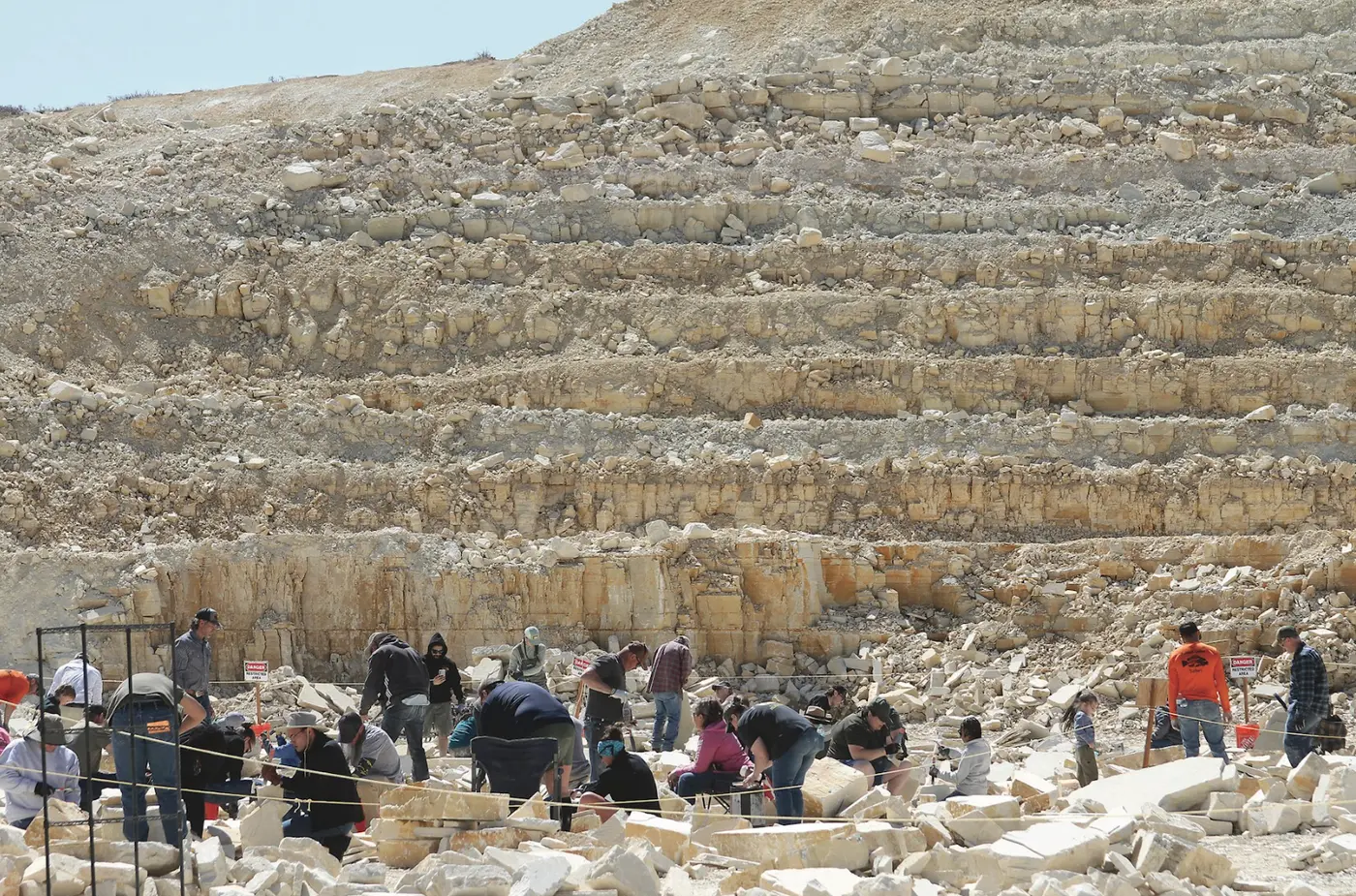
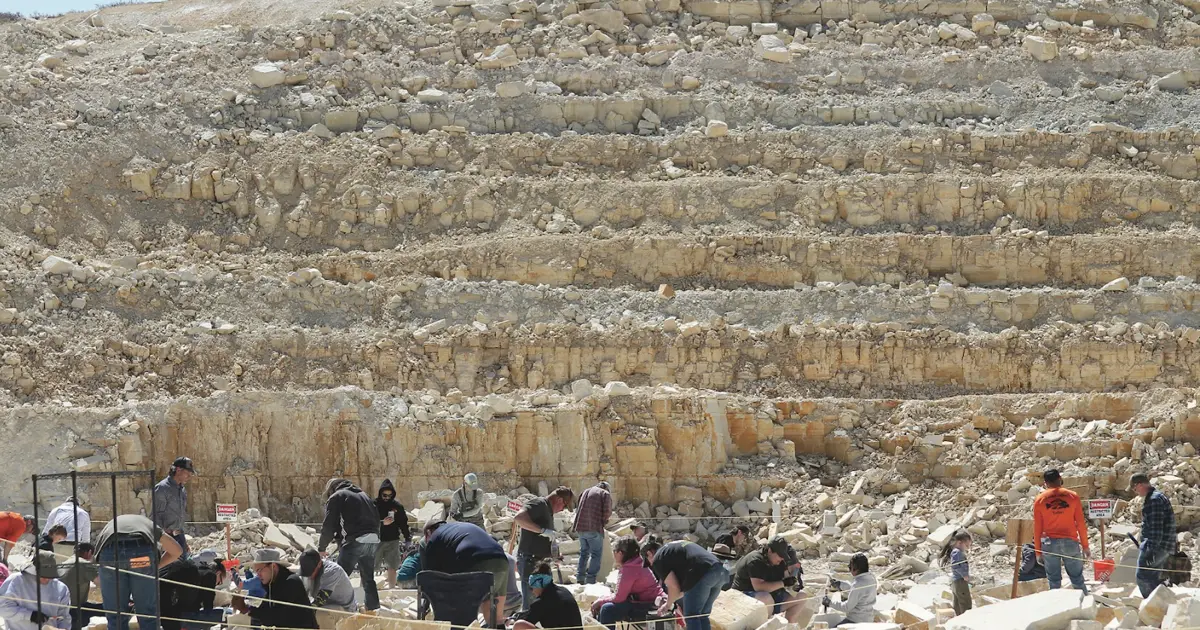
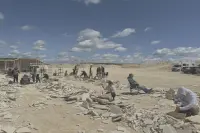
On Saturday, May 9, 2026, the sound of metal chisels on limestone carried across the Fossil Lake Safari quarry outside Kemmerer. Its owner, Matt Heaton, calls it “quarry music.” License plates from around the region filled the parking area, the Kemmerer Gazette reported. About 100 people came that day, drawn by a discount for local residents; Heaton estimated that fewer than 1% of the quarry’s visitors usually come from Lincoln County. The Stower family had driven up from Colorado because their son Izsak, 8, wanted to dig fossils for his birthday. “He picked this specific rock and we are still chiseling away,” his mother, Michelle Stower, said. “He’s adamant there is something in this one.”
The quarry lies about half an hour northwest of town, at 7,300 feet. The route runs north on Highway 189 past the Ridley’s grocery, turns left onto Highway 233 at the sign for Lake Viva Naughton, and then turns left onto Dempsey Road. That road is about 8 miles of dirt and crosses four cattle guards. The operator warns that map apps may send drivers onto an unimproved road that is now closed. Passenger cars, school buses, and RVs make the trip when the road is dry, but rain turns it to mud that calls for four-wheel drive. There is no cell signal in the pit. A phone will pick up a signal on the hill above, and there is Starlink internet by the check-in building. The operator lists the season as May 9 through September 30. The Fossil Basin promotion board gives it as Memorial Day through September.
Hammer, chisel, and a block of lake bed
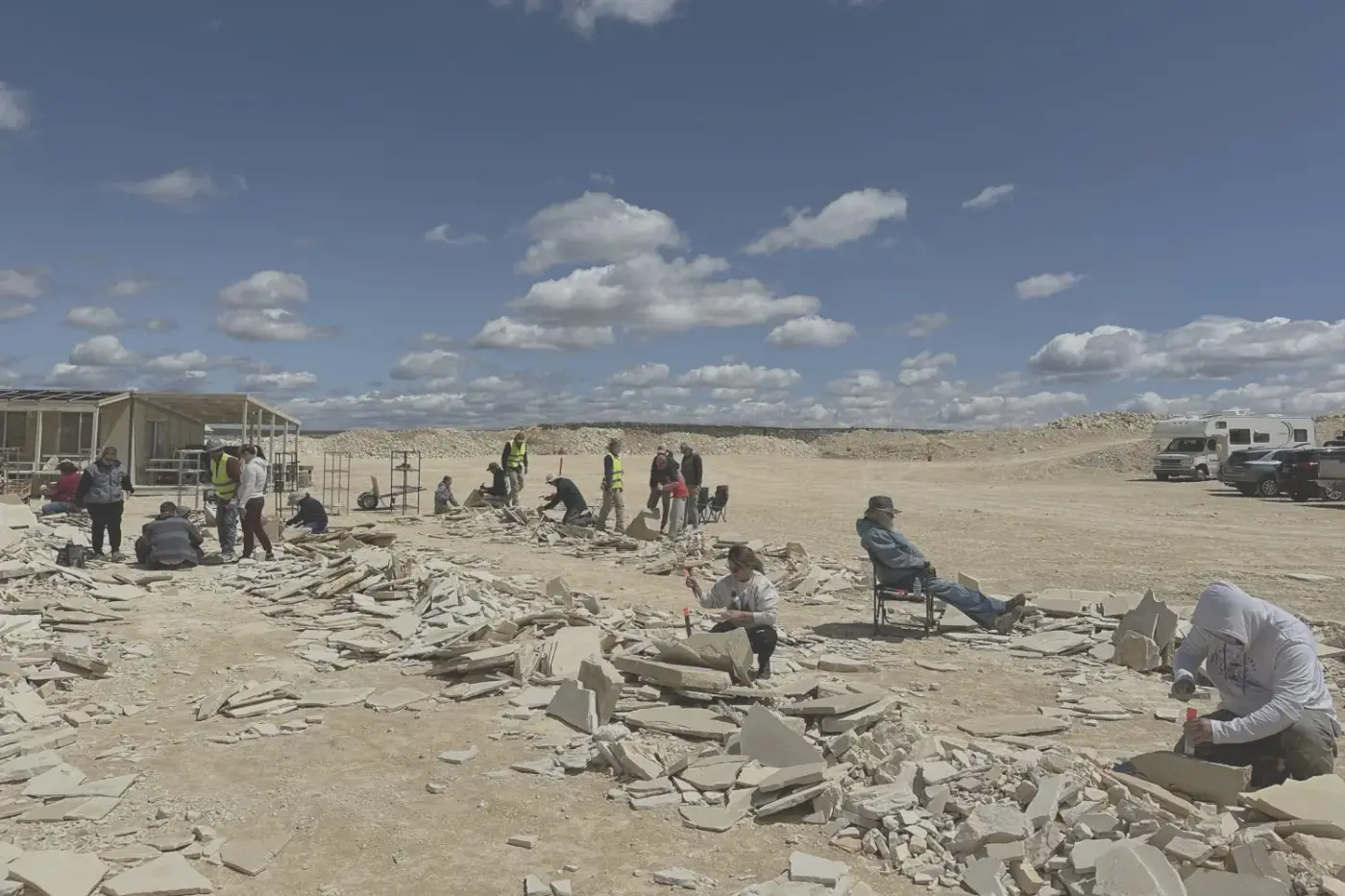
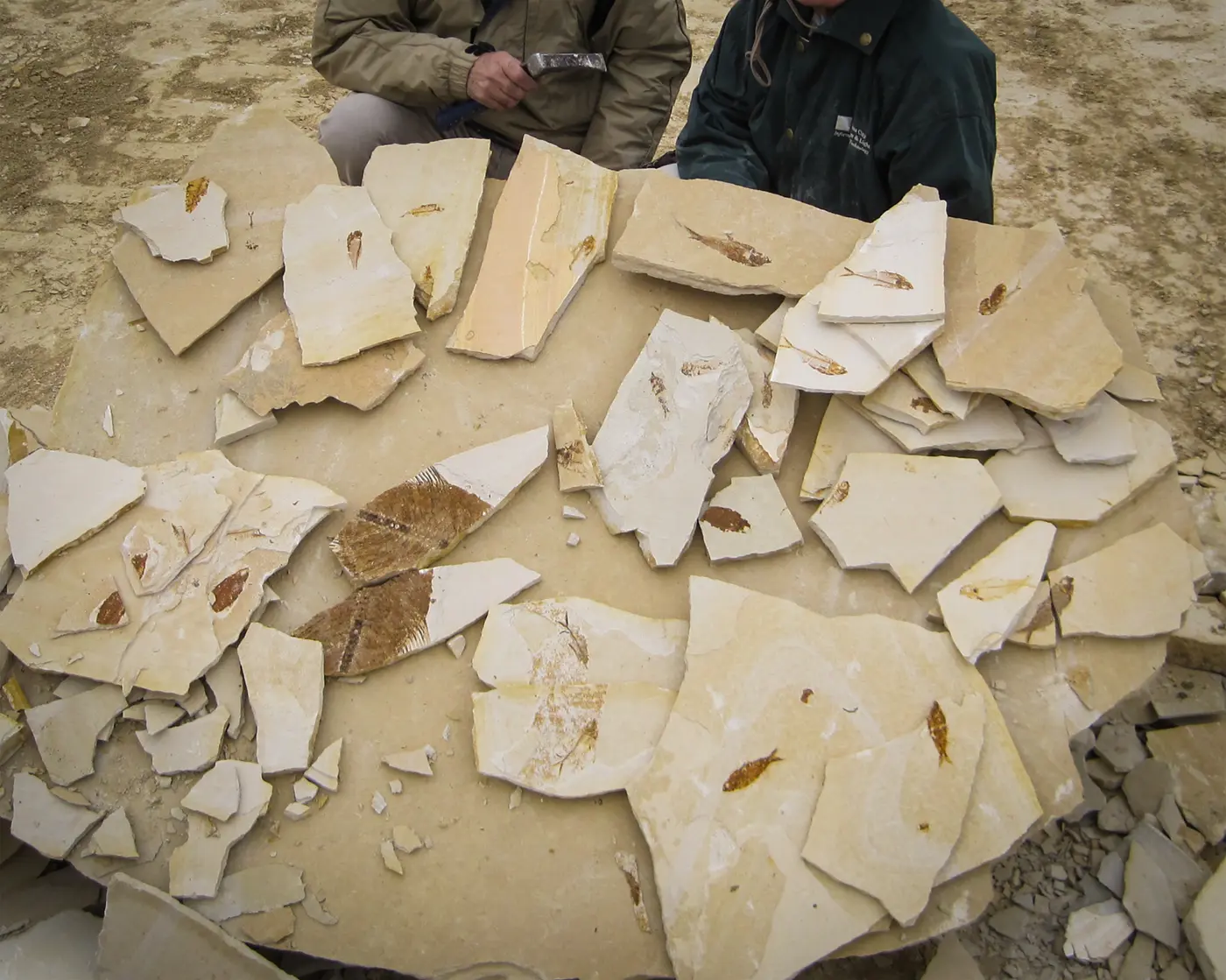
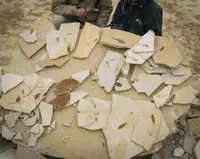
A dig begins with an orientation. One visitor’s review names Jordan, who went over procedures, and Paul, who demonstrated technique. The quarry supplies hammers, chisels, gloves, and rock. Another reviewer, Joe Mallahan, described the owner cutting cubes of lake bed roughly two-thirds of a meter on a side and setting them on the quarry floor, where diggers split them into thin sheets. “One in ten splits reveals a meaningful fossil,” he wrote. Staff ask diggers to split the rock thin and not bash it, because the most productive fish layer is only several feet thick. Visitors who come late may find “a lot of the bigger rocks were already split,” Kyle Coulon wrote.
The site has spring water, coffee, porta-potties, and a shaded sitting area. Reviewers mention hot chocolate, a small shop selling cleaning tools and fossil preservatives, and wind that can raise sand. Several advise bringing a camping chair. At the end of the session, diggers trim their slabs on tile saws so the fossils can be carried home. Dan Ely forgot boxes and bubble wrap and then split out a slab larger than he expected: “Have a plan on how to get something big (1 foot by 3 feet) home.”
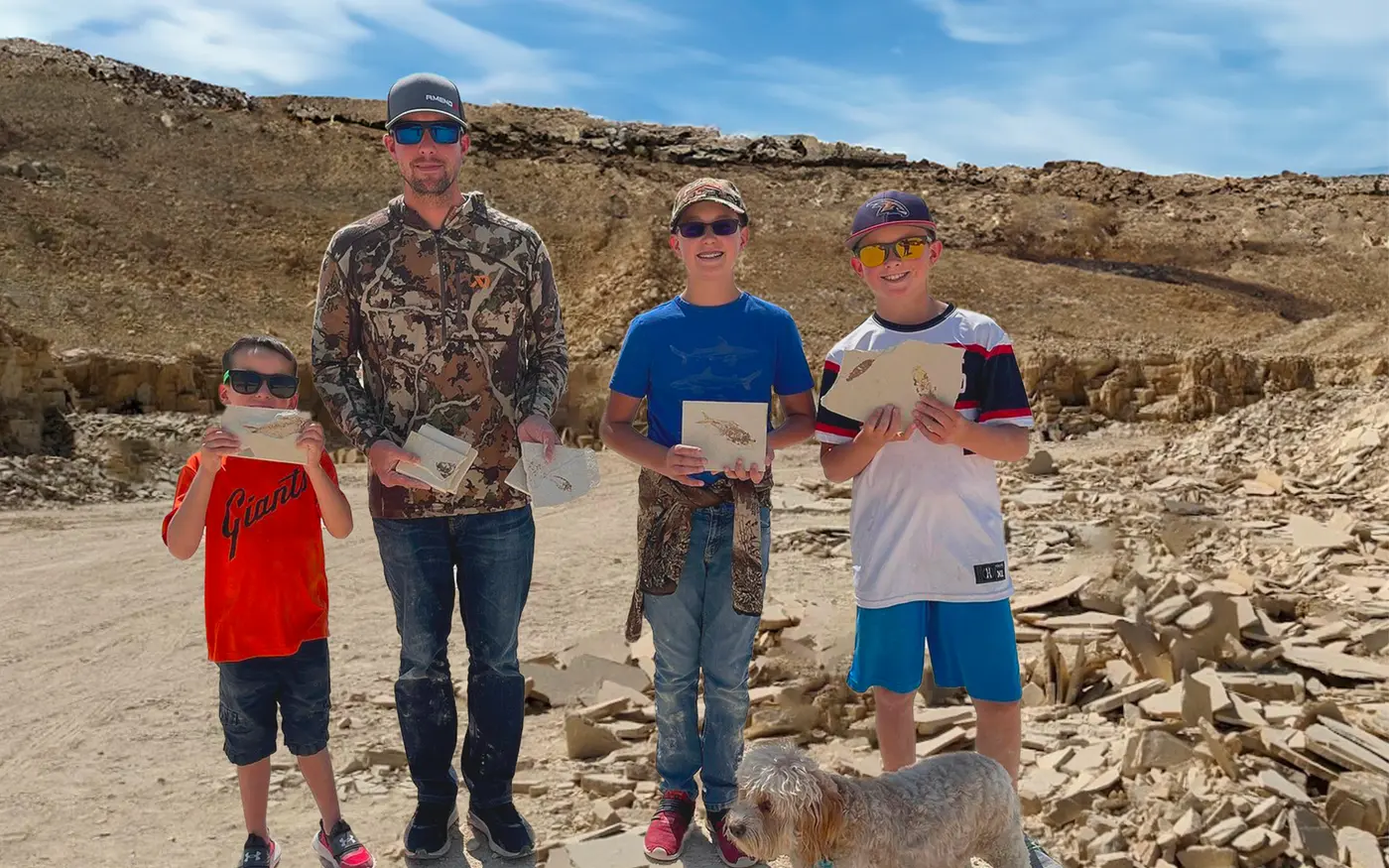
Visitors keep essentially everything they find, including all fish, plants, and insects. The exception is a specimen valued above $100,000, usually a bird, mammal, or reptile. The lease requires the company to pay the landowner a royalty on such a find, so the fossil goes to FossilEra Adventures, and the finder may buy it at a discount. The company says it would encourage anyone who finds something new to science to donate it or help place it with an institution.
Knightia by the hundred
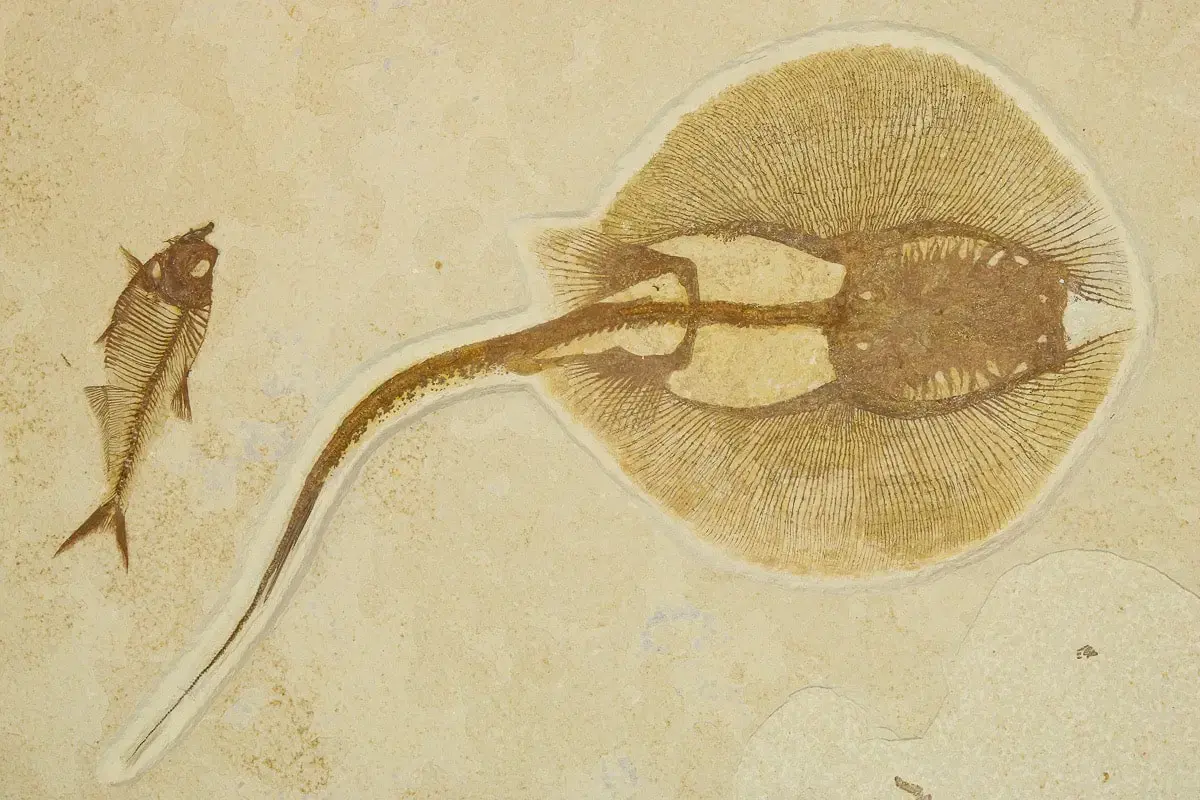
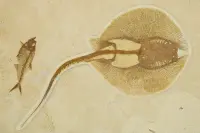
About 70% of the fish found here are Knightia eocaena, a schooling fish of the herring family, typically 3 to 4 inches long and sometimes found in mass-mortality layers of hundreds. It is the state fossil of Wyoming. The second most common fish is Diplomystus, whose steeply jutting jaw suggests it fed near the surface, snatching Knightia from below. Rarer fish turn up as well:
- Mioplosus, often fossilized with smaller fish lodged in its throat.
- Phareodus, whose name means “to have teeth,” found with spines of other fish in its stomach.
- Freshwater stingrays, about 1,000 of them over the quarry’s four decades.
- Gars, about one complete specimen a season, though their scales are common.
Crocodile teeth and coprolites turn up often. Complete crocodiles are extremely rare.
The operator says most visitors who stay a full day find dozens of fish. Eric Li reported more than thirty fossils in four hours. His 82-year-old mother was “banging rocks for the whole duration.”
Fifty-two million years of settling
The rock belongs to the Fossil Butte Member of the Green River Formation. It was laid down on the floor of Fossil Lake, which the Gazette says is believed to have covered about 1,500 square miles of what is now southwestern Wyoming. The operator dates the fish to about 52 million years ago. One of its pages rounds the figure to 50 million, and the Fossil Basin listing gives the fossils’ age as Eocene, 40 to 60 million years.
The operator explains the preservation this way. The lake bottom held little or no oxygen, which kept bacteria and scavengers away. The mountains around the lake were mostly limestone, so the streams carried dissolved calcium carbonate, which settled out of the lake water and coated the bottom in fine sediment. A FossilEra.com page adds that the lake was cold, so dead fish sank quickly. It also says that each millimeter of sediment took an estimated 7 to 8 years to accumulate.
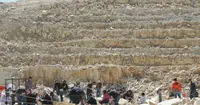
The formation is almost 2,000 feet thick, but the good fossil layers are only a few meters thick and exposed over a small area. Before each season, crews strip away the overburden, 20 to 40 feet of it by one company page and 20 to 50 by another. Heaton puts the cost of each season’s bulldozing in six figures. “We have two seasons of rock exposed there right now,” he told the Gazette in May 2026. He also said that most Green River deposits lie on federal land, where digging is prohibited, and that the private quarries work closely with Fossil Butte National Monument.
Tynskys, Hebdon, and the North Dempsey Quarry
Three generations of the Tynsky family worked the quarry, starting in 1969 with Sylvestor Tynsky, whom the operator calls one of the most famous Green River collectors. In 1986 the ground was leased to Rick Hebdon of Warfield Fossils. Hebdon created Fossil Safari, which the current operator describes as the first large-scale pay-per-dig operation. The same page credits him with nearly 40 years at the site and, in a photo caption, with over 30. Over the decades the place has been called Fossil Safari, the Warfield Fossils Quarry, and the North Dempsey Quarry. By the operator’s account, it was the first commercial quarry on the formation to collect the “sandwich beds” extensively, and it has likely produced more fossils than any other Green River quarry.
Hebdon’s finds include 13 holotypes for new species, and many of his specimens are on display at the Field Museum in Chicago. Warfield Fossils found a Saniwa monitor lizard here, one of only three known specimens of the species. The operator calls it possibly the most spectacular fossil the quarry has produced. The quarry has also yielded at least 13 new types of birds and three skeletons of the otter-like mammal Palaeosinopa.
In early 2024, FossilEra acquired the quarry from Warfield Fossil Quarries and renamed it Fossil Lake Safari. Heaton is FossilEra’s CEO. He told the Gazette he has collected fossils his whole life and came back to them after years in computer science and marketing. The 2024 acquisition announcement described a change that would let customers keep nearly all their finds “instead of just the common fish.” A 2022 Fossil Basin story about Warfield’s Fossil Safari, however, had already said visitors could keep everything except specimens that might exceed $100,000.
The first season under the new owners turned up two notable finds:
- A pair of unidentified mammals, spring 2024. Crews found them side by side in a mud-flow layer above the fish beds while removing overburden. The best guess is baby Lambdotherium, though they may prove to be a new type of mammal, and they are being prepared.
- A three-toed horse’s front foot, summer 2024. It was articulated and complete to the shoulder blade, which lay in another rock. The operator suggests it was left over from a crocodile or giant turtle tearing apart a carcass.
Heaton estimates that the area’s quarries draw about 20,000 visitors each summer. He says rooms in Kemmerer were already scarce and that construction workers tied to TerraPower are making them scarcer. “Our biggest problem with expansion is actually lodging,” he said. He also recalled a find from about two years before that interview, when workers uncovered a five-foot crocodile. “I think it’s the most beautiful crocodile to come out of this area.”
Notable Events
- 1969Going back to 1969, the quarry was initially worked by three generations of the Tynsky family beginning with Sylvestor Tynsky. fossilsafari.com
- 1986The quarry was leased to Rick Hebdon of Warfield Fossils, who would operate it for nearly 40 years and create Fossil Safari, the first large scale pay-per-dig operation. fossilsafari.com
- 2024FossilEra acquired the Fossil Safari quarry from Warfield Fossil Quarries. fossilsafari.com
- About 100 people came to a discounted fossil dig at the quarry, an effort by the owner to bring Lincoln County residents out to the site. buffalobulletin.com
- Workers uncovered a five-foot crocodile fossil at the quarry, which the owner said he thought was the most beautiful crocodile to come out of the area. buffalobulletin.com
People
- Matt Heaton, CEO of FossilEra, which acquired Fossil Safari.
- Rick Hebdon, owner of Warfield Fossil Quarries who created the Fossil Safari and operated the quarry (leased the quarry in 1986 and operated it for nearly 40 years).
- Sylvestor Tynsky, first of three generations of the Tynsky family to work the quarry; one of the most famous Green River collectors (from 1969).