Puyallup
Pierce County, Washington. County seat.
Puyallup is a suburban city in Pierce County about five miles southeast of Tacoma, platted in 1877 by Ezra Meeker, the valley’s hop tycoon.1,2
Details
- Name
- The town takes the Puyallup Tribe’s name, which the city translates as generous people; Meeker took responsibility for the name, though some credit A. S. Farquharson, a stave mill owner.1,4
- County seat
- The Pierce County seat was Steilacoom from 1852, and in 1880 county voters moved it to New Tacoma, now Tacoma.5
- Last checked
- October 6, 2026.
Point at a dot to see the place.Tap a dot to see the place. Road map of Puyallup.
In Puyallup
The Calendar
History
Meeker’s Townsite on Puyallup Land
In Pioneer Park, on Meridian Street between 3rd and 4th Avenues SE., the 1950 edition of the state guide found a lifesize statue of Ezra Meeker by Victor Alonzo Lewis, with ivy Meeker had planted draped over a shelter and fountain behind it.3 Puyallup, pronounced Pew-al’-up, is a suburban city about five miles southeast of Tacoma, counted at 36,790 in 2007, and in HistoryLink’s words it was once the hub of an agricultural cornucopia.1 The valley is the ancestral home of the Puyallup Tribe, and after 1850 it began to draw white settlers who came for the rich alluvial soil.1 The city’s own history says the tribe’s hospitable spirit gave it the name Puyallup, which translates to generous people.4
The Indian War of 1855-1856 drove the few homesteaders to Fort Steilacoom, they did not return in any numbers until 1859, and Ezra Meeker and his family came back in 1862, the year a post office called Franklin was established.1 In February 1856 U.S. soldiers built a fort on the river to protect the John Carson ferry; the 1926 Washington State Historical Society marker calls it Fort Maloney, and the 1950 guide calls it Fort Malone.2,3 In February 1877 Meeker platted 20 acres of his farm as the first townsite and, according to the 1950 guide, named it Puyallup so that the town would have a name unlike any other in the world.1,3 Some controversy remains over whether Meeker or A. S. Farquharson, a stave mill owner, chose the name, though Meeker was quoted as saying he bore the onus for it.1
Hops and the Northern Pacific
In March 1865 Ezra Meeker and his father, Jacob, planted the valley’s first hop cuttings; the Olympia brewer Charles Wood had imported hop roots from England that year, and the Meekers obtained and planted some of them.1,5 Meeker built Puyallup’s first hop-drying barn next to his cabin, on ground that is now Pioneer Park.5 HistoryLink counts the valley among the world’s foremost hop-growing areas from 1870 to 1890, and its hops were shipped to London for sale on the international market.1,5 Coal was being mined at the head of the valley, the Northern Pacific had laid track through Puyallup, and eighteen trains a day, coal, freight, and passenger, passed through the town.1
Leading citizens incorporated the town in 1888, but after the Washington State Supreme Court declared that illegal, 1,500 citizens approved a legal incorporation on August 16, 1890, and elected Meeker mayor; a fire department followed on September 19, 1890, two days after the Great Puyallup Fire destroyed much of downtown.1 Hop lice invaded the fields in 1892, devastating the crop from California to British Columbia and wiping out several fortunes, Meeker’s among them, though HistoryLink’s own summary dates the loss to 1891.1,5 At seventy five Meeker left Puyallup in 1906 with two oxen, a wagon, a driver, and a dog to retrace the Oregon Trail, and he returned home in June 1908 after pleading his cause to President Roosevelt.6
Berries, Bulbs, and the Valley Fair
Berries, brought to the valley in the late 1870s, replaced hops as the main cash crop, and by 1912 the Puyallup and Sumner Fruitgrowers’ Association had 1,300 members and was considered, HistoryLink says, the largest association of fruit growers in the world.1 George Lawler brought daffodils to the valley around 1910, the valley was producing 60 million bulbs by 1929, and on March 17, 1934, the bulb farmers sponsored their first Daffodil Parade.1
The Valley Fair opened on October 4, 1900, inside a 10-foot fence on a vacant lot west of Pioneer Park, and its main promoter was Lewis Alden Chamberlain, a Buckley farmer.7 Chamberlain stood at the gate most of Thursday morning without any exhibits turned in until about noon, when Romulous Nix came down the dusty road leading a shorthorn bull, and Chamberlain found a fencepost where the bull could be tied.7 That first fair drew some 3,000 visitors and netted a profit of $583.7 The 1950 guide tells it another way, with “Dad” Chamberlin starting a livestock show in the nineties with a bull and a goose while the town laughed.3 In the spring of 1942 the fairgrounds became Camp Harmony, the first assembly point for people of Japanese ancestry from the Seattle area and from Alaska, who were held there before being shipped to the Minidoka War Relocation Center in Idaho.1,5 The fair, now called the Washington State Fair, draws 1.6 million fairgoers a year by HistoryLink’s town history and about 1.3 million by its county history.1,5,8
Housing Tracts and the Meeker Mansion
The 1950 census counted 9,955 residents, and in the postwar boom housing developments and malls spread across the fields while competition from California and foreign growers finished off the berry industry.1 The Pierce County Auto Company was formed in 1912 to sell Ford automobiles, and as of 2007 auto sales brought in about 25 percent of the city’s sales-tax revenue.1 Part of Puyallup lies within the boundaries of the Puyallup Reservation, whose tribe signed a land claims settlement valued at $162 million on March 25, 1990.9
The Meeker home at 321 E. Pioneer, which the 1950 guide found serving as a G.A.R. clubhouse, is on the National Historic Register and is owned and run by the Puyallup Historical Society, with many original furnishings on display.3,4 The city’s preservation plan dates the oldest standing houses to the 1890s and calls the Puyallup Hotel, built about 1890, one of the oldest hotels.8
Within 30 Miles
Measured in a straight line from the town, nearest first.
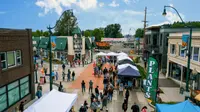
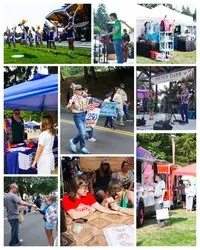
- Rhubarb DaysSumner · Street fair & festivalRhubarb Days is a free June street fair in downtown Sumner, Washington, selling rhubarb pie, crisp and IPA from a valley that has forced the plant in hothouses since 1914.
- Milton DaysMilton · City community celebrationMilton Days, an August weekend in Milton, Washington, has marked the town's 1907 incorporation since 1948 with a costume party, a parade down Milton Way, and a car show.
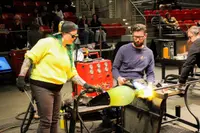
- The Hot ShopTacoma · Working artist's studioThe Jane Russell Hot Shop, a working glass studio inside the Museum of Glass's tilted steel cone on Tacoma's Thea Foss Waterway, where glass is blown all day, every open day.
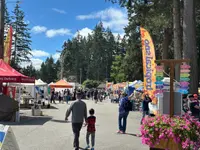
- Pierce County FairGraham · Traditional county fairPierce County's four-day August fair, held since 1968 in Frontier Park at Graham, Washington, one of only a few fairs in the state set in a park.
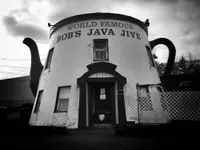
- Bob's Java JiveTacoma · Coffee-pot bar & music venueA 1927 concrete coffee pot on South Tacoma Way, the old US 99, now a bar where karaoke runs every night beneath a ceiling of visitors' signatures.
- Enumclaw Sales PavilionEnumclaw · Licensed and bonded auction yardA Saturday poultry and livestock auction yard on the Enumclaw plateau, established in 1938, where the morning's lots run from baby chicks and peacocks to fertile eggs.
- Buckley Log Show and ParadeBuckley · Two-day logging competitionAn amateur logging competition held the last full weekend of June in Buckley, Washington, open only to local contestants, where a retired logger is named Bull of the Woods.
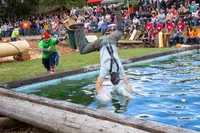
- Wilkeson DaysWilkesonDay 1 has handcar races, parade and vendor market at Historic Coke Oven Park. Day 2 has art displays, history walk, vendor market and Duh Kwooz at Wilkeson Town Hall.
- Grand Old Fourth of JulySteilacoom · Annual july fourth celebrationThe Steilacoom Chamber of Commerce's day-long Fourth of July on Lafayette Street in Steilacoom, Washington, ending with fireworks from a barge paid for entirely by private donations.
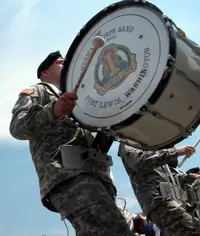
- Kent Cornucopia DaysKent · Annual festivalThe festival happens on Meeker Street in downtown Kent; the car show is at 4th & Meeker Street, spread over 3 blocks and additional side parking lots.
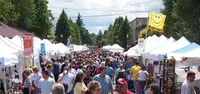
- Chinook Scenic BywayEnumclaw · All-american roadThe Chinook Scenic Byway, State Route 410 from Enumclaw to Naches, Washington, crosses 5,430-foot Chinook Pass beneath a 1936 log-and-stone arch that carries the Pacific Crest Trail.
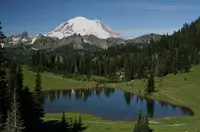
- Good WaterEnumclaw · Roadside springA free roadside spring on Washington's Highway 410, directly across from milepost 34, where a Greenwater resident built a platform for filling jugs.
- Kent International FestivalKent · FestivalAn annual free festival of the greater Kent community's heritages at the accesso ShoWare Center in Kent, Washington, where visitors collect stamps at ten cultural passport booths.
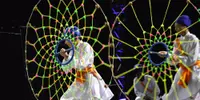
- Steilacoom-Anderson Island FerrySteilacoom · FerryPierce County-owned ferry route from Steilacoom to Anderson Island with a Ketron Island spur; only road connection to both islands; free youth fares funded by Washington State Move Ahead Washington; eligible for Federal Transit Administration funding distributed by the Puget Sound Regional Council and administered by Pierce Transit, but not classified as a public transit system under Washington law.

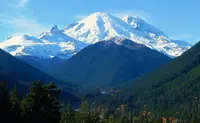
- Mather Memorial ParkwayEnumclaw · National scenic bywayMather Memorial Parkway Created in 1931, this paved two-lane classic Cascades drive along Highway 410 from Enumclaw to the eastern edge of Mount Rainier National Park presents majestic views of Mount Rainier and surrounding peaks.
15 more within 30 miles on the road map.
Nearby towns: Enumclaw, Bremerton, and Snoqualmie. All the towns of Washington. More of Washington: Flea Markets, Town Festivals, and Fairs & Rodeos.
Sources
- Puyallup -- Thumbnail History historylink.org/file/8447
- Puyallup River Crossing (historical marker) hmdb.org/m.asp?m=250943
- Washington: A Guide to the Evergreen State (1950), p. 390 babel.hathitrust.org/cgi/pt?id=mdp.39015010545013&seq=494
- Puyallup’s History puyallupwa.gov/1911/Puyallups-History
- Pierce County -- Thumbnail History historylink.org/file/8001
- Old Oregon Trail (historical marker) hmdb.org/m.asp?m=39786
- First Puyallup Valley Fair is held in Puyallup beginning on October 4, 1900. historylink.org/file/8004
- City of Puyallup Historic Preservation Plan dahp.wa.gov/sites/default/files/Puyallup%20Preservation%20Plan.pdf
- Puyallup Avenue Bridge historylink.org/File/10423