The Hot Shop
Tacoma, Pierce County, Washington. Working artist's studio.
Details

- Where
- 1801 Dock Street, Tacoma, WA 98402. Directions
- When
- Live glassblowing demonstrations occur all day, every day the Museum is open.
- Fees
- Adults $18; Seniors (65+) $16; Military (active and veteran, with ID) $16; Youth (6-18) $9; Children under 6, members, AAM and WMA members free; free admission 5-8pm the Third Thursday of each month.
- Hours
- Wednesday-Sunday 10am-5pm.
- Access
- Traditional gallery spaces are closed until December 2026 during a capital renovation; the Museum stays open and the Hot Shop, Education Studio, Store, and Cafe operate without disruption.
- Walk-in or reserve
- No timed tickets required; tickets sold at the Admission Desk; last ticket 4:30pm.
- Phone
- 253.284.4750
- Managed by
- Museum of Glass.
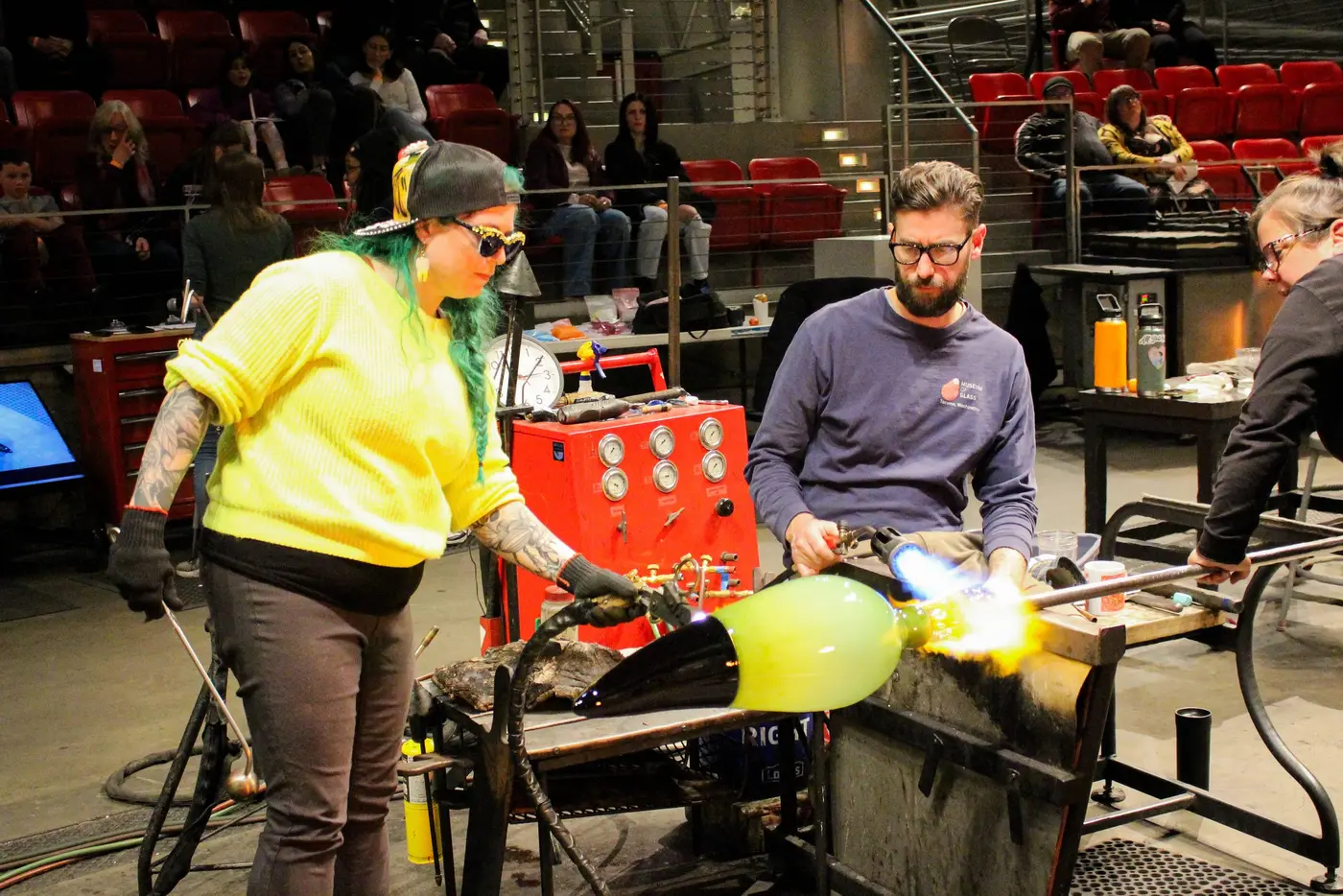
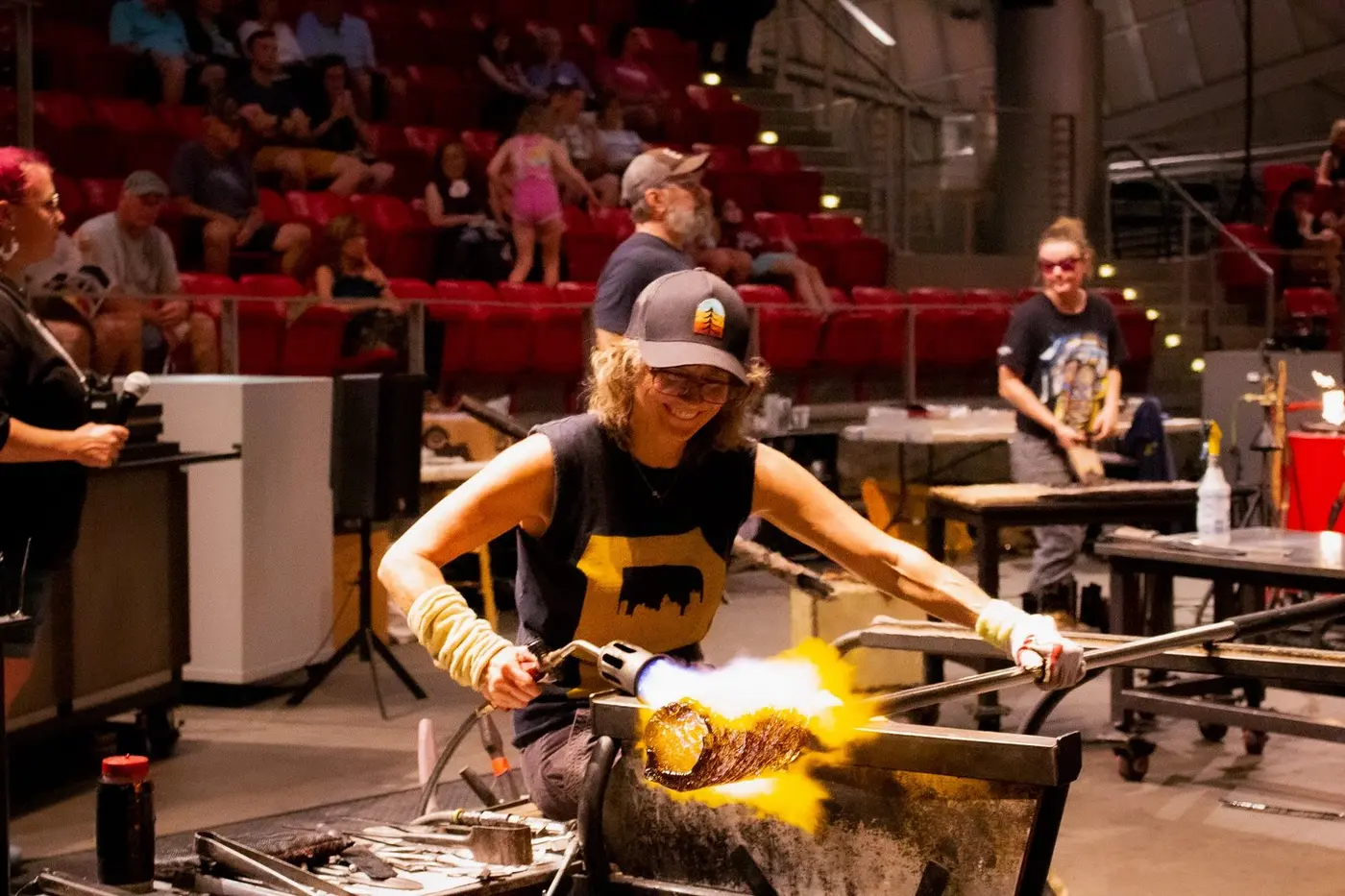
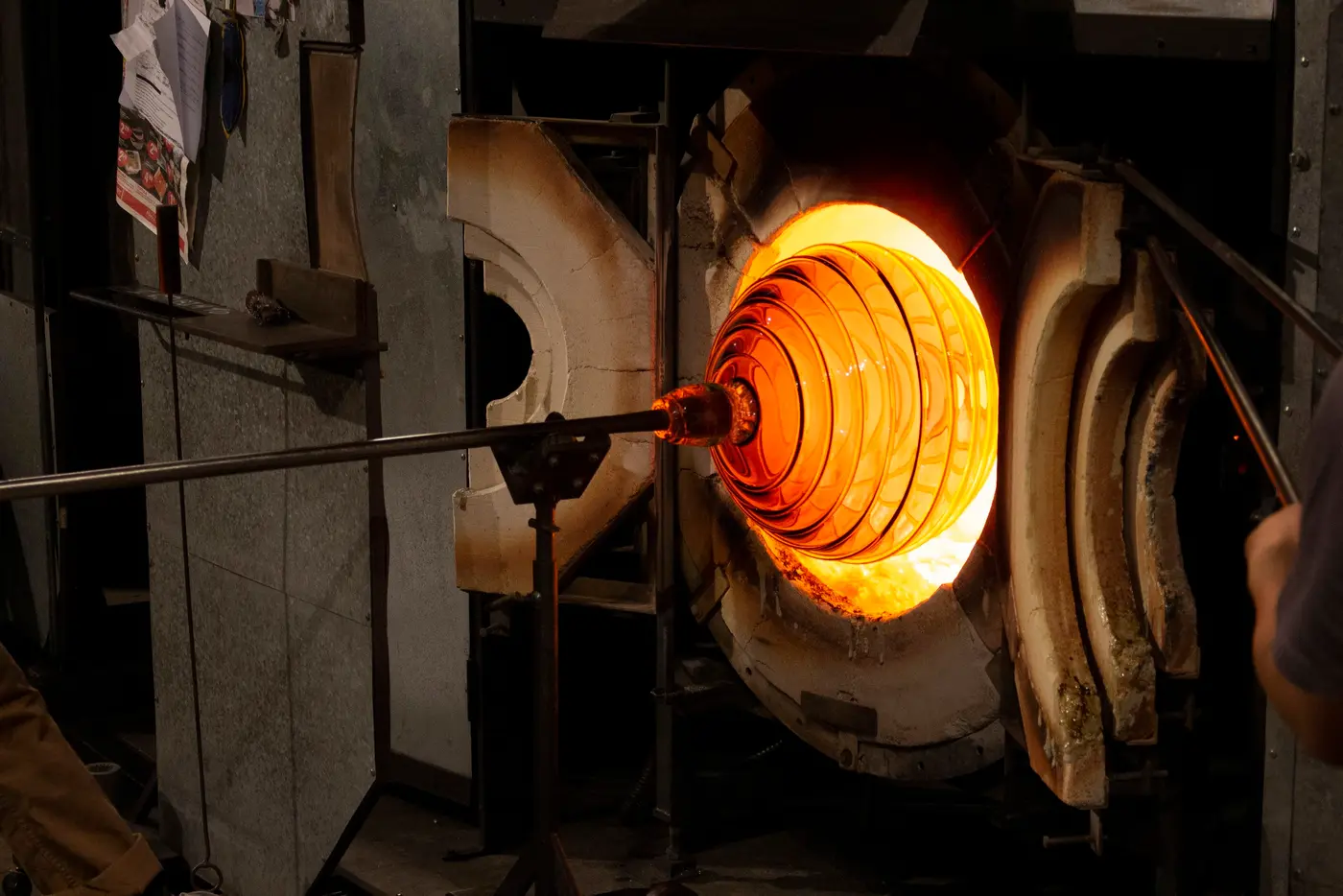
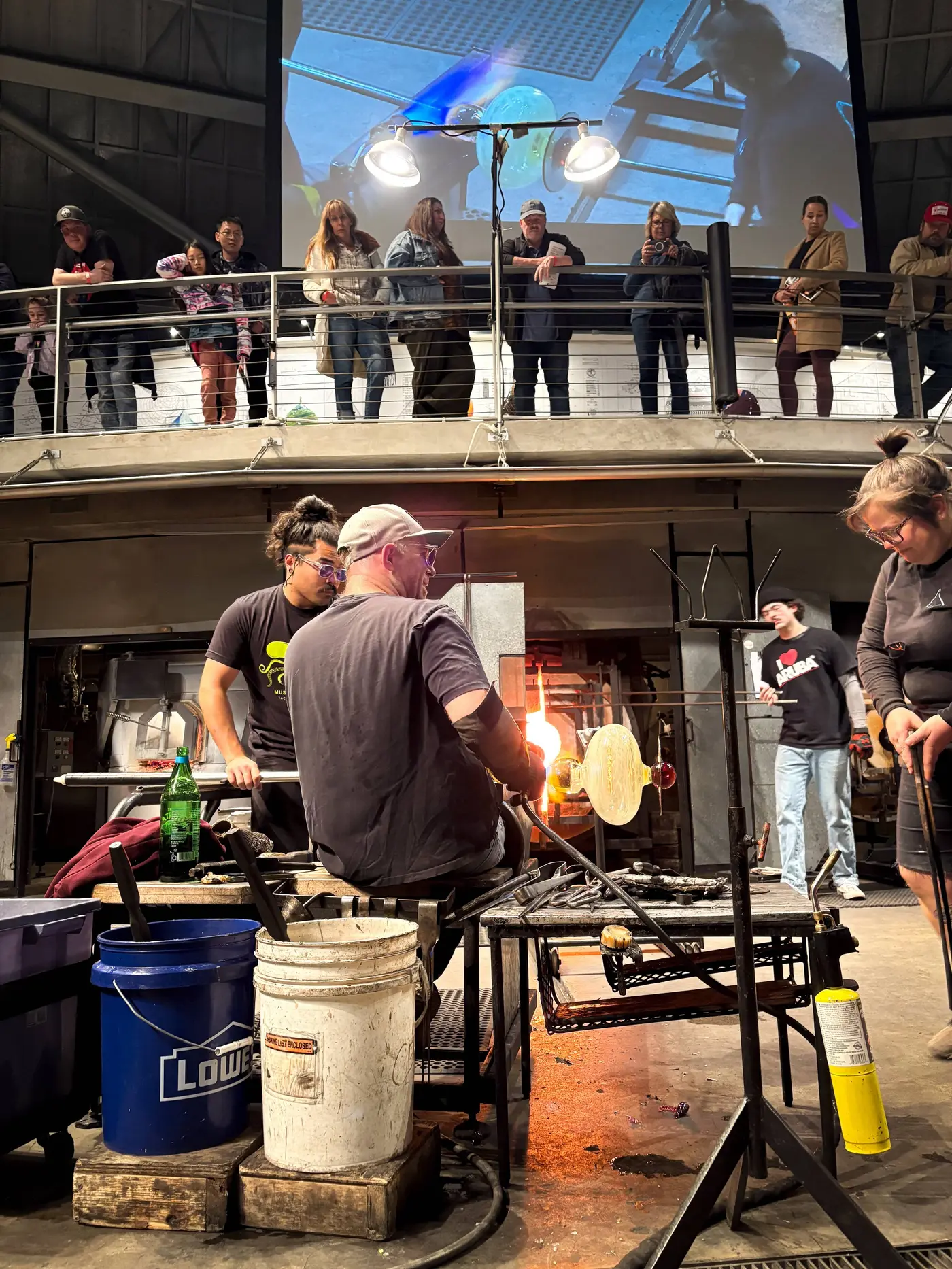
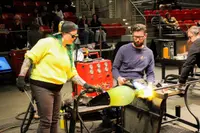
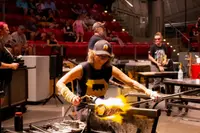
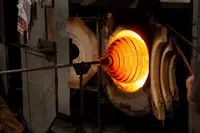
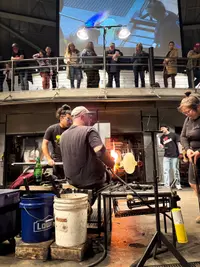
A stainless-steel cone, 90 feet tall and tilted, stands at the edge of the Thea Foss Waterway in Tacoma. Inside it the furnaces run from opening to closing. The Hot Shop of the Museum of Glass, formally the Jane Russell Hot Shop, is a working studio built with seats for an audience. The resident Hot Shop Team and the Visiting Artists work molten glass there all day, every day the museum is open, Wednesday through Sunday. “When we opened our doors, we set out to make the Hot Shop a glimpse into the working artist’s studio,” says Ben Cobb, the Hot Shop Director. “Our audience has the opportunity to watch the creative process happen.”
The cone holds two shops, a hot shop and a cold shop, and the museum says every piece of glass made there is finished, start to finish, within those two rooms. When the building opened in 2002, the Hot Shop Amphitheater held 140 seats, and cameras in fixed positions sent the work at the bench to large video screens just outside the studio. A livestream now carries the same view to the museum’s YouTube channel.
Most visitors coming from downtown cross the Chihuly Bridge of Glass, a 500-foot pedestrian span that rises 80 feet above Interstate 705 and several rail lines. On the way they pass under the Seaform Pavilion’s ceiling of colored glass, along the Venetian Wall of more than 100 vessels, and between two glacial-blue Crystal Towers. Stairs spiral around the base of the cone to the museum entrance, and the museum suggests climbing them before leaving. On the esplanade below stands Howard Ben Tre’s Water Forest, 20 bronze and glass towers set around a granite bench. Each tower fills with water, overflows, and fills again. Sliced Sandwiches runs the café inside.
The crew at the bench
The team visitors watch is small. Benjamin Cobb, director and lead gaffer, has spent 25 years in glassblowing and has demonstrated at studios in Sweden, the Czech Republic, Italy, and France. Gabe Feenan, the other gaffer, started in 1996 in production studios around San Francisco Bay, and his own work is built from stacked geometric shapes. Sarah Gilbert, the starter, took her BFA at the Rochester Institute of Technology in 2005 and was a Hauberg Fellow at Pilchuck Glass School. Nick Davis, the lead technician, also makes tools to order for artists around the world. Kristin Elliot is the museum’s only coldworker and keeps a cold shop of her own in Tacoma. Walter Lieberman, the emcee, has worked in glass for 40 years as a glass painter. His work is in the Metropolitan Museum of Art and the Victoria and Albert Museum. The museum reports that Visiting Artists repeatedly name this crew among the best glassblowing groups in the world.
Those artists come from around the world, both established and emerging, for residencies that run from a single day to several weeks. Many give a presentation on their last day. Since 2007, when the museum began collecting, work by artists who completed Hot Shop residencies has gone into its permanent collection.
Phil Phibbs, who first proposed the museum, wrote in 2007 that he could “sit in the hot shop day after day and never be bored.” One Saturday the emcee asked the audience, “How many of you have been to this museum before?” Phibbs recalled that “all kinds of little hands went up; very few adult hands were in evidence.” Those children had come first on school tours and were now bringing their parents.
Galleries shut, furnace lit
In April 2026 the museum began its first capital renovation, a project of roughly $25 million. The traditional galleries closed and are expected to stay closed until December 2026. The Hot Shop, Education Studio, store, and café have kept their regular schedule, smaller exhibitions hang in the Grand Hall, and much of the construction takes place in the evening. Parking in the museum garage is limited while the work goes on. In March 2026 The Seattle Times reported that construction would take about six months. The museum’s own project page puts it at about eight. The old theater is becoming gallery space. A new Lino Tagliapietra Legacy Gallery of about 4,000 square feet will show more than 50 pieces at a time, opening with Lino Tagliapietra: Maestro. The museum lists that gallery as opening in fall 2026 and expects the rest of the galleries to reopen in December.
The crew also works outside the cone. At the 2026 Pumpkin Patch Festival on October 10, the Hot Shop Team is scheduled to make glass pumpkins live on the Grand Plaza. Katelyn Moody of Moody Studio Arts will give a flameworking demonstration, locally made glass pumpkins will be for sale, and there will be face painting, a bouncy house, and a tarot reader. The event depends on the weather.
A conversation in 1992
Accounts of the museum’s beginning differ in their wording. In his 2007 essay, Phibbs wrote that about a month after he retired as president of the University of Puget Sound in 1992, Dale Chihuly came to see him. Chihuly was thinking of moving part of his operation to Tacoma, including a hot shop. Phibbs recalled blurting out, “Dale, what we really should have in Tacoma is a museum devoted to your work.” The Seattle Times, writing in 2002, put the visit in late summer 1992 at Phibbs’s home and quoted him as saying, “What we really should have is a museum of glass.” The museum’s own history dates the conversation to August 1992.
Phibbs then called Erling Mork, a former Tacoma city manager, who sent him to a meeting of business and government leaders. Phibbs’s essay calls the group the Economic Development Council. The museum and the Times call it the Executive Council for a Greater Tacoma. Phibbs expected a polite dismissal. Instead the chairman, George Russell, asked him to stay for the next presentation, which was a plan to redevelop the Thea Foss Waterway. At the time the waterway was an empty industrial strip along a channel so polluted it qualified as a federal Superfund site. When the presentation ended, Phibbs wrote, Russell told him, “We would like your museum to be the anchor tenant.” Russell later gave his reason: “We had to bring business people together to see if we couldn’t get Tacoma to stop turning its lights off at 5.”
Chihuly, the museum says, insisted that the museum take in glass artists from around the world rather than his work alone. His own work went onto the bridge instead. The Times reported in 2002 that the city paid $3.7 million for the bridge, designed by Arthur Andersson of Austin, Texas. It also reported that Chihuly had asked that the bridge not carry his name and that the city overruled him. Through every change of plan, one element held. “The focus of the museum would be a hot shop,” Phibbs wrote. “The commitment of everyone never wavered on this point.”
A sawdust burner on the tide flats
The cone belongs to the Canadian architect Arthur Erickson, who unveiled the design in September 1997. Phibbs grew up in the Northwest and remembered the sawdust burners that once dotted the landscape, especially on Tacoma’s tide flats. He wrote that Erickson “used that history to link the new museum to Tacoma’s past with the dramatic cone for the hot shop.” Josi Callan became director in January 2000, construction began that June, and the cone’s steel frame was complete by March 2001. The $63 million museum opened on July 6, 2002. At a media preview that June, Callan told reporters, “This museum is a bit different, as you’re about to see.” Erickson pointed to the stairs climbing around the cone: “I think that’s the essence of this project.”
George and Jane Russell had agreed to co-chair the founding board in 1995. Jane died before the museum opened. Phibbs remembered her as usually a listener in the board’s arguments, until a critical point, when “she would quietly intervene with a comment or an idea that got us back in focus.” George named the Hot Shop for her because it had been her favorite place in the museum. Phibbs died in 2022, and George Russell in 2025. “The hot shop remains my favorite spot in the museum,” Phibbs had written.
Nineteen residencies
Lino Tagliapietra was born on Murano in 1934 and entered a glass workshop as an apprentice at 11. The museum’s history says he first came to Pilchuck Glass School in Washington in 1979. Cobb dates his first visit to the Northwest to the early 1980s. Tagliapietra completed 19 residencies in the Hot Shop and drew standing-room-only crowds in the amphitheater, with thousands more watching on the livestream. The museum mounted three major exhibitions of his work, in 2008, 2012, and 2014. In March 2023 he made his final blow in the United States in the Hot Shop. He later gave the museum 175 works from his archive. “He shared that with anyone who was willing to watch, listen, and understand what he was doing,” Cobb said.
Tagliapietra once explained his touch in one sentence: “For some reason, my hands stay a little bit light.”
Notable Events
- 1990sThe museum mission was refined to present glass within the context of contemporary art. museumofglass.org
- 1990sThe museum vision became more focused and its site along the Thea Foss Waterway was secured from the City of Tacoma. museumofglass.org
- 1992Chihuly visited Phillip Phibbs to discuss starting a hotshop studio and glass center in Tacoma. archive.seattletimes.com
- 1992Phil Phibbs and Dale Chihuly discussed the idea that became the museum. museumofglass.org
- 1995After planning was completed, George and Jane Russell agreed to co-chair the board of trustees. cityartsmagazine.com
- 1997Canadian architect Arthur Erickson unveiled the Museum's design concept, which included an iconic, tilted cone. museumofglass.org
- 1999While Tacoma Art Museum sought a site, talks resumed about joining forces with the Museum of Glass, ranging from sharing a receptionist to a full merger. archive.seattletimes.com
- 2000Josi Callan began as museum director. museumofglass.org
- 2001The Chihuly Bridge of Glass was underway by July of the year the cone steel frame was completed. museumofglass.org
- 2002Museum of Glass and the Chihuly Bridge of Glass opened to thousands of visitors. museumofglass.org
- 2007Museum of Glass became a collecting institution. museumofglass.org
- 2008The museum organized and hosted Lino Tagliapietra: In Retrospect, a Modern Renaissance in Italian Glass. museumofglass.org
- 2012The museum organized and hosted Maestro: Recent Works by Lino Tagliapietra. museumofglass.org
- 2023Lino's final blow in the United States took place at Museum of Glass. museumofglass.org
- 2026Museum of Glass began construction on its first capital renovation project. museumofglass.org
- 2026The museum anticipates its new gallery spaces will open; construction is expected to take about eight months, while the Hot Shop, smaller exhibitions and educational programming continue. museumofglass.org
People
- Barbara Johns, Tacoma Art Museum acting director during renewed talks about joining forces with Museum of Glass.
- Chase Rynd, Tacoma Art Museum director involved in the original joint glass-museum planning; recalled a plan for a single institution.
- Jaroslava Brychtová, Czech artist whose glass sculpture was selected for The Inner Light at the museum's opening.
- John Cage, Artist whose paintings were selected for the museum's opening exhibition.
- Mark Tobey, Painter whose works were selected for the museum's opening exhibition.
- Michael Sullivan, Former city cultural-division manager who believed the glass museum was geared toward independence from the start.
- Morris Graves, Painter whose works were selected for the museum's opening exhibition.
- Stanislav Libenský, Czech artist whose glass sculpture was selected for The Inner Light at the museum's opening.
- Anne Gould Hauberg, Initial board member with knowledge of art and artists working in glass.
- Bill Philip, Tacoma banker and long-time civic leader described among the initial board members.
- Craig Sively, Public Works Department official who helped the museum navigate permits and construction.
- David Allen, Economic Development Council executive director assigned to work with Phibbs on the museum project.
- Erling Mork, Former Tacoma city manager consulted by Phibbs on how to advance the museum idea.
- Jane Russell, co-chair of the Museum's founding Board of Trustees.
- Kelso Gillenwater, Initial board member; publisher of the Tacoma News Tribune with a vision for the city's future.
- Paul Perot, Smithsonian figure who provided professional advice and guidance to the museum founders.
- Ray Corpuz, Tacoma city manager who helped the museum navigate permits and construction.
- Lino Tagliapietra, Artist who completed 19 Hot Shop residencies and whose work was shown in three major museum exhibitions (2008–2014).
- Susan Warner, Museum of Glass Curator of Education.
- George F. Russell, Jr., Founding Board of Trustees co-chair who helped bring Museum of Glass to life (1932-2025).
- Phil Phibbs, retired University of Puget Sound president who suggested Tacoma should have a glass museum.
- Benjamin Cobb, Hot Shop Director and Lead Gaffer.
- Gabe Feenan, Hot Shop gaffer.
- Kristin Elliot, Hot Shop coldworker; the museum's sole coldworker.
- Nick Davis, Hot Shop lead technician.
- Sarah Gilbert, Hot Shop starter.
- Walter Lieberman, Hot Shop emcee.
- Arthur Erickson, architect; the Museum of Glass is his first major art museum in the United States.
- Dale Chihuly, Artist who insisted that the museum expand beyond his work to include artists worldwide.
- George Russell, co-chair of the Museum's founding Board of Trustees.
- Josi Callan, Museum director (January 2000).
- Ben Cobb, Hot Shop Director.
- Debbie Lenk, Museum executive director speaking about the renovation and Tagliapietra collaboration.
- Tim Butler, Museum marketing and communications director describing visitor feedback about limited gallery space.
- Arthur Andersson, Architect who collaborated with Chihuly on the bridge linking the museum to downtown.
- Howard Ben Tre, Creator of Water Forest, the public art installation near the museum.
- Neil Watson, Museum of Glass chief curator at the opening.
- Bill Baarsma, Tacoma mayor during the Foss Waterway cleanup and Museum of Glass opening.
Sources
- museumofglass.org/the-hot-shop
- museumofglass.org/visit
- cityartsmagazine.com/issues-tacoma-2007-07-happy-fifth-anniversary-museum-glass
- archive.seattletimes.com/archive/20020630/glass30/glass-houses-tacomas-museum-of-glass-is-ready-to-open-this-week
- seattletimes.com/entertainment/visual-arts/museum-of-glass-in-tacoma-to-begin-25m-renovation-this-spring
- historylink.org/file/5055
- tacomahistory.org/media/dynamic/files/597_Tacoma_Mayors.pdf
- museumofglass.org/george-russell
- museumofglass.org/hot-shop-team
- museumofglass.org/2026
- museumofglass.org/making-of-museum-of-glass
- tacomadailyindex.com/2002/06/27/opening-soon-museum-of-glass-a-work-of-art-itself