Jacksonville
Jackson County, Oregon. County seat.
Jacksonville, founded in 1852 as a gold camp on Jackson Creek in southern Oregon, stagnated for decades, and that kept its buildings of the 1850s through the 1880s standing.1,2,3
Details
- Founded
- Jacksonville was founded as a mining town in 1852, after James Cluggage and J. R. Poole discovered gold in Jackson Creek.1,4
- County seat
- Jacksonville was the seat of Jackson County from 1853 by the National Register nomination’s account, or January 12, 1852 by the Oregon History Project’s, until the seat moved to Medford in 1927.1,5,6
- Last checked
- October 6, 2026.
Point at a dot to see the place.Tap a dot to see the place. Road map of Jacksonville.
In Jacksonville
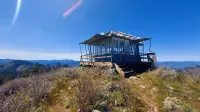
- Acorn Woman Peak LookoutJacksonville · Fire lookout (USFS rental)A 14-foot-square L-4 fire lookout on a Siskiyou ridge above the Applegate Valley, rented by the night, with its Osborne Firefinder still at the center of the room.
- Valley View WineryJacksonville · Winery/vineyardSouthern Oregon's Premier Winery - Established in 1972. Home to award winning Domaine Rogue wines.

History
Gold on Jackson Creek
Jacksonville stands on Jackson Creek, a small tributary of the Rogue River in southern Oregon, several miles west of Medford.2,3 The building survey’s record dates the strike to December 1851, when two prospectors from California found gold on the creek, and says James Cluggage and James Poole began working placers in January 1852.2 The 1940 Federal Writers’ Project guide put the discovery in January 1852 and named the second man J. R. Poole, and the Oregon History Project places the find in Rich Gulch.4,5 Word spread when the Oregon men went down to Yreka, California, for provisions, and by one account Californians trailed a drunken new arrival back to his camp, after which a thousand miners from California had overrun the country in a short time.2 By the summer of 1852 the camp was a tent city of 500.1 That November the Swiss-born Peter Britt walked in nearly penniless, hauling his photographic apparatus in a small cart, came to mine for gold, and found photography more profitable.3,7 The Oregon History Project says the Territorial Legislature set apart Jackson County on January 12, 1852, and named the camp its seat, while the National Register nomination has Jacksonville becoming county seat in 1853.1,5
Gold Dust and the Fire of 1873
The 1940 guide wrote of a place where men washed as much as a pint cup of gold in a day.4 The town became a supply point for mining throughout the region, with churches, schools, boarding houses, and saloons.3,8 Legend, as the 1940 guide told it, has the Methodist church built in 1854 with one night’s take at the gaming tables.4 Beginning in 1860, C.C. Beekman, agent for Wells Fargo & Company, carried gold over the stage route to Sacramento and Portland, and the 1940 guide says his bank sent express shipments of gold to Crescent City.4,5 The Chinese were the largest single ethnic group in the region and in the 1860 census made up at least 50 percent of the men identified as miners; on September 1, 1866, the editor of Jacksonville’s Oregon Sentinel wrote that “these people” added nothing to the permanent wealth of this country.8 In 1873 a fire destroyed much of the business section, the Union Hotel among it, and the town was rebuilt at once; the brick U.S. Hotel opened in 1880 with a visit by President Rutherford B. Hayes.1,9
The Railroad Goes to Medford
As gold mining declined in the 1870s, residents put money into new homes and businesses and watched a new courthouse go up while they waited for the Oregon and California Railroad.5 The line reached the Rogue Valley in 1883, and Jacksonville officials, sure the railroad could not survive without their town, declined to buy a right-of-way.5 The National Register nomination says the railroad by-passed the town four miles to the east in 1884, while the Oregon History Project says the track was laid five miles to the west, where Medford grew up.1,5 In 1891 the five-mile Rogue River Valley Railway was built to the main line at Medford to revive the town’s trade.10 William Barnum ran it much of the time as a family business, and in 1893 a railroad magazine featured his 13-year-old son John as the nation’s youngest conductor.6 Trolley service began on the electrified line in 1916, passenger service ended in 1920, and the line closed in 1925.6,11 The county seat moved to Medford in 1927, and the Great Depression followed in 1929.6 In 1940 the Federal Writers’ Project guide counted 806 people and found bearded men drowsing on benches outside dusty shops with empty whiskey bottles in the windows, and small back-yard mines where family gardens had been.4
Saving the Old Town
The Southern Oregon Historical Society was founded in 1946 to save the 1875 Jacksonville Courthouse from demolition, though another account dates the new courthouse to 1884.3,12 Desperately poor and ramshackle after World War II, Jacksonville began to flourish after the 1960s, when citizens pushed to have it listed as a National Historic Landmark.13 In 1966 it became one of the first historic districts named under the National Historic Preservation Act, and Southern Oregon Historical Society staff helped make it a National Historic Landmark.3,12 The City Hall, built in 1880-81 for $2500.00 with two jail cells and room for fire equipment, has been in use as a city meeting hall since 1881.14 The sources disagree on the Beekman Bank’s date: the National Register nomination gives 1856, the 1940 guide gives 1862, and a photograph caption gives 1863.1,3,4 The railway depot, now the Jacksonville Chamber of Commerce, is the line’s one remaining building.10 The sequoia that Peter Britt planted in 1862 when his son Emil was born still dominates the landscape.7
Within 30 Miles
Measured in a straight line from the town, nearest first.
- Jackson County FairCentral Point · County fairThe Jackson County Fair, held each July at The Expo in Central Point, Oregon, traces to an 1859 Agricultural Show in Jacksonville, where a Talent man's grape took a blue ribbon.

- Oregon Old Time Fiddlers monthly jam, Roxy Ann GrangeMedford · Monthly old-time fiddlers jam
- Cantrall-Buckley ParkRuch · County parkA county park of 88 acres on the Applegate River near Ruch, Oregon, laid out around a pioneer swimming hole and run for twenty years by its neighbors.
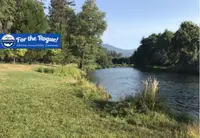
- Gold Dust Day Heritage CelebrationGold Hill · Community eventGold Hill, Oregon, holds its Gold Dust Day on the first Saturday in June, with a parade down 2nd Avenue and free raft rides on the Rogue River.

- TouVelle State Recreation SiteCentral Point · Day-use state recreation siteA Rogue River day-use park at the foot of Table Rock with picnicking, fishing, boat launch, swimming, and a 2-mile trail
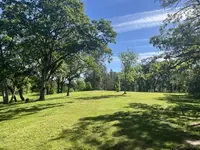
- Talent Harvest FestivalTalent · Harvest celebrationSouthern Oregon's free downtown harvest festival in Talent, begun in 1971 as the Talent Tomato Festival, where neighbors' backyard apples and pears go into one community cider.
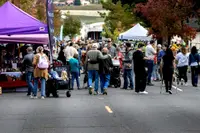
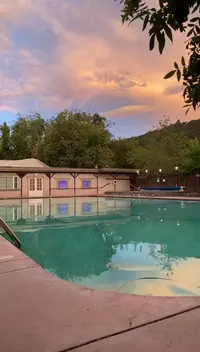
- Jackson WellspringsAshland · Mineral hot springs wellness retreat centerMineral spring-fed public-soak wellness retreat center with swimming pool, private tubs, sauna, steam room, showers, locker room, and patio; campground on the property
- National Rooster Crow WeekendRogue River · FestivalA late-June weekend in Rogue River, Oregon, held since 1953, whose main event counts how many times each entered rooster crows in thirty minutes.
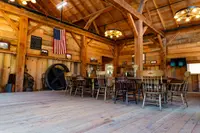
- Butte Creek MillEagle Point · Water-powered flour millA water-powered grist mill on Little Butte Creek in Eagle Point, Oregon, built in 1872 and burned on Christmas morning 2015, again grinding on its original French buhr stones.
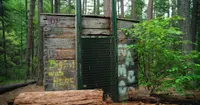
- Bigfoot TrapRuch · The only bigfoot trap in the worldThe only bigfoot trap in the world, on the Collings Mountain Trail, which features spectacular views of the Siskiyou Crest and Applegate Lake.
- Sundance DistillingGrants Pass · DistilleryBrandan and Barbara Conover operate a local distillery in Grants Pass. They craft all of their products in-house, boasting a selection of around 20 items.
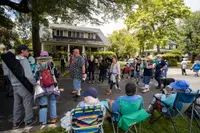
- PorchfestGrants Pass · Free, family-friendly music festivalA free one-day music festival on the front porches of historic houses in northwest Grants Pass, Oregon, where the streets close to cars and the bands play for tips.
- Wooldridge Creek WineryGrants Pass · Oregon's first combined winery & creameryOregon's only combined winery and creamery; the creamery was founded in 2015 and uses only local, organic milk.
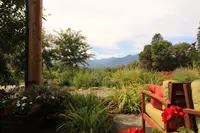
- Josephine County FairGrants Pass · County fairThe Josephine County Fair runs five August days on fairgrounds south of Grants Pass, Oregon, where a racetrack, a blackberry gully turned arena, and 1920s buildings still stand.
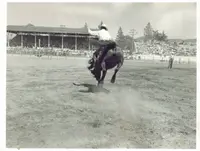
- Southern Oregon Flea MarketGrants Pass · Flea marketThe Grants Pass flea market is located at the Josephine County Fairgrounds in the event building. Also being held in the parking lot during the summer months.
2 more within 30 miles on the road map.
Nearby towns: Grants Pass. All the towns of Oregon. More of Oregon: Lookouts & Cabins.
Sources
- National Register nomination, Jacksonville, OR npgallery.nps.gov/NRHP/GetAsset/NHLS/66000950_text
- Jacksonville Historic District, Jacksonville, Jackson County, OR loc.gov/pictures/item/or0090
- California Street, Jacksonville, c1890 oregonhistoryproject.org/articles/historical-records/california-street-jacksonville-c1890
- Oregon: End of the Trail (1940), p. 326 archive.org/details/oregonendoftrail00writrich/page/326
- Jacksonville The First Town (oregonhistoryproject.org) oregonhistoryproject.org/articles/jacksonville-the-first-town
- Jacksonville’s Rogue River Valley Railway 1891-1925 (historical marker) hmdb.org/m.asp?m=113390
- Peter Britt (1819-1905) oregonencyclopedia.org/articles/britt_peter_1819_1905_
- © Kay Atwood and Dennis J. Gray, 2003. Updated and revised by OHP staff, 2014. oregonhistoryproject.org/narratives/as-long-as-the-world-goes-on-the-land-and-people-of-southwest-oregon/new-names-on-the-land/gold
- P.J. Ryan’s Dwelling House (historical marker) hmdb.org/m.asp?m=255921
- History Right Here - Horse Powers (historical marker) hmdb.org/m.asp?m=112896
- Medford-Jacksonville streetcar system oregonencyclopedia.org/articles/medford_jacksonville_streetcar_system
- Southern Oregon Historical Society oregonencyclopedia.org/articles/southern_oregon_historical_society
- Unending Delight, Vigorous Exercise, and the Creative Spirit oregonhistoryproject.org/narratives/as-long-as-the-world-goes-on-the-land-and-people-of-southwest-oregon/back-to-the-land/unending-delight-vigorous-exercise-and-the-creative-spirit
- City Hall (historical marker) hmdb.org/m.asp?m=91781