
Acorn Woman Peak Lookout
Jacksonville, Jackson County, Oregon. Fire lookout (USFS rental).
Details

- Where
- 6941 Upper Applegate Road, Jacksonville, OR 97530. Directions
- Season
- Available for rent during the snow-free season with a maximum length of stay being 5 consecutive nights.
- Getting there
- From Jacksonville, Highway 238 west 8 miles to Ruch, left on Upper Applegate Road 10.2 miles to Forest Road 20 (Beaver Creek Road), left 4.1 miles to Forest Road 2010, right 5.1 miles to Forest Road 2010/350, then through the locked gate to the lookout.
- Access
- Access road is steep and windy and may not be suitable for passenger vehicles or large trucks.
- Walk-in or reserve
- Reserved through Recreation.gov; access road is gated and locked with combination lock, the combination provided in the reservation confirmation letter.
- Phone
- 541-899-3800
- Website
- recreation.gov
- Managed by
- Rogue River-Siskiyou National Forest.
- Established
- 1942.
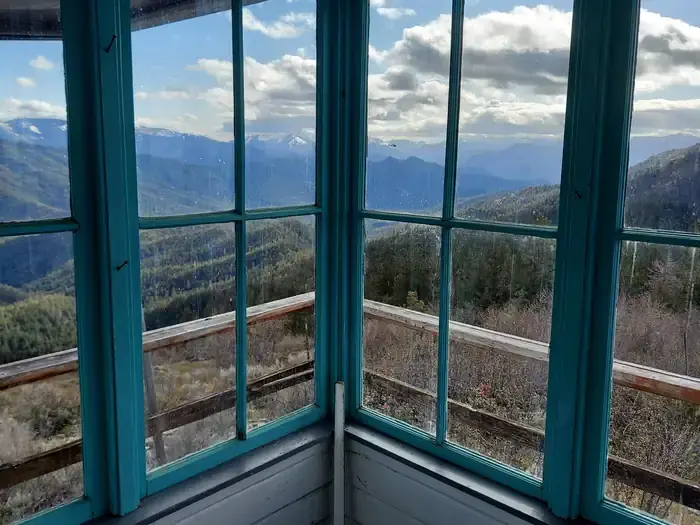
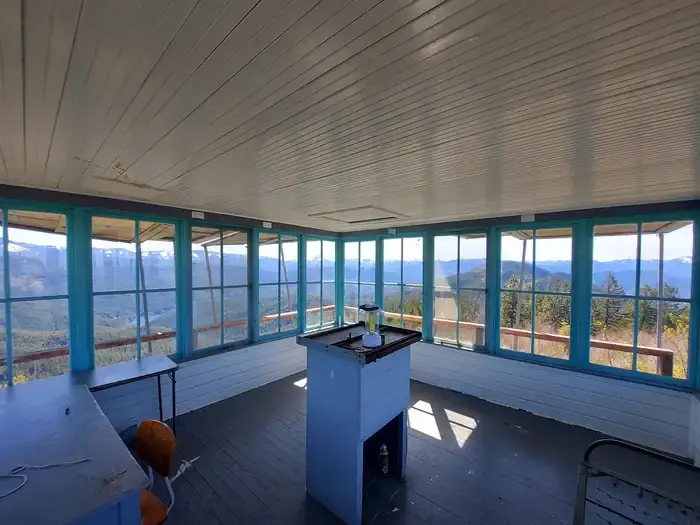
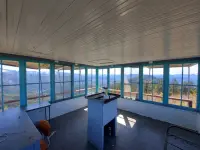
The door is in the east wall, near the northeast corner, and it opens on a single room fourteen feet square. The other walls are mostly window: banks of small fixed panes, five to a side, with the fifth on the east side given up to the door. At the center of the floor a working Osborne Firefinder sits on its work table. A small wooden table stands near it. The room also holds a broom, a mop, a fire extinguisher, and a storage box with toilet paper, forest and ranger district maps, and notes on the lookout and its surroundings. Cheryl Hill, who has set out to visit every standing fire lookout in Oregon, stayed here July 3–7, 2019. She wrote that it was the first lookout she had rented where the fire finder was still in place.
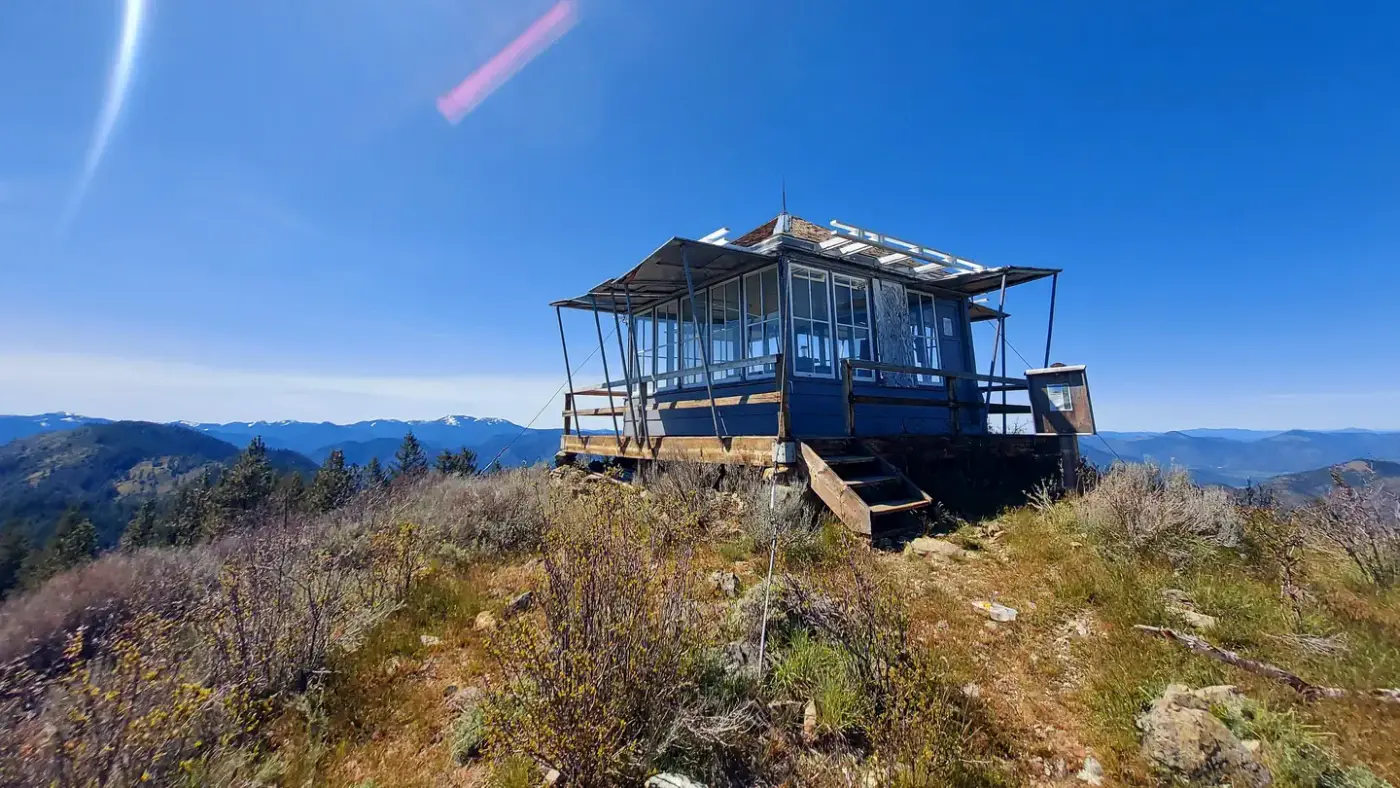
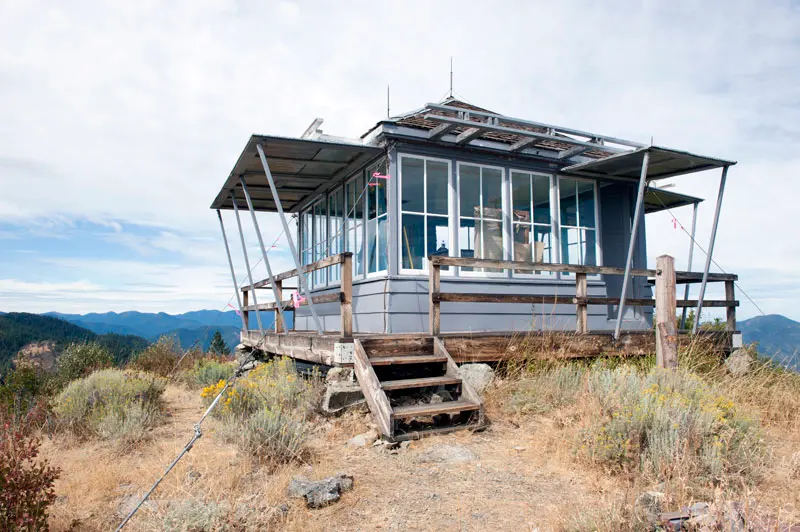
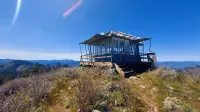
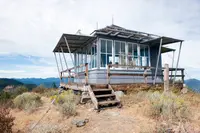
Acorn Woman Peak Lookout is a ground cabin with no tower. It rests on low mortared-rock footings at the summit of a peak in the Siskiyou Mountains, about 25 miles south of Jacksonville in Jackson County. The Rogue River-Siskiyou National Forest rents it in the snow-free season to one or two people at a time, for no more than five nights. The cabin is let nearly bare. There is no water, so renters pack in what they need for drinking, cooking, and washing, and they bring their own stove, light, bedding, matches, cookware, and garbage bags. Hill found no beds and brought camping cots. A vault toilet stands near the cabin, and there is a firepit but no firewood. On the summit Hill also found a Remote Automatic Weather Station, which she called “a bit of an eyesore,” and an old rusting bed frame behind the outhouse.
The last mile is gravel. From Ruch, Upper Applegate Road leads to Beaver Creek Road, which leads to Hanley Gulch Road, which climbs to a gate at Hanley Gap. Hill notes the gap is unsigned. Renters work the combination lock and drive Forest Road 350 uphill to the cabin. The Forest Service calls the road steep and windy and says it may not suit passenger cars or large trucks. Hill found it steep in spots but in good condition.
The view from the catwalk
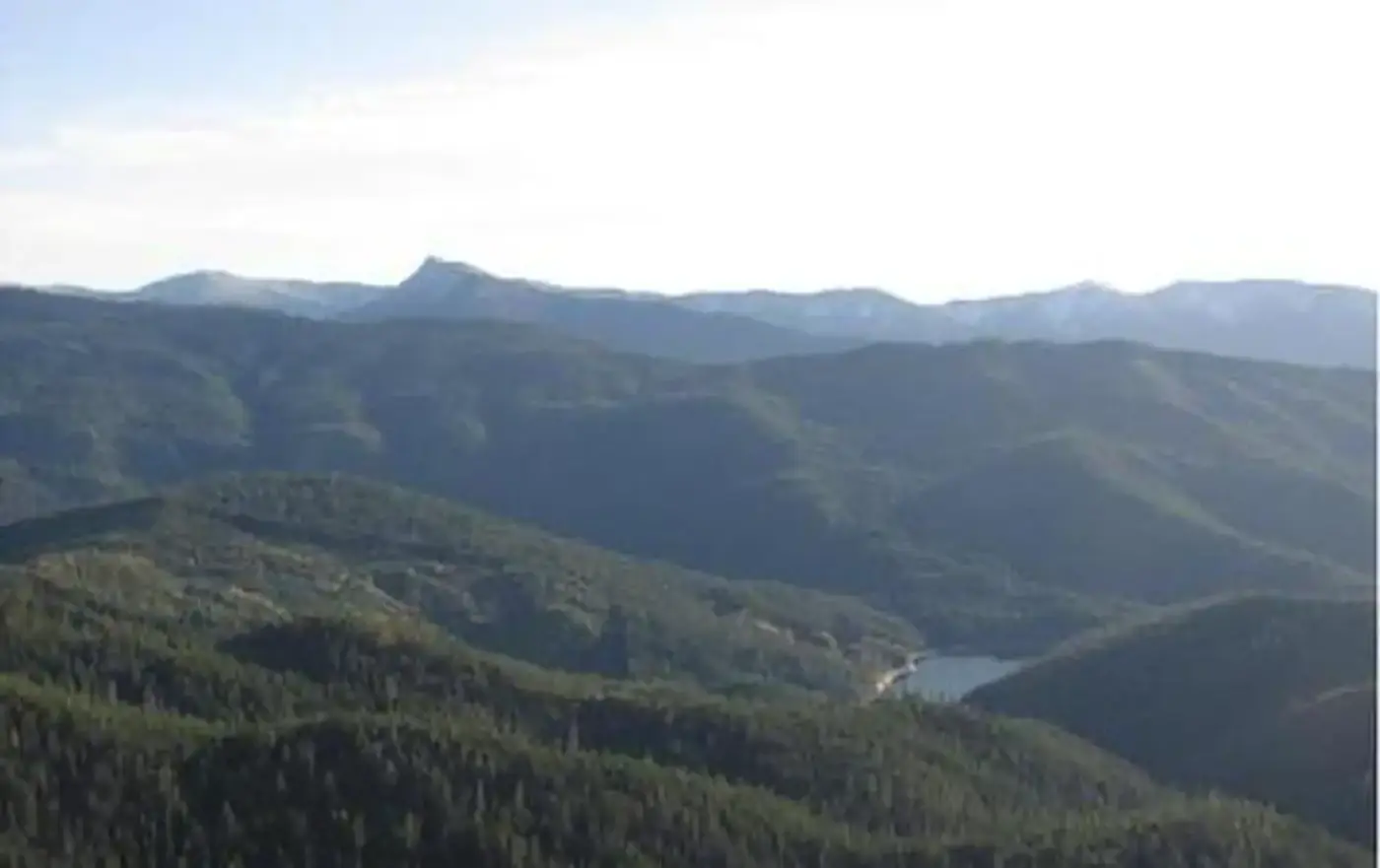
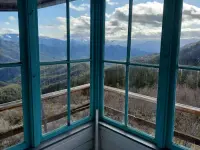
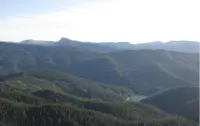
A catwalk three feet wide, floored with 2-by-4 lumber, runs around the cabin. Wooden steps reach it from the north and south. The building faces south, toward the Red Buttes Wilderness on the California line and the Acorn Woman Lakes. The Little Applegate Valley lies below. To the north are the Rogue Valley and Mount McLoughlin, and to the east are Wagner Butte and Dutchman Peak. On a clear day the rim of Crater Lake can be seen, along with Mount Bailey and Mount Thielsen. The National Forest Foundation adds views down into California.
The peak is a high point on an east-west ridge, with Little Grayback Mountain to the west and Acorn Woman Mountain to the east. Its north slope drains into the Beaver Creek watershed of the Applegate River, and its south slope into the creek the 1999 nomination calls Squaw Creek. The nomination and Hill give the summit as 4,984 feet; firelookout.com gives 4,964. Winters here are milder than on the higher peaks, and the snow is usually gone by April or early May.
Dry open meadows and brushfields of buckbrush, ceanothus, and greenleaf manzanita cover the southern flank. Mixed conifer and true fir hold the north slope: Douglas-fir, ponderosa pine, western white pine, white fir. Scrub oak grows near the summit.
Five nights in July 2019
Hill’s stay began badly. A rock punctured a tire on the drive south, the car needed four new tires in Salem, and she reached the gate after dark and ate dinner at 10 p.m. The days after went smoothly. Lizards darted over the rocks. On the last morning she filmed a hummingbird at a Cascade lily, though most of the wildflowers were done. She prepared food inside the cabin, cooked outside on a Coleman stove, and ate on the deck in the mornings and evenings, when there were no bugs. Carpenter ants were plentiful. One night something seemed to rustle the pots and pans, and she advised keeping food in a lidded tub. The cabin has no heat, and she never needed it.
The evening light lasted a long time. Her stay fell on a new moon, and with little light pollution the stargazing was excellent. “It was incredibly quiet and even air traffic was almost non-existent,” she wrote.
An Aladdin kit for the upper Applegate
The sources disagree on the building date. The Forest Service, Recreation.gov, Travel Oregon, and the National Forest Foundation give 1942. Forest engineering records cited in the National Register nomination, along with firelookout.com and the Southern Oregon University archive, give 1943. The cabin came as a pre-cut kit that the Forest Service bought from the Aladdin Manufacturing Company. According to the nomination, the kit may have sat at the ranger district’s warehouse compound until a crew was available to pack it by horse to the summit and put it up. The nomination says the lookout was probably built to improve fire detection over the upper Applegate Valley, especially the farming and ranching country from Star Gulch south to the California border.
The cabin is a standard wood-frame L-4 with a hipped roof. It is virtually identical to the L-4s the Forest Service put up at Mount Stella, Rustler Peak, Blue Rock, and many other places in Oregon and Washington between 1932 and the 1940s, before the flat-topped R-6 became standard. As in every L-4, one floor served as both fire observatory and living quarters. Sawn cedar shingles cover the roof, laid five inches to the weather and doubled along the hips. The walls are horizontal 1-by-6 rustic siding. In the 1950s gray asbestos shingles were nailed over the siding below the windows, and they were later removed. In winter, shutters of tongue-and-groove boards close over the glass, two to a side. In summer they are propped open on poles set against the catwalk floor.
Storm watch, register, and repair
The staffing record also comes in two versions. Fire management records cited in the nomination show the lookout staffed regularly through 1961, and after that only during electrical storms at the height of fire season. Firelookout.com says it was last staffed full-time in 1966 and afterward used for emergencies, and early in the season when snow blocked the road to Dutchman Peak. In the severe fire season of 1987 it was used to watch fires in the Applegate Valley.
Historian Jeff LaLande wrote a heritage evaluation and rehabilitation report on the lookout in 1998. Katherine C. Atwood of Ashland prepared the National Register nomination for the Forest Service, dated November 1, 1999. The building was listed on December 29, 2000, as Squaw Peak Lookout. It was one of a group of Forest Service structures on the Rogue River National Forest listed together, along with Dutchman Peak Lookout of 1927 and Mount Stella Lookout of 1933. In the listing, the Keeper of the Register added architecture to its areas of significance.
When Hill looked into the lookout in 2015, it was on Recreation.gov but not yet open, and it needed work that included a new roof. In 2016 the Sand Mountain Society and its volunteers re-roofed the cabin, replaced siding, and built furniture. Hill checked again in early March 2019 and found the cabin open for booking with only a handful of dates taken. She reserved the Fourth of July weekend.
Acorn Woman
In September 2022 the Department of the Interior announced new names for 650 geographic features that used a slur for Native American women. Fifty-three were in Oregon. Squaw Peak became Acorn Woman Peak, and Squaw Mountain became Acorn Woman Mountain. The pair of lakes to the south became Acorn Woman Lakes. Brook Colley, who chairs the Native American Studies program at Southern Oregon University, said her father had refused the old name for the lake in a 1994 book on swimming holes. “He called it ‘Lovely Lady Lake,’” she said. The creek through the lakes became Téel Creek, from a word meaning yellowjacket, chosen because Yellowjacket Ridge is nearby.
Acorn Woman was a powerful figure in the mythology of the Takelma people of the Rogue Valley. “She would come down from where she lived most of the year on Mount McLoughlin and tear off pieces of her flesh and throw them onto oak trees. They would grow into acorns,” LaLande told the Medford Mail Tribune. The paper wrote that the name also honors the work women did to feed their people. Raw acorns carry tannins, and over generations people learned to wash them out with water. “It took a tremendous amount of experimentation over generations,” LaLande said.
In the 1850s most of the Indigenous people of the Rogue Valley were forcibly moved to the Siletz and Grand Ronde reservations in northwest Oregon. Robert Kentta, cultural resources director for the Confederated Tribes of Siletz Indians, described a project with Southern Oregon University and other partners to restore access to traditional foods. “We hope to gather acorns in the Rogue Valley on properties where we’re invited,” he said.
Notable Events
- 1940The Aladdin kit that became the lookout may have been stored at the Ranger District's warehouse compound, awaiting personnel to pack the material by horse to the mountain-top and erect it. heritagedata.prd.state.or.us
- 1943The L-4 cab was built in 1943. firelookout.com
- 1943Forest engineering records indicate that the building was constructed in 1943. heritagedata.prd.state.or.us
- 1961Fire management records show the lookout was staffed regularly through 1961, after which it served only during electrical storms at the height of fire season. heritagedata.prd.state.or.us
- 1966The lookout was last staffed fulltime in 1966, then used for emergencies and early-season staffing when access to Dutchman's Peak was blocked by snow. firelookout.com
- 1987During the severe fire season of 1987, the lookout was used to observe fires in the Applegate Valley area. heritagedata.prd.state.or.us
- 2000Squaw Peak Lookout was listed in the National Register of Historic Places, NRIS Reference Number 00000512. heritagedata.prd.state.or.us
- 2016The lookout underwent a major restoration by the Sand Mountain Society in 2016, and the Rogue River-Siskiyou National Forest now rents the lookout during the summer and fall seasons. nationalforests.org
- 2022Squaw Peak was renamed to Acorn Woman Peak in 2022, three years after the author's stay at the lookout. cherylhill.net
People
- Jeff LaLande, Author of the Squaw Peak Lookout Heritage Resource Evaluation and Rehabilitation Project Report (1998).
- Katherine C. Atwood, Prepared the National Register nomination for the USDA Forest Service.
Sources
- recreation.gov/camping/campgrounds/251546
- recreation.gov/api/camps/campgrounds/251546
- traveloregon.com/things-to-do/destinations/parks-forests-wildlife-areas/squaw-peak-lookout
- firelookout.com/or/squawpeakr.html
- nationalforests.org/article/unforgettable-experiences-squaw-peak-lookout
- sou.libraryhost.com/subjects/334
- cherylhill.net/firelookouts/2019/07/15/squaw-peak
- heritagedata.prd.state.or.us/historic/index.cfm?do=main.loadFile&load=NR_Noms%2F00000512.pdf
- fs.usda.gov/r06/rogue-siskiyou/recreation/acorn-woman-peak-lookout
- jcls.org/2023/07/17/windows-in-time-lecture-series-presents-acorn-woman-mountain-new-names-honor-native-american-culture
- yahoo.com/news/local-places-squaw-slur-names-122400627.html