

Butte Creek Mill
Eagle Point, Jackson County, Oregon. Water-powered flour mill.
Details

- Where
- 402 N Royal Ave, Eagle Point, OR 97524. Directions
- When
- Bingo Night at the Mill runs every Wednesday, October 14 through November 18 on the mill's own event calendar.
- Getting there
- Take Interstate 5 (Exit No. 30) northward ten miles (toward Crater Lake) to Eagle Point via Oregon Highway 62. Turn right at the intersection of Highway 62 and Linn Road. Turn Right on Linn Road. Go to your first stop sign, which is Royal, and turn left. We are down 2-3 blocks on the right side.
- Fees
- Market and bazaar vendors pay $25.00 per 6 ft indoor table space per day, with 2 tables maximum per vendor, or $50.00 per 10x10 outdoor space per day; the mill rents a limited number of tables for $15.00 for events.
- Hours
- open at 10:00.
- Access
- The Mill is on the National Historic Register and kept its status because the lower level was preserved; groups can use the grounds of the Mill for events.
- Walk-in or reserve
- Market and fair vendors register through the mill's own application page and email apply@buttecreekmill.com with questions.
- Phone
- 541-690-5356
- Website
- buttecreekmill.com
- Managed by
- Butte Creek Mill Foundation, a 501 (c)(3) not-for-profit.
- Established
- 1872.
The loading dock on North Royal Avenue
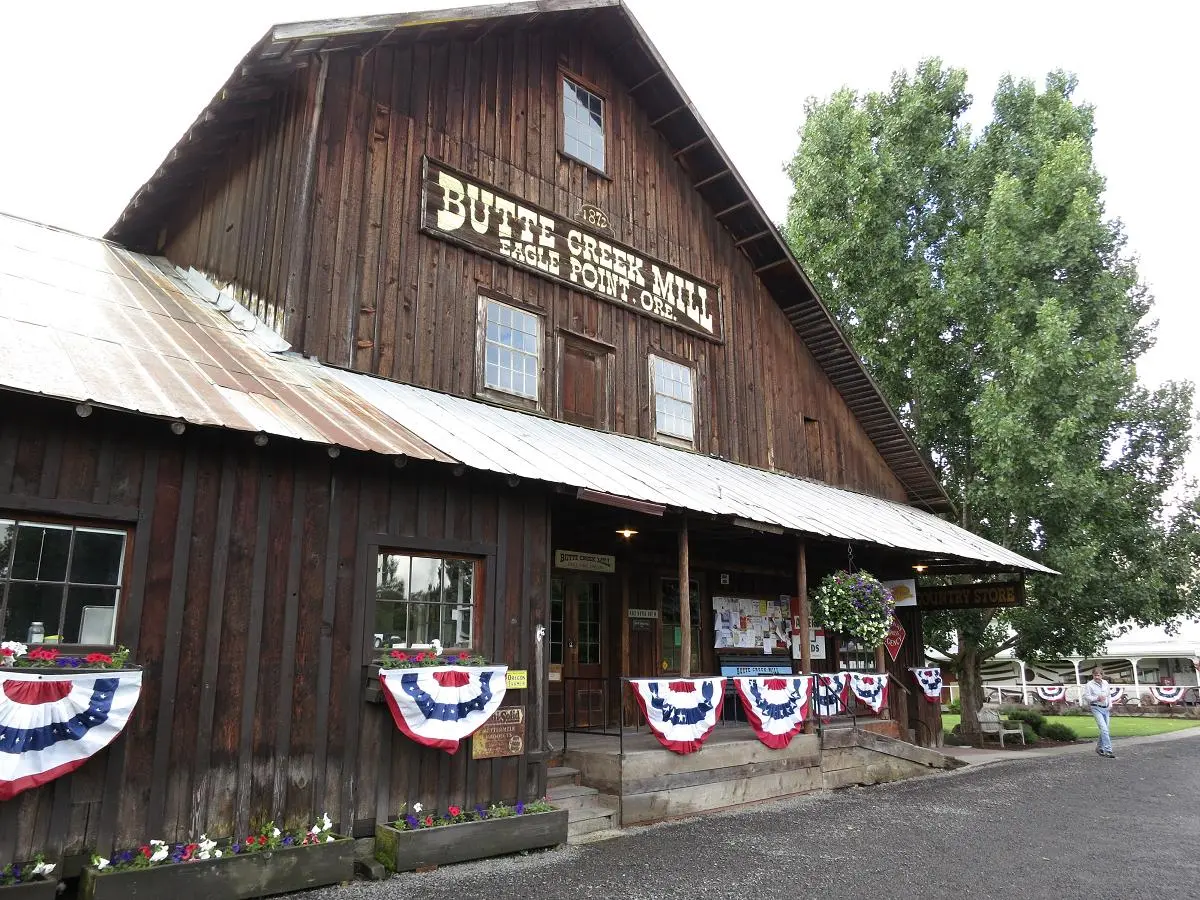
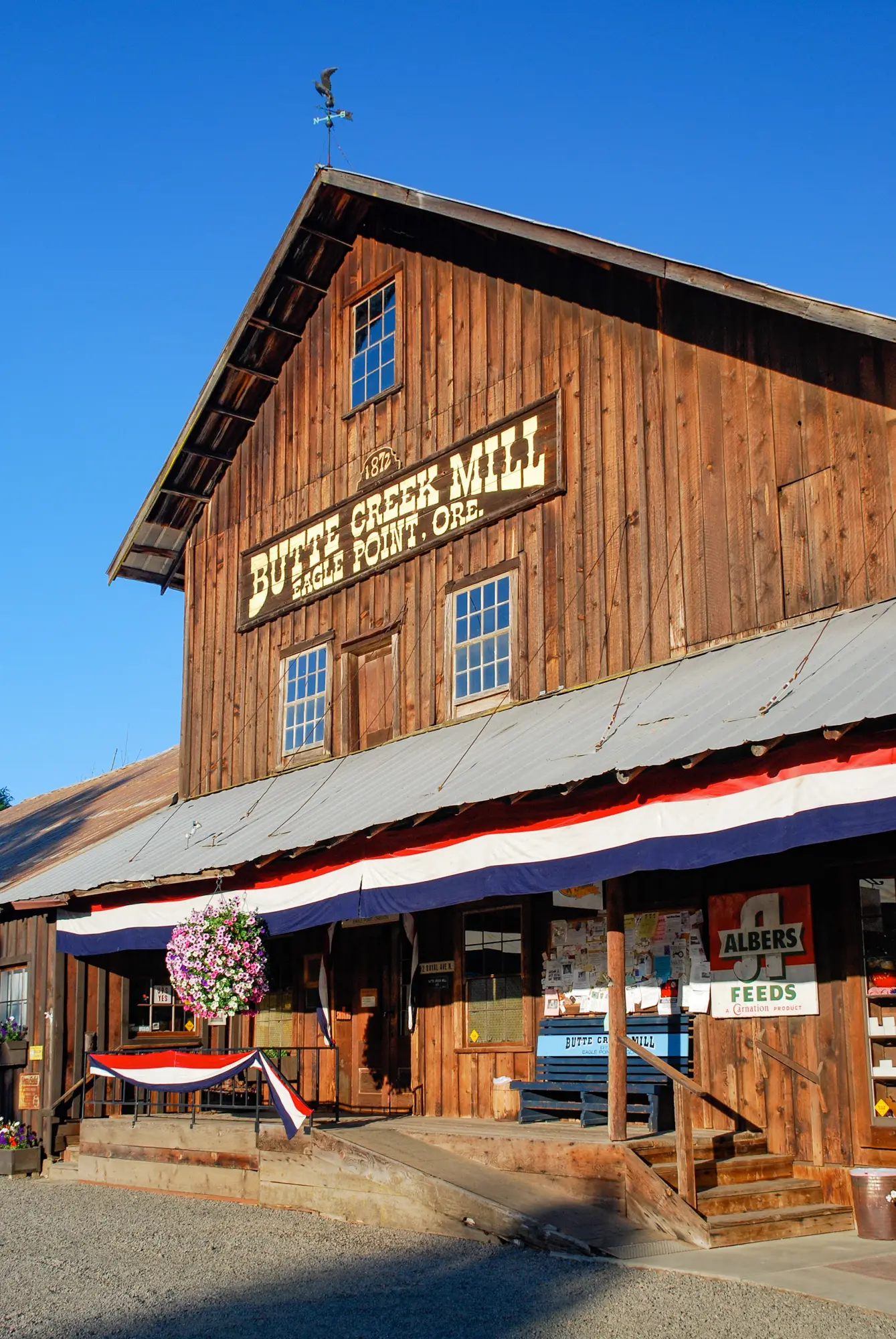
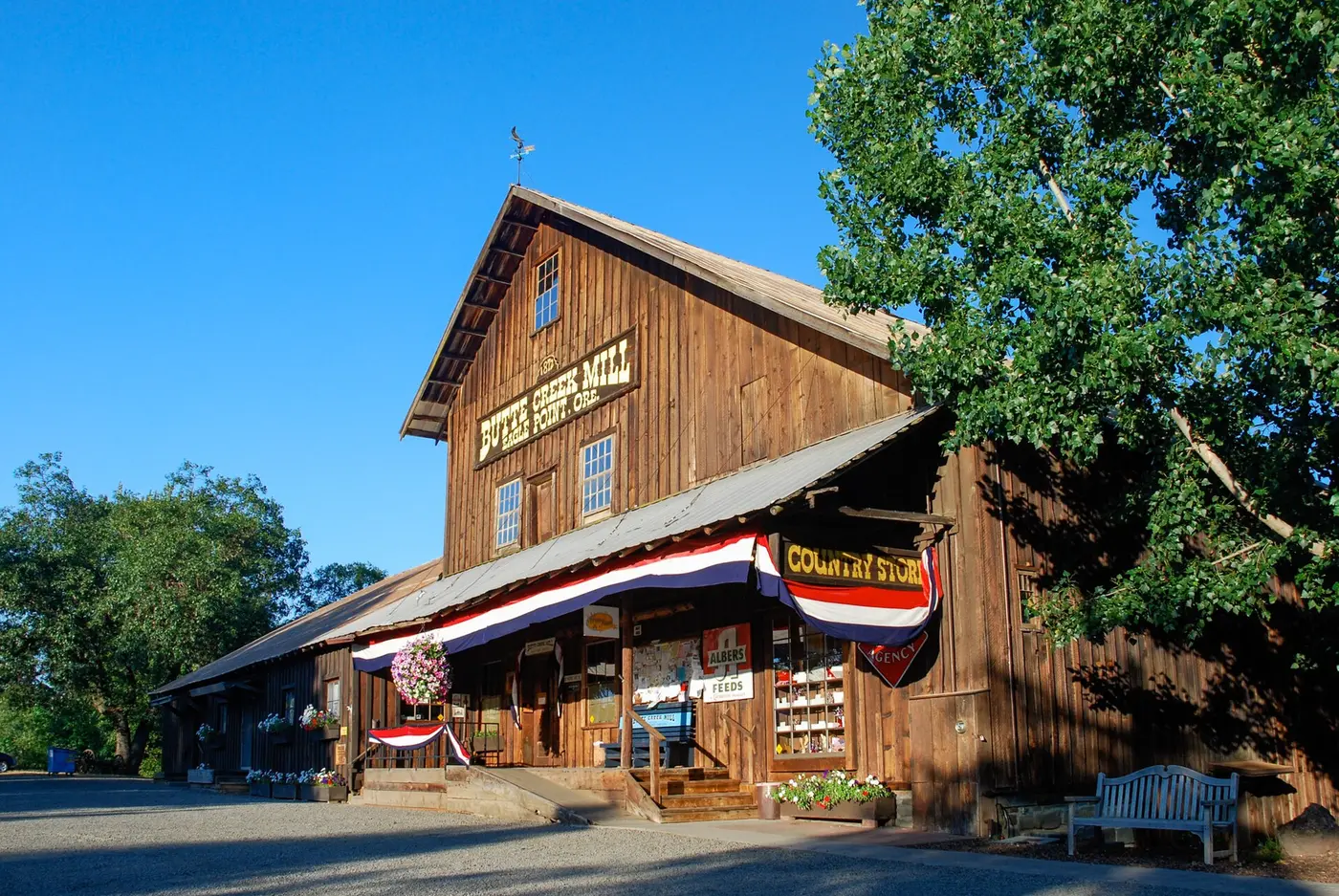
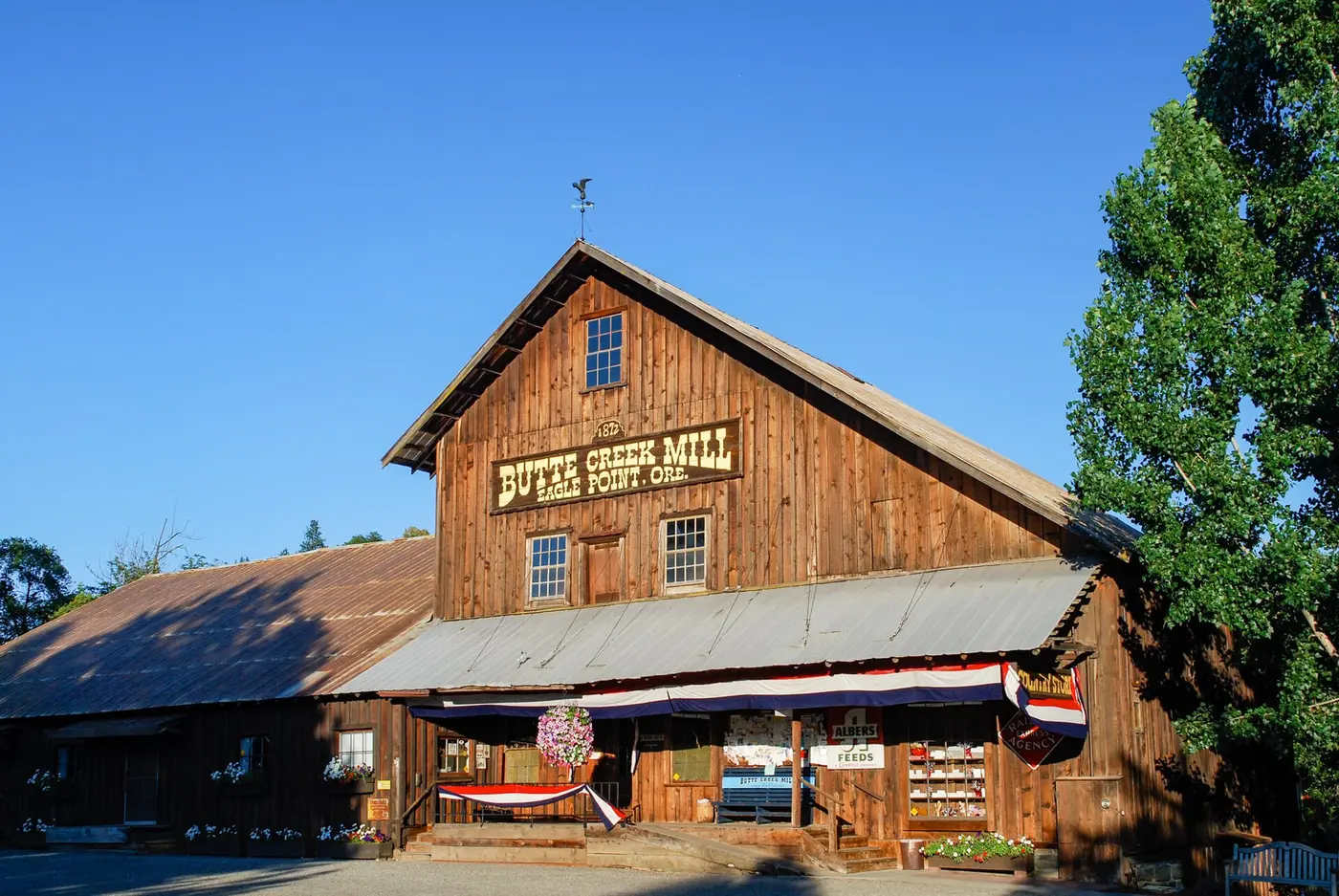
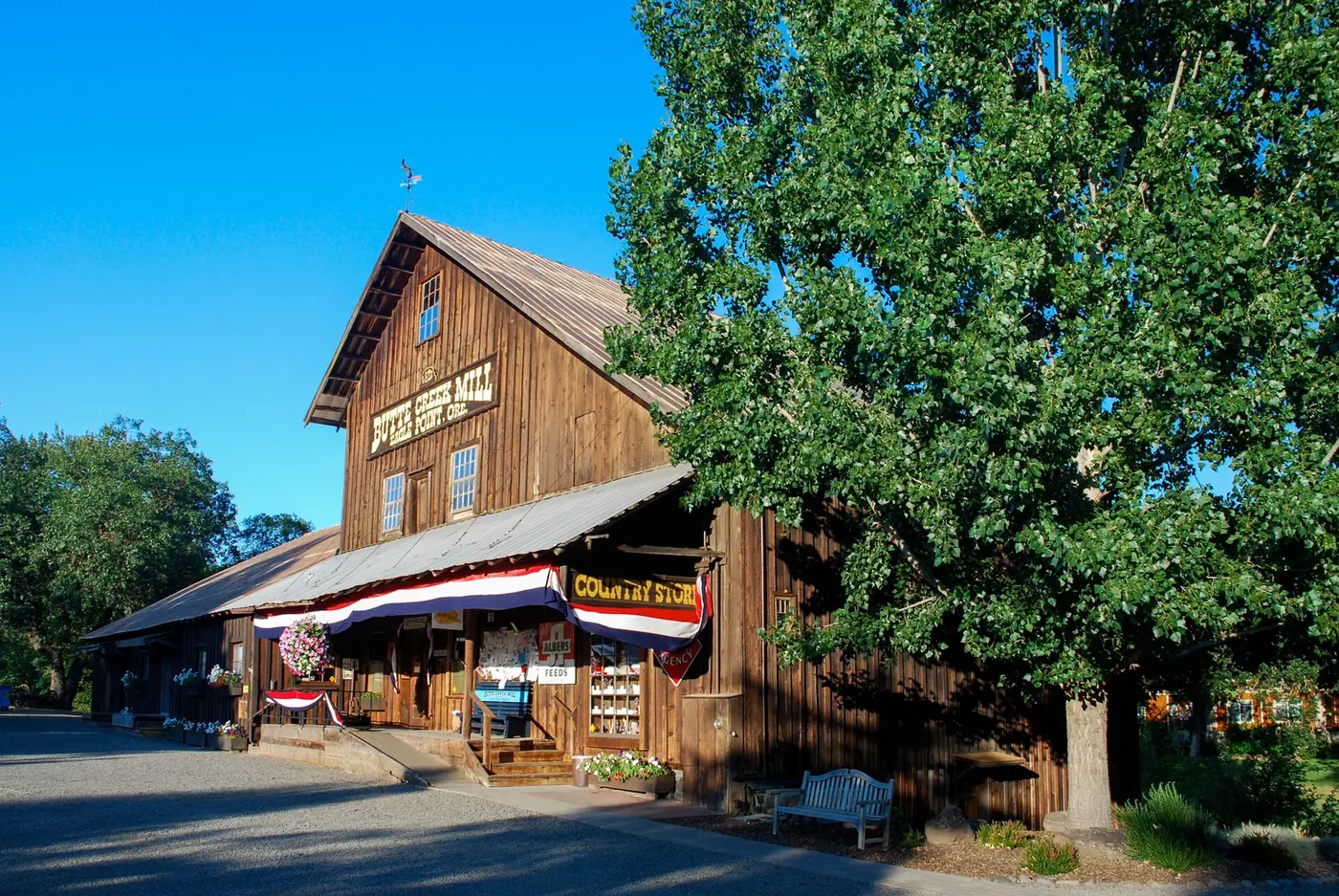
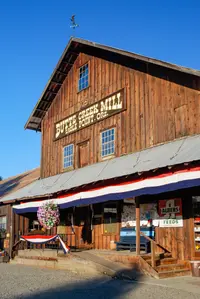
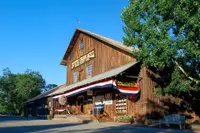
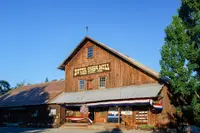
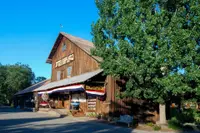
A broad overhang shades the front loading dock of Butte Creek Mill, two blocks off Oregon Highway 62 on the way to Crater Lake. The dock holds tables and chairs and an old wooden bench. Through the open doors come the clacking and humming of pulleys and belts working the machinery, and the smell of newly crushed grain drifts out to the street. Below, in the lower level, water from Little Butte Creek arrives through a millrace nearly half a mile long and turns the turbine. The grinding is still done on the French buhr stones that came to Eagle Point in 1872. The Butte Creek Mill Foundation, which owns and runs the place, calls it the only water-powered grist mill on this side of the Mississippi River.
The dock leads into the Country Store, where antique memorabilia stands behind the shelves. The store sells the mill’s pancake and waffle mix, bran muffin mix and cornbread mix, along with stone-ground hard red wheat, hard white wheat and pastry flour. It also stocks bulk spices, loose teas, kitchen and baking goods, made-in-Oregon items and cold drinks. A counter serves soft serve in cones and cups, including a pineapple dole whip. On sample Saturdays the store hands out what it has just baked. Posts from September 2026 list oatmeal cookies, banana bread and a new Bigfoot cookie mix, with Oregon Mountain Coffee by the bag. In September 2026 the Foundation reported its new kitchen nearly finished, and the first bran muffins baked in it went out as free samples. The kitchen is certified for food classes and was one of the expansions the Foundation announced for 2026, along with a new deck.
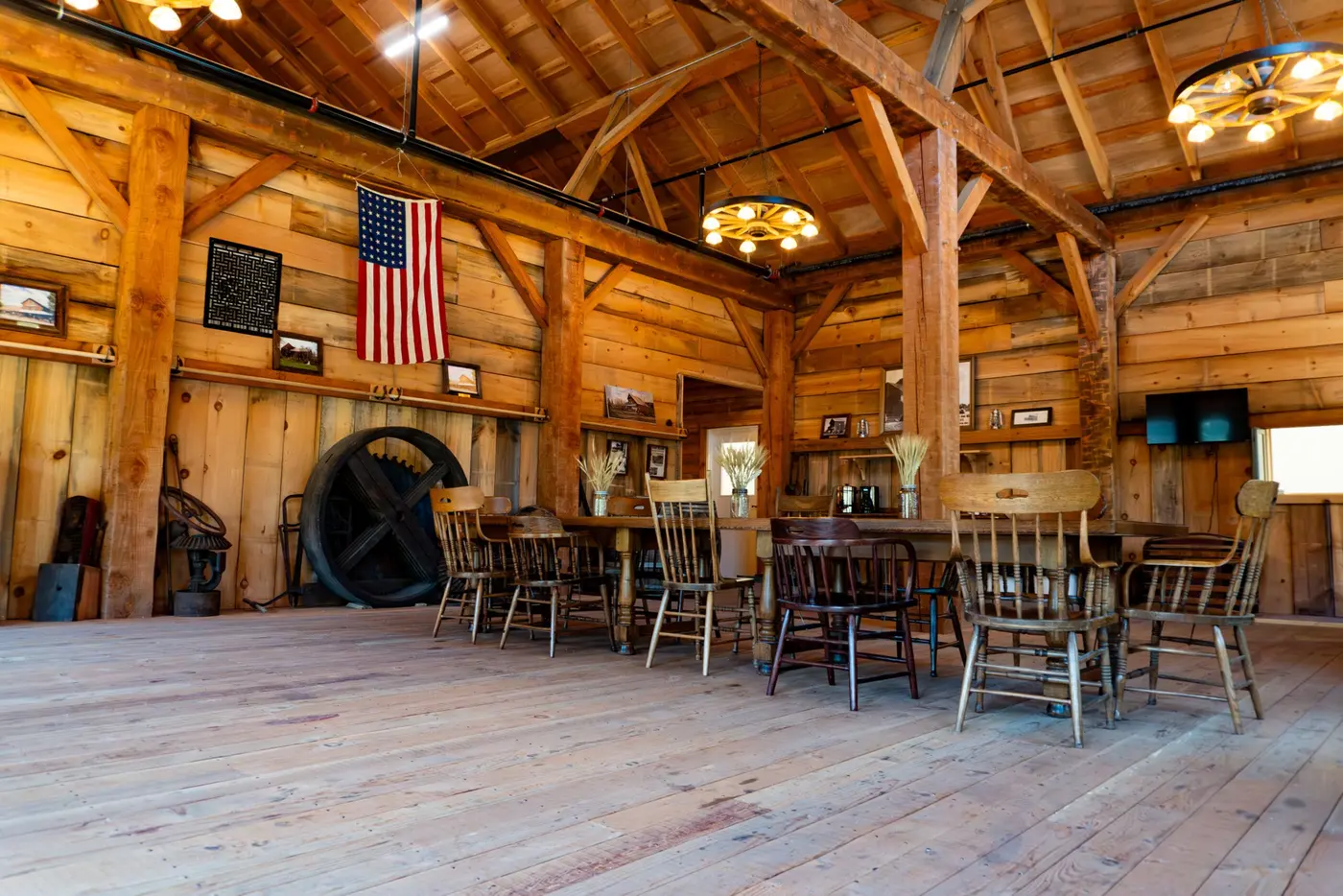
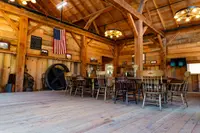
Behind the store is a Great Room, rebuilt using the original timber framing and vaulted ceilings and rented for weddings, reunions and banquets of up to about 100 people. Beside the mill stand the former Ice House and a garden named for Debbie Russell, a former owner who died of cancer three months before the fire. The garden can be rented by the community.
Bingo, barbecue and a Camaro full of toys
The Foundation is a 501(c)(3) not-for-profit, and its events pay part of the mill’s way. October 2026 opens with the last of the season’s second-Saturday farmers markets on October 10. The markets run monthly from April and carry baked goods, jams, plants and vegetables from Jackson, Josephine and Siskiyou counties, and the mill’s chili is promised for the final one. Bingo is played inside the mill on Wednesday evenings from October 14 through November 18, with $5 cards and food for sale. A Sourdough 101 class meets October 17. A pig barbecue and dinner on October 24 runs from 3:00 to 6:00 p.m. for $15. On October 31, Halloween at the Mill brings candy, costumes, trick-or-treating among local businesses’ tables, and a pumpkin carving contest, with some of the pumpkins supplied by Harry & David and the Grange Co-op. A makers market follows on November 7 and 8, and a holiday market and bazaar on November 21 and 22. The Magic of Christmas at the Mill runs from December 4, 2026, through January 1, 2027.
The Christmas season starts in September. On September 27, 2026, classic cars came to the mill packed with toys for the annual toy drive, and the day opened with coffee, cookies and free chili. Donna Fagan-Pelissier, president of the Foundation, told KOBI-TV that afternoon: “So we did two trophies, we did a fan favorite, and then we did the most toys. 95 toys in one camaro definitely was the winner, so I don’t know, I think we had 50 or 60 cars.” The mill’s own post that evening gave the most-toys trophy to the Rogue Eagle Motoring Group with 94 toys and put the day’s total at about 140. KOBI’s headline said over 150. The toys are stored until December, when Santa hands them to children at the mill. “What I really love about it,” Fagan-Pelissier said, “is that they sit outside and go ‘it just feels good being here.’”
French stones and a half-mile race
The stones came first in the planning and last in the building. Eber Emery, born in 1819, reached Oregon by pack train in 1850 and as a millwright had built Ashland’s first flour mill and sawmill. In February 1872 he and John Daley bought a mill site on Little Butte Creek. In March they bought a right of way from a landowner, John Mathews, to cut the millrace. Adronirum John Daley picked a spot on a fairly steep bank on the west side of the creek, and an old irrigation ditch there was dug deeper by horse and hand labor. His father, John W. Daley, Sr., and Emery began building in July 1872. On September 7, 1872, the Democratic Times reported John Daley at work on a new gristmill.
The lumber came from a pine stand at Butte Falls. The frame was hand-hewn posts and beams 12 to 14 inches square, joined by mortise and tenon and held with oak pegs, set on a 20-inch mortared stone wall along the street side. The finished mill stood four stories, counting a daylight basement.
The accounts of the stones’ route differ. The marker erected in 2006 by the Umpqua Joe and Humbug chapters of E Clampus Vitus says they were quarried in France near Paris and assembled into four-foot stones in Moline, Illinois. From there, it says, they were shipped around the Horn to Crescent City, California, and carried over the mountains by wagon. The Foundation’s history says the stones, about 1,400 pounds each, traveled by ship down the Mississippi, around Chile to the California coast, and then by ox cart to Eagle Point. The 1976 National Register nomination repeats a story it calls never substantiated: Daley supposedly sent his two sons by wagon to fetch the stones from Crescent City, and one was killed in an Indian attack on the way back.
The Foundation dates the first flour to August 30, 1873, under the name Daley and Emery Butte Creek Mills, and says output reached 40 barrels a day within weeks. A notice dated September 1, 1873, announced the partners ready to store wheat and set grinding for the 10th of the month, at a toll of an eighth of a bushel or by exchange. The road out front, by the marker’s account, was the old military road to Fort Klamath. Farmers’ wagons lined it for miles at harvest, and Klamath Indians walked 90 miles from the fort to trade berries and leather goods for flour.
Snowy Butte, rollers and the Putmans
In 1878 Emery and Daley dissolved the partnership. Daley’s son A.J. and grandson George took over and called the business the Snowy Butte Mill. When a rival group of investors tried to start a flour mill down the road, the Snowy Butte Mill replaced its stones with roller machinery and the rivals gave up. The Foundation dates the change to 1889, the nomination to the latter part of the 1880s. The stones went into storage.
The sales that followed are told two ways. The Foundation says the Daleys sold in 1892 to Jacksonville residents, who ran it as the Snowy Butte Roller Flouring Mill Company, and that William Holmes, two of his brothers and Harry Carlton took over in 1896. The nomination has A.J. Daley as miller until 1893, when he sold to the Holmes Brothers of Eagle Point. The flour took a First Premium at the Oregon Industrial Exposition in 1898. A photograph from 1899 shows George Bearl Daley with bags of Snowy Butte Flour. In 1912 an addition on the south side gave storage and a loading dock. Its siding was cut with a circular saw where the original had been whip-sawn, and its basement joints were nailed rather than pegged.
FS and GW Brandon bought the mill in 1916 and added equipment to steam and roll barley and oats. In 1918, according to the Medford Mail, the mill ran at full capacity on a government contract for 70,000 barrels of flour for the war. The Foundation says it closed in 1919 and passed to the Eagle Point Bank. The nomination says the Brandons went out of business in 1920 and Henry Campbell, an Eagle Point banker, acquired it. Either way it stood idle until 1932, when George Putman bought the mill and water rights from Campbell’s widow. The Foundation names her as president of the bank. Putman and his sons Ed and Frank ran it as Putman Bros. Feed and Seed. In the 1930s a north addition housed frozen-food lockers and a meat cutting room, where customers brought slaughtered animals to be cut and wrapped.
In 1950, the year the Medford Mail Tribune reported “Old Burrstones Again to Turn at Eagle Point Mill,” George Putman pulled out the rollers and put the old stones back to work. The store sold flour alongside farm tools, horse medicine, veterinary supplies and feed. George and Ed died within months of each other in 1962, and Frank carried on, selling flour to bakeries in the Willamette Valley.
Frank sold to Peter and Cora Crandall in 1972, by the Foundation’s date, or 1973, by the nomination’s. Peter was a mechanical engineer who developed the stone-ground recipes, and Cora managed the business and baked. They turned the feed and animal supply area into the Country Store, renamed the place Butte Creek Mill, and gave tours. The mill went on the National Register of Historic Places on September 1, 1976. At that time it was the only one of Oregon’s two water-powered mills grinding flour; Thompson’s Mill in Shedd ground only animal feed. When Crandall retired he sought a buyer who would keep it running. In 2005 Bob and Debbie Russell bought it and kept a sign on the counter: “Enter as Strangers, Leave as Friends.”
Christmas morning, 2015
The fire began at about 3:00 a.m. on December 25, 2015, and was later ruled an accidental electrical malfunction. No one was hurt. About 70 percent of the 143-year-old building was lost, along with an estimated $1,000,000 in antiques. Its Lloyds of London policy, the only one the owners could find, covered $400,000. The basement survived, and so did the two millstones and the adjoining antique store. That surviving 30 percent kept the mill on the National Register. Russell, by then Eagle Point’s mayor, had lost his wife three months earlier. He moved the property into a foundation formed to rebuild. The Foundation dates its charity status to 2016; a January 2018 statement from the mill puts it in early 2017. That same statement reported $400,000 raised in cash and $500,000 in kind, and said the Timber Framers Guild had taken the rebuilding as its 2018 community project.
Every new piece of lumber was cut to the dimensions of the 19th-century original. Millwrights from Washington State restored the machinery and grinding by 2020, by the Foundation’s account. In 2022 Trout Unlimited bought the mill’s senior water right from Russell. Between 6.62 and 8.4 cubic feet per second now stay in Little Butte Creek permanently for fish and wildlife. The remaining 16 cubic feet per second still power the mill and stay in the stream when the mill is idle. The Foundation says the right is non-consumptive: the water passes through the lower level and goes back to the creek, which runs Coho, Chinook and steelhead.
On an October 22, crowds estimated in the thousands came for the reopening of the lobby and Country Store, marking the mill’s sesquicentennial and its return after seven years. Volunteers under Therese Hoehne mixed and bagged the mill’s flour into the old baking and pancake mixes. By KOBI’s count, the rebuilding took more than $2.5 million in community donations. On Christmas 2025, ten years after the fire, the mill held a holiday market and a tree lighting, and Santa came. “I felt like the community needed an opportunity to have Christmas back,” Fagan-Pelissier said.
Notable Events
- 1872The Democratic Times announced construction. buttecreekmill.com
- 1872French stones were assembled in Illinois and shipped around Chile to California, then taken by ox cart to Eagle Point. buttecreekmill.com
- 1872Eber Emery and John Daley purchased the land in what is now Eagle Point, along Little Butte Creek, for a flour mill site in February 1872. buttecreekmill.com
- 1873The first wheat was ground into flour, commencing operations. buttecreekmill.com
- 1873Daley and Emery were ready to store wheat and scheduled grinding for the 10th instant, with terms of an eighth bushel or exchange. truwe.sohs.org
- 1878Daley's son AJ and grandson George took over, calling the mill Snowy Butte Mill. buttecreekmill.com
- 1880sRoller machinery replaced the stones. npgallery.nps.gov
- 1889A rival group of investors tried to start a flour mill down the road, but the Snowy Butte Mill replaced its original millstones with rollers and the rivals gave up; the original millstones were kept in storage. buttecreekmill.com
- 1890An addition was built where the Country Store now stands. buttecreekmill.com
- 1892AJ and George sold the mill, now Snowy Butte Roller Flouring Mill Company; George remained involved. buttecreekmill.com
- 1893A.J. Daley sold to the Holmes Brothers of Eagle Point. npgallery.nps.gov
- 1896William Holmes, two brothers and Harry Carlton took ownership. buttecreekmill.com
- 1898The mill won a First Premium designation for its flour at the Oregon Industrial Exposition. buttecreekmill.com
- 1912An addition provided storage and a loading dock. buttecreekmill.com
- 1916FS and GW Brandon took ownership and added equipment to steam and roll barley and oats. buttecreekmill.com
- 1918According to the Medford Mail, the mill ran at full capacity for a government flour contract supporting World War I. buttecreekmill.com
- 1919Snowy Butte Mill closed and Eagle Point Bank took ownership. buttecreekmill.com
- 1920The Holmes Brothers sold out to the Brandon Brothers in 1916, who operated it until 1920 when they went out of business and Henry Campbell (an Eagle Point banker) acquired the mill. npgallery.nps.gov
- 1930sA north addition housed frozen-food lockers and a meat-cutting area. buttecreekmill.com
- 1932Mrs. Campbell sold the mill and adjoining land to the Putman family after their restoration work. buttecreekmill.com
- 1932The mill stood idle until 1932, when George Putman purchased the mill and water rights from Campbell's widow. npgallery.nps.gov
- 1950George Putman dismantled the modern roller units and returned the mill to a grist mill with millstones. buttecreekmill.com
- 1962Ed and George Putman died within months; Frank became responsible for the mill and feed store. buttecreekmill.com
- 1972Ownership passed from the Putman family to Peter and Cora Crandall, who kept it as a water-powered flour mill. buttecreekmill.com
- 1973The Crandalls converted the feed area into the Country Store; the mill was now named Butte Creek Mill. buttecreekmill.com
- 1973Frank sold to Peter Crandall, the owner and operator when the nomination was written. npgallery.nps.gov
- 1976The mill was placed on the National Register of Historic Places. buttecreekmill.com
- 2005The Crandalls transferred ownership to Bob and Debbie Russell. buttecreekmill.com
- 2005Russell bought and operated the mill until an electrical fire destroyed it beyond repair. ijpr.org
- 2006The E Clampus Vitus outpost erected the marker. hmdb.org
- 2015A Christmas Day fire ravaged the mill. buttecreekmill.com
- 2015The historic marker was destroyed in the fire. hmdb.org
- 2015The mill burned but its basement, millstones and adjoining antique store survived. ijpr.org
- 2015The catalogue describes the mill burning to the ground, with Bob Russel planning to rebuild. research.sohs.org
- 2016Bob Russell transferred the property to the Butte Creek Mill Foundation to restore the mill; the Foundation received 501(c)(3) status. buttecreekmill.com
- 2016The fire was deemed accidental. buttecreekmill.com
- 2017The Foundation received nonprofit charity status and began a rebuilding capital campaign. hmdb.org
- 2017The property was deeded to the all-volunteer Foundation to oversee reconstruction and restoration. yahoo.com
- 2018The guild committed to rebuilding the mill as its community project. hmdb.org
- 2020Washington State millwrights restored machinery and grinding. buttecreekmill.com
- 2021Trout Unlimited received $459,828 to purchase a senior industrial water right for mill operation and an instream transfer; additional water and reopening were anticipated benefits. oregon.gov
- 2022Trout Unlimited purchased a senior water right from Bob Russell, securing permanent protections for Little Butte Creek while ensuring the mill can keep operating. buttecreekmill.com
- No one was injured; investigators had not yet determined the fire's cause. oregonlive.com
- Crowds estimated in the thousands celebrated the landmark's sesquicentennial and return after seven years. yahoo.com
People
- Adronirum John Daley, Selected the mill site (1872).
- Bob Russell, Mill owner and Eagle Point mayor who reported the building destroyed.
- Cora Crandall, Purchased the mill with Peter from Frank Putnam.
- Debbie Russell, Owner with Bob Russell (2005).
- Eber Emery, Builder (July 1872).
- Ed Putman, George's son; died within months of his father (1962).
- Frank Putman, former owner of Butte Creek Mill.
- FS Brandon, Owner with brother GW Brandon (1916).
- George Bearl Daley, Posed with bags of Snowy Butte Flour (1899).
- George Putman, Bought the mill and water rights (1932).
- George, Daley's grandson; assumed operations with AJ.
- GW Brandon, Owner with brother FS Brandon (1916).
- Harry Carlton, Owner with William Holmes and his brothers (1896).
- John Mathews, Sold the millrace right of way (March 1872).
- John W. Daley, Sr., Builder (July 1872).
- Mrs. Campbell, President of Eagle Point State Bank who sold the old mill to George Francis Putnam and son Ed.
- Peter Crandall, Purchased the mill with Cora from Frank Putnam.
- William Holmes, Owner with two brothers and Harry Carlton (1896).
- A.J. Daley, Miller who sold to the Holmes Brothers (until 1893).
- Ed, Son of George Francis Putnam who purchased the old mill with him.
- Frank Putnam, Sold the mill to Peter and Cora Crandall.
- Frank, George's other son; succeeded George and Ed, selling flour to Willamette Valley bakeries.
- Henry Campbell, Eagle Point banker who acquired the mill (1920).
- Peter B. Crandall, Property owner identified in the nomination.
- Myron Harvey, Jackson County Fire District 3 battalion chief.
- Bob Russel, Planned to rebuild after the Christmas Day fire (2015).
- Debbie, Purchased the mill from Crandall with RBob Russel.
- George Francis Putnam, Purchased the old mill with son Ed from Mrs. Campbell.
- John Daley, Builder of the new gristmill.
- Jay O'Neil, Foundation chair.
- John Parsons, Foundation board member and witness to the Christmas Day fire (2015).
- Lynn Leissler, Eagle Point customer returning for the Country Store reopening.
- Mike Butterfield, Foundation board member.
- Sandy Butterfield, Mike Butterfield's wife, describing customers' emotional response to reopening.
- Therese Hoehne, Volunteer coordinating a team to mix and package mill flour into prepared baking and pancake mixes.
Sources
- kobi5.com/news/local-news/over-150-toys-donated-at-butte-creek-mills-toy-drive-316149
- npgallery.nps.gov/GetAsset/3e04e10e-a5e4-4df5-bc0f-e9ee354668a3
- kobi5.com/news/top-stories/butte-creek-mill-marks-10-years-since-devastating-christmas-fire-290512
- buttecreekmill.com/events
- buttecreekmill.com
- research.sohs.org/index.php/node/756907
- research.sohs.org/node/756268
- truwe.sohs.org/files/eaglets1872.html
- oregon.gov/owrd/programs/FundingOpportunities/Documents/2021_WPGL_Award_information_2022MAR18.pdf
- yahoo.com/news/communitys-mill-now-eagle-point-234400349.html
- oregonlive.com/pacific-northwest-news/2015/12/christmas_fire_destroys_jackso.html
- capitalpress.com/2015/12/28/owner-of-grist-mill-in-holiday-fire-says-rebuilding-possible
- ijpr.org/show/as-it-was/2017-03-28/owner-determines-to-rebuild-butte-creek-mill
- hmdb.org/m.asp?m=113901
- buttecreekmill.com/mill-history