Lewistown
Fergus County, Montana. County seat.
Lewistown, the seat of Fergus County, began as a small trading post on the Carroll Trail and filled with sandstone buildings built by Croatian stonemasons.1,2,3
Details
- Founded
- The state highway marker says Alonzo Reed and John Bowles opened a trading post in 1874, and a fairgrounds nomination gives 1873 as the year of founding.3,4
- Name
- The name likely comes from the army’s Camp Lewis, which was named for Major William Lewis, though the 1939 guide says the town took the name at incorporation in 1899 to honor a Major Lewis.2,3,5
- County seat
- Lewistown has been the seat of Fergus County since the county was created in 1885.1
- Last checked
- October 6, 2026.
Point at a dot to see the place.Tap a dot to see the place. Road map of Lewistown.
In Lewistown
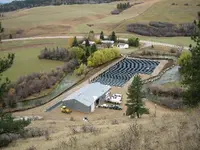
- Big Springs Trout HatcheryLewistown · Trout hatcheryMontana's largest coldwater trout hatchery sits at the head of Big Spring, seven miles from Lewistown, where a fifth-grader's creek samples once led investigators to its raceway paint.
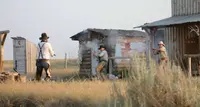
- Central Montana MuseumLewistown · MuseumThe museum is administered by the Central Montana Historical Association, a non-profit group. Our mission is to collect, preserve and exhibit artifacts and material items which depict the cultural aspects of Central Montana, beginning with the first inhabitants of the area.
- Charlie Russell Chew Choo Dinner TrainLewistown · Dinner trainAn excursion dinner train out of Lewistown, Montana, running 56 miles round trip on the old Milwaukee Road to Denton, across three high trestles in 1950s Budd cars.
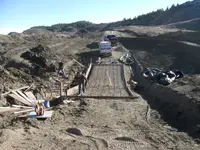
- Missouri Breaks Back Country BywayLewistown · National back country bywayThe Missouri Breaks National Back Country Byway traverses one of the most geologically unique and historically significant areas in Montana. The Wild and Scenic River from Fort Benton downstream to the James Kipp Recreation Area is the foremost component of the Lewis & Clark National Historic Trail.
The Calendar
History
Reed’s Fort and Camp Lewis on the Carroll Trail
The 1911 Mackey Building sits directly over Big Spring Creek, and at the Montana Tavern, which opened after Prohibition, patrons can still look at Spring Creek through an opening in the floor.6 Lewistown has kept growing slowly and serves as a regional commercial, educational, social, and transportation center in central Montana.7
The state highway marker says that in 1874, after the Diamond R. Transportation Company established the Carroll Trail, Alonzo Reed and John Bowles opened a trading post in the area.3 At about the same time, the U.S. Army built Camp Lewis, named for Major William Lewis, and in summer its infantry and cavalry companies protected travelers on the Carroll Trail.3 The 1939 Federal Writers’ Project guide says the place was first called Reed’s Fort, for Maj. A. S. Reed, who opened the first post office in 1881, while a fairgrounds nomination dates the trading post to 1873.2,4 In 1879, Metis families of French and Chippewa-Cree descent, among them Francis A. Janeaux and Paul Morase, homesteaded near Camp Lewis, and many street names remember them.1 According to the 1939 guide, the name was changed at incorporation in 1899 to honor a Major Lewis, who established Fort Lewis in 1876, but the town’s National Register inventory says the name was likely derived from the army post.2,5
Cattle, Sheep, and the Fight of July 4, 1884
Open range cattle ranching, nearby gold discoveries, and the growing sheep industry soon made Lewistown a regional supply center.1 Francis Janeaux, a merchant, fell into debt to his supplier, T. C. Power, and lost his buildings, merchandise, and some lots.8 The fairgrounds nomination says Janeaux secured a post office for his village in 1884, and the inventory says a man named Erickson became Lewistown’s first postmaster on March 10, 1884.4,5
The 1939 guide takes a story from the Journal of Granville Stuart: at a time of large-scale rustling, on July 4, 1884, two suspected ringleaders, Edward (Longhair) Owen and Charles (Rattlesnake Jake) Fallon, rode into town.2 They lost most of their money on a horse race, got very drunk, beat up one citizen, and began shooting up the town, and local men with Winchesters took positions in the stores and saloons along the single street.2 Rattlesnake Jake was hit nine times and Longhair eleven, and the two made their last stand in front of an itinerant photographer’s tent; he photographed the bodies where they fell and made money from the pictures.2 Fergus County was created in 1885 with Lewistown as its seat, and after several failed attempts the town was incorporated in August 1899 with a population of 1096.1,5
The Jawbone and the Homestead Boom
The first train arrived in October 1903 on the Montana Railroad, which was called the Jawbone; legend has it that the name came from how much its builder, Richard Harlow, talked up the line.9 Good weather and publicity from the railroad and the government drew thousands of homesteaders, and Lewistown grew from 1,100 people in 1900 to 6,000 in 1920.7 The Great Northern finished a branch line from Moccasin on November 20, 1912, and the Milwaukee built its Lewistown depot in 1913.9 All the building brought a sizable community of Croatian craftsmen, who quarried, cut, and transported the stone themselves, and the Carnegie Library nomination says they built most of Lewistown’s early stone buildings from 1899 to 1913.10
Rain had been plentiful in the decade after 1909, but the homestead bust came in the late teens, along with what the inventory calls the worst drought in Montana’s history, in 1919.5,7 Through the drought and the depression, Joe Alweis of The Hub clothing store told customers who could not afford clothes to “just pay the freight,” and his motto is repeated on the sidewalk outside.11 In 1939 the Federal Writers’ Project guide counted 5,358 people and called the town the capital of the agricultural interests of the Judith Basin, with mining in the mountains to the north and drilling in the Cat Creek oil field also bringing money in.2
Flying Fortresses over Main Street
In 1942 the Army Air Corps set up a B-17 Flying Fortress training base west of town, and on October 28, 1942, the first bombers roared over Main Street with their bomb bays open, buzzed the treetops, and landed.12 Nearly 1,000 GIs trained there, and on Wednesdays young women from town, who called themselves the “bomba-dears,” rode buses to the base for dances.12,13 The field was declared surplus in 1944 and has been the municipal airport ever since; one National Park Service page calls its Norden bombsight storage shelter the only known identifiable example left in the United States, while another says it is one of a few.12,14
Sandstone Blocks and 150 Feet of Track
The Central Business Historic District has 81 buildings, among them the Bank of Fergus Co., Lewistown’s first bank, built of sandstone and brick in 1904 to plans by Kent and Bell, designers of the Montana State Capitol.5,8 The Courthouse Historic District, which reflects the town’s growth as a governmental and business center, holds C. E. Bell’s 1904 stone jail, the 1905 Carnegie library, and the 1907 brick Fergus County Courthouse, and the Silk Stocking district has seven large houses built between 1904 and 1919.1,15 Passenger trains stopped running in 1955 on the Milwaukee and in 1966 on the Great Northern line, the railroad era in Lewistown ended in 2003, and 150 feet of track remain as a reminder.9
Within 30 Miles
Measured in a straight line from the town, nearest first.
All the towns of Montana. More of Montana: Fairs & Rodeos, Town Festivals, and Scenic Drives.
Sources
- Lewistown Courthouse Historic District historicmt.org/items/show/340
- Montana: A State Guide Book (1939), p. 254 archive.org/details/montanastateguid00federich/page/254
- Lewistown (historical marker) hmdb.org/m.asp?m=143336
- National Register nomination, Draft Horse Barn. Fergus County Fairgrounds npgallery.nps.gov/GetAsset/c0202544-bfea-4060-b974-56456892c7da
- National Register of Historic Places Inventory-Nomination ... mhs.mt.gov/Shpo/docs/MPDs/MT_FergusCounty_LewistownMPD.pdf
- Mackey Building (Montana Tavern) (historical marker) hmdb.org/m.asp?m=143360
- Lewistown Central Business Historic District historicmt.org/items/show/345
- Lewistown Central Business Historic District historicmt.org/tours/show/27
- The History of Central Montana Railroads (historical marker) hmdb.org/m.asp?m=143508
- National Register nomination, Lewistown Carnegie Library npgallery.nps.gov/NRHP/GetAsset/c07e4ce2-2a82-40f7-b20f-bd618096823d
- The Hub (historical marker) hmdb.org/m.asp?m=143363
- Lewistown, Montana (U.S. National Park Service) nps.gov/places/lewistown-montana.htm
- Recreation Building: Lewistown Satellite Airfield Historic District historicmt.org/items/show/378?index=12&tour=28
- Lewistown Satellite Airfield Historic District (U.S. National Park Service) nps.gov/articles/lewistown-satellite-airfield-historic-district.htm
- Lewistown Silk Stocking Historic District historicmt.org/items/show/380