Big Springs Trout Hatchery
Lewistown, Fergus County, Montana. Trout hatchery.
Details

- Where
- Lewistown, Fergus County, MT. No street address stated. Directions
- When
- Monday-Friday 8am-4:30pm.
- Season
- Year-round (FWP lists Open 2010-01-01 to 2010-12-31).
- Getting there
- From Lewistown, go south on 1st Avenue South, which turns into Upper Spring Creek Road (County Road 238) as it leaves town; drive 5 miles, then turn right onto Fish Hatchery Road (County Road 466); drive 2 miles to the signs for the upper and lower units.
- Fees
- No Site Fees.
- Access
- Employees only on outside raceways, limited indoor access; no animals on raceways or in buildings; discharge of weapons prohibited year round; no site fees.
- Website
- myfwp.mt.gov
- Managed by
- Montana Fish, Wildlife & Parks.
- Established
- 1922.
- Coordinates
- 47.00214, -109.34347.
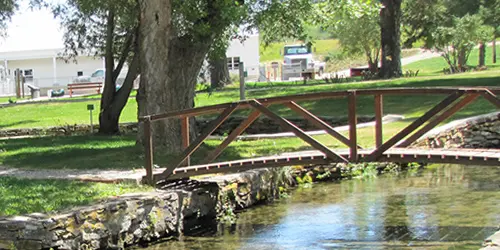
In the city park beside the hatchery, near the place where the spring leaves the ground, a circular display pool holds large trout. Visitors buy a handful of fish food and throw it to them. The City of Lewistown keeps the park, which has a picnic area, shelters, restrooms, volleyball and baseball fields, and trails that follow the creek as it starts toward town. Deer, small mammals and a variety of birds use the grounds. Rock-walled ponds and bridges stand among willows planted around the spring.
The spring and the hatchery beside it
Big Spring rises from the Madison limestone in the foothills of the Big Snowy Mountains. Montana Outdoors, the Fish, Wildlife & Parks magazine, counts it among the largest natural springs in the state, flowing at 50,000 gallons per minute at a near-constant temperature of around 52 degrees. A covered well collects part of the flow, and that water is piped straight into Lewistown homes. The rest becomes Big Spring Creek. The fly fisher Vern Field described the creek as running northwest 30 miles, mostly between the Big Snowy and Judith mountains, until it enters the Judith River west of Brooks.
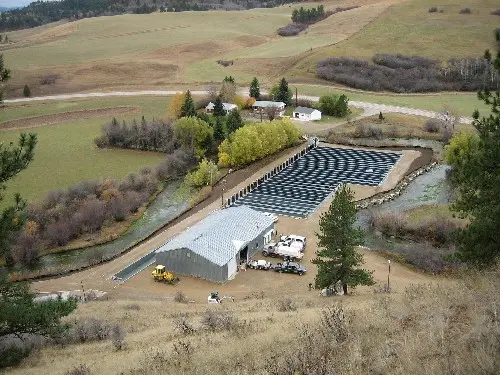
The hatchery stands at the source, seven miles southeast of Lewistown on 23.78 acres. Montana Fish, Wildlife & Parks operates it and calls it Big Springs, in the plural. The spring itself is Big Spring.
The sources differ on how close a visitor may come. FWP lists weekday hours of 8 a.m. to 4:30 p.m., keeps the outside raceways to employees only, and allows limited access indoors. The Enjoy Lewistown visitor listing describes grounds open every day from dawn to dusk, where the public can look at fish in the raceways but should not feed or bother them. Both agree that no animals are allowed on the raceways or in the buildings.
Two units and the fish they raise
The original hatchery is now called the Upper Unit. It has an egg incubation room and indoor raceways, where fish are raised to about two inches before they move to outside raceways at the Upper or Lower Unit. The Lower Unit, half a mile up the road, has 30 outside raceways. Most eggs arrive from other hatcheries in Montana and Wyoming. One strain of rainbow trout is spawned each spring from wild fish at Holter Reservoir. The hatchery raises five strains of rainbow trout along with brown trout, kokanee salmon and Chinook salmon, and it stocks fish from 2 to 12 inches long.
The figures vary by source. FWP says the hatchery can produce 160,000 pounds of fish a year for about 100 waters. Enjoy Lewistown gives more than 130,000 pounds. Montana Outdoors, writing in 2015, counted up to two million fingerlings and young trout planted in more than 50 waters, among them Canyon Ferry Reservoir, Fort Peck Reservoir and community fishing ponds. The fish go to lakes and reservoirs. None are stocked in Big Spring Creek or in any other stream or river.
A $1,200 hatchery and its additions
The Montana History Portal dates the start to 1922, when the Lewistown Rod and Gun Club raised $1,200 to build a hatchery along Big Spring Creek. FWP and Enjoy Lewistown credit the City of Lewistown and the club together. The accounts also differ on the stonework. Enjoy Lewistown places the raceways, rock-walled bridges, ponds and willows in the original construction. FWP attributes the rock-walled ponds and bridges, and the willow plantings, to Works Progress Administration crews during the New Deal of the 1930s.
Inside and outside raceways, houses and garages were added over the years. In 1959 the Montana Fish and Game Department built the Lower Unit. At first it drew water from the creek, which ran muddy after rain and floods. In the early 1970s a canal and pipe system let it draw directly from the spring. In the 1990s, after whirling disease was discovered in Montana, the hatchery enclosed its water supplies from Big Springs.
Big trout below the culverts
Vern Field, a retired Lewistown teacher, wrote in Fly Fisherman in 2011 about a story that once circulated on the creek: double-digit trout were being caught below the hatchery’s culvert tubes. During summer, hatchery employees scrubbed the raceways every morning. Small injured and dying rainbows, which Field called normal hatchery mortality, washed into the stream. Large trout waited under the brush on the far bank near the outflow and grew huge on them.
Field drove the seven miles upstream late one morning and parked in the visitor area. He stood on a sod-covered culvert and cast a Platinum Blonde, a big streamer the writer Joe Brooks had given him. His first retrieves moved nothing. He cast ten feet farther upstream and let the fly sweep under the overhanging brush. On the third pull a large rainbow struck, leaped, jackknifed back and ran downstream for the thicker brush, and it broke his 2X leader. Field wrote that the hatchery area was also a haunt of Jack Pittman, a big-fish hunter and commercial fly tier. When Field asked him whether persistence and knowledge of the creek mattered in taking trophies, Pittman answered, “Oh yeah, you have to find the fish. Then you go visit them every day.”
A fifth-grader’s sediment samples
PCBs first appeared in the creek two miles upstream of Lewistown, at Brewery Flats. That floodplain had held a railroad roundhouse, a coal mine, an oil refinery and a brewing plant, and when FWP restored the stream’s meanders there, the streambed soils showed traces of PCBs. Don Skaar, chief of the Special Projects Bureau of FWP’s Fisheries Division, told Montana Outdoors that “nobody was really surprised.”
In 1997 Isaac Opper, a ten-year-old Lewistown fifth-grader, collected more than a dozen sediment samples along the creek for a science project and sent them to labs. Samples taken upstream of Brewery Flats showed spikes in PCB levels, though the levels there should have been lower. He reported the results to the Montana Department of Environmental Quality. Over the next several years DEQ investigators confirmed the finding, and the readings rose as they moved toward the spring. In 2003 a DEQ colleague phoned Skaar in Helena. Skaar recalled the call: “The good news is that we believe we know where the PCBs are coming from. The bad news is that the contamination appears to be emanating from FWP’s Big Springs Hatchery.”
Jack Boyce, the hatchery manager at the time, said, “We had no idea where the PCBs were coming from. We checked the fish food and it was clean. Then one of our guys Googled ‘PCBs’ and ‘paint’ on the Internet.” The source was the coating on the 30 raceways, the inside tanks, the floors and the walls. It had been supplied by Columbia Paint & Coatings, and it contained PCB ingredients made by Monsanto. The History Portal dates the paint to the 1960s and the finding to December 2003. As the paint cracked and chipped, some of it wore to fine dust, and that dust flushed into the creek whenever the raceways were emptied for cleaning.
The well that supplies Lewistown, covered by design, tested free of PCBs. People who ate fish from the creek, lived along it or worked at the hatchery gave blood samples for testing at labs of the Centers for Disease Control, and none showed elevated levels. As a precaution, FWP destroyed more than 700,000 fish held in tainted raceways, and fishing on the creek became catch-and-release only. Skaar said, “We had lost public trust. We knew the only way to win it back was by admitting the mistake and fixing it.” A citizen advisory committee reviewed the cleanup reports. Lyle Gorman chaired it on behalf of the creekside landowners, and David Stuver of Trout Unlimited’s Snowy Mountain Chapter represented sportsmen. More than 200 streamside landowners sued. Monsanto paid them $5 million, the state $650,000 and Columbia Paint & Coatings $300,000. A second settlement brought another $5 million from Monsanto to the state.
The History Portal records that until 2004 the hatchery produced two to three million fish a year, and that the cleanup begun that year curtailed production. Over three summers an eight-person crew vacuumed more than 1,500 tons of sediment from the three miles of creek below the hatchery. The sludge was drained in settling ponds and trucked to a landfill near Great Falls, and about 95 percent of the PCBs in that stretch were removed. At the hatchery, FWP stripped all the paint, replaced the old raceways and installed new tanks. Jim Drissell, a later manager, said the hatchery “is now a far more efficient fish-rearing facility.” Trevor Selch, the FWP fisheries pollution biologist, found that “aquatic organism diversity and total abundance were greater than before the cleanup.” Settlement money helped build a 20-mile recreation trail and six fishing access sites along the creek.
Richard Opper, Isaac’s father, counts Big Spring among his favorite trout streams. “It’s Lewistown’s pride and joy,” he said in 2015. “And today there’s a self-sustaining wild trout population thriving in it.”
Notable Events
- 1922The City of Lewistown and local Rod & Gun Club helped begin construction; raceways, rock-walled bridges, ponds and willow plantings followed. enjoylewistown.com
- 1930sWorks Progress Administration crews built rock-walled ponds and bridges and planted willow trees around the hatchery and spring. myfwp.mt.gov
- 1959The Montana Fish and Game Department built the Lower Hatchery. mtmemory.org
- 1959An additional hatchery site a half-mile away was developed with 30 outdoor raceways. myfwp.mt.gov
- 1970sA canal and pipe system let the Lower Unit draw directly from Big Springs, eliminating muddy-water problems caused by rain and floods. myfwp.mt.gov
- 1990sAfter whirling disease was discovered in Montana, the hatchery improved and enclosed its Big Springs water supplies to prevent contamination. myfwp.mt.gov
- 1997Lewistown fifth-grader Isaac Opper collected more than a dozen sediment samples along Big Spring Creek for a science project and sent them to labs, where samples from upstream of Brewery Flats showed spikes in PCB levels. fwp.mt.gov
- 2003A DEQ colleague phoned FWP's Don Skaar to report that the contamination appearing in Big Spring Creek appeared to be emanating from FWP's Big Springs Hatchery. fwp.mt.gov
- 2003The department found high PCB levels in soils downstream, dispersed from raceway paint used in the 1960s. mtmemory.org
- 2004A large cleanup of Big Spring Creek began and curtailed hatchery fish production. mtmemory.org
People
- Don Skaar, Chief of the Special Projects Bureau of the Montana Fish, Wildlife & Parks Fisheries Division, who took charge of the hatchery's PCB cleanup (2003).
- Jack Boyce, The hatchery's manager when the PCB contamination was traced to the facility, who says FWP crews had no idea they were applying a hazardous substance to the raceways (retired in 2006).
- Jim Drissell, Current hatchery manager after FWP removed all paint, replaced old raceways and installed new tanks, who says the hatchery is PCB free and a far more efficient fish-rearing facility.
- Lyle Gorman, A respected member of the community who represented creekside landowners as chair of the citizen advisory committee FWP formed to review the hatchery cleanup reports.