Central Montana Fair
Lewistown, Fergus County, Montana. Fairground; the last week in July.
Details

- Where
- 153 Fairgrounds Rd, Lewistown, MT. Directions
- When
- 2027 Fair - July 28-31, 2027.
- Fees
- Pioneer Day (70+) - free with ticket. Military (w/ Military ID) - free with ticket.
- Hours
- 11:00am - Central Montana Fair opens.
- Walk-in or reserve
- Tickets sold online directly at cmtfair.com; the fair warns against third-party resellers.
- Phone
- (406) 535-8841
- Website
- cmtfair.com
- Managed by
- Fergus County Event Center.
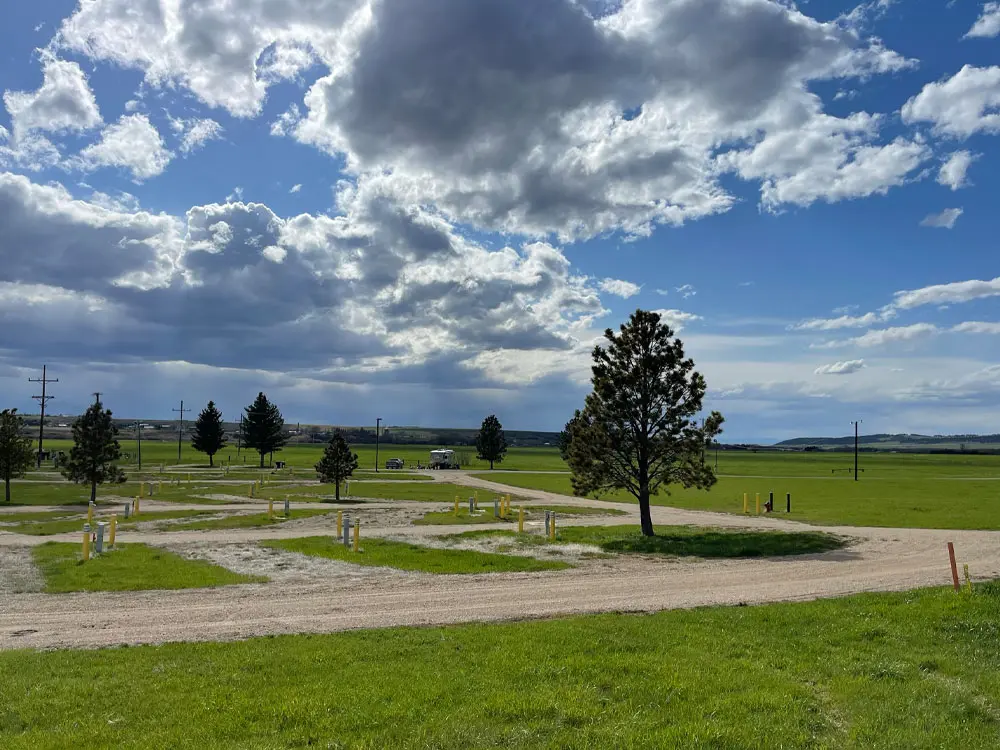
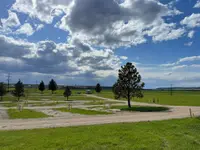
The fairgrounds lie about a mile and a half north of Lewistown on the west side of U.S. Highway 191: about 50 acres at an elevation of about 3,900 feet, northeast of where Breed Creek meets Big Spring Creek. A row of evenly spaced green ash trees and a low concrete fence run along the highway, and the foothills of the Judith Mountains begin to rise immediately to the east. Fergus County runs the Central Montana Fair through the Fergus County Event Center. The Enjoy Lewistown listing puts the fair in the last full week in July. The fair’s own page says the last week in July.
Four days on the grounds
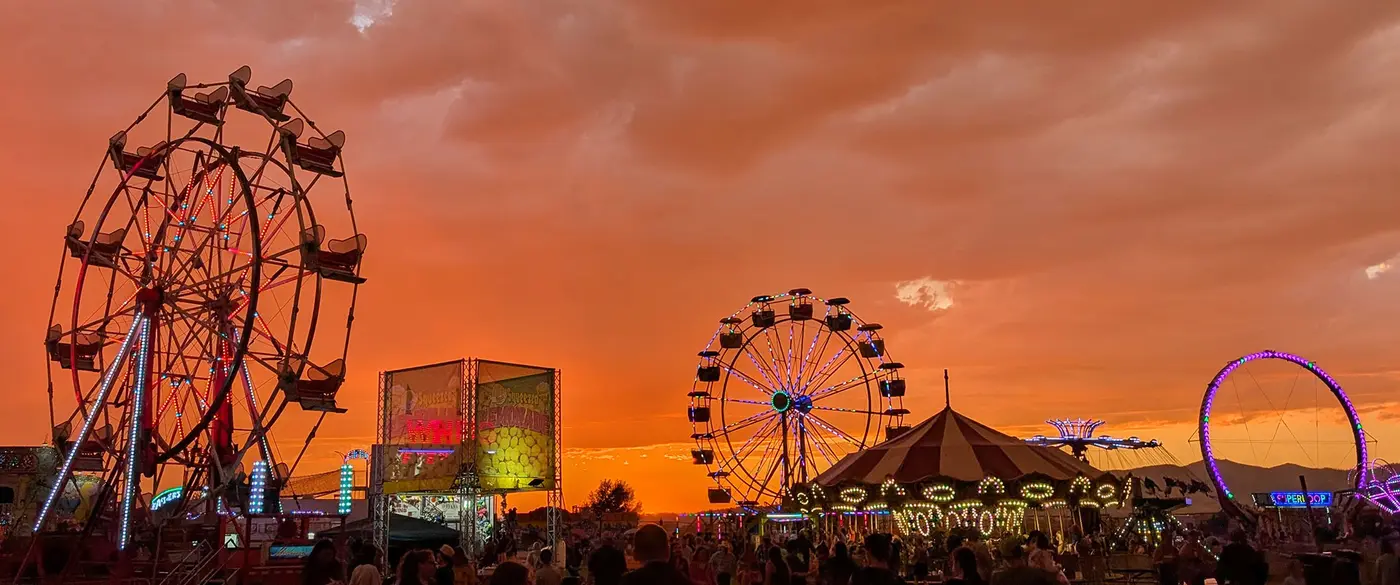
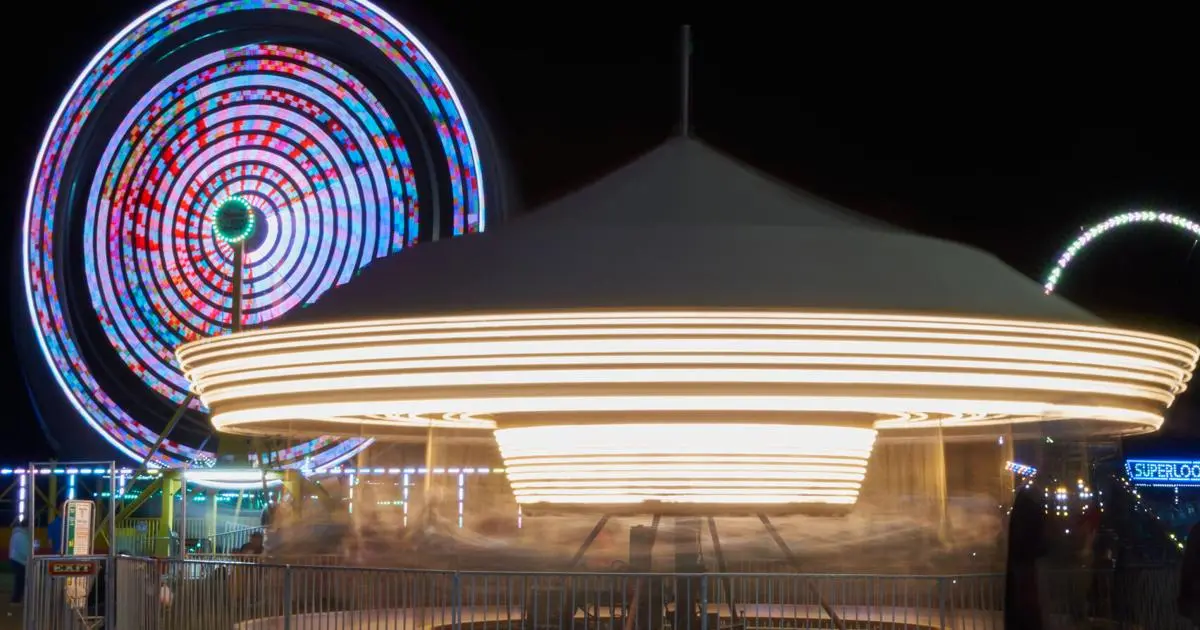
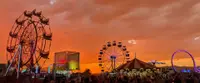
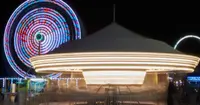
In 2026 the gates opened at 11 a.m. on Wednesday, July 22. The carnival came on at noon each day and ran until midnight. Scot Meader, the county’s Facilities and Maintenance Supervisor, counted approximately 16 to 18 rides on the Midway, “a mixture of bigger rides and kid rides.” A Ferris wheel stood against the sunset on the Friday. Strolling acts worked the crowd all day. Mirror Man, in Meader’s words, is “a walk-around attraction, so he’ll cruise all around.” Messy Mania is “like a kid’s fun zone,” and Young Guns, Surprise! and a Captain Jack Sparrow went about the grounds as well. The magician Sean Watson performed twice daily on the Fergus County Federal Credit Union stage on the Midway. Aiden Bailey, a local singer-songwriter, took the same stage on Thursday night and again on Friday afternoon.
The food runs to cotton candy, corn dogs, pies, burgers and hot dogs. Vendor booths line the area beneath the grandstands, and the 4-H runs a food booth of its own. The beer garden is operated by the Central Montana Jaycees, and the Enjoy Lewistown listing calls it “a favorite gathering spot.”
The 4-H program begins well before the carnival arrives. In 2026 interview judging opened at the Trade Center on July 14. A pocket pet and cat show, a dog show in the gazebo area behind the Ag Building, and a rabbit agility show in the Small Animal Barn followed. On the Wednesday the fair opened, the swine show began at 8 a.m. in the Pavilion, with the sheep and goat shows that afternoon. The beef and dairy shows were held Thursday, the same morning a fair parade went down Main Street. On Friday the program moved to the Pavilion Sale Ring: pig kissing at 3:15 p.m., then awards to the year’s Fergus and Petroleum county 4-H graduates, then the junior livestock sale at 4 p.m. Processors came for the sold animals at 5 a.m. Saturday.
Rodeo, a country singer and a derby
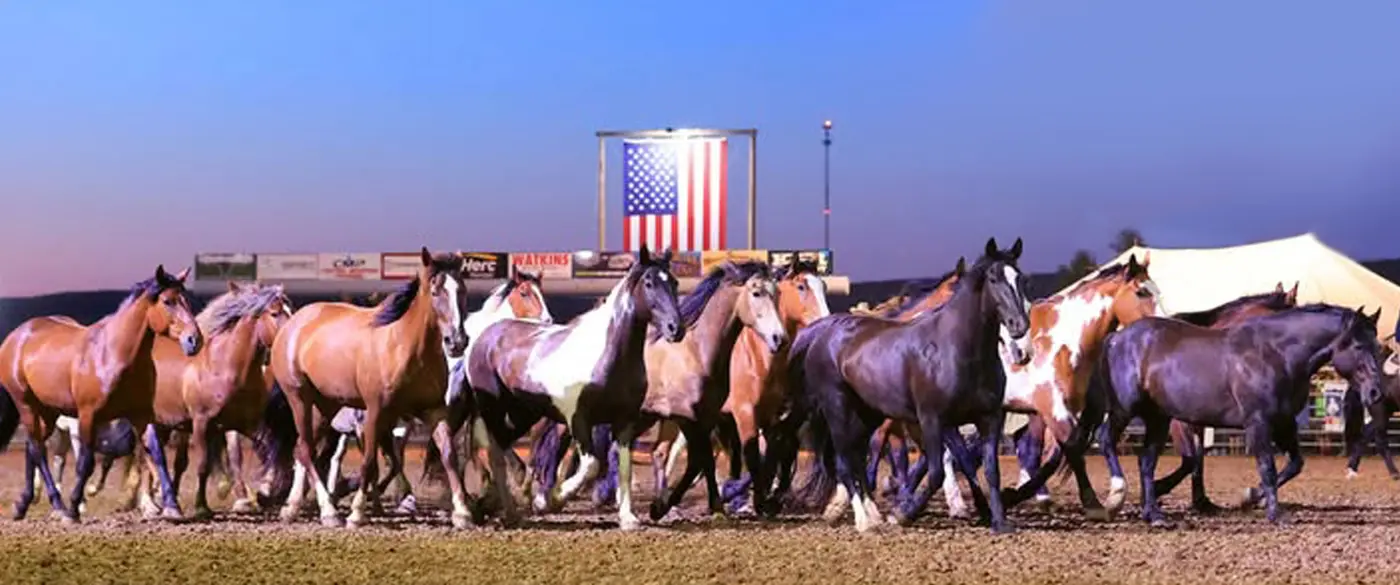
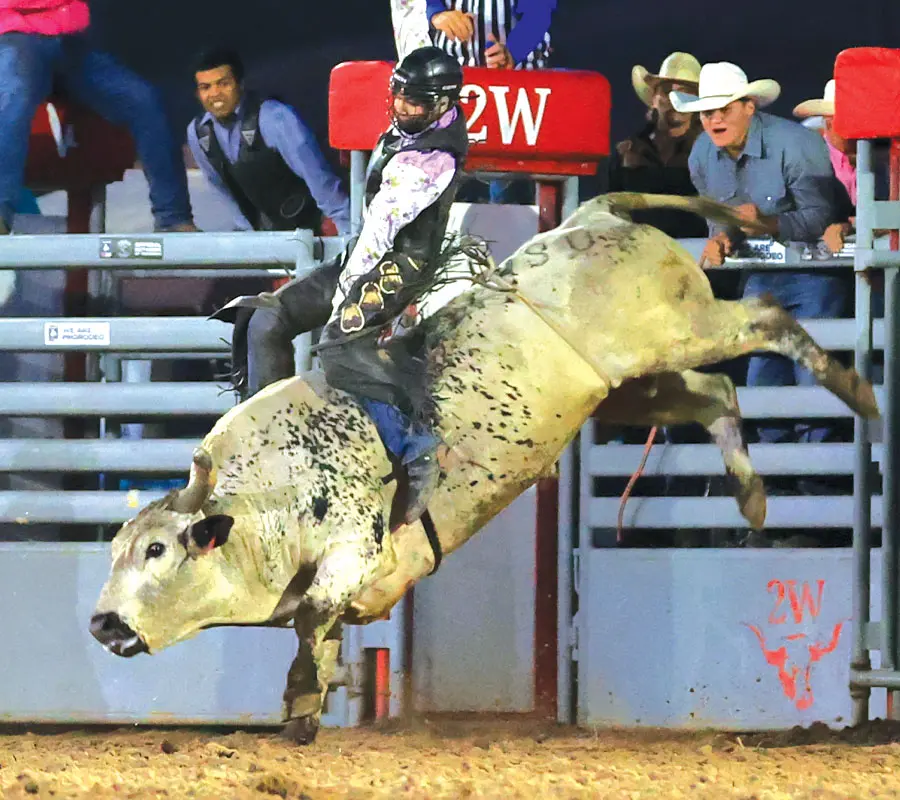
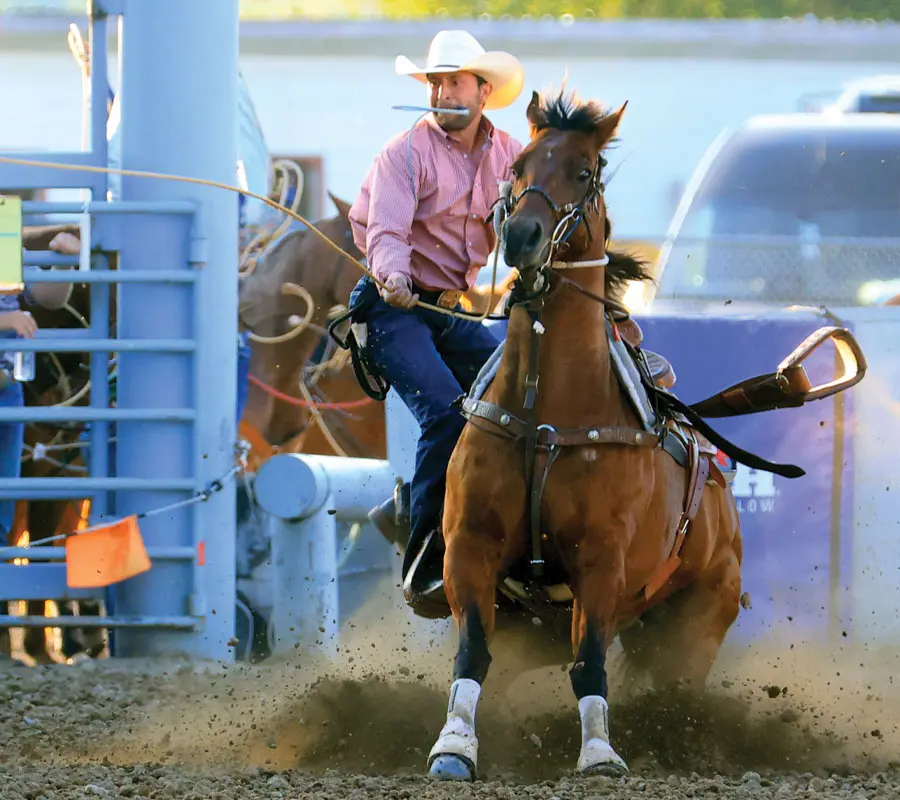
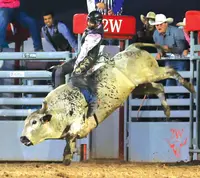
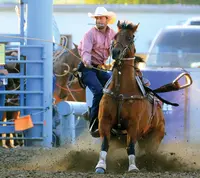
The PRCA rodeo fills the Grandstand Arena at 7 p.m. on Wednesday and Thursday. Its slack runs that Wednesday morning with free admission. Wednesday is Military & Pioneer Night, when anyone 70 or older and current and prior military get in free with a complimentary ticket. Both performances include the Shari Gardner Memorial PRCA Breakaway Roping and mutton bustin’. The 2026 Wednesday show added Tough Enough to Wear Pink, and the second night closed with a wild horse race. More than 300 competitors entered across the two nights. In 2026 the fair set tables on the arena floor. On night two, two bucking horses stopped just shy of the barrier in front of them. “I ran into one couple who said they won’t sit in the grandstands anymore,” Meader said.
The Friday night show changes with the Fair Board’s taste. “Last year they did rock and this year they’re doing country,” Meader said in 2026, when Chris Cagle played, with the Copper Mountain Band opening and then playing an after-party in the arena. The News-Argus reported that in the moments when town quieted, his songs could be heard blocks from the fairgrounds.
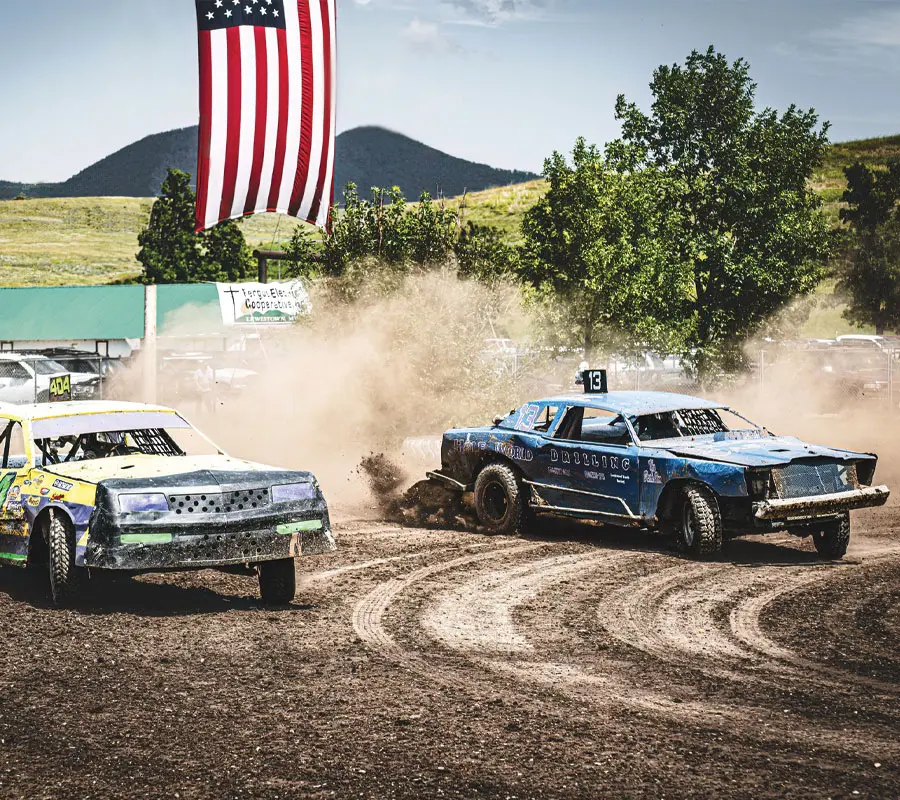
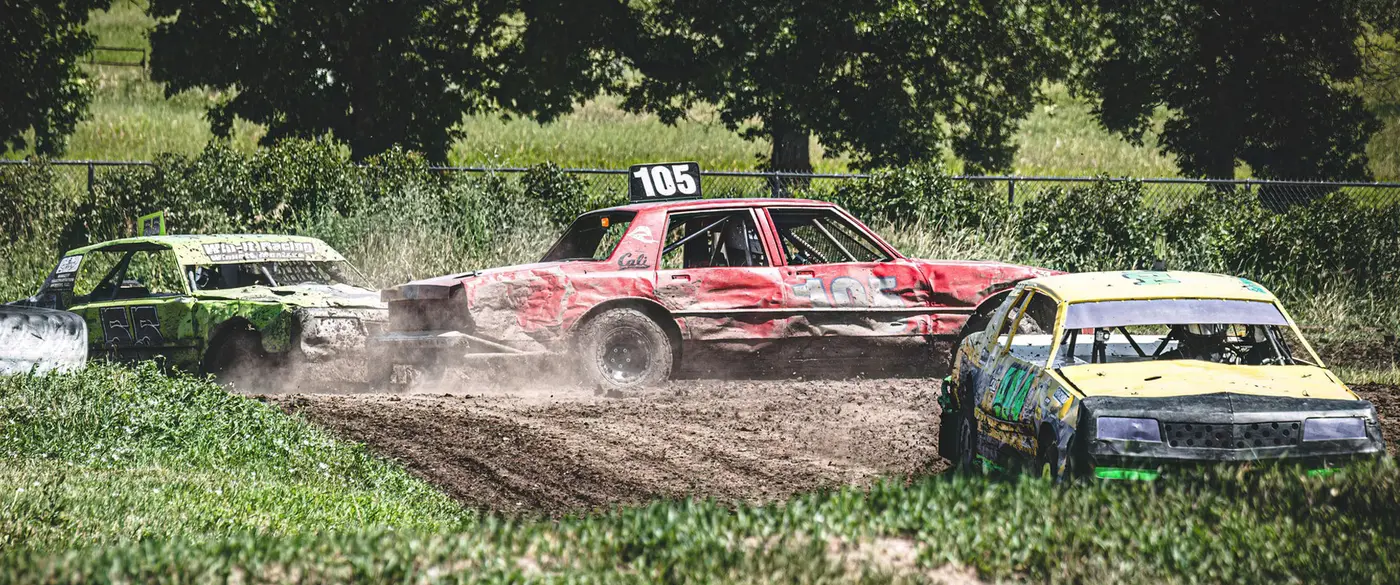
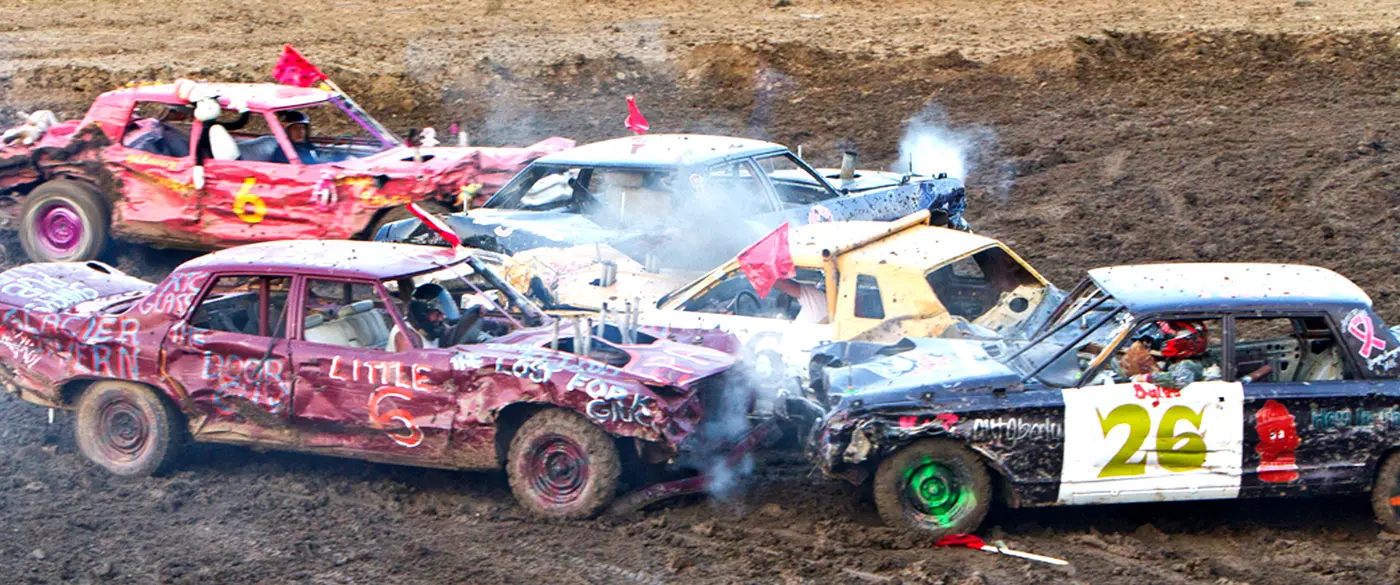
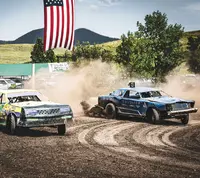
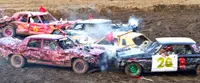
Saturday is Motor Madness. BGM races start at noon, and in 2026 forty-two cars took the dirt track. The demolition derby begins at 6:30 p.m., and Meader called it “kind of the finale of the fair.” Thirty-four cars entered in 2026. Katie Awbery, president of the Lewistown Derby Club, said the full weld class was short because the cars are “getting harder to find,” and sellers want “anywhere from $3,000 to $3,500 for them, and then it costs anywhere from $1,200 to $2,000 to build them.” The stands stayed full through the pitman race, run 10 minutes after the final heat. Meader put the fair’s attendance at around 22,000 to 24,000. The Thursday rodeo and the derby sold out.
New lights went up over the arena for 2026, after four years of work with the County Commissioners and Fair Board. “The light poles for the Grandstands Arena are approximately 60 feet, and we updated the lights to a bigger LED,” Meader said. The fair’s site gives the 2027 fair as July 28 through 31, with the open horse shows the weekend before. The News-Argus reported a span of July 21 to 31 for 2027, with the carnival opening July 28.
A kite-shaped track and a county board
A chronological list held in the Central Montana Historical Documents collection at the Lewistown Public Library dates the Lewistown fairs to 1891. That year began with a group of businessmen and boosters. On May 27, 1891, they filed articles of incorporation for the Fergus County Agricultural, Mineral and Stock Association, formed to acquire land and improve it for exhibitions and fairs. D. M. Crowley, a rancher and horse breeder and the association’s largest stockholder, provided the site. The association first built a kite-shaped racetrack, which was soon made into an ordinary oval. Money was short. In 1892 the association doubled its capital stock, and that was still not enough. Its National Register nomination puts the first Fergus County Fair in 1893, with horse racing at its center.
There was no fair in 1901, because the association could not find enough attractions or exhibitors to justify the expense. In 1902 the fair came back with racing, exhibits, bronc riding and balloon ascensions by an aeronaut billed as Professor Baldwin. Storms cancelled at least parts of the 1908 and 1909 fairs. The 1910 fair was cancelled, which was disastrous for the association, even as large grandstands went up beside the track that year. In February 1913 the association reorganized and put the fairgrounds up as collateral for its debts. Its stockholders drafted a resolution in November 1915 to transfer the grounds to the county, and the commissioners approved it almost a year later. In December 1916 the Fergus County Democrat reported that a fair was assured for the following year. The new County Fair Board had five members: Amos Snyder, Ben Hill, Oden Romanstadt, Thomas Nicholson, and C. L. Wentworth, who had State Fair connections.
Sales rings, hiatuses and new grandstands
The board built in 1917. It put up a two-story Agriculture Hall of structural clay tile, designed by the local architect O. F. Wasmansdorff. The 1918 fair was given over entirely to livestock and agriculture because of the war. A poultry building followed in 1922, and in 1923 the trick rider Doris Ranger performed. When the Rocky Mountain Association of Fairs was founded in 1926, its first meeting was held in Lewistown and Larry H. Fitton, the Fergus County Treasurer, became its first president. Purebred livestock sales returned in 1927 and were held during the fair to draw a crowd. The local stockman Ed Cooper led that purebred focus. A sheep barn went up that year, a spring sale was added in 1928, and a 4-H livestock pavilion and race horse corrals were built in 1930.
The fair was called off from 1933 to 1935, at the height of the Great Depression. W. C. McLaughlin revived the livestock sales in 1935, and the fair returned on a smaller scale in 1936. A Civilian Conservation Corps camp was set up on the grounds in 1938, and an earlier stone fence was reputedly built by the CCC. In 1939 WPA crews put up light posts and repaired the cattle and horse barns. The fair stopped again from 1942 to 1945 and resumed in 1946. Commercial livestock sales left the grounds in 1949, and the following year the commission opened a facility across the highway. The Central Montana Stockyards, dated 1950, stand on the rolling foothills east of the road.
A western horse show with classes for men, women and children began in 1953, and a draft horse show joined the program in 1978. Kitty Wells played the grandstand in 1972, Barbara Mandrell in 1977, Don Williams in 1979, Patty Loveless in 1989, Dan Seals in 1990, and Holly Dunn and Tanya Tucker in 1992. On September 15, 1980, rural residents raised their concerns about the fair’s direction at a contentious public meeting in Lewistown. The Trade Center was ready before the 1981 fair. In 1991 the old grandstands were torn down and buried in the track infield, and new grandstands and an enlarged rodeo arena were done in time for the 1992 fair. The 1917 Cattle Barn and Office-Restaurant came down in 1995 for an addition to the Livestock Exhibition Building. In 1999 the board planned to demolish Agriculture Hall and met passionate resistance. Emma Light, longtime director of the Floral Department, lobbied to save it, and Shirley Barrick, the County Superintendent of Schools, organized a petition. The hall still stands. Somewhere along the way the Fergus County Fair took a new name meant to reflect its reach across the region: the Central Montana Fair.
The barn by the north gate
Of the fair’s early buildings, only the Draft Horse Barn and Agriculture Hall, both of 1917, and the 4-H Livestock Building of 1930 remain where they were built. The barn stands just inside the north entrance, facing Fairgrounds Drive. The Fergus County Sales Corporation built it that year as a horse barn, along with a cattle barn and a small office. Link & Haire designed them, Earl I. Bryan drew the plans, and the contractor was John E. Plank, a local carpenter and livestock man. The mason was John Valach, born October 23, 1892, in Rostin, Moravia, who later became one of Central Montana’s most prominent builders. The first sale was held July 17, 1917.
The barn measures 100 by 56 feet. Its walls are variegated red structural clay tile made by the Lewistown Brick & Tile Company, a material the nomination calls rare on Montana’s ranches and fairgrounds. On the south front a semicircular parapet hides the gable roof and frames a fanlight, with heavy pilasters at the corners. Sliding wood doors are braced in a “double British brace” pattern and open onto double alleys between four rows of stalls. The floor is dirt, and two metal ventilators rise from the ridge. The nomination compares the front to the false fronts of early western storefronts, built to impress fairgoers and livestock buyers alike. Since 1981 the barn has housed draft horse entries.
In early 2010 a Save the Barns Committee formed under Jim Dullenty. The nomination puts the restoration at four phases between 2011 and 2013, and dates the main rehabilitation to 2012 and 2013 at a cost of $200,000. The crews stabilized the masonry, restored the fanlight, and repaired the sliding doors and the original windows. Ken Sievert, a Great Falls preservation architect, was on the team. The committee cut the ribbon on October 3, 2013, and received a Preservation Excellence Award from the Montana Preservation Alliance in 2014. The barn’s National Register nomination was received on October 30, 2017. One of the local masons on the rehabilitation was Robert Valach, grandson of one of the barn’s original builders.
Notable Events
- 1891The original kite-shaped racetrack was soon converted into a typical oval course. npgallery.nps.gov
- 1892Financial difficulties forced the association to double capital stock, but it was still insufficient. npgallery.nps.gov
- 1893When Fergus County did finally host its first fair in 1893, horse racing remained an integral component. npgallery.nps.gov
- 1901The association could not secure enough attractions or exhibitors to justify the expense. npgallery.nps.gov
- 1902The fair returned with racing, exhibits, bronc riding and balloon ascensions. npgallery.nps.gov
- 1908Storms cancelled at least portions of the fair. npgallery.nps.gov
- 1910Fair cancellation was disastrous for the association, and the next two fairs were only marginally better. npgallery.nps.gov
- 1910Racetrack development included construction of large grandstands. npgallery.nps.gov
- 1913The association reorganized in February 1913, putting up the fairgrounds as collateral for its debts. npgallery.nps.gov
- 1915Stockholders drafted a transfer resolution; county commissioners approved almost a year later. npgallery.nps.gov
- 1916By December of 1916, the Fergus County Democrat could happily report that a fair was assured for the following year; the new County Fair Board was made up of five county residents. npgallery.nps.gov
- 1917The county fair board erected a two-story structural clay-tile Agriculture Hall. npgallery.nps.gov
- 1918The board devoted the wartime fair entirely to livestock and agriculture. npgallery.nps.gov
- 1922A poultry building was constructed. npgallery.nps.gov
- 1926The proliferation of fairs led to the creation of the Rocky Mountain Association of Fairs (RMAF) in 1926; the Central Montana Fair figured prominently in its founding, with Lewistown hosting its first meeting and Larry H. Fitton serving as its first president. npgallery.nps.gov
- 1927The first sale was held with the fair to assure strong attendance. npgallery.nps.gov
- 1927A sheep barn was constructed. npgallery.nps.gov
- 1928The fair livestock sale expanded to include a spring sale. npgallery.nps.gov
- 1930A 4-H livestock pavilion and race horse corrals were constructed. npgallery.nps.gov
- 1933The fair was called off at the height of the Great Depression. npgallery.nps.gov
- 1935W. C. McLaughlin revived livestock sales at the fairgrounds. npgallery.nps.gov
- 1936The fair resumed after a three-year hiatus on a smaller scale. npgallery.nps.gov
- 1938A Civilian Conservation Corps camp was established at the fairgrounds. npgallery.nps.gov
- 1939WPA labor put up light posts and repaired cattle and horse barns. npgallery.nps.gov
- 1942The fair was called off during World War II. npgallery.nps.gov
- 1946The fair resumed following its wartime hiatus. npgallery.nps.gov
- 1949Commercial livestock sales ended at the fairgrounds; the commission opened a facility across the highway the following year. npgallery.nps.gov
- 1953The horse show focused on western riding with classes for men, women and children. npgallery.nps.gov
- 1962More stalls accommodated growing 4-H horse entries. npgallery.nps.gov
- 1978A draft horse show joined the fair program. npgallery.nps.gov
- 1980Rural residents raised concerns at a contentious public meeting in Lewistown. npgallery.nps.gov
- 1981The Draft Horse Barn was converted to house growing draft horse entries. npgallery.nps.gov
- 1981The Trade Center was ready for use ahead of the fair. npgallery.nps.gov
- 1984County commissioners accepted Don Bost's livestock building estimate. npgallery.nps.gov
- 1991Replacement construction began by demolishing the old grandstands and burying them in the track infield. npgallery.nps.gov
- 1992New grandstands and an enlarged rodeo arena were completed ahead of the fair. npgallery.nps.gov
- 1995The Cattle Barn and Office-Restaurant were removed for a Livestock Exhibition Building addition. npgallery.nps.gov
- 1999The board's plan to tear down Agriculture Hall met passionate resistance. npgallery.nps.gov
- 2010Preservation advocates formed a committee in response to the potential loss of historic barns. npgallery.nps.gov
- 2011The assembled team restored the barn in four phases. npgallery.nps.gov
- 2013The committee celebrated restoration with a ribbon-cutting ceremony. npgallery.nps.gov
- 2014The committee received the Preservation Excellence Award from the Montana Preservation Alliance. npgallery.nps.gov
- 2017The nomination for the Draft Horse Barn, Fergus County Fairgrounds was received 10/30/2017 and placed on the pending list 11/27/2017. npgallery.nps.gov
People
- Amos Snyder, First member of the new County Fair Board.
- Barbara Mandrell, Grandstand performer (1977).
- Ben Hill, First member of the new County Fair Board.
- C. L. Wentworth, First County Fair Board member with State Fair connections.
- C. W. Cooley, Cooley Chevrolet owner and longtime Fair Board member (1942, start of board service).
- Clarence Smith, Provided evening musical revues.
- D. M. Crowley, prominent local rancher and horse breeder who provided the fairgrounds site north of Lewistown and was the association's single largest stockholder.
- Dan Seals, Grandstand performer (1990).
- Don Bost, Submitted accepted livestock building estimate (July of 1984).
- Don Williams, Grandstand performer (1979).
- Doris Ranger, Trick-riding performer (1923).
- Ed Cooper, local stockman who led the Central Montana Fair's purebred livestock focus.
- Ed Vogl, Named as Trade Center architect and provider of preliminary livestock building plans.
- Emma Light, Longtime Floral Department director lobbying to save Agriculture Hall.
- Gene Vogl, Trade Center architect (May of 1980).
- George Eastman, Local architect of the grandstand.
- Hall Cement, Fair Board Secretary explaining wartime cancellation.
- Holly Dunn, Grandstand performer (1992).
- Jeff Tubb, General contractor of the grandstand.
- Jim Dullenty, Leader of the Save the Barns Committee.
- John E. Plank, local carpenter and livestock man, selected as the general contractor for the livestock barns.
- John Valach, mason on the livestock barns at the fairgrounds, later one of Central Montana's most prominent builders (born October 23, 1892 in Rostin, Moravia).
- Ken Sievert, Great Falls preservation architect on the barn rehabilitation team.
- Kitty Wells, Grandstand performer (1972).
- Larry H. Fitton, Fergus County Treasurer and first president of the Rocky Mountain Association of Fairs (first president at the RMAF's 1926 founding).
- Louis D. Blodgett, Lewistown Chamber secretary assisting the new Fair Board.
- O. F. Wasmansdorff, Local architect of Agriculture Hall.
- Oden Romanstadt, First member of the new County Fair Board.
- Patty Loveless, Grandstand performer (1989).
- Professor Baldwin, Aeronaut performing balloon ascensions (1902).
- Robert Valach, Local mason on the rehabilitation team; grandson of an original barn builder.
- Shirley Barrick, County Superintendent of Schools organizing a petition to save Agriculture Hall.
- Tanya Tucker, Grandstand performer (1992).
- Thomas Nicholson, First member of the new County Fair Board.
- W. C. McLaughlin, Revived livestock sales at the fairgrounds (1935).
- W. S. Devine, Lewistown designer of the swine barn.
Sources
- cmtfair.com
- cmtfair.com/entertainment/rodeo
- cmtfair.com/entertainment/night-show
- cmtfair.com/entertainment/motorsports
- cmtfair.com/entertainment/carnival
- lewistownnews.com/news/central-montana-fair-main-events-kick-off-wednesday/article_23cc7537-72ec-4146-b0cb-b8657bfd9c52.html
- lewistownnews.com/news/another-year-another-central-montana-fair/article_652c06a9-998c-4f4e-9b4e-d8019d36ead1.html
- cmtfair.com/contact
- cmtfair.com/images/2026.schedule-web.pdf
- fceventcenter.com
- facebook.com/CentralMontanaFair
- enjoylewistown.com/central-montana-fair
- rmaf.net/businessesPrint.aspx?c=28&co=2
- mtmemory.org/nodes/view/3851
- npgallery.nps.gov/AssetDetail/NRIS/100001895
- npgallery.nps.gov/GetAsset/c0202544-bfea-4060-b974-56456892c7da