Cripple Creek
Teller County, Colorado. County seat.
Cripple Creek, the Teller County seat west of Pikes Peak, was reduced to rubble by two fires in 1896 and rebuilt in brick.1,2
Details
- Name
- The Colorado Encyclopedia reports a legend that Levi Welty named the creek after a string of accidents and injuries there, but it thinks the Womack family more likely named it after Cripple Creek, Virginia.3
- County seat
- Cripple Creek has been the seat of Teller County since the county was formed out of El Paso County in March 1899.3
- Last checked
- October 6, 2026.
Point at a dot to see the place.Tap a dot to see the place. Road map of Cripple Creek.
In Cripple Creek
The Calendar
History
A County Seat Built in Brick
Cripple Creek stands in Teller County west of Pikes Peak and is the county seat, and the brick buildings put up after the 1896 fires still set the look of the town.1,2,4 Many of those buildings now hold casinos, and mining goes on at the Cripple Creek & Victor Gold Mine.4
The Broken Box Ranch and Womack’s Claim
In 1885 Horace Bennett, Julius Myers, and Alexander Houseman acquired hundreds of acres here for their Broken Box Ranch.3 The National Register nomination calls Robert Womack a young cowhand, and in 1886 he filed a gold claim in the area but found no investors, because Colorado was in the middle of a silver boom.3,5 In October 1890 he took ore samples to Colorado College to be assayed, people began to notice them, and by early 1891 prospectors were heading up to the Broken Box Ranch.3 On July 4, 1891, Winfield Scott Stratton staked the Independence on the slope of Battle Mountain, where the county’s history says his granite ledge assayed $380 to the ton.3,6 In the fall of 1891 a straggling settlement of tents and cabins grew up on the site, and through 1892 the towns of Fremont and Hayden Placer grew; Hayden Placer was soon renamed Cripple Creek, and the two merged under that name.3,5 That year the town was laid out around a cattle ranch and incorporated with about 500 residents.2,5 The Colorado Encyclopedia reports a legend that the homesteader Levi Welty named the creek after a string of accidents and injuries there, but it thinks the Womack family more likely named it after Cripple Creek, Virginia, which was not far from their former home in Kentucky.3 History Colorado’s account says the creek was named for its alleged habit of breaking the legs of grazing cattle that tried to cross it.7
Two Fires in April 1896
The big mines of the district were discovered and developed in 1893, and that year the town grew as a direct result of the repeal of the Sherman Silver Purchase Act, as former silver miners and investors sought new opportunities in gold.4,5 The Colorado Encyclopedia has the Florence & Cripple Creek Railroad arriving in 1894 and the Midland Terminal Railroad in 1895.3 The town had 10,000 people by 1896; for its height, the Federal Writers’ Project guide gives a population of 20,000 and the National Register nomination gives 25,000.4,5,8 Around 1 pm on April 25, 1896, fire broke out on the second floor of the Central Dance Hall on Myers Avenue.4 Rebuilding was well under way on April 29 when Frank Angel, head chef at the Portland Hotel, jostled a pan in the kitchen, and the second fire later set off 700 pounds of dynamite at a grocery store.4 The two fires did an estimated $3 million in damage, destroyed forty blocks of businesses and more than 1,000 houses, and left refugees in tents in the hills above town.4 The Federal Writers’ Project guide dates the fire to 1906 and says an overturned stove in a Myers Avenue hotel started it, while History Colorado’s register entry places the fires in the late 1880s.8,9 Residents rebuilt in brick, and the town decided to build a new City Hall and Central Fire Station that took two years to finance and finish, opening in 1898.4,10
Teller County and the Strikes
People in the district were tired of sending their mines’ tax revenue to Colorado Springs, so in March 1899 they broke from El Paso County to form Teller County with Cripple Creek as its seat, and the Teller County Courthouse opened in 1901.3,6 The Colorado Encyclopedia counts sixty-eight saloons, fifty-two stockbrokers, and forty-nine grocers in the town, while the Federal Writers’ Project guide lists 70 saloons, 91 lawyers, 41 assay offices, and one coroner at the beginning of the century.3,8 Strikes in 1894 and 1903 pitted the working-class miners against the mine owners; the WFM unions called the second strike in August 1903, and more than 200 union members were deported from Teller County.1,3,7
Melodrama, Casinos, and the Pit
The Federal Writers’ Project guide reported that not a building went up from 1914 to 1934, and that when a five-room house was built the news went out over the press wires.8 The same guide said that hundreds of buildings had been torn down for their lumber and that scores of houses had been moved to Manitou Springs and Colorado Springs.8 Mining revived briefly in the mid-1930s, and production reached $3.5 million in 1935.3 The federal government suspended gold mining during World War II, the Midland Terminal stopped running in 1949, and by 1950 the district had fewer than 2,000 people.3 In 1946 Wayne and Dorothy Mackin of Colorado Springs bought the empty Imperial Hotel, and in July 1948 they opened the Gold Bar Room Theater, a Victorian melodrama house, in its basement.3 The Mollie Kathleen Mine stopped mining in 1949 and began offering underground tours, and the Old Homestead, a parlor house that had closed in 1916, reopened in 1958 as a brothel museum.3,11 Cripple Creek was named a National Historic Landmark in 1961, Colorado voters approved limited-stakes gambling in 1990, and Bronco Billy’s and the Brass Ass were among the first casinos to open, in October 1991.2,3 In 1994 the Cripple Creek & Victor Gold Mine began large-scale pit operations, and its gold was used to re-gild the State Capitol dome during the restoration of the early 2010s.3
Within 30 Miles
Measured in a straight line from the town, nearest first.
- Victor Gold Rush DaysVictor · CommunityAnnual Victor Gold Rush Days festival: live mining demonstrations, colorful parades, live music, and guided tours celebrating Victor's mining heritage.
- Guffey Gorge / Paradise CoveGuffey · Swimming siteA Bureau of Land Management day-use swimming hole in southern Park County, Colorado, where West Fourmile Creek drops through granite into a pool once known to a few hundred people a year.
- Florissant Fossil QuarryFlorissant · Private fossil quarryA family-run fossil quarry off Teller County Road 1 in Florissant, Colorado, where visitors split late Eocene lake-bottom shale by hand and keep the fossils they find.
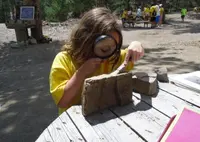
- Bronc DayGreen Mountain Falls · Annual western heritage celebrationA free western heritage festival held the last Saturday in July in Green Mountain Falls since 1939, whose parade once counted 149 horses.
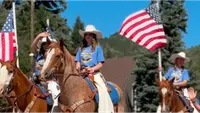
- Manitou WineryManitou Springs · WineryLocally owned & operated winery. Tastings, batches/ labels, patio seating, private events, wine club, dog friendly, etc..
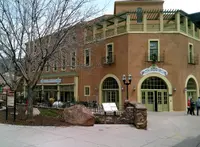
- Emma Crawford Coffin Races & FestivalManitou Springs · Coffin racesThe Emma Crawford Coffin Races in Manitou Springs, Colorado, held since 1995, run wheeled coffins with a helmeted "Emma" riding inside along Manitou Avenue each October.

- Manitou Mineral SpringsManitou Springs · Mineral springsEach spring has its own distinctive flavor and effervescence. Centuries ago the great tribes of the plains and the Mountain Utes drank these same medicinal waters. Beginning in 1871, developers created the resort of Manitou Springs to provide the popular water therapies. Springs restored and kept running by the Mineral Springs Foundation.
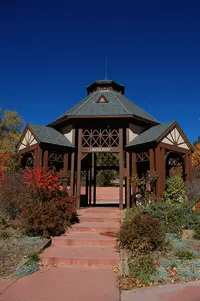
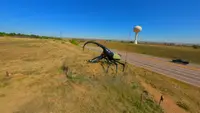
- Herkimer, World's Largest BeetleColorado Springs · StatueHerkimer, a male Hercules beetle built 48 times life size, marks the turn from Colorado 115 to the May family's tropical insect museum south of Colorado Springs.
- L & O VineZCañon City · WineryWe might have started as a small and humble vineyard, but we're on our way to becoming the talk of Cañon City, Colorado!
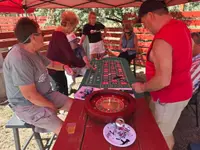
- Cañon City Music & Blossom FestivalCañon City · Community-run school music competition and paradeCañon City's May festival of school band, orchestra, choir and jazz competitions and a Main Street parade, descended from an 1890s Fruit Day that gave fruit away by the plateful.

- Brush Hollow WineryPenrose · Winery/vineyardBrush Hollow Winery and Vineyard found in Colorado's Apple Valley is a Colorado family-owned business with over 20 years experience in the wine industry, offering wine and mead in the vineyard, the tasting room, or out back in one of our cabanas.
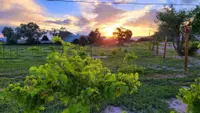
- Bugling Elk Vineyards & WineryPenrose · VineyardA veteran-owned vineyard and tasting room on Apple Lane in Penrose, Colorado, where a retired Green Beret gave up on malbec and turned to cold-hardy marquette.
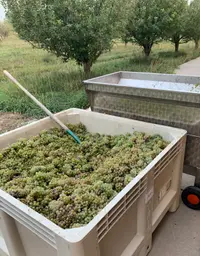
- The Ranch at Emerald ValleyColorado Springs · Wilderness retreat (all-inclusive)Booking engine for the Broadmoor wilderness properties; ranch room types are Cabin King, One Bedroom Suite, and Standalone Cabin.
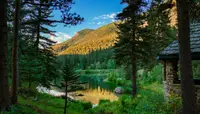
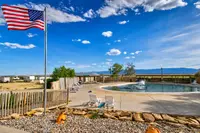
- Dakota Hot SpringsPenrose · Hot springs resortDakota Hot Springs is located on the south side of US Hwy 50 approximately one mile west of the junction of US Hwy 50 & CO Hwy 115 in Penrose, CO.
- Penrose Apple DayPenrose · Annual apple day celebrationResidents and tourists fill the streets each October to celebrate apples, including a free slice of pie.

7 more within 30 miles on the road map.
Nearby towns: Manitou Springs and Cañon City. All the towns of Colorado. More of Colorado: Town Festivals and Holiday Celebrations.
Sources
- Teacher Resource Set 1 Title Cripple Creek (Historic District) Developed by coloradoencyclopedia.org/sites/default/files/ARS_CRIPPLE_CREEK_HISTORIC_DISTRICT_0.pdf
- Teller County (coloradoencyclopedia.org) coloradoencyclopedia.org/article/teller-county
- Cripple Creek (coloradoencyclopedia.org) coloradoencyclopedia.org/article/cripple-creek
- Cripple Creek Fires of 1896 coloradoencyclopedia.org/article/cripple-creek-fires-1896
- National Register nomination, Cripple Creek, CO npgallery.nps.gov/NRHP/GetAsset/1112bbfe-3339-43ca-ba65-200e62a03d69
- Teller County History tellercounty.gov/395/Teller-County-History
- The Man Who Regretted His Millions historycolorado.org/lost-highways/2023/01/19/man-who-regretted-his-millions
- Colorado: A Guide to the Highest State (1941), p. 246 archive.org/details/coloradoguidetoh00writ_0/page/246
- Cripple Creek Historic District historycolorado.org/location/cripple-creek-historic-district
- Cripple Creek City Hall 1898 (historical marker) hmdb.org/m.asp?m=250574
- Old Homestead Parlour House (historical marker) hmdb.org/m.asp?m=51824