
Herkimer, World's Largest Beetle
Colorado Springs, El Paso County, Colorado. Statue; May 1 to October 1.
Details

- Where
- 710 Rock Creek Canyon Road, Colorado Springs, CO 80926. Directions
- When
- 9:00 a.m. to 6:00 p.m. daily.
- Getting there
- At the entrance to Rock Creek Canyon along Highway 115.
- Fees
- Adults (13-60): $14.
- Walk-in or reserve
- Groups of 10 or more visit by appointment.
- Phone
- 719.576.0450
- Website
- coloradospringsbugmuseum.com
- Managed by
- May Museum.
- Established
- 1952.
- Coordinates
- 38.7051511, -104.8406412.
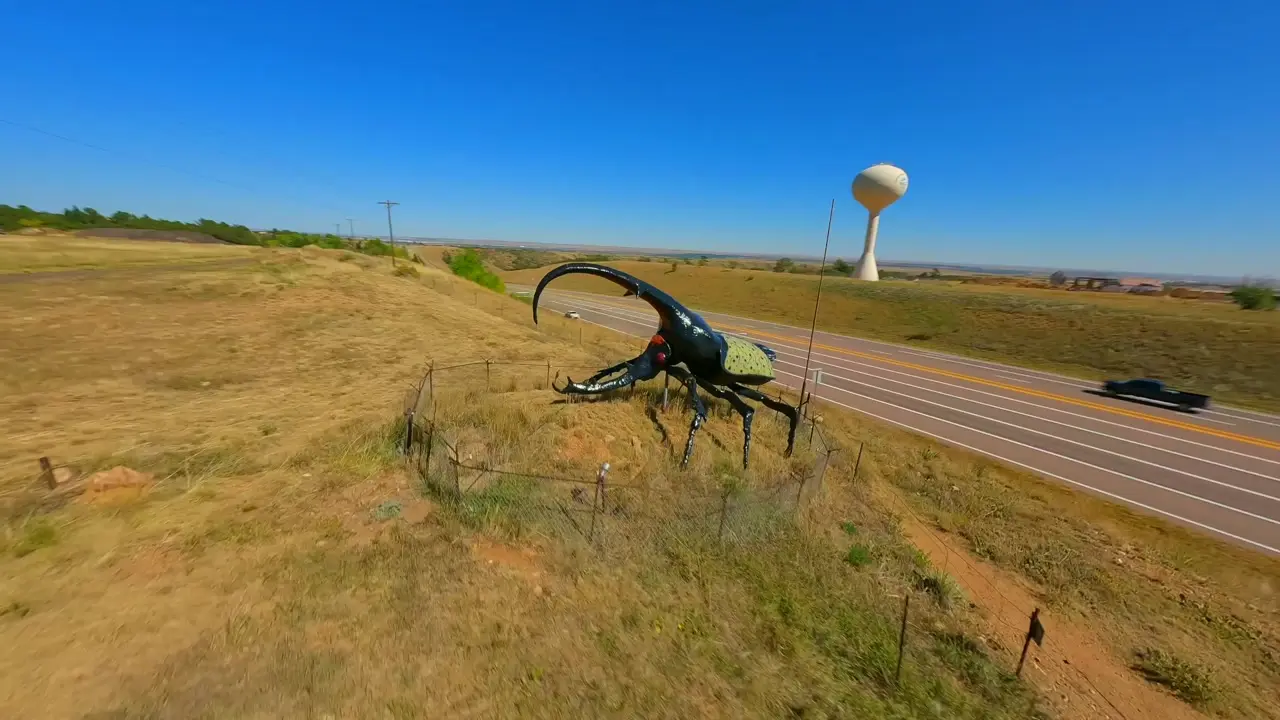
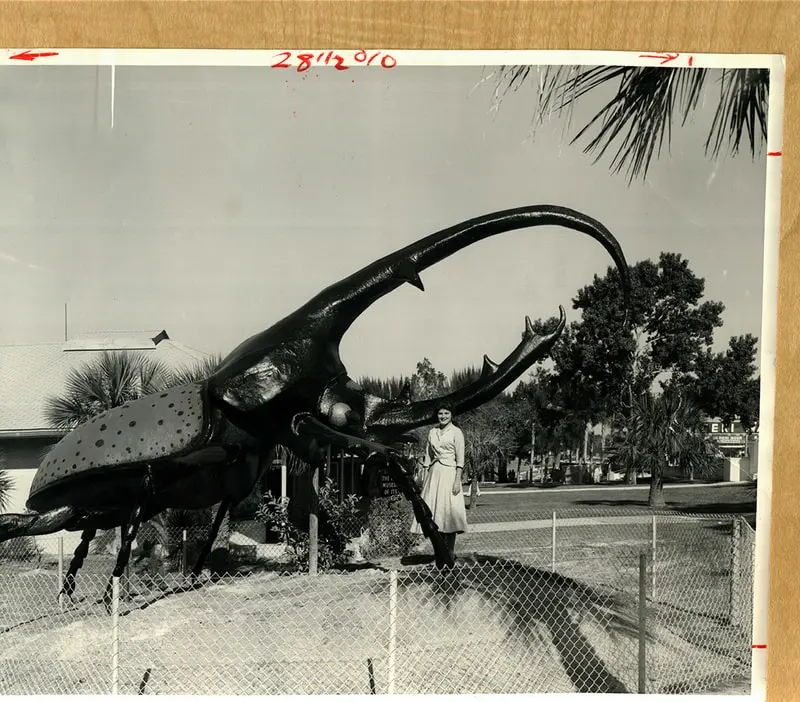
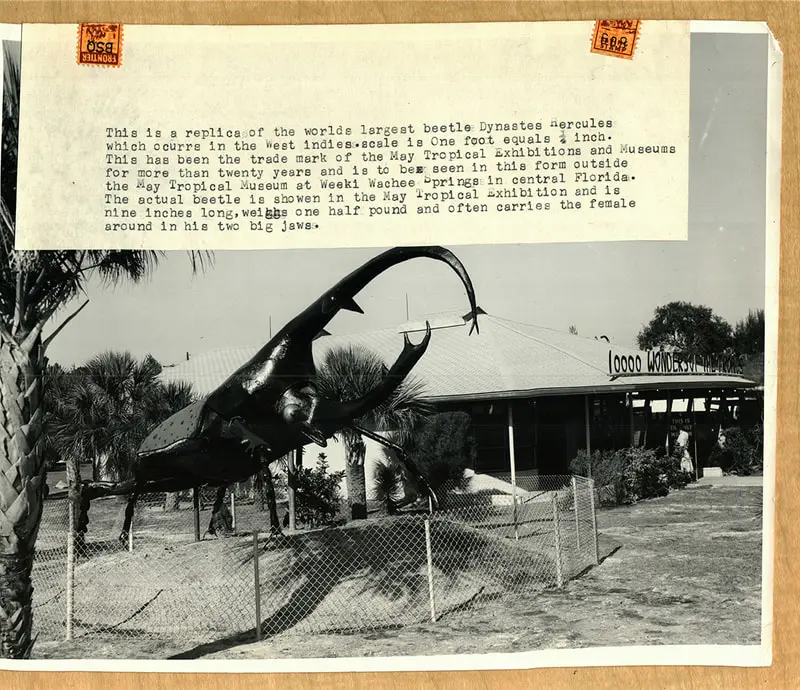
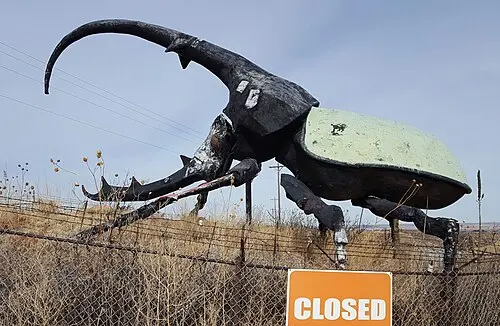
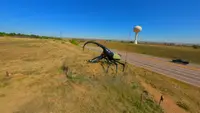
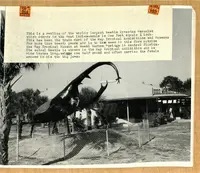
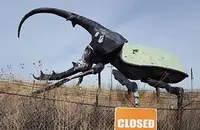
A few miles south of Colorado Springs, on a stretch of Highway 115 that Hunter Oatman-Stanford of Collectors Weekly called nondescript, a giant beetle stands beside a sign for the May Natural History Museum. Its horns, in his words, are “as tall as a house.” This is Herkimer, a male specimen replica of Dynastes Hercules, a beetle native to the West Indies. The museum gives the scale as one foot to a quarter inch, which makes him 48 times the size of the real animal. He stands at the entrance to Rock Creek Canyon, where the museum says he has been for more than sixty years, and he has been the museum’s trademark since 1952. When Top Trumps and Hasbro unveiled an official Colorado Springs Monopoly game on March 31, 2025, the May Museum and Herkimer were on the board, and the museum gift shop sells the game.
A mile up Rock Creek Canyon Road
The museum sits about a mile up Rock Creek Canyon Road, on the right, in a building the family describes as Pikes Peak Granite-colored. Joshua Berman visited for The Denver Post in 2015. He wrote that most of the creatures are pinned behind glass along a spiral path through a low-lit building. He saw iridescent butterfly and grasshopper wings, fist-sized beetles and walking sticks, and many of the specimens were a hundred years old and intact. The cases are antique glass. The incandescent light fixtures were made by hand to John May’s design. R.J. Steer, the museum’s president when Collectors Weekly visited in 2015, called it “a static display style one would expect to see in the 1940s or ‘50s.”
The counts vary by source. The museum and Collectors Weekly give about 7,000 unique specimens on display, while Berman’s article gives 8,000 out of a collection of 100,000. Real Hercules beetles are among them, up to nine inches long and half a pound, and the museum notes that males can carry females in their two big jaws. “It’s like a brick,” Steer said of the largest. A flying one, he said, could knock a cyclist off a bicycle.
Nearby are an 18-inch stick insect from New Guinea, an Atlas silk moth from India and a female Queen Alexandra’s Birdwing. An Elephant beetle sits beside a featherwing beetle that Steer describes as no bigger than a pinhead. The blue Morpho butterflies draw the most attention. Some of the original wrappings survive as well. An insect would be folded into a triangular paper football made of local newspaper and set in a matchbox, and the matchboxes were packed in a cigar box.
In 2015 the one living specimen was a female black widow. Berman’s daughters met her as Wanda, “creeping upside-down across her small glass cage.” Steer explained that she is kept alive because a black widow’s red hourglass fades after it dies. “She lives in a glass cage, we feed her flies, and she’s happy.”
The museum sits on Golden Eagle Ranch, a thousand acres of wilderness with miles of hiking trails, and the Golden Eagle Campground lies just behind it. Berman’s daughters ended their visit outside, feet wet in a shallow stream, looking for bugs. The family still runs the place. “We all grew up working in the business,” Diana Fruh told Berman, pointing to a teenage boy at the register. “He’s fifth generation.”
James May’s collection
A plaque at the entrance to the main display room reads: “This vast collection was started by James Frederick William May in South Africa in the year 1903.” Steer, his great-grandson, tells the longer version. James May was born in England. His father collected for the British Museum and took the family to Brazil, where the father died of malaria. James went to South Africa for the Second Boer War in 1899 and was critically injured and left for dead. A group of Zulu people carried him to a British aid station, and while he recuperated he began saving insects. Later, in Canada, he built the collection by trade. He might ship specimens to a missionary in Borneo, for instance, who would send local specimens back by parcel post.
His eldest son, John May (1916–2007), learned to make airtight wooden cases from an old German cabinetmaker. He bought a truck trailer, built collapsible stands, and took the collection to stock shows, flower shows, auto shows and state fairs. He was 13 when it first toured Canada and the northern United States. The museum says that by that age he had two men working for him during the Great Depression, and that admissions and donations fed the family. Fruh dates the traveling show to the 1920s.
The family chose the Front Range for its dry air. “Humidity is an enemy of an entomology collection,” Steer said. Accounts of the land purchase differ. Collectors Weekly says Steer’s grandmother, Vicky May, bought about 180 acres during World War II as the first parcel. The Denver Post and Wikipedia say the family bought 1,000 acres in 1942.
The museum says that in 1947, with little money, John made the concrete blocks for the building himself. The May Natural History Museum of the Tropics opened in 1952, and at some point the “Tropics” was dropped. James May kept collecting until his death in 1956, and a campground opened in 1960. According to the museum, John bought an entire Camp Carson barracks and reused every board. Self-taught, he also won a Colorado Supreme Court water case against the U.S. Army.
Walt Disney toured the grounds with John in the mid-1950s and made an offer on the whole collection. Steer says his grandfather insisted that it be shown as the James May Collection. “Well, that’s not how Disney works, and it was a deal breaker.”
The beetle on the truck
Herkimer’s beginning is told several ways:
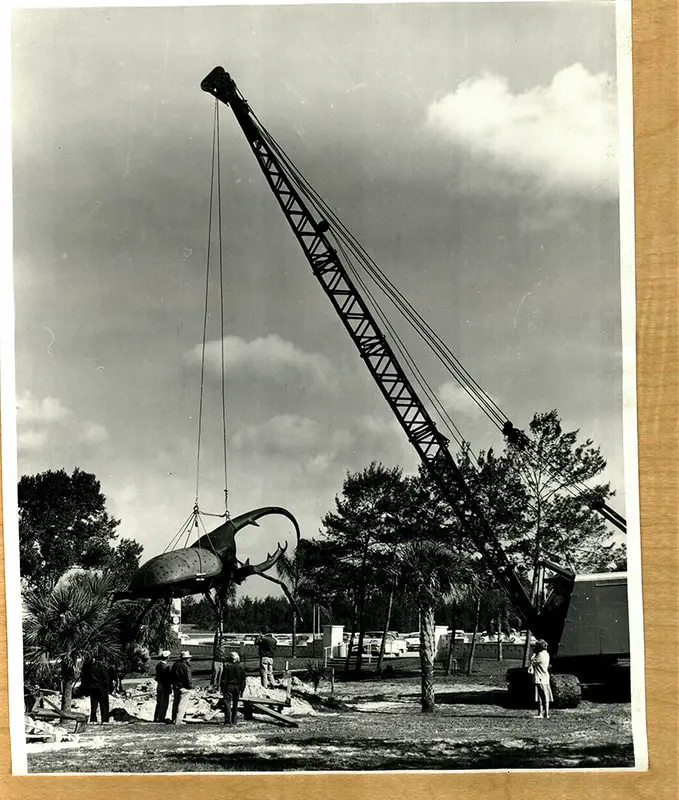
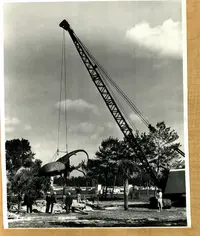
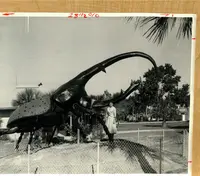
1949: A 2022 museum blog post says John May designed and built him that year. 1950: Diana Fruh told The Denver Post that her grandfather built him in 1950 to advertise the collection. She said the family hauled him from fair to fair strapped to the roof of their truck, with the horn hanging over the windshield. * 1958: Collectors Weekly, drawing on Steer, says the beetle was built in 1958 for a branch museum at Weeki Wachee Springs, Florida.
The museum’s own page says only that he was part of the traveling May Tropical Exhibition and marked the entrance to the exhibit at Weeki Wachee in the 1950s.
The Florida branch did not last. Steer said humidity attacked part of the collection at once, and his grandfather built sealed metal cases and an air-circulation system to save it. A few years later MGM Studios bought the Weeki Wachee resort and gave the Mays a choice: sell their exhibits or leave. They left, driving back to Colorado with the giant beetle on a flatbed truck.
Seven weeks away in 2022
By 2022 it had been decades since anyone had done major work on Herkimer. The family wrote that he was “in dire need of repair lest he be lost forever.” On April 18, 2022, they dismantled him and moved him to the indoor pavilion on Golden Eagle Ranch. At what they called substantial cost, they hired Mark Cline, an artist, sculptor and owner of Enchanted Castles Studio. Over four days Cline directed the sanding, fiberglass patching and resin coating. John May’s grandchildren RJ Steer and Lynn Steer and his grandson-in-law Mike Woolf worked on the repairs with their own hands.
On May 3 Herkimer left the May property by pickup and trailer, by the family’s count for the first time in sixty-eight years. He went to the airport hangar of Gene Kear, a professional aircraft refinisher, who donated about three weeks of his time. With help from Dave DeVere and Woolf, the beetle was sanded, primed and painted. On June 6, 2022, after seven weeks away, Herkimer returned to his post on 115.
“Taking the giant Hercules beetle apart was a much simpler process than putting him back together,” the family wrote. Over several days the larger body parts went back up with the family backhoe and a lot of manpower. Then the legs were welded and the whole structure secured.
Notable Events
- 1949May Museum founder John May designed and built Herkimer. coloradospringsbugmuseum.com
- 1950sHerkimer marked the entrance when the collection was housed at Weeki Watchee Springs. coloradospringsbugmuseum.com
- 1950Her grandfather built Herkimer in 1950 to advertise his family's inherited collection of insect and arachnid specimens. denverpost.com
- 1952The statue has been the May Museum's trademark since 1952. coloradospringsbugmuseum.com
- 1958The gigantic Hercules beetle was constructed in 1958 for the Florida location. collectorsweekly.com
- 2022Herkimer left the May Family Property for the first time in sixty eight years and was taken by pickup and trailer to aircraft refinisher Gene Kear's airport hangar. coloradospringsbugmuseum.com
- 2022Herkimer began restoration; the May family dismantled and moved him to the indoor pavilion on Golden Eagle Ranch. coloradospringsbugmuseum.com
- 2022After a seven week absence, fully restored Herkimer returned to his post on the May Family property along highway 115. coloradospringsbugmuseum.com
- 2025Top Trumps and Hasbro unveiled the official Colorado Springs Monopoly game including the May Museum and Herkimer. coloradospringsbugmuseum.com
People
- John May, May Museum founder; designed and built Herkimer (1949).
- Dave DeVere, May family member who helped sand, prime and paint Herkimer.
- Gene Kear, Professional aircraft refinisher whose airport hangar received Herkimer for restoration; donated about three weeks of his time.
- Mike Woolf, John May's grandson-in-law and hands-on participant in the repair project.
- Mark Cline, Artist who orchestrated sanding, fiberglass patching and resin coating during restoration.
- Lynn Steer, John May's grandchild and hands-on participant in the repair project.
- RJ Steer, John May's grandchild and hands-on participant in the repair project.
- Diana Fruh, One of the family operators of the May Natural History Museum; granddaughter of Herkimer's builder.
Sources
- coloradospringsbugmuseum.com/herkimer-worlds-largest-beetle.html
- coloradospringsbugmuseum.com/rates-and-information.html
- coloradospringsbugmuseum.com/directions.html
- coloradospringsbugmuseum.com/blog/test-post-2
- coloradospringsbugmuseum.com/blog/test-post
- coloradospringsbugmuseum.com/blog/herkimers-journey-part-three
- coloradospringsbugmuseum.com/blog/where-is-the-bug-herkimers-journey-part-four
- coloradospringsbugmuseum.com/about
- denverpost.com/2015/07/02/bugging-out-at-the-may-natural-history-museum
- collectorsweekly.com/articles/the-worlds-weirdest-most-beautiful-bugs