
Cripple Creek & Victor Narrow Gauge Railroad
Cripple Creek, Teller County, Colorado. Heritage narrow-gauge railway.
Details

- Where
- 520 E Carr Ave, Cripple Creek, CO. Directions
- When
- Trains depart every 70 minutes starting at 10:00am until 5:00pm.
- Season
- The railroad operates 7 days a week from Memorial Day weekend through the first weekend in October.
- Getting there
- from our 1894 depot and gift shop at the head of historic Bennett Avenue in Cripple Creek.
- Fees
- Adults: $19; Seniors (65+): $17; Children (3-12): $14; Children (under 3): Free.
- Hours
- We are open 7 days a week! 9:30am - 5pm! Departure are 10am, 11:10am, 12:20pm, 1:30pm, 2:40pm, 3:50pm, and 5pm.
- Access
- All cars are open so please dress for weather conditions. Trains run rain or shine. No reservations. First come first serve.
- Walk-in or reserve
- No reservations. First come first serve.
- Phone
- (719) 689-2640
- Website
- cripplecreekrailroad.com
- Managed by
- his son Jim and his family.
- Established
- June 28th, 1967.
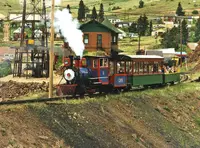
The Cripple Creek & Victor Narrow Gauge Railroad sells its tickets from a small depot at the head of Bennett Avenue. The building was put up in 1894 for another town. Beside it stands the original Cripple Creek Midland Depot, now the Cripple Creek District Museum. A National Register form of 1975 describes that building as three stories under a gabled roof, stone on the first level and brick above, and says it was purportedly erected in the early 1890s. No old water tower could be found for the railroad. The founder, John Birmingham, had a wooden one made by Denver Tank and Reel and moved to the site.
Trains leave every seventy minutes, seven a day, from 10:00 in the morning until 5:00. There are no reservations, and tickets go first come, first served. All cars are open, and the trains run rain or shine. On a drizzling September morning in 2026 the railroad posted a film of No. 3, “The Porter,” pulling out on the 10:00 run. That season a food truck, LeNguyen’s Saigon Garden, parked at the station. On cold days the staff lit the coal-fired stove inside. The gift shop carries T-shirts, books, logo goods, and Thomas the Tank items.
Out to Echo Valley and back
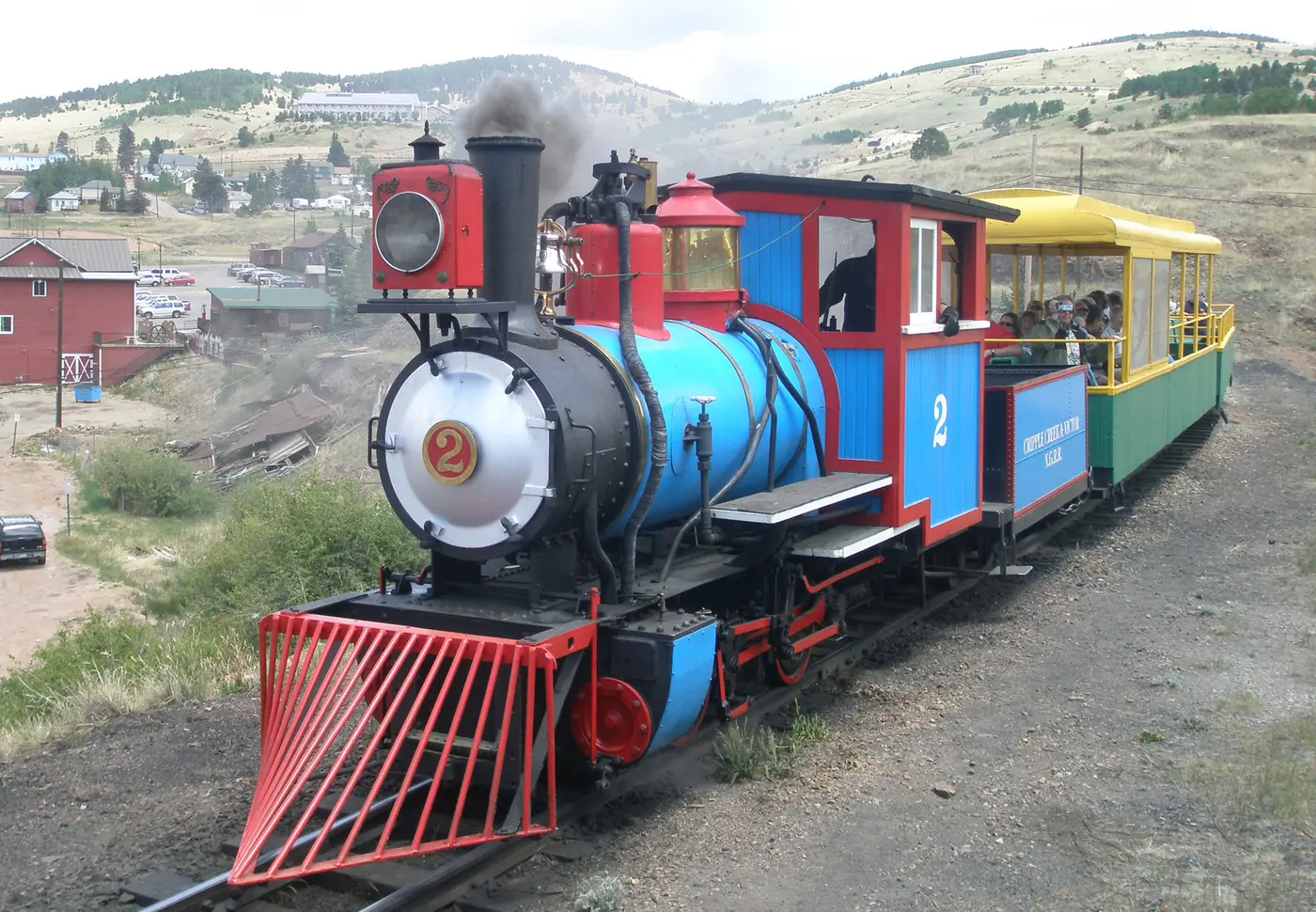
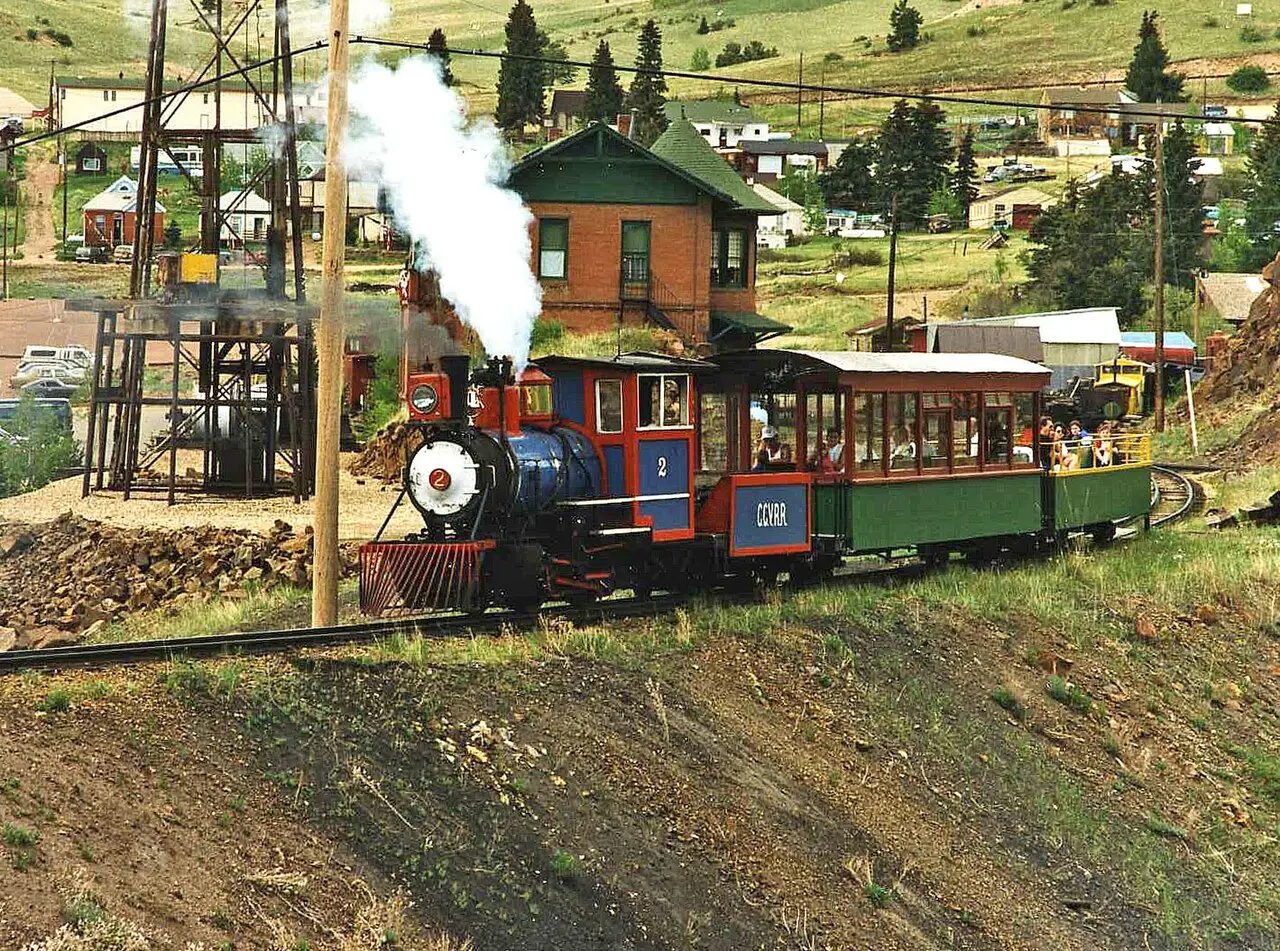
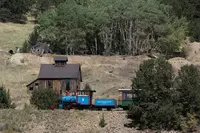
The track is two feet between the rails. The railroad describes its engine as “a 15 ton iron horse of the 0-4-0 type.” The trip takes about 45 minutes and covers four miles. The line runs south out of Cripple Creek, past the old Midland Terminal Wye and over a reconstructed trestle, then past a string of historic mines to Echo Valley and World’s Fair. There the train turns back. It stops at the wye, at Echo Valley, and at World’s Fair for photographs. According to KOAA, the engineer “pulls double duty as tour guide,” narrating the mining history along the way.
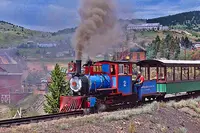
The railroad’s own page speaks of “the old steam engine with its pillaring smoke, sounds of steam and working steel.” It calls these the effects familiar to the miners who rode the Midland Terminal roadbed when the district’s population passed 50,000. Kenneth Jessen, writing in the Loveland Reporter-Herald in 2012, said the coal-fired engines give riders “an authentic sound and smell of a historic Colorado railroad.” He also noted that the only other two-foot-gauge railroad ever to operate in Colorado was the long-abandoned Gilpin Gold Tram.
The 2026 season opened May 23. Through late September the railroad posted reports on the turning leaves along the west side of Bennett Avenue. The last trains ran October 4, the second day of the town’s Fall Fest. The railroad said it would reopen Memorial Day weekend for the 2027 season.
Engines from Germany, Pennsylvania, and a South African sugar estate
According to the railroad, three of its four steam locomotives work in summer, all of them coal-fired. Most of the roster came by way of Mexican mines.
- No. 1 is an articulated 0-4-4-0 Mallet built by Orenstein & Koppel in Germany in 1902. HawkinsRails records it as built for Guillermo Purcell. It then served the Compañía de Minerales y Metales and the Compañía Minera de Peñoles before coming to Cripple Creek.
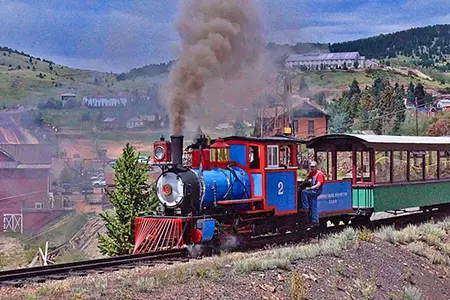
- No. 2 is a Henschel 0-4-0. The railroad’s history gives its date as 1936. HawkinsRails lists it as Henschel No. 28490, built in 1948 for Hanseatische Kieswerke in Germany. That account says it passed through private owners in the United States and was “Americanized” with a cab, pilot, and tender.
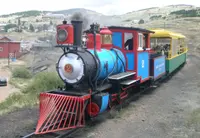
- No. 3, the Porter, is an 0-4-0 tank engine. HawkinsRails dates it to July 1927 as Porter No. 7063. Jessen wrote that it was built in Pennsylvania and first worked at a lead and zinc mine at Avalos Zacetacua, Mexico.
- No. 4 is a Bagnall 0-4-4-0T from England. The railroad dates it to 1947, HawkinsRails to 1946 as Bagnall No. 2831. In the HawkinsRails account it was built for Hulett & Sons in South Africa and went on to Darnell Sugar Estates, the Reynolds Brothers Sugar Company, and Western Rails Inc. The railroad says it is under restoration.
The track crew uses a fifth engine, a four-wheel General Electric diesel-electric of 1951. It was first battery-powered for underground work at the Idarado Mine near Telluride.
A depot that outlived Anaconda
The ticket office began as the Anaconda station on the Midland Terminal line in 1894. Anaconda was one of the gold camps of the Cripple Creek district. Jessen wrote that fire almost totally consumed the town in 1904 and the depot survived. The railroad and Jessen both say the building was then moved to Bull Hill, which Jessen places near Goldfield.
A marker on the southeast corner of the gift shop, around back from the entrance, gives another date. The railroad put it up under the title “The Bull Hill Station.” It says the station was relocated to Bull Hill, northeast of Victor, in 1912. The marker also records that the Midland Terminal discontinued service in 1949. The depot came to its present spot in 1968.
The Midland Terminal had been one of three railroads into the district. The National Register form counts three railroads and two trolley lines serving more than 50,000 people at the district’s peak. That form says a Midland Terminal line from Divide and the Florence & Cripple Creek from Cañon City both reached Cripple Creek in 1894, the latter sending its first train in on July 2. American-Rails gives a different chronology. It says the Florence & Cripple Creek opened in 1893 and the Midland Terminal, organized that year, began running between Cripple Creek and Divide by December 1895. HawkinsRails describes the Midland Terminal as standard gauge, tying the district to Colorado Springs and the main lines. American-Rails says today’s narrow gauge runs on about four miles of track owned by the Midland Terminal and the Florence & Cripple Creek. When the National Register form was written in 1975, the town was “in the process of restoring the old Cripple Creek-Victor leg of the Midland Railroad.”
A chemist’s railroad
John M. Birmingham was born in 1929 in Beatrice, Nebraska, to James and Stella Birmingham. His obituary in the Boulder Daily Camera says his father’s work as a Union Pacific locomotive engineer “sparked John’s life-long interest in steam locomotives.” The railroad adds that his grandfather was a Union Pacific engineer too.
Birmingham took a chemistry degree at the Massachusetts Institute of Technology and a doctorate at Harvard. At Harvard he studied under Geoffrey Wilkinson. In October 1952 he became the first person to prepare an organic compound of zirconium. In 1961 he and his wife Miriam founded Boulder Scientific Company. The same year he bought a 1906 Baldwin steam locomotive from the Great Western Railroad in Loveland.
In 1965 Birmingham bought two locomotives from the Climax Molybdenum mine of Colorado. Both were in Mexico at the time. One was fully operational, and the other was 60 percent through a major overhaul. American-Rails credits him with saving the former mining line from certain abandonment in the mid-1960s. He built the railroad in his spare time and on vacations, with help from friends and family. He and Miriam opened it for business on June 28, 1967, and moved the Anaconda depot to Cripple Creek the following year.
In 1991 casinos came to Cripple Creek’s streets. Jessen wrote that the railroad kept its riders, “especially for families coming to this famous mining town that seek more than gambling.” In 2007 Birmingham founded Hudson Terminal Rail Services. He died in Longmont on April 24, 2017, at 87. His son Jim and Jim’s family operate the railroad.
Notable Events
- 1867The Reporter-Herald states that work started on the line in 1867 using the abandoned standard gauge Colorado Midland roadbed. reporterherald.com
- 1894The depot was originally built in 1894 as the Anaconda station on the Midland Terminal line. cripplecreekrailroad.com
- 1895American-Rails states that the Midland Terminal Railway was organized and began operations between Cripple Creek and Divide by December of that year, and that what became today's Cripple Creek & Victor Narrow Gauge operates on track owned by the Midland Terminal and Florence & Cripple Creek. american-rails.com
- 1902Number 1, an 0-4-4-0 complete Mallet, was built 1902 as O&K #2797 in Germany for Guillermo Purcell, passing through Compania de Minerales y Metales #1 and Compania Minera de Penoles #1 before becoming Cripple Creek & Victor NG #1. hawkinsrails.net
- 1904The fire of 1904 destroyed most of Anaconda; the Anaconda station was moved to Bull Hill afterward. cripplecreekrailroad.com
- 1912The station was relocated in 1912 to Bull Hill, northeast of Victor. hmdb.org
- 1927A side tank locomotive was built in July 1927 as Porter #7063, arriving via Compania de Minerales y Metales and Compania Minera de Penoles in Mexico. hawkinsrails.net
- 1927A locomotive dating back to 1927 was constructed in Pennsylvania and originally saw service at the lead and zinc mine at Avalos Zacetacua, Mexico. reporterherald.com
- 1936The operator's history page says the Number 2 engine is a Henschel built in 1936 0-4-0, built in Germany. cripplecreekrailroad.com
- 1946Locomotive #4, an 0-4-4-0T Meyer Mallet, was built 1946 as Bagnall #2831, arriving from Hulett & Sons and Darnell Sugar Estates in South Africa. hawkinsrails.net
- 1947The operator's history page says the Number 4 engine is the Bagnall built in 1947 0-4-4-0T, currently being restored. cripplecreekrailroad.com
- 1948A well tank locomotive was built in 1948 as Henschel #28490 for Hanseatische Kieswerke, Germany, later Americanized with cab, pilot and tender. hawkinsrails.net
- 1949The M.T.R.R. discontinued service in 1949. hmdb.org
- 1951The railroad owns a 1951 General Electric, four wheel, Diesel-Electric engine, originally battery operated for underground work at the Idarado Mine near Telluride, now used by the track crew. cripplecreekrailroad.com
- 1960sAmerican-Rails dates the railroad's start to Dr. John M. Birmingham, who saved the former mining line from certain abandonment in the mid-1960s and worked from that point forward at restoring the property into a popular tourist attraction. american-rails.com
- 1961In 1961 John M. Birmingham purchased a 1906 Baldwin steam locomotive from the Great Western Railroad in Loveland. dailycamera.com
- 1965In 1965 he purchased two locomotives from the Climax Molybdenum mine of Colorado. They were located in Mexico, one was fully operational the second was 60% through a major overhaul. cripplecreekrailroad.com
- 1967Dr. John M. Birmingham opened the Cripple Creek and Victor Narrow Gauge Railroad for business on June 28, 1967. cripplecreekrailroad.com
- 1968The depot was moved to its present location in 1968. cripplecreekrailroad.com
- 1991The character of Cripple Creek changed in 1991 with the advent of modern-day gambling and the construction of numerous casinos lining its streets; the railroad has remained popular, especially for families coming to this famous mining town that seek more than gambling. reporterherald.com
- 2017Dr. John M. Birmingham, aged 87, of Longmont, Colorado, passed away on April 24, 2017. dailycamera.com
People
- Dr. John M. Birmingham, founded the Cripple Creek & Victor Narrow Gauge Railroad in 1967 with his wife Miriam; bought a 1906 Baldwin steam locomotive from the Great Western Railroad in Loveland in 1961 (1929-2017).
- Jim Birmingham, John's son; now operates and manages the railroad with his family.
- Jim, John's son; operates and manages the railroad with his family.
- Miriam Birmingham, wife of Dr. John M. Birmingham; with her husband she founded the Cripple Creek & Victor Narrow Gauge Railroad in 1967 (1967).
Sources
- cripplecreekrailroad.com
- facebook.com/Cripple-Creek-Victor-Narrow-Gauge-Railroad-214276705282924
- npgallery.nps.gov/NRHP/GetAsset/1112bbfe-3339-43ca-ba65-200e62a03d69
- american-rails.com/ccvng.html
- reporterherald.com/2012/07/07/tiny-trains-serve-cripple-creek-victor-narrow-gauge-railroad
- dailycamera.com/obituaries/john-birmingham-boulder-co
- hmdb.org/m.asp?m=250176
- hawkinsrails.net/preservation/ccvngr/ccvngr.html