Concord
Contra Costa County, California. County seat.
Concord, in Contra Costa County, grew from a village where building lots went free in 1869 to residents of flood-, fire-, and earthquake-battered Pacheco.1
Details
- Founded
- In 1868 Salvio Pacheco, his son Fernando Pacheco, and his son-in-law Francisco Galindo had 20 acres surveyed for the village of Todos Santos, which became Concord.1
- County seat
- Concord is not the county seat; the 1939 guide gives Martinez as the seat of Contra Costa County since 1850.2
- Last checked
- October 6, 2026.
Point at a dot to see the place.Tap a dot to see the place. Road map of Concord.
In Concord
The Calendar
History
The Pacheco Adobe and the Devil’s Ranch
In 1939 descendants of Salvio Pacheco lived in the thick-walled adobe Pacheco House, in the shade of pepper trees at Concord and Salvio Avenues.2 The 1939 guide places the town on Rancho del Diablo, granted to Salvio Pacheco in 1834, and the state landmark names the grant Monte del Diablo.2,3 The sources disagree on the date of the house: the state landmark says Pacheco finished the two-story adobe on June 24, 1835, and calls it the first building erected in the valley, the 1939 guide says he built it about a decade after the grant, and a 1976 marker reads circa 1846.2,3,4 American squatters had settled on Pacheco’s land by 1852, but the United States Government secured his title the next year, and in 1939 the patent date, 1853, could be read on the stone boundary posts in front of the house.2 His son, Don Fernando Pacheco, built an adobe of his own in 1843, a quarter mile north of a state plaque at Grant Street and Solano Way, and it was reconstructed in 1941.1,3 In 1865 Salvio Pacheco gave land for Live Oak Cemetery to serve Clayton and Concord.5
Todos Santos for the People of Pacheco
Dr. J. H. Carothers laid out the nearby town of Pacheco in 1857 around a warehouse and a flour mill, and it was largely swept away by flood in 1862, twice ravaged by fire in the next 6 years, and almost leveled by earthquake in 1868.2 In 1868 Salvio Pacheco, his son Fernando, and his son-in-law Francisco Galindo had 20 acres beside the old Pacheco-Clayton road surveyed for a village they called Todos Santos, with 19 residential and commercial blocks and a public plaza.1 In 1869 building lots went at no cost to former merchants and residents of Pacheco, and immigrants followed, among them gold and coal miners and ranchers.1 By 1869 the village had become known as Concord.1 Galindo’s home, now a Concord Historical Landmark, was built in 1856.6
Rails, a Charter, and a High School
The Southern Pacific Railroad crossed the southwest edge of town, and Blum and Wittenmeyer laid out a major addition between the tracks and the original town.7 A Victorian Concord School went up between Willow Pass Road and Salvio Street in 1892, and in 1896 the Odd Fellows Hall was moved from Pacheco to the corner of Salvio and Colfax Streets.7 The Martinez-Pacheco-Clayton stagecoach line stopped at the Henry Ivey Livery Stable on Salvio Street.7 Concord was incorporated in 1905, and blacksmith Joseph Boyd became its first mayor.7 The Mount Diablo Union High School campus opened the same year, and the town chronology says it would become the longest continually operating large high school in California.7 In the 1900s the Oakland & Antioch Electric Railroad crossed the northeast side of town, streets were graveled and paved, sewers were installed, and saloon operations were curtailed.7 In 1939 the Federal Writers’ Project guide gave Concord 1,125 people and found it shipping the farm produce of the surrounding valley.2
The 1944 Explosion and Todos Santos Plaza
Near Concord at 10:18 p.m. on July 17, 1944, an explosion obliterated two ships, killed 320 men, and wounded 390, and the Navy and National Park Service marker calls it the worst stateside disaster of World War II.8 Most of the dead were African-American stevedores, and according to the marker the disaster helped push the Navy to reconsider its policy of racial segregation.8 Concord and Kitakami, Japan, became sister cities on October 25, 1974.9 The Concord Historical Society has marked the Keller House, built in 1902-03, and the Elworthy House, built in 1913, as Concord Historical Landmarks.10,11 A 1994 plaza marker calls Concord the largest city in Contra Costa County.1 The founders dedicated the old central plaza as a public park in perpetuity, it was formally named Todos Santos Plaza by 1970, and it has held wisteria, a bandstand, two naval cannons, and a redwood pergola around its edge.1
Within 30 Miles
Measured in a straight line from the town, nearest first.
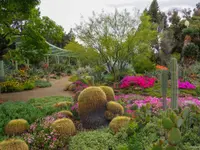
- The Ruth Bancroft GardenWalnut Creek · Botanical garden and plant nurseryThe Ruth Bancroft Garden houses a unique and diverse collection of cacti, succulents and drought tolerant plants from around the world. The many large mature specimens located throughout the 3.5 acre garden serve as an excellent example of just how stunning a dry garden can be.
- Benicia Torchlight Parade and Fourth of July PicnicBenicia · Annual torchlight paradeAn evening parade down First Street in Benicia, California, each July 3, begun by the volunteer fire department when handheld torches were its only light.
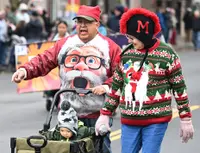
- Holiday Parade and MarketBenicia · Holiday parade & marketBenicia's downtown Christmas parade and holiday market, staged on First Street by Benicia Main Street, where in 2025 Santa rode an Army Jeep handing out candy canes.
- Pear and Wine FestivalMoraga · Community eventCelebrates the Moraga Valley’s pear-orchard heritage.
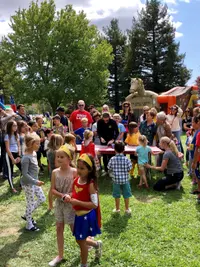
- Hercules Cultural FestivalHercules · Cultural festivalAn annual free cultural festival in Hercules, California, revived in 2023 after a decade's hiatus, where a Polynesian troupe dances a haka to live drums.
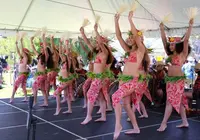
- Harvest Time in Brentwood u-pick loopBrentwood · AgritourismHarvest Time, a farmers' nonprofit founded in Brentwood, California, in 1976, maps more than 65 u-pick farms, stands, and wineries on a numbered trail through East Contra Costa County.
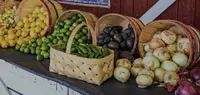
- Berkeley Old-Time Music ConventionBerkeley · Old-time music conventionAn annual five-day old-time music convention spread across Berkeley, California, whose string band contest still pays in agricultural prizes, as its 1968 ancestor paid in rutabagas.
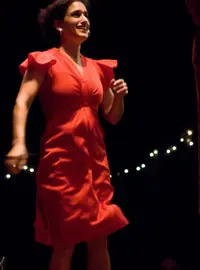
- Berkeley Flea MarketBerkeley · Open-air marketplaceThe Berkeley Flea Market has been a Bay Area cultural landmark since the early 1970s, grown out of the community surrounding the Ashby BART station and known for global crafts, music, food, and strong roots in African American culture.
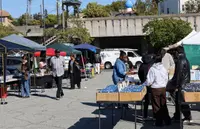
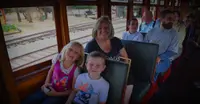
- Western Railway MuseumSuisun City · History museumA museum dedicated to preserving trains from California's past! Come visit us in Suisun City, CA.
- Oakland Coliseum Swap MeetOakland · Swap meet and public marketAn open-air swap meet on a former drive-in lot in East Oakland, open seven days a week, where the old movie screen still stands over the kiddy train.
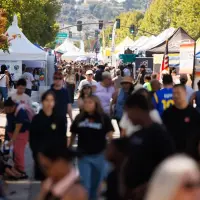
- Castro Valley Fall FestivalCastro Valley · Community traditionA free two-day street festival in Castro Valley, California, held since 1972, whose stages one local musician has booked for nearly 30 years.
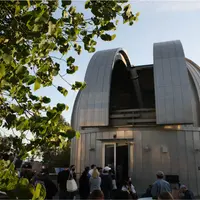
- Chabot Space & Science CenterOakland · Space and science centerOakland's home for STEAM education, located within Redwood Regional Park, with an Observatory, Planetarium, and exhibition galleries.
- Cherry FestivalSan Leandro · FestivalA one-day street festival and parade in downtown San Leandro, California, dating to a 1909 bumper crop of cherries, where every food vendor must put a cherry item on the menu.
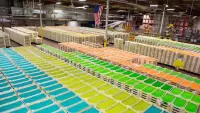
- Jelly Belly FactoryFairfield · Factory tourThe Jelly Belly factory in Fairfield, California, where an elevated quarter-mile tour lane runs above a candy plant the company says makes 1,680 jelly beans a second.
- Rio Vista Bass Derby and FestivalRio Vista · FestivalA three-day striped bass and salmon derby on the Sacramento River at Rio Vista, California, first held in 1933, with every fish weighed at the foot of Main Street.
10 more within 30 miles on the road map.
Nearby towns: Benicia, Berkeley, Fairfield, and Sebastopol. All the towns of California. More of California: Holiday Celebrations and Flea Markets.
Sources
- Dedicated to the Founders of Todos Santos (historical marker) hmdb.org/m.asp?m=17440
- California: A Guide to the Golden State (1939), p. 584 archive.org/details/californiaguidet00federich/page/584
- California State Parks ohp.parks.ca.gov/?page_id=21415
- Don Salvio Pacheco Adobe (historical marker) hmdb.org/m.asp?m=240403
- Live Oak Cemetery (historical marker) hmdb.org/m.asp?m=93630
- Francisco Galindo Home (historical marker) hmdb.org/m.asp?m=56583
- History of Concord, California onlinecalifornia.us/concord_history_05.shtml
- Disaster (historical marker) hmdb.org/m.asp?m=177667
- Concord, California - Kitakami, Japan (historical marker) hmdb.org/m.asp?m=206220
- Keller House (historical marker) hmdb.org/m.asp?m=206353
- Elworthy House (historical marker) hmdb.org/m.asp?m=57336