

Jelly Belly Factory
Fairfield, Solano County, California. Factory tour.
Details

- Where
- 1 Jelly Belly Lane, Fairfield, CA 94533. Directions
- When
- 9:15 a.m. to 4:00 p.m., open 7 days a week unless a scheduled event.
- Fees
- Adults $8, children ages 3-17 $4, children under 2 free.
- Access
- Foods and confections at the Candy Store and Cafe contain certain allergy triggers; questions to JBVCquestions@jellybelly.com.
- Walk-in or reserve
- None required for the self-guided tour; tickets purchased at the Jelly Belly Visitor Center.
- Phone
- (707) 399-2286
- Managed by
- Ferrara Candy Company.
- Established
- 1986.
Above the factory floor
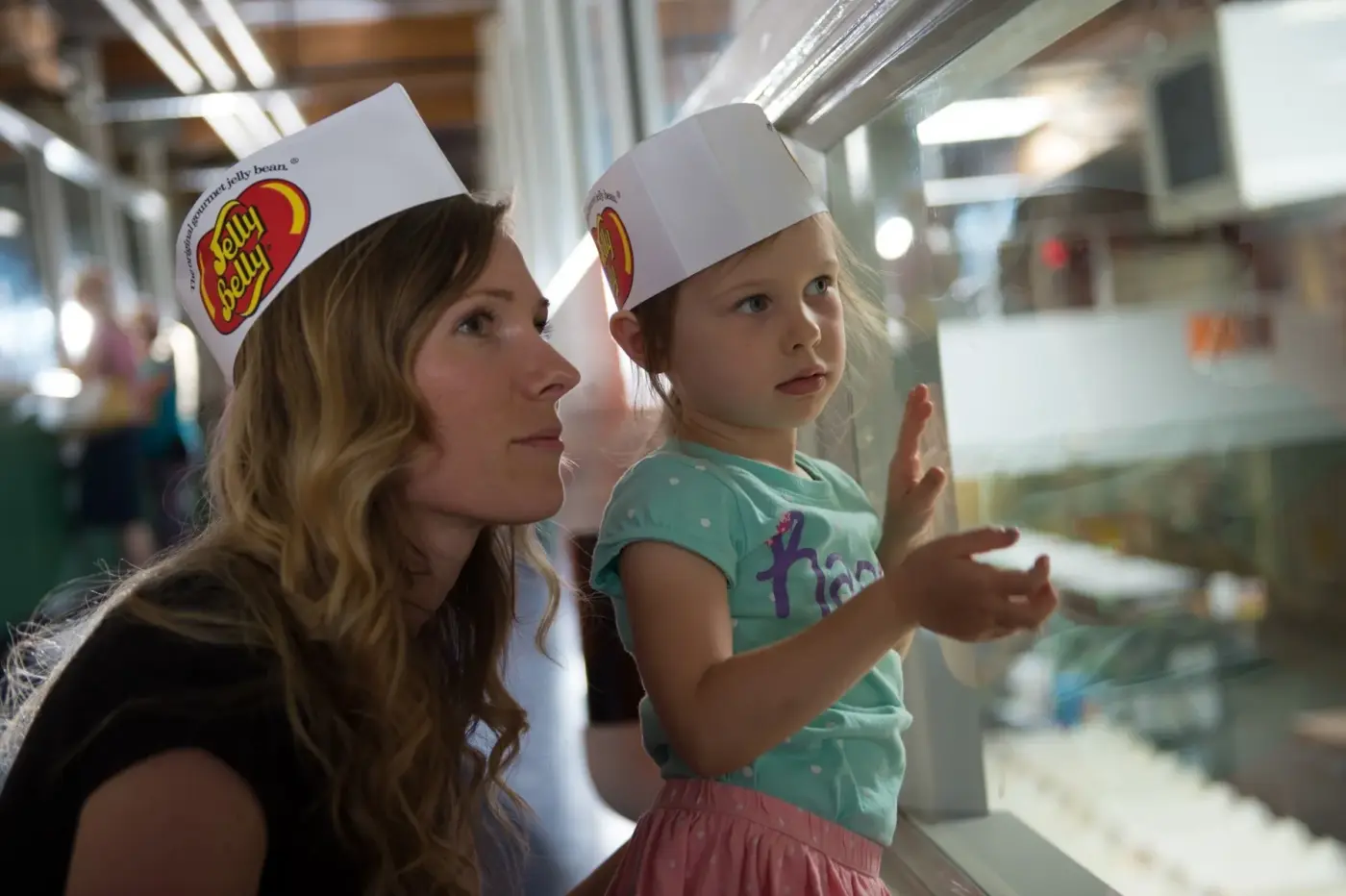
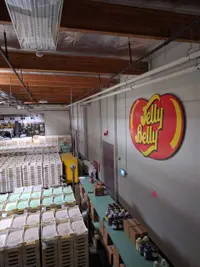
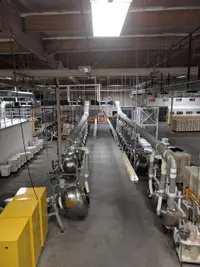
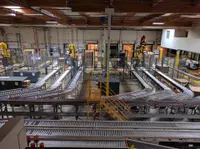
The tour at the Jelly Belly factory in Fairfield follows an elevated lane a quarter mile long, set above the whole candy operation. Tickets are sold in the Visitor Center at 1 Jelly Belly Lane. The company says the plant below makes 1,680 jelly beans every second. A 2018 KCRA report put the figure at about 1,700, with each bean taking seven to 10 days to finish. Flash photography is not allowed inside.
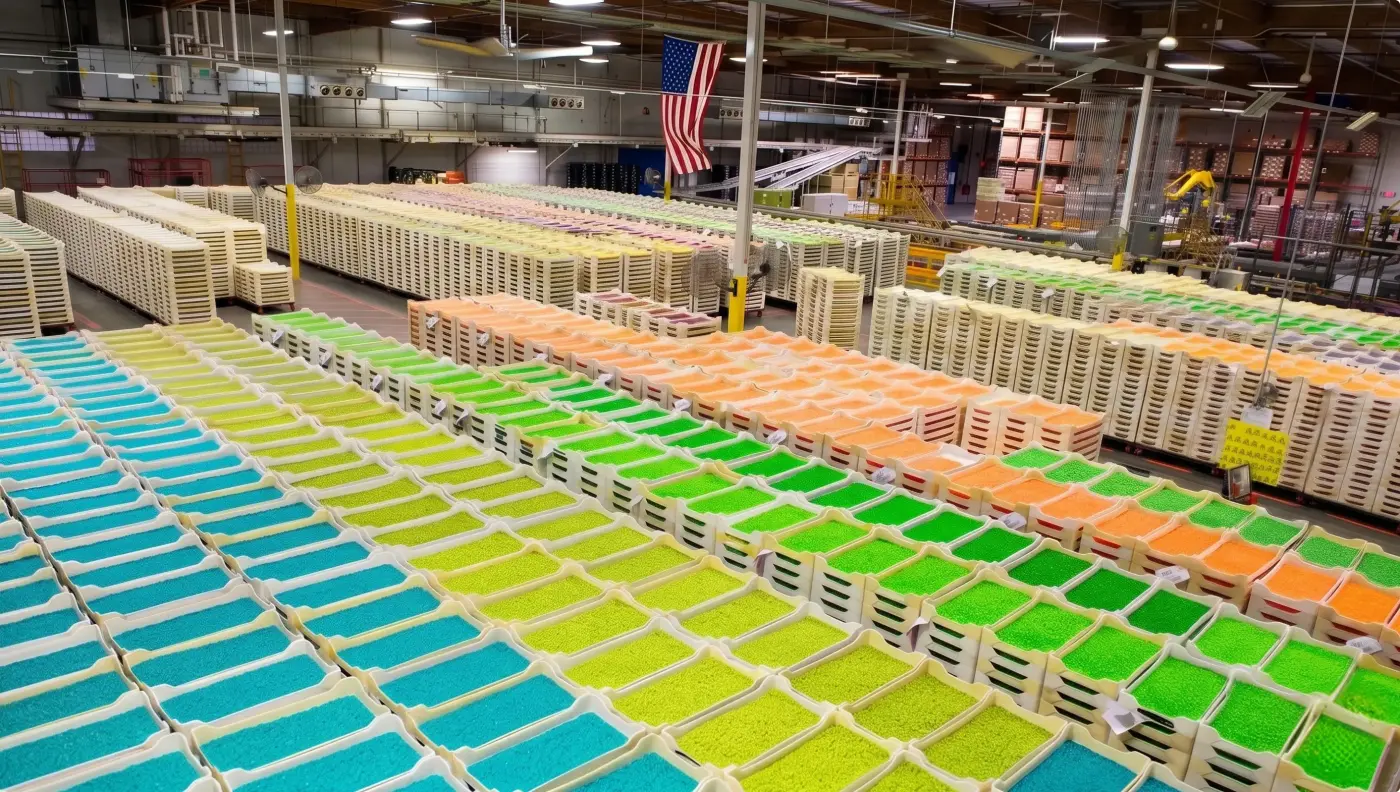
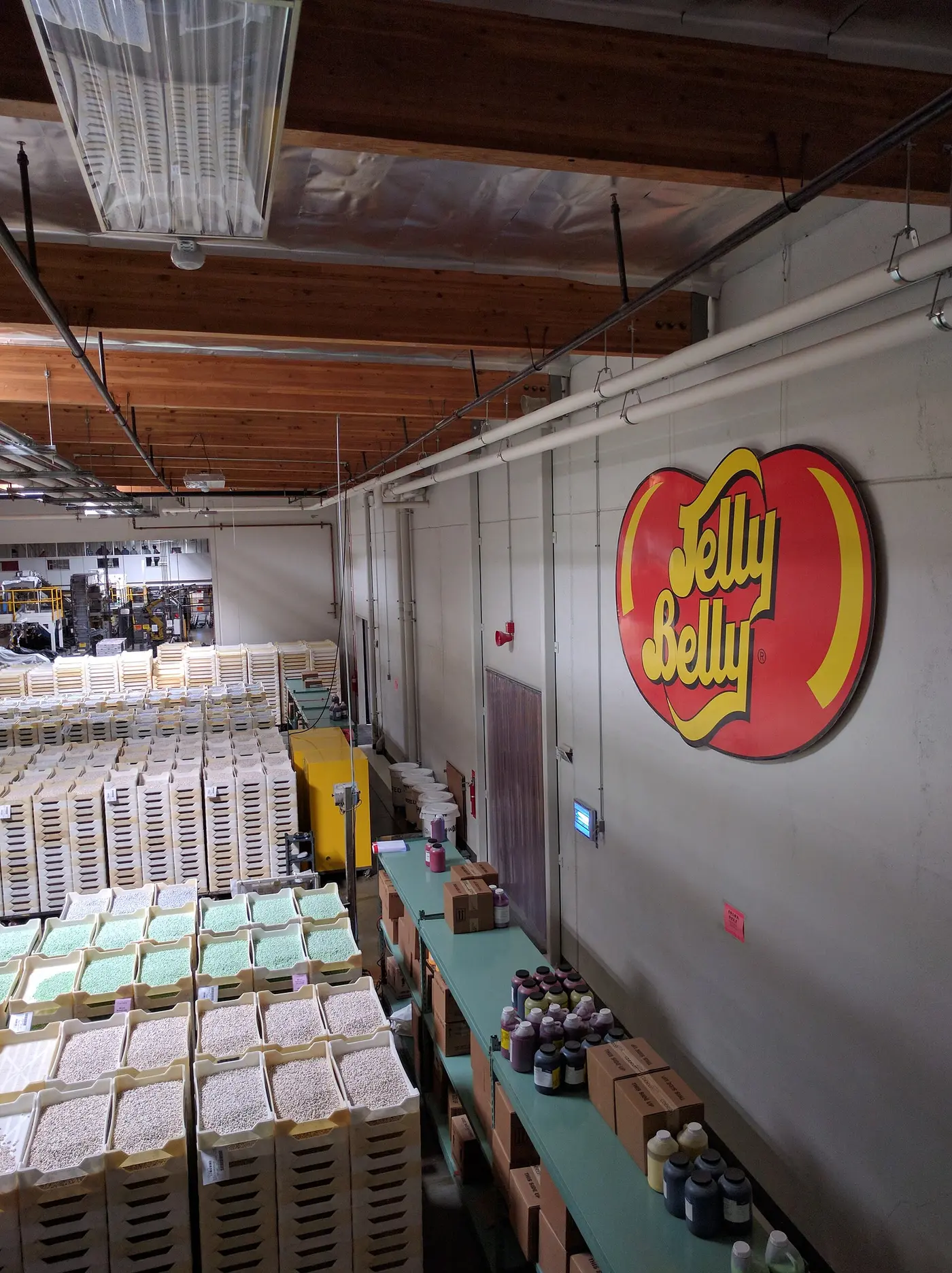
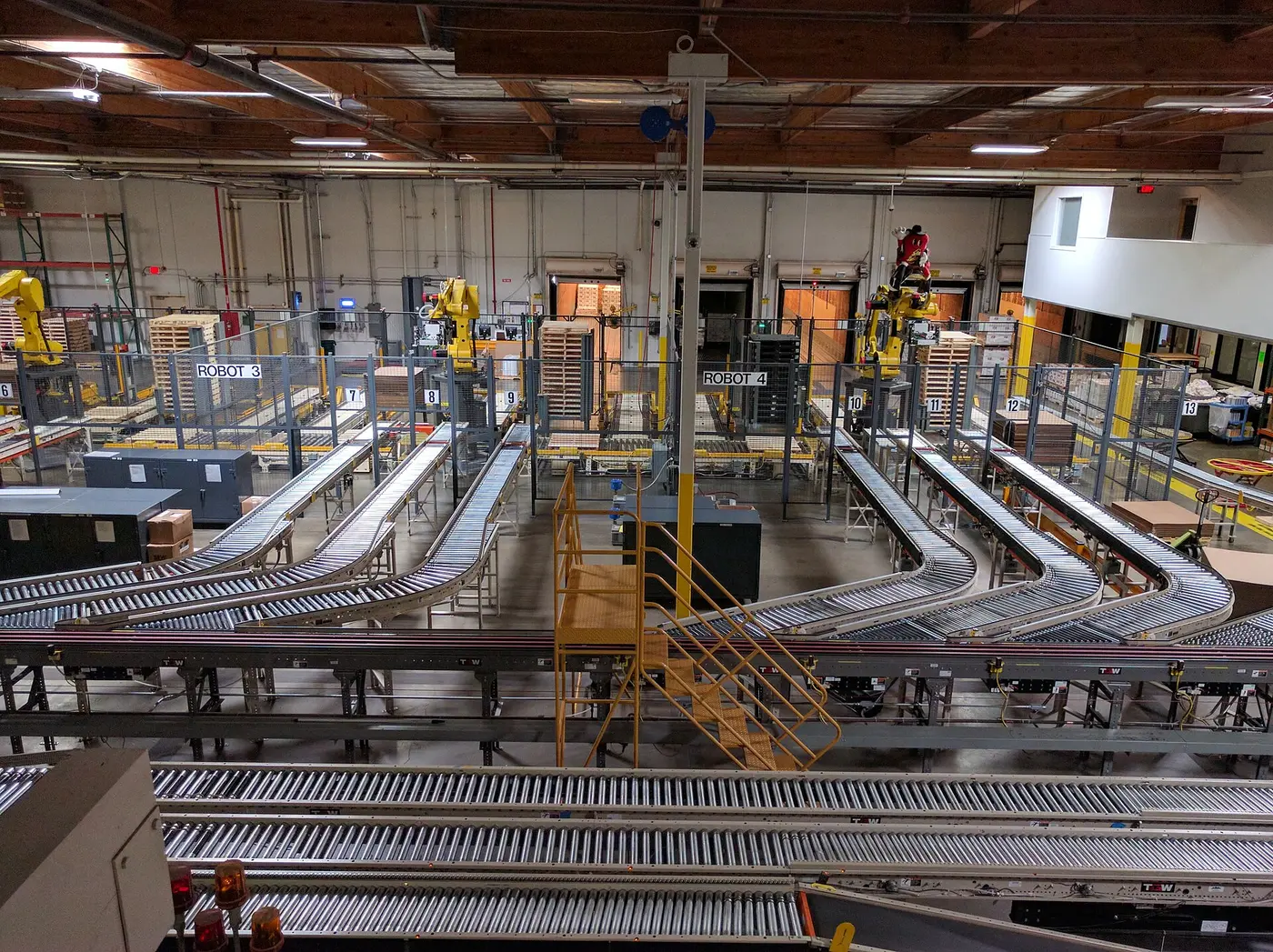
The work follows a fixed order. In the kitchen, sugar, corn syrup, and corn starch cook in large kettles, and flavor and color go in along the way. The mix is called slurry. It drains to filling stations that inject the hot candy into molds, where it firms overnight in trays to become the center of the bean. The next day the trays are flipped, the centers pass through a sugar shower, and robots stack them in 25-pound trays to rest.
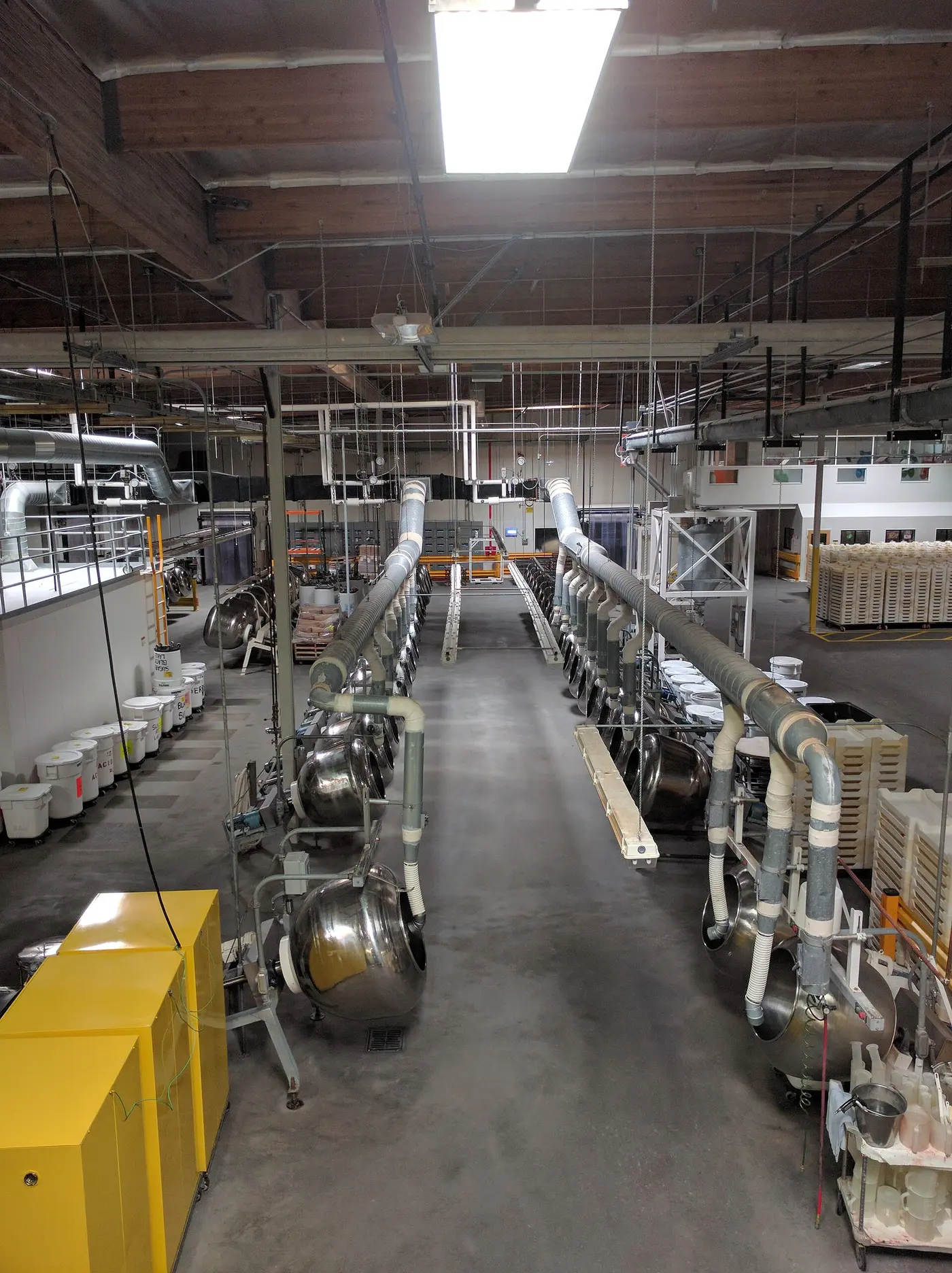
The centers then go into tumblers. For a couple of hours workers alternate wet and dry ingredients, sugar, flavor, and color, until the shell is built and the bean is 30 percent larger. The beans are polished and moved out to what the company calls the Sea of Beans. A roller then marks each one with a white logo. A last tumble sorts out the misshapen, the cracked, and those with incomplete logos. These rejects are the Belly Flops. Conveyor belts combine flavors for packing, and machines fill and seal the bags.
The factory runs Monday through Friday, and production slows after 1 p.m. On weekends the candy makers, in the company’s words, “are at home with their families.” Tours still go on over a still floor, and HD/4K videos along the lane give close views of the work. The same holds for about three weeks a year, typically in April, when there is little or no production. The videos carry subtitles. A ride on the Jelly Belly Express is part of the tour. Guided tours for groups of up to six go through both the factory and the museum.
In 2018 KCRA counted dozens of pictures made of jelly beans lining the factory. They showed the Statue of Liberty, Star Wars, presidents, and the A’s and Giants in the 1989 World Series. The bean artist paints a canvas, lines it with adhesive, sets the beans, and covers the work with a finish. The World Series piece was on display at Candlestick Park when the Loma Prieta earthquake struck, and not a single bean fell off.
Bean-shaped burgers and Belly Flops
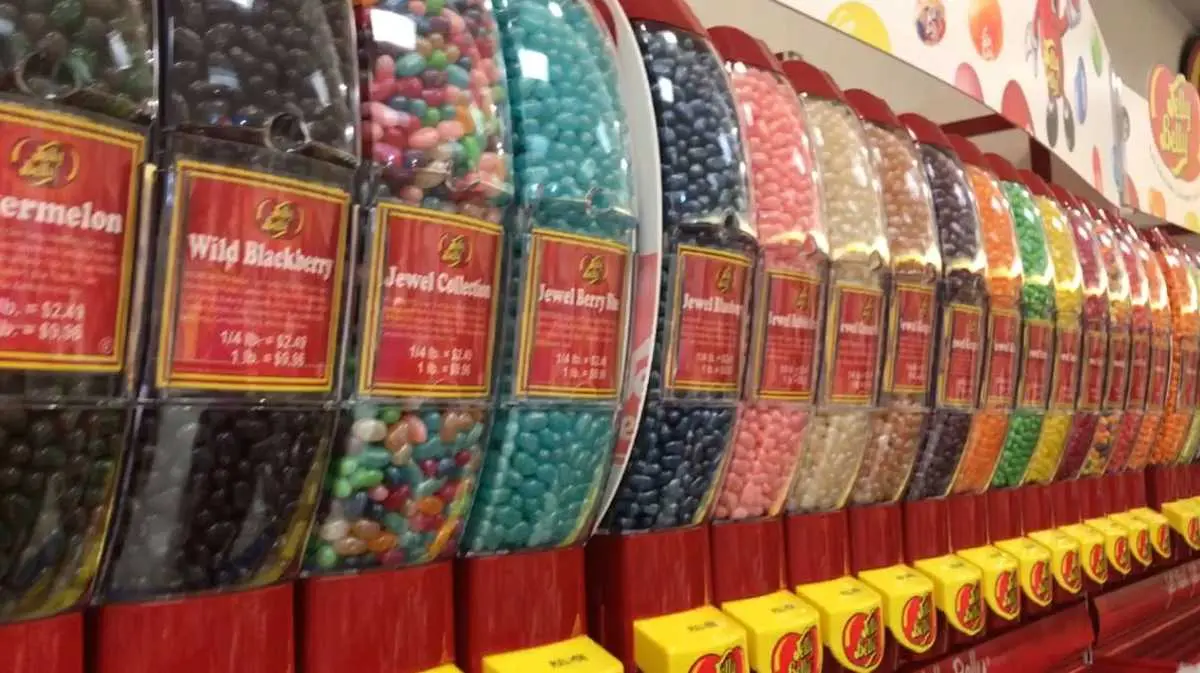
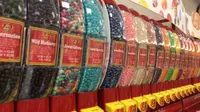
The Visitor Center holds the Café and Snack Bar, the Chocolate Shoppe, and the Candy Store. The café serves breakfast and lunch, including bean-shaped burgers, bean-shaped pizzas, and gourmet ice cream. In the Chocolate Shoppe, chocolatiers handcraft clusters, truffles, and fudge where customers can watch. The Candy Store sells Mr. Jelly Belly toys and t-shirts and keeps a Caseload Sale Room. It also sells Belly Flops by the bag. In 2022 the building also housed a California Welcome Center and an art gallery.
Sampling at the counters follows the calendar. Over August 21 to 23, 2026, the center handed out samples of a new Fall Fireside Collection, its posts tagged red apple, buttered popcorn, toasted marshmallow, cappuccino, and sizzling cinnamon. The following weekend it sampled a Cherry Turnover recipe for National Cherry Turnover Day. Mr. Jelly Belly and other local mascots posed for photographs at the 17th annual Mascot Day on August 5, 2026. The 13th annual Candy Palooza, on September 26 and 27, 2026, brought candy samples, arts and crafts vendors, food, entertainment, and free admission to the tour and museum.
A train to the museum
The Jelly Belly Express, a small passenger train, carries visitors from the Visitor Center to the Jelly Belly Museum at the opposite end of the corporate office, weather and staffing permitting. Decorative jelly beans hang from the museum ceiling.
The collection spans more than a century of candy-making equipment. It includes a ball cream beater, a vacuum chamber, a chocolate melter, a Howe scale, and an old kettle the Goelitz Confectionary Company used in the nineteenth century to make mellocreme candies. Mould boards that shaped the Gummi Rattler and the Gummi Pet Rat are on display. So are jelly bean mosaics of Elvis Presley, Marilyn Monroe, and George Washington, and an electronic Jelly Belly Chorus Line Theatre. QR codes call up videos narrated by Herm Rowland, chairman of the board. According to John Jamison, a Jelly Belly vice president, the museum was Rowland’s idea.
Some exhibits come from Rowland’s own collection: a 1934 Ford V8 Touring Sedan, a 1935 Chris-Craft boat, and a 1982 Maserati Quattroporte. “You’ll see stuff in here (and say), ‘What’s that? That’s not candy!’” Rowland told The Vacaville Reporter before the opening. “It might just be something I like.”
One display is given to Ronald Reagan. As president he gave jars of jelly beans to visiting dignitaries. The company made a jar of its own, bearing the presidential seal, and delivered it to him whenever he ran out. That jar is now in the museum. At the end of the walk are places for photographs: a spinning jelly bean backdrop, a candy-themed spinning drum, the Jelly Belly Bean Machine (a motorcycle with a bean-shaped sidecar), and a bench beside Mr. Jelly Belly.
The museum opened on Friday, July 1, 2022. Rowland cut the ribbon, and Vice Mayor Rick Vaccaro gave him and company president Lisa Brasher a key to the city. “Jelly Belly has made Fairfield the sweetest place west of the Mississippi River,” said Mayor Harry Price. Shantelle Fields of Suisun City came with her three-year-old son, Everett. “He loved the train ride,” she said.
Belleville, Portland, Oakland, Fairfield
The kettle in the museum goes back to the start. In 1869 Gustav Goelitz ran a small confectionery business in Belleville, Illinois. It grew into the Goelitz Confectionary Company, which specialized in mellocreme candies such as candy corn. The trade passed to his sons and, according to KCRA, came through the sugar rationing of World War II. His son Herman formed the Herman Goelitz Candy Company in Portland, Oregon, in 1921 and moved into a factory in Oakland in 1924.
In the 1960s the Goelitz family made tangerine slices, spice drops, and mini jelly beans. The company says it was the first to put flavor in a jelly bean’s center as well as its shell. Tomi Holt, its communications director, dated the start to 1965 and named the product Goelitz Mini Jelly Beans. Ronald Reagan took up those beans in 1966, when he ran for governor of California, as part of his effort to give up pipe smoking. The company sent a monthly shipment to the governor’s office through both of his terms. “We can hardly start a meeting or make a decision without passing the jar of jelly beans,” Reagan wrote to the company in 1973.
The first eight Jelly Belly flavors came in 1976: root beer, green apple, licorice, cream soda, lemon, tangerine, very cherry, and grape. The company says seven of them remain among its most popular, and grape has since become Grape Soda. When Reagan was inaugurated president in 1981, 7,000 pounds of red, white, and blue beans went to Washington. Through the 1980s the beans were passed around the table at Cabinet meetings and carried into space by astronauts.
The company expanded to the United Kingdom in 1982. In 1986 it moved its headquarters from Oakland to Fairfield and opened the factory to tours. Buttered Popcorn followed in 1989, which the company calls the world’s first savory jelly bean flavor. The factory was enlarged in 1992, Sours arrived in 1993, and from 1996 the name was stamped on every bean. The Visitor Center was enlarged in 1999. In 2001 the California and Chicago-area Goelitz companies combined as the Jelly Belly Candy Company, headquartered in Fairfield. BeanBoozled came in 2008. Ferrara Candy Company acquired Jelly Belly in 2023, and in 2026 the brand took on a refreshed look.
Mr. Jelly Belly
The name came from outside the family. According to The Seattle Times, in 1976 David Klein, then 30, was living in Temple City, California, and working as a distributor for Garvey Nut & Candy. He imagined a gourmet miniature bean with flavor in both shell and center, in flavors such as cream soda and watermelon, to sell for $2 a pound. He ordered a batch from the Herman Goelitz Candy Co., whose products he already sold. Goelitz developed the recipes, made the beans, and shipped them to him. Marinus van Dam, who once worked at Goelitz, developed those recipes. Klein named the candy Jelly Belly, after the folk and blues musician Lead Belly. He rented a corner of Fosselman’s Ice Cream in Alhambra and had the niece of one of its owners design the logo, a red bean with yellow highlights.
At $2 a pound, Klein had 300 pounds of candy and no takers. He persuaded an Associated Press writer and photographer to visit and arranged for family and friends to line up out the door. Within days, candy shops were calling for bulk orders.
Klein became Mr. Jelly Belly. He first appeared under that name on The Mike Douglas Show in 1977. Later he wore a top hat decked with jelly beans and a matching white cowboy suit. People magazine photographed him in a bathtub full of the beans. In 2011 Herman G. Rowland Sr. recalled his reaction to the AP: “When I saw that thing, I went, ‘Oh my God, this is the end of Jelly Belly. No one will ever want to eat one.’ Well, I was wrong.”
In the fall of 1980, Goelitz executives offered Klein and his partner $10,000 apiece every month for 20 years in exchange for the trademark, a total of $4.8 million. Klein said he caved and regretted it at once. He has said Rowland bullied him into selling at a rock-bottom price, which Rowland emphatically denies. Rowland said he pressed to buy only after learning that Klein’s partner had trademarked the name, which meant it could have gone to any other candy maker. “I went from hero to zero in about 60 seconds,” Klein told the AP.
Who made the bean is disputed too. In the 2010 documentary Candyman, produced by his son Bert, Klein claims he conceived the inside-and-out bean in then-unheard-of flavors such as cotton candy. In 2013 Holt told the Daily Republic that the company had made such a bean since 1965. By her account, Klein came along eleven years later and suggested natural flavors, selling the flavors separately instead of in a variety pack, and the name. Rowland said the company credits Klein with the name and the idea of natural flavors and purées. Holt also said Klein’s name had always been mentioned on the tour. Klein’s own account: “It was their formula, their machinery, their investment, but it was my blood, sweat and tears that got that product going.”
Klein went on to run a small candy factory in Covina, California. A Daily Republic columnist noted in 2013 that the crimson cartoon Mr. Jelly Belly atop the 62-foot “Welcome to Fairfield” sign off Interstate 80 looks nothing like the original. “Col. Sanders created a product and when he sold it he was still Col. Sanders,” Klein said. “His picture was still on the buckets and everything.”
Notable Events
- 1869Gustav Goelitz operated a small confectionery business in Belleville, Illinois, the company's origins. thereporter.com
- 1921Goelitz's son Herman formed the Herman Goelitz Candy Company in Portland, Oregon. thereporter.com
- 1924Herman Goelitz Candy Company began operating out of a factory in Oakland. thereporter.com
- 1960sThe company says it was the first to infuse jelly bean centers as well as shells with flavor. jellybelly.com
- 1965Communications director Tomi Holt says the company started making Goelitz Mini Jelly Beans with flavor inside and out; Reagan ate these as governor. dailyrepublic.com
- 1970sKlein promoted Jelly Belly wearing a bejeweled top hat and matching white cowboy suit. hollywoodreporter.com
- 1976In Candyman, Klein claims he conceived inside-and-out flavored jelly beans with unusual flavors such as cotton candy. dailyrepublic.com
- 1976Klein envisioned better-tasting jelly beans in natural flavors sold under a clever name. hollywoodreporter.com
- 1976The Jelly Belly brand became the company's official name, stated as 25 years after it began selling the brand. thereporter.com
- 1977Klein first appeared on The Mike Douglas Show as Mr. Jelly Belly, wearing the product logo. dailyrepublic.com
- 1980David Klein sold the trademark to Rowland for $4.8 million in installments over 20 years, splitting the proceeds with a partner. dailyrepublic.com
- 1980sJelly Belly beans were passed around Reagan administration Cabinet meetings and carried into outer space by astronauts. hollywoodreporter.com
- 1981Jelly Belly provided 7,000 pounds of jelly beans for President Ronald Reagan's inauguration; the article says the company then exploded. dailyrepublic.com
- 1982The company expanded beyond North America to the United Kingdom. jellybelly.com
- 1986The company moved its headquarters from Oakland to Fairfield. dailyrepublic.com
- 1989Buttered Popcorn launched, described by the company as the world's first savory jelly bean flavor. jellybelly.com
- 1992The Fairfield factory expanded. thereporter.com
- 1993Sours arrived as a new expression of flavor. jellybelly.com
- 1996The company began stamping its name on every jelly bean. jellybelly.com
- 1999The Fairfield Visitor Center expanded. thereporter.com
- 2001The California and Chicago-area Goelitz companies combined as Jelly Belly Candy Company, headquartered in Fairfield, California. reaganlibrary.gov
- 2008BeanBoozled launched. jellybelly.com
- 2010The documentary Candyman was produced by Klein's son Bert and presents Klein's account. dailyrepublic.com
- 2022The Jelly Belly Museum was added to the factory tour, with its grand opening scheduled for Friday at the Visitor Center. dailyrepublic.com
- 2022After the museum ribbon cutting, Vaccaro presented Rowland and Brasher with a key to the city. thereporter.com
- 2023Ferrara Candy Company acquired Jelly Belly, adding it to Ferrara's confectionery portfolio. jellybelly.com
- 2026Jelly Belly unveiled a refreshed brand look. jellybelly.com
- The company began specializing in jelly beans. thereporter.com
People
- Bert, Klein's son and producer of the Candyman documentary (2010).
- David Klein, Inspired the Jelly Belly empire.
- Herman Rowland Sr., Head of Goelitz; said Klein appeared happy with the trademark deal and that the company had poured everything into Jelly Belly.
- Mike Douglas, Namesake of a television show where Klein promoted and sampled Jelly Belly flavors.
- Ronald Reagan, Former president and jelly bean enthusiast, commemorated in the museum.
- Tomi Holt, Jelly Belly director of communications; disputed Klein's invention claim and said his name was mentioned on the tour.
- Herm Rowland, Chairman of the board; narrated museum videos about candy-making equipment.
- John Jamison, Vice president of Retail Operations at Jelly Belly Candy Company; explained the museum's purpose.
- Bert Klein, Klein's son who recalled the effect on his father of losing Jelly Belly.
- Herman G. Rowland Sr., Jelly Belly chairman; emphatically denied Klein's allegation that he bullied Klein into selling at a rock-bottom price.
- Gustav Goelitz, Operator of the small Belleville confectionery business from which the company originated (1869).
- Lead Belly, Folk and blues musician whose name inspired Jelly Belly.
- Marinus van Dam, Marich Confectionery founder who once worked at Goelitz and developed Klein's jelly bean recipes.
- Chuck Timm, Council member who presided over the museum ribbon cutting.
- Doriss Panduro, Council member who presided over the museum ribbon cutting.
- Harry Price, Fairfield mayor who presided over the museum ribbon cutting.
- Herm Rowland, Sr., Jelly Belly owner whose vision led to the museum.
- Herman, Goelitz's son; formed Herman Goelitz Candy Company in Portland and later operated in Oakland (1921; 1924).
- Lisa Brasher, Jelly Belly president who said the museum would show the company's history.
- Rick Vaccaro, Vice mayor who presided over the museum ribbon cutting and presented Rowland and Brasher the city key.
- Scott Tonnesen, Council member who presided over the museum ribbon cutting.
Sources
- jellybelly.com/factory
- jellybelly.com/visitor-center
- jellybelly.com/museum
- jellybelly.com/visit-us
- jellybelly.com/our-heritage
- dailyrepublic.com/lifestyle/local-lifestyle-columnists/not-so-sweet-story-of-original-mr-jelly-belly/article_fd8e4a33-0424-5fdc-9c5a-01917a21f0c9.html
- dailyrepublic.com/news/fairfield/jelly-belly-adds-museum-to-its-tour-features/article_af660886-209f-5067-bdae-6737d46be535.html
- thereporter.com/2022/07/01/jelly-belly-museum-opens
- hollywoodreporter.com/lifestyle/style/jelly-belly-david-klein-255106
- seattletimes.com/life/food-drink/jelly-belly-creator-sour-over-lost-legacy-but-sweet-on-future
- kcra.com/article/look-inside-fairfield-jelly-belly-factory-see-how-beans-are-made/16237848
- reaganlibrary.gov/reagans/ronald-reagan/jelly-bellyr-jelly-beans-and-ronald-reagan