Benicia
Solano County, California.
Benicia, in Solano County, was a waypoint to the mines in 1849, state capital in 1853-54, and site of an army arsenal that closed in 1964.1,2,3
Details
Point at a dot to see the place.Tap a dot to see the place. Road map of Benicia.
The Calendar
History
Francisca on Carquinez Strait
The state guide to California places Benicia, in Solano County, along the northern shore of Carquinez Strait, at the base of low hills that slope gently down to the water’s edge.1,2 The town rose on Gen. Mariano Vallejo’s Rancho Suscol, which he deeded in 1846 to Dr. Robert Semple, editor of the Californian, and Thomas O. Larkin.2 Gen. W. T. Sherman recalled in his Memoirs that Semple and others believed in 1847 that the great city of the Bay of San Francisco would rise on Carquinez Straits.5 The 1939 Federal Writers’ Project guide says the town was first named Santa Francisca in honor of Vallejo’s wife, while the 1947 marker to Semple says he suggested naming it after her and selected Francisca.2,4 Officials of Yerba Buena then changed their own town’s name to San Francisco by ordinance, and Semple renamed his city Benicia, after Senora Vallejo’s second name.2,4 Sherman wrote that he was satisfied Benicia was the best natural site for a commercial city, and that the name San Francisco fixed the rival city where it stands.5
Capitol, Courthouse, and Lodge Hall
In 1849, the 1939 guide says, Benicia was a thriving waypoint on a main traveled road to the mines.2 Benicia Lodge No. 5 began its hall in the summer of 1850 with lumber donated by Robert Semple, and the state landmark calls it the first Masonic hall built in California.6,7 Solano was one of the state’s 27 original counties, with Benicia named its seat, and the Court of Sessions sat on the hall’s lower floor.7 A red-brick building erected in 1852, ostensibly as Benicia’s City Hall, became one of the four locations of the ‘Capitol on Wheels.’2,6 The state landmark dates its term as capital from February 4, 1853, to February 25, 1854, the state park from February 9, 1853, and the 1939 guide from December 1853 to April 1854.2,6,8 The building then served as the Solano County Courthouse in 1854-59 and the town school until 1882, and in 1939 it held the city hall, library, and museum.2 It was deeded to the state in 1951, and Benicia Capitol State Historic Park calls it the only pre-Sacramento Capitol that survives.6,8
Barracks and Arsenal
Benicia Barracks, established on April 30, 1849, by Brevet Lt. Col. Silas Casey of the 2nd U.S. Infantry, was Army headquarters for the Department of the Pacific from 1851 to 1857.3 Captain Charles P. Stone and 21 enlisted men established Benicia Arsenal as an ordnance depot in August 1851, and its first building was a small wooden powder magazine.9 Between 1853 and 1863 Congress authorized $550,000 for the post, and some 15 stone and frame buildings went up.9 A marker dates the Clock Tower to 1859 and calls it the first stone fortress in the far west, while the 1939 guide dated the arsenal’s sandstone building with a square clock tower to 1869.2,10 It had two towers until an accidental explosion in 1912, after which it was rebuilt with one and given its present clock.10 The barracks had become part of the arsenal by the time it closed in 1964, the year the Native Sons of the Golden West marked the 115th anniversary of its founding.3,11 The state landmark says the post hospital, built in 1856, is the only remaining structure of the original barracks.3
Wharves, Ferries, and the Turner Yard
The Pacific Mail Steamship Company built wharves and shops along the deep-water harbor, making the town a coaling and repair stop for river boats.2 Shipwrights of the company built St. Paul’s Episcopal Church to a design drawn in 1859 by Lt. Julian McAllister, and it was consecrated in 1860.6 From 1860 the Solano Hotel was a Pony Express home station, and its marker tells of rider Sam Hamilton riding down First Street and arriving at 6:25 A.M., 63.3 miles from Sacramento in 5 hours and 10 minutes.12 The mail passed to Thomas Bedford, keeper of the hotel’s livery stable, who rode to the foot of First Street to take the Ferry Carquinez to Martinez.12 From 1879 to 1930 twin Southern Pacific ferries carried whole trains between Benicia and Port Costa, and in 1939 one of them, the Solano, lay abandoned beyond the waterfront shacks.2 In 1882 Matthew Turner moved his shipyard from San Francisco to Benicia, and of his 228 vessels, which the state landmark says made him the most prodigious shipbuilder in North America, 169 were launched here.6 James Robertson bought the yard in 1913 and ran it until 1918, and the remains of the yard and of the whaler Stamboul, once used as a work platform, show at low tide.6
Within 30 Miles
Measured in a straight line from the town, nearest first.
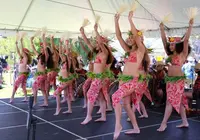
- Hercules Cultural FestivalHercules · Cultural festivalAn annual free cultural festival in Hercules, California, revived in 2023 after a decade's hiatus, where a Polynesian troupe dances a haka to live drums.
- Solano Swap MeetConcord · Open-air marketA lively open-air market where you can shop for bargains, fresh produce, clothing, antiques, and more, with great food, unique finds, and a fun, family-friendly atmosphere every weekend on the West Wind Solano Drive-In lot.
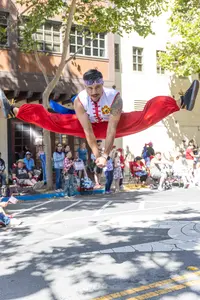
- Fourth of July Parade, Festival & FireworksConcord · July 4th celebrationConcord's Fourth of July in Contra Costa County, California: pancakes and a parade looping Todos Santos Plaza, then a free, alcohol-free festival and fireworks at Mt. Diablo High School.
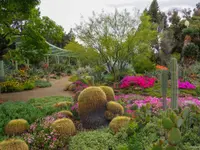
- The Ruth Bancroft GardenWalnut Creek · Botanical garden and plant nurseryThe Ruth Bancroft Garden houses a unique and diverse collection of cacti, succulents and drought tolerant plants from around the world. The many large mature specimens located throughout the 3.5 acre garden serve as an excellent example of just how stunning a dry garden can be.
- Jelly Belly FactoryFairfield · Factory tourThe Jelly Belly factory in Fairfield, California, where an elevated quarter-mile tour lane runs above a candy plant the company says makes 1,680 jelly beans a second.
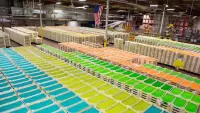
- Berkeley Old-Time Music ConventionBerkeley · Old-time music conventionAn annual five-day old-time music convention spread across Berkeley, California, whose string band contest still pays in agricultural prizes, as its 1968 ancestor paid in rutabagas.
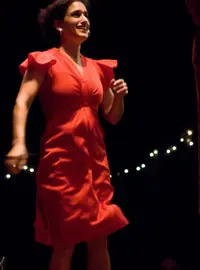
- Suisun Valley farm standsFairfield · Fruit & vegetable storeA fourth-generation farmer's stand, opened by Larry and Lisa Balestra in the summer of 1986 at the current location on Suisun Valley Rd. near Fairfield, CA.
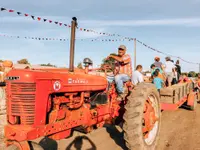
- Pear and Wine FestivalMoraga · Community eventCelebrates the Moraga Valley’s pear-orchard heritage.
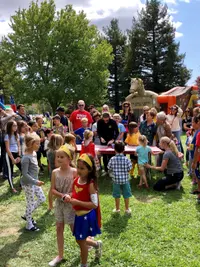
- Berkeley Flea MarketBerkeley · Open-air marketplaceThe Berkeley Flea Market has been a Bay Area cultural landmark since the early 1970s, grown out of the community surrounding the Ashby BART station and known for global crafts, music, food, and strong roots in African American culture.
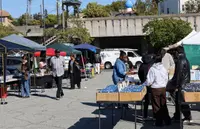
- Western Railway MuseumSuisun City · History museumA museum dedicated to preserving trains from California's past! Come visit us in Suisun City, CA.
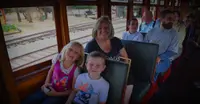
- Chabot Space & Science CenterOakland · Space and science centerOakland's home for STEAM education, located within Redwood Regional Park, with an Observatory, Planetarium, and exhibition galleries.
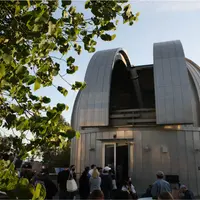
- Oakland Coliseum Swap MeetOakland · Swap meet and public marketAn open-air swap meet on a former drive-in lot in East Oakland, open seven days a week, where the old movie screen still stands over the kiddy train.
- Pleasants Valley Agriculture Association Open Farm DayVacaville · Association of farmers in vacavilleEvery year the farmers in Vacaville open their doors to an Open Farm Days - meet the farmers, pet the animals, taste the goodies, and purchase directly from the farmers.
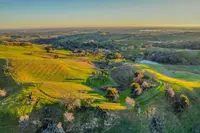
- Fourth of July ParadeNovato · ParadeNovato's Fourth of July parade, run by volunteers along seven-tenths of a mile of Grant Avenue in Marin County, descends from township parades documented as early as 1908.
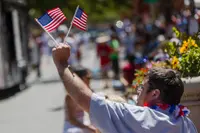
- Alameda Point Antiques FaireAlameda · Antique showA monthly antiques faire on the old runways of Naval Air Station Alameda, where more than 800 dealers may sell only goods at least 20 years old.
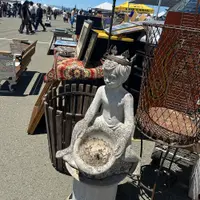
12 more within 30 miles on the road map.
Nearby towns: Concord, Fairfield, Berkeley, and Sebastopol. All the towns of California. More of California: Holiday Celebrations.
Sources
- Founders of Benicia (historical marker) hmdb.org/m.asp?m=16360
- California: A Guide to the Golden State (1939), p. 574 archive.org/details/californiaguidet00federich/page/574
- SITE OF FORMER BENICIA BARRACKS ohp.parks.ca.gov/ListedResources/Detail/177
- Robert Semple (historical marker) hmdb.org/m.asp?m=16371
- sfmuseum.org/hist10/phelanhist.html
- California State Parks ohp.parks.ca.gov/?page_id=21527
- National Register nomination, DATE npgallery.nps.gov/NRHP/GetAsset/c6487ebd-27f8-4290-9a6e-d5fa1c67047d
- Benicia Capitol State Historic Park parks.ca.gov/beniciacapitol
- California State Parks ohp.parks.ca.gov/ListedResources/Detail/176
- Clock Tower (historical marker) hmdb.org/m.asp?m=16305
- 1849 - Benicia Arsenal – 1964 (historical marker) hmdb.org/m.asp?m=16297
- Solano Hotel (historical marker) hmdb.org/m.asp?m=29711