Pullman
Whitman County, Washington. County seat.
Pullman, a university town in southeastern Washington, took its name from Chicago railcar magnate George Pullman, who by HistoryLink’s account had nothing to do with it.1,2,3
Details
- Founded
- Daniel G. McKenzie and Bolin Farr homesteaded at Three Forks in 1877, though local histories also credit Farr with arriving in 1876.2,3
- Name
- Orville Stewart named his June 1881 post office Pullman in honor of Chicago railcar magnate George Pullman.2
- County seat
- Pullman is not the county seat; Colfax, about fifteen miles away, is the seat of Whitman County.1,4
- Last checked
- October 6, 2026.
Point at a dot to see the place.Tap a dot to see the place. Road map of Pullman.
In Pullman
The Calendar

History
Where Three Creeks Meet
Pullman stands at the confluence of Missouri Flat Creek, Dry Creek, and the South Fork of the Palouse River, about 10 miles west of Moscow, Idaho, at an elevation of 2,552 feet.3 HistoryLink calls it by far the largest city in Whitman County, with nearly 30,000 residents, and Washington State University is the county’s largest employer.3
Three Forks and the Name Pullman
The Stevens Treaties of 1855 left the site of Pullman just inside the new Nez Perce Reservation, and another treaty in 1863 removed the reservation from Southeastern Washington.3 Local histories credit Bolin Farr with arriving in 1876 where a river and two creeks meet and naming his village Three Forks, while other versions put Daniel G. McKenzie first, in 1878.3 HistoryLink’s reading of the records holds that both men most likely settled on the site in 1877, McKenzie slightly ahead of Farr, in September.3 The story long told is that Farr’s supposed friend George Pullman, the Chicago railcar magnate, sent Farr and his neighbors $50 for the Fourth of July in 1881, and a grateful citizenry renamed the town for him.3 HistoryLink finds no evidence of a village called Three Forks, and gives the name to newcomer Orville Stewart, who in June 1881 set up an informal post office in his general store and named it Pullman.3 By that account the industrialist never had anything to do with the town, and the closest he came to it was a seat on the Board of Directors of the Oregon Railway & Navigation Company.3 McKenzie and Charles Moore of Moscow, Idaho, combined plats drawn in 1881 and 1882 into the original townsite, which already held a blacksmith shop, a saloon, and a hotel.3
Two Railroads and the Artesian City
Farmers had paid the O. R. & N.’s high rates at Almota and Wawawai on the Snake River until the Columbia and Palouse Railway completed its line into Pullman in 1885.2,3 The Northern Pacific’s Spokane and Palouse branch followed in 1887, giving a community of roughly 250 people access to ready markets at competitive rates.3 The town burned on June 26, 1887, and two business blocks were rebuilt in brick.5 Pullman was incorporated by court order on April 11, 1888, and after the state supreme court twice voided its standing, the court upheld it in 1894.2 The College Hill nomination counts 23 businesses and over 300 residents in the town and says the years from 1888 to 1892 have been called Pullman’s “boom time.”1 In May 1889 workers drilling a well for M. C. True, owner of the Palace Hotel on Main Street, struck a pressurized supply, the first of several artesian wells.3 The town burned a third time on July 3, 1890, yet the “Artesian City,” by then some 850 people, set out to keep its railroads and win the new state college.3,5
The College on College Hill
Representative W.S. Oliphant introduced a grant in 1890 to establish a land-grant institution in Pullman, and on May 30, 1891, Pullman was chosen as the site, a decision then challenged in court.1 Original enrollment stood at 84 students, all but 15 of them from Whitman County.1 The Campus, Rose Park, and Chambers additions were all platted by 1905, and the nomination credits the building boom on College Hill with making Pullman the leading town in Whitman County by that year.1 By 1910 the State College of Washington was serving 1,016 students, and Pullman had an additional 2,600 permanent residents.3 The United Presbyterians built a wooden church in 1899 for $4,000, and in 1913 moved it to the back of the lot, built a brick addition in front, and veneered the whole in Tenino sandstone for $50,000.6 That building, the Greystone, stood vacant for 25 years until Glenn and Melodie Petry of Pullman bought it in April 2004, and its renovation was completed in July 2005.6 In 1950 the Writers’ Program state guide reported test farming on a large scale at the Washington Agricultural Experiment Station at Pullman.7
Veterans, a University, and Deeper Water
The population went from 4,417 in 1940 to 12,022 in 1950, an increase of 172.2 percent, and HistoryLink gives the larger role to the “GI Bill.”3,5 On Easter Sunday, April 17, 1949, George A. McIntyre, a veteran who had opened an electric repair shop on Grand Avenue, headed up the west side of brush-covered College Hill and killed three law-enforcement officers and a taxicab driver in a 40-minute gun battle.4 Enrollment swelled to more than 7,000 students, and in 1959 an act of the legislature made Washington State College into Washington State University.3 Edmund O. Schweitzer III joined the faculty after finishing his Ph.D. in engineering in 1977, and in 1982 he founded Schweitzer Engineering Laboratories, which by 2014 employed nearly 3,800 people, about 2,000 of them at its complex in Pullman.3 The artesian wells tapped out in the 1970s, and the town now draws its water from an ancient volcanic reservoir buried beneath hundreds of feet of rock.3
Within 30 Miles
Measured in a straight line from the town, nearest first.
- Palouse Empire FairColfax · Agricultural fairWhitman County's four-day September agricultural fair, held since 1887 and on its own ground west of Colfax, Washington, since 1949, with a pink cow named Patience for its trademark.
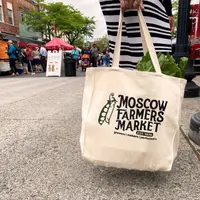
- Moscow Farmers MarketMoscow · Farmers marketThe Moscow Farmers Market is an award-winning, bustling community event that has been a beloved tradition since 1976. Nestled in the heart of the Palouse region, Moscow is a community that takes its agricultural heritage seriously, and the market reflects that commitment to farm-to-fork culture.
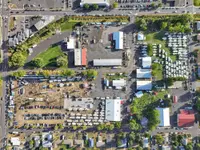
- Latah County FairMoscow · Four-day, admission free eventA four-day, admission free event welcoming over 20,000 of our families, friends, neighbors and communities from across the Palouse with a carnival, food, fun, games, entertainment, animals, logging sports, educational activities and more. A very proud Latah County tradition since 1911.
- Palouse DaysPalouse · Town daysWorld Famous Palouse Days, an annual community celebration the second weekend after Labor Day in downtown Palouse.
- The Codger PoleColfax · Chainsaw artworkArtist John LaBenne used a chainsaw to carve the faces of all 51 players into five 65-foot tall cedar poles.
- Concrete River DaysColfax · Annual concrete river days celebrationA one-day July festival in downtown Colfax, Washington, named for the town's concrete river, where rubber ducks once raced the canal and now serve as raffle tickets.
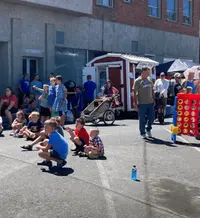
- Palouse Scenic BywayColfax · Scenic bywayKnown as a renowned photography destination, the Palouse Scenic Byway winds through rolling hills and farmland dotted with buttes formed by prehistoric glacial flooding. A mix of highways and quieter roads provides ample opportunity for peaceful exploration.

- Bald Mountain Lookout (Nez Perce-Clearwater National Forests, ID)Potlatch · Fire lookoutA retired fire lookout cab on a timber tower atop Bald Mountain in Idaho's Hoodoo Mountains, rented by the night since 1998, with the Palouse hills spread to the south.
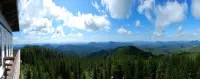
- Lewis and Clark Trail Scenic BywayClarkston · Scenic bywayThe Lewis and Clark Trail Scenic Byway in Washington follows the path of Meriwether Lewis and William Clark's famous Corps of Discovery expedition as it moved west along the Snake and Columbia rivers.
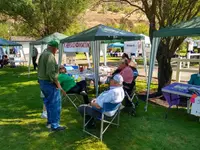
- Blackberry Festival & Classic Car ShowJuliaetta · Annual summer celebrationAn annual September festival and classic vehicle show in Juliaetta, Idaho's Centennial Park, where tractors park beside hot rods and dachshunds race on the softball field.
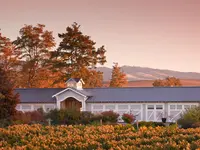
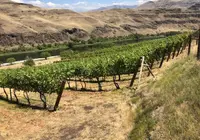
- Rivaura Estate Vineyards and WineryJuliaetta · Tasting roomOur original tasting room in Juliaetta, Idaho, sits just steps from the estate vineyard along the Clearwater River and welcomes guests looking to experience Rivaura wines where they are grown and crafted.
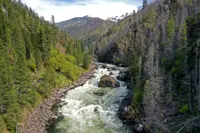
- Northwest Passage Scenic BywayLewiston · All american roadA route through the rivers, deep canyons, and rugged mountains of north-central Idaho and the land of the Nez Perce.
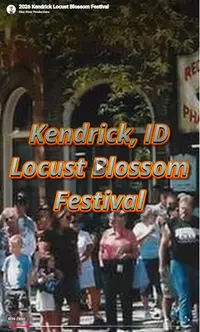
- Locust Blossom FestivalKendrick · FestivalThe Kendrick Lions Club's one-day spring festival in a Potlatch River canyon town of Latah County, Idaho, held since 1961, when the barbecue beef sandwich cost a dollar.
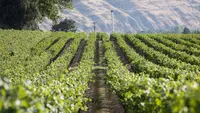
- Clearwater Canyon CellarsLewiston · Estate wineryAn estate winery on the Nichols family's 1916 century farm in the Lewiston Orchards, where a granddaughter's first Merlot made the valley's first vinifera wine since Prohibition.
- Garfield County Fair & RodeoPomeroy · County fair and rodeoThree September days of livestock shows, exhibit halls and a Sunday rodeo at the Garfield County Fairgrounds in Pomeroy, Washington, where the rodeo card runs from mutton busting to wild cow milking.
6 more within 30 miles on the road map.
All the towns of Washington. More of Washington: Town Festivals and Factory Tours.
Sources
- National Register nomination, College Hill Historic District npgallery.nps.gov/GetAsset/efaa4fe6-a96c-49af-88a0-3bdffadce633
- Pullman incorporates on April 11, 1888. historylink.org/File/11117
- Pullman -- Thumbnail History historylink.org/file/11116
- George A. McIntyre shoots and kills four people in Pullman on April 17, 1949. historylink.org/File/8824
- Historic Context Study of the Chinese Community in Pullman, 1860-1970 dahp.wa.gov/sites/default/files/The%20Chinese%20in%20Pullman%20Historic%20Context_August%202023_0.pdf
- History of the Greystone Church (historical marker) hmdb.org/m.asp?m=305948
- Washington: A Guide to the Evergreen State (1950), p. 24 babel.hathitrust.org/cgi/pt?id=mdp.39015010545013&seq=62