Thermopolis
Hot Springs County, Wyoming. County seat.
Thermopolis, seat of Hot Springs County, Wyoming, stands on land the Shoshone and Arapaho sold in 1896, hot springs included; settlers from nearby towns then moved there.1,2
Details
- Founded
- Thermopolis began in the 1880s near the mouth of Owl Creek, and in 1897 its residents moved the town to the newly opened land beside Hot Springs State Park.1
- Name
- The town was named for the nearby hot springs, combining the Greek words thermo, hot, and polis, city.2
- County seat
- On Feb. 9, 1911, the Legislature established Hot Springs County with Thermopolis as its county seat.1
- Last checked
- October 6, 2026.
Point at a dot to see the place.Tap a dot to see the place. Road map of Thermopolis.
In Thermopolis
- State Bath HouseThermopolis · Bath houseFree public soaking facility inside Hot Springs State Park on Tepee Street.
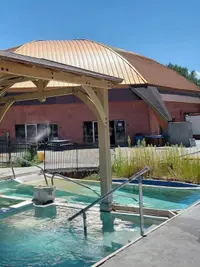
- Tepee Pool and SpaThermopolis · Swimming poolHot Springs State Park in Thermopolis, Wyoming, was established in 1897 as the Big Horn Hot Springs State Reserve, making it Wyoming's first state park. The park is centered around the world's largest mineral hot springs, which flow at a rate of approximately 8,000 gallons per minute at a constant temperature of 135 degrees.
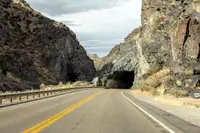
- Wind River Canyon Scenic BywayThermopolis · Wyoming state scenic bywayA Geologic Masterpiece. The Wind River Canyon Scenic Byway begins in the town of Shoshoni and follows U.S. 20 north through Wind River Canyon and the Wind River Indian Reservation ending just south of Thermopolis.
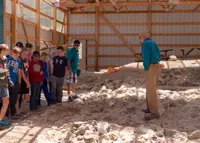
- Wyoming Dinosaur Center dig sitesThermopolis · Half-day digWith over 70 mounted skeletons and hundreds of displays and dioramas, the Wyoming Dinosaur Center will educate, inspire and capture the imagination of children and adults alike.
The Calendar
History
A Street for Sixteen Mules
Broadway was laid out 150 feet wide after freighter Henry “Sixteen Mule Team” Johnson asked for a street wide enough to turn his team of sixteen mules.2 The town stands on the Northern Burlington railroad line at the mouth of Wind River Canyon, about 120 miles southeast of Yellowstone National Park.3 Its name, for the nearby hot springs, joins the Greek words thermo, hot, and polis, city.2
The Springs and the Sale of 1896
The Shoshone held the large hot springs sacred, recognizing their therapeutic properties and thinking of them as inhabited by spirits.1 Fur trapper Daniel Potts described them in a letter home to Pennsylvania as early as 1826.1 After the Shoshone Reservation was established in 1868 the springs lay within it, and though settlers could not formally claim the land, squatters lived near them in tents and dugouts.1 By the mid-1890s the springs were producing 19 million gallons of hot water a day, and, historian Geoffrey O’Gara writes, entrepreneurs had dug ditches to bring the flow to “tent-walled spas with names like Hotel de Sagebrush.”4 The Plaza Hotel marker quotes an 1886 report by Indian Inspector James McLaughlin that the 132-degree water, with salt and pepper added, tasted very much like fresh chicken broth.5 McLaughlin raised his offer for the springs land to $60,000, and on April 21, 1896, 180 Shoshones and 93 Arapahos signed, just under 60 percent of the adult men.4 Washakie added a single condition, that people always be allowed to bathe there for free, and free swimming is still offered year round at the state bath house in Hot Springs State Park.4 Each year the town stages “The Gift of the Waters,” in which a Shoshone reads Washakie’s words from a 1925 script, though WyoHistory notes that no record of the 1896 negotiations mentions such a speech.1
From Owl Creek to the Townsite
The first Thermopolis began in the 1880s near the mouth of Owl Creek, just outside the reservation and downstream from the present site, with stores serving ranchers and homesteaders.1 Sources differ on the old town: the State Historic Preservation Office calls it Andersonville, WyoHistory puts Andersonville just across the Bighorn River from Thermopolis, and the state marker names both Andersonville and Old Thermopolis.1,2,3 Outlaws including Jim McCloud, Harry Longabaugh, known as the Sundance Kid, and Robert Leroy Parker, known as Butch Cassidy, appear to have visited Andersonville regularly.1 Through the efforts of Congressman Frank W. Mondell, Congress passed his plan in 1897, Hot Springs State Park opened, and residents moved the town onto the newly opened land by the park.1,6 A Natrona County Tribune writer in 1901 described the thirty-six-hour, 140-mile stage ride from Casper and, near Andersonville, saw across the river where the old town of Thermopolis had stood just three years before.7
Rails, Sanitaria and the County Seat
The first sanitarium opened in 1902, and in 1906 Drs. J.R. and Charles Richards financed and built a sanitarium and hotel in the park.6 Copper was found nearby in 1906, the first oil drilling rigs arrived in 1913, and sulphate of potassium was discovered in 1916.6 The Burlington Railroad reached Thermopolis from the north in 1910, its first train carrying sixty or more people, and with it, the state marker says, the freighting era was gone forever.1,2 The Burlington finished its line through Wind River Canyon in 1911, and on Feb. 9, 1911, the Legislature made Thermopolis seat of the new Hot Springs County, whose government was organized in January 1913.1 The 1900 census counted 299 men, women and children, the Chamber of Commerce reported 1500 in 1910, and in 1917 the Laramie Republican estimated that 30,000 tourists had visited Thermopolis.6 By 1932, the National Register nomination notes, only one hotel was left, and it asks what happened between the late 1920s and early 1930s.6
Sandstone, Brick and Travertine
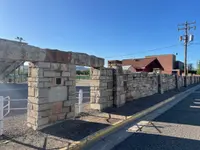
The Downtown Thermopolis Historic District, listed on the National Register of Historic Places in 1983, holds commercial buildings constructed between 1898 and 1923.2,3 The nomination calls a building begun in 1898 and given a second story in 1906 the oldest in the district, and credits buildings of 1916-1919 to Charlie Smith, a local bricklayer.6 A building put up in 1923 for the Wyoming Trust Company served as the county courthouse from 1937-39.6 In the park, master bricklayer James Callaghan fired the bricks for his apartments in kilns along the Big Horn River, and Dr. P.W. Metz bought the building in 1921 and renamed it the Plaza Hotel, which its marker calls the only remaining hotel in the park from the era of early commercialization.5 Nearby, the Tepee Fountain, built in 1909 to vent steam from the piped mineral water, still gathers layer upon layer of travertine as the water cools over it.8
Within 30 Miles
Measured in a straight line from the town, nearest first.
- Wyoming State BBQ Championship and Bluegrass FestivalWorland · BBQ championship and bluegrass festivalA KCBS-sanctioned barbecue championship and bluegrass festival held each third weekend of August since 2004 at the Washakie County Fairgrounds in Worland, where purchases are made in Bone Bucks.
- Worland Artesian FountainWorland · Artesian water fountainTwo artesian wells about 20 miles northeast of Worland supply this downtown fountain, which invites thirsty travelers to share and partake of the award-winning mountain water.
- Big Cedar Ridge fossil plant areaWorland · Fossil siteA federal fossil plant site off Blue Bank Road southeast of Worland, Wyoming, where a Late Cretaceous landscape lies buried in place beneath a band of volcanic ash.
- Washakie County FairWorland · FairWe would like to take this opportunity to thank all of the sponsors, advertisers, work crews & volunteers, but most of all you, the participant, for helping to make the Washakie County Fair the tremendous success that it is.
All the towns of Wyoming. More of Wyoming: Fairs & Rodeos, Scenic Drives, and Town Festivals.
Sources
- Hot Springs County, Wyoming wyohistory.org/encyclopedia/hot-springs-county-wyoming
- Broad Streets of Thermopiles (historical marker) hmdb.org/m.asp?m=97782
- Downtown Thermopolis Historic District (wyoshpo.wyo.gov) wyoshpo.wyo.gov/index.php/programs/national-register/wyoming-listings/view-full-list/591-downtown-thermopolis-historic-district
- When the Tribes Sold the Hot Springs wyohistory.org/encyclopedia/when-tribes-sold-hot-springs
- The Plaza Hotel (historical marker) hmdb.org/m.asp?m=97758
- Downtown Thermopolis Historic District National Register ... wyoshpo.wyo.gov/index.php/files/749/Hot%20Springs%20County%20NR%20forms/532/Downtown%20Thermopolis%20Historic%20District%20National%20Register%20form.pdf
- Riding the Stage from Casper to Thermopolis, 1901 wyohistory.org/encyclopedia/riding-stage-casper-thermopolis-1901
- Tepee Fountain (historical marker) hmdb.org/m.asp?m=97743