Delta
Millard County, Utah.
Delta is a Millard County, Utah, town lying fifteen miles east of the Topaz Relocation Center site.1,2
Details
- Last checked
- October 6, 2026.
Point at a dot to see the place.Tap a dot to see the place. Road map of Delta.
In Delta
- A New Dig Fossils QuarryDelta · Owner-run paleontological trilobite fee dig (wheeler shale quarry)A fee dig at Antelope Springs in Utah's House Range, where Clay Holman's excavator turns up Wheeler Shale for visitors and once turned up an animal found nowhere else.
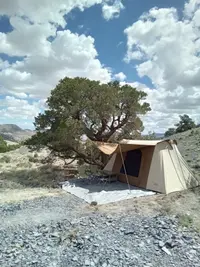
- Gem.tours fee digs (Solar Wind & Searle Canyon mines)Delta · Private gem mine dig operatorGem.tours sells guided fee digs at five world-famous mines in Utah's West Desert near Delta; visitors keep what they find.
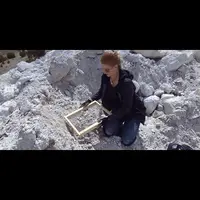
- Sunstone KnollDelta · Knoll formed of volcanic vents (early pleistocene eruptions)Sunstone is a transparent, yellowish labradorite (a plagioclase feldspar mineral) found as crystals in these volcanic rocks and on the flats surrounding the knoll.
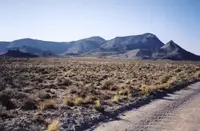
- Topaz Mountain Rockhound Recreation AreaDelta · Rockhound recreation areaSome of the most productive and diverse rockhound areas in the west; visitors can collect a variety of topaz and crystals, with trilobite beds at Antelope Springs and geode beds near Dugway nearby.
The Calendar

History
Fort Deseret and the Sevier Dams
A photograph dated 1910, held in the LaVell Sorenson Johnson collection at the Utah State Historical Society, shows the Milton Moody Land Office in Delta.3 Settlement in western Millard County has run in a string of boom and bust cycles, most of them tied to water.2 Near Delta, the state marker records, Fort Deseret was built in 1866 of adobe mud by two teams of 98 men to protect settlers during the Black Hawk Indian Wars.1
Pioneers worked to tame the tail end of the Sevier River with dams, canals, and reservoirs.2 In August 1909 Hiette E. Maxfield kept the time log for work on Burtner Dam, and the river broke through in 1909-1910.3 Construction on the Sevier Bridge Reservoir was under way on 23 November 1913, and its dam, pictured in 1916, was renamed Yuba Dam in 1987.3 By the 1910s the major dams were stable, and a boom followed when the Union Pacific Railroad invited Midwesterners to farm the area.2
Main Street, Sugar Beets, and Fire
Photographs from 1910 show the S. W. Eccles General Merchandise Store on Main Street and a single building that served as church and school.3 The Bank Hotel appears in a picture from 1912, and other views show a Union Pacific train on the tracks at Delta Station.3 The Utah-Idaho Sugar Company kept an office building in Delta, and the Delta Sugar Factory had its own railroad, mess hall, and infirmary.3 Photographs taken at Sugarville show the Delta North Tract in 1919-1920 and the Cochrane Ranch in September 1919.3
Canals broke in the Great Wash in May 1919.3 A series of crop failures discouraged the Iowa transplants, but local Delta realtors soon invited new farmers onto the abandoned land.2 In 1922 fire took the Ward Hotel, and photographs record Clark or Main Street after the blaze.3 In 1927 Pete Sampson tore down the sugar factory and shipped it away.3 In 1941 the state guide to Utah found the irrigated lands around Lynndyl and Delta quite productive, along a US 6 route paralleled by the Union Pacific between Elberta and Delta.4 A photograph in the Johnson collection shows the Brush Beryllium Plant northeast of Delta.3
Topaz, Fifteen Miles West
After Pearl Harbor, Delta realtors heard that the government wanted places to house Japanese-Americans removed from the coast, and secret meetings between Delta residents and officials took place as early as January and February 1942.2 The 17,000-acre Central Utah Relocation Center, later renamed Topaz after a nearby mountain, went up fifteen miles west of Delta, beyond the small town of Abraham.2 The camp opened 11 September 1942, and Japanese-Americans from the San Francisco area, held since March at Tanforan Race Track, came to Delta by train.2 The Utah History Encyclopedia puts the camp’s population at about 8,000 soon after opening, while a state teaching guide says Topaz housed more than 11,000 people between 1942 and its closing in 1945.2,5
Internees could get passes to shop in Delta and some found work there, though one man employed at the local newspaper was then charged “rent” at the camp.2 On 11 April 1943 a guard shot James Wakasa, age 63, as he stood near the southwest section of the fence.2 The camp closed in October 1945, and its buildings were dismantled or moved, leaving cindered roads and the foundations of latrines and mess halls.2 In 1976 the Japanese-American Citizen League erected a monument near the site of the camp.2
Within 30 Miles
Measured in a straight line from the town, nearest first.
- Oak City DaysOak CityA two-day event held in August to celebrate the founding of the town.
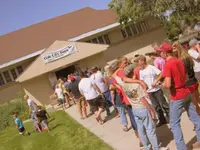
- Leamarado DaysLeamington · Homecoming celebrationLeamington's Labor Day homecoming in Millard County, Utah, begun in 1946 for returning World War II soldiers, runs from a morning talent show at Town Hall to a 3:30 rodeo.
- Crystal Peak quartz collectingDelta · Rockhounding siteIn the Crystal Peak area you can find very small white quartz crystals.
- Utah State Fiddle ContestFillmore · Fiddle contestCategories span Junior Fiddle through Harmonica across age groups; awards for winners will be presented at the conclusion of the contest.
All the towns of Utah. More of Utah: Fairs & Rodeos and Rockhounding.
Sources
- Fort Deseret (historical marker) hmdb.org/m.asp?m=69544
- Topaz Relocation Center historytogo.utah.gov/topaz-relocation-center
- The LaVell Sorenson Johnson Photograph Collection, 1934-1980 history.utah.gov/finding-aids/data/C00011/c0011.html
- Utah: A Guide to the State (1941), p. 410 babel.hathitrust.org/cgi/pt?id=uc1.$b339&seq=502
- OUR PAST, THEIR PRESENT Teaching Utah with Primary Sources history.utah.gov/wp-content/uploads/2018/11/K12_Japanese-Internment-at-Topaz_OPTP.pdf