A New Dig Fossils Quarry
Delta, Millard County, Utah. Owner-run paleontological trilobite fee dig (Wheeler Shale quarry).
Details

- Where
- Hinckley, Delta, UT 84635. Directions
- Season
- Open any day of the year, weather permitting.
- Getting there
- From Delta travel west on Highway 6/50 for 29 miles (mile marker 56), turn right onto a maintained gravel and dirt road, travel 20 miles (dangerous curves about 11 and 15 miles up); the quarry is at Antelope Springs, just around the bend from U-Dig Fossil Quarry.
- Fees
- $80 per adult 4-hour dig ($160 full 8-hour day); $20 youth 13-18; group rate 10+ people $60; student group rate 4+ people $40; children 12 and under free per paying adult, additional children $10.
- Access
- Roads well maintained and any vehicle can get here; four wheel drive is not necessary; carry a spare tire and fuel up in Delta; printed directions recommended as navigation service drops in the mountains.
- Walk-in or reserve
- Required - call or text at least a day or two before you plan to visit.
- Website
- anewdigfossils.com
- Managed by
- A New Dig, Inc. (Clay Holman, Jessica Schenk).
At the Antelope Springs stand pipe in the House Range, where water runs out of a pipe beside the road, a little yellow sign points up a driveway. The printed directions tell visitors to pass the U-Dig sign, “hug the turn to the right, take two breaths,” and look for it. The hill road ends at A New Dig, a fee quarry in the Wheeler Shale at nearly 7,400 feet. Clay Holman and Jessica Schenk run it, and visitors there split rock for trilobites.
The approach starts in Delta. An Explorer Corps marker outside the R.J. Law Community Center on Main Street is about trilobites, and the Main Street Rock Shop on the west side of town keeps the quarry’s fliers and map. From town, Highway 6/50 runs west 29 miles to mile marker 56. There a maintained gravel and dirt road turns off to the right and climbs 20 miles into the mountains, with dangerous curves at about 11 and 15 miles. Electronic navigation usually drops once the road reaches the mountains, so the quarry asks visitors to print the directions, carry a spare tire and jack, and fuel up in Delta. Four-wheel drive is not needed. The last stretch passes through another quarry, and the operators ask visitors to make sure they have reached A New Dig before they start digging.
At the end of August 2026 a storm left rapids and washouts on one route in. According to the quarry’s account, the same storm toppled a train and blew out windows in a rural town twenty miles away, and water still ran through the dry washes a day later. The Long Ridge Road approach from mile marker 56 stayed open. The next visitors arrived in a Tesla with white seats and a small hybrid SUV: four mothers and six children. The account quoted the mothers: “These kids are fossil hunting today!” It recorded the car as the first Tesla to reach the quarry.
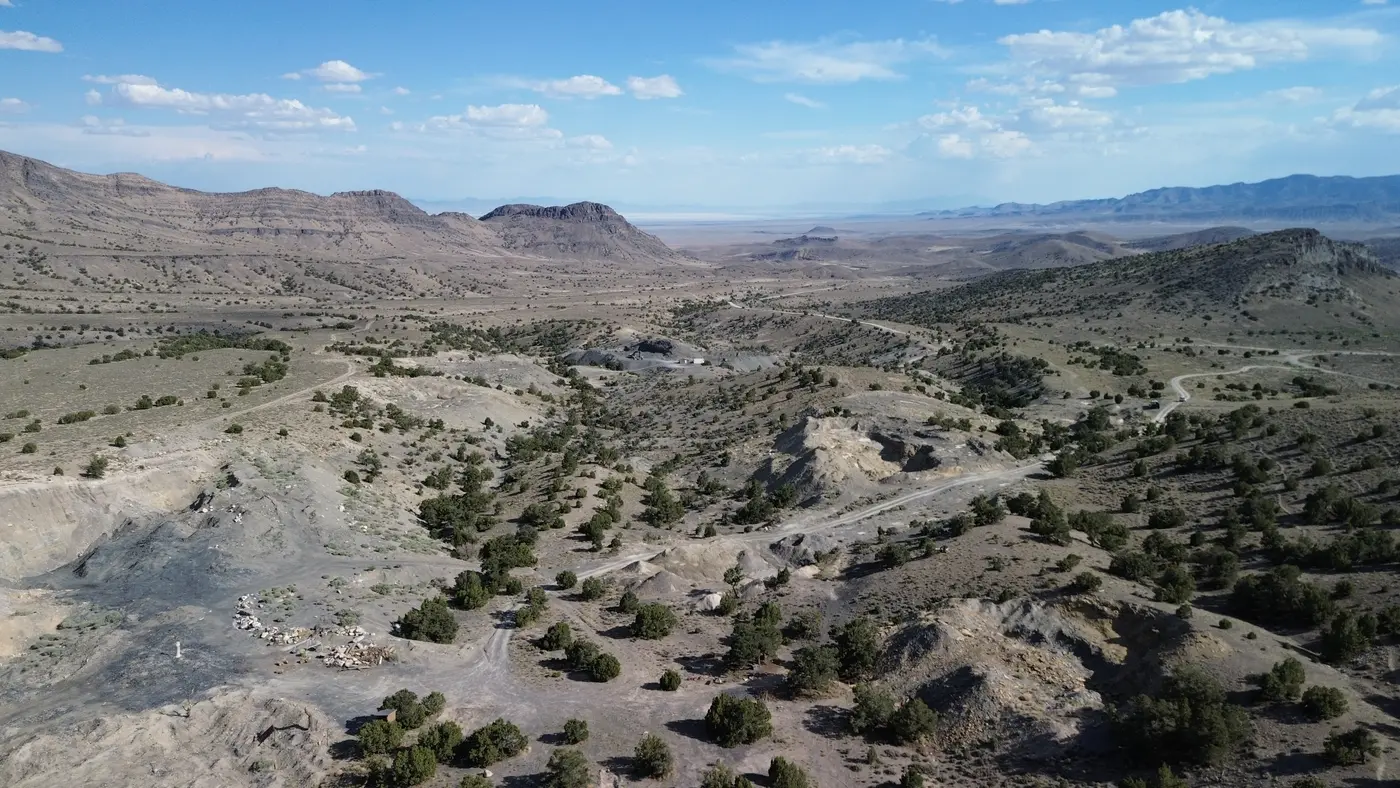
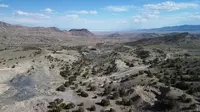
The company leases one 40-acre quarry from Utah State Trust Lands. It also works with the 40 acres along its southern border, which it calls the oldest trilobite quarry in the area. Swasey Mountain wraps around the ridge, Notch Peak stands in the distance, and the slopes carry piñon pine, juniper, and sage.
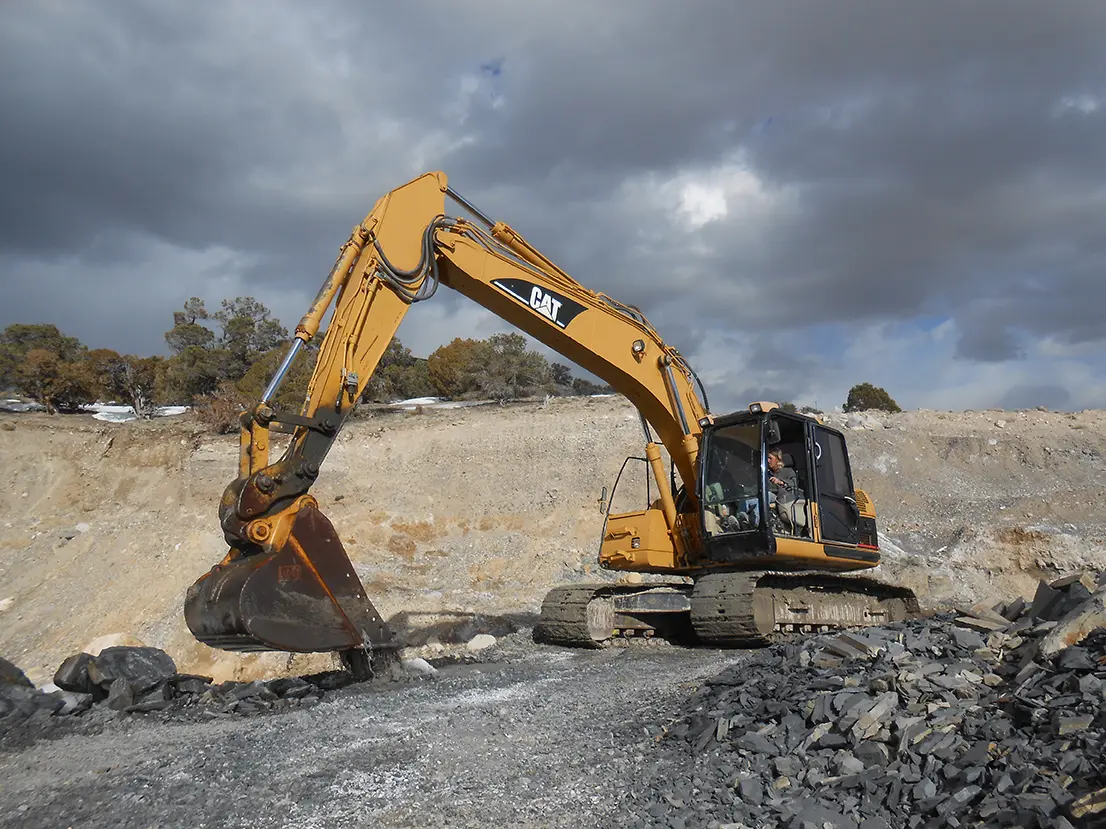
Splitting shale beside the excavator
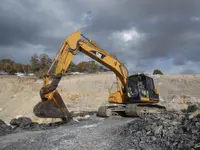
Holman runs the excavator. He pulls fresh rock from the face and stirs the old piles. For a visitor with a bad back, the quarry says, he will bring the scoop right to the car. Diggers bring thick gloves, buckets or flat cardboard boxes, and paper towels for wrapping specimens. The quarry lends flat-edged rock hammers to anyone without one.
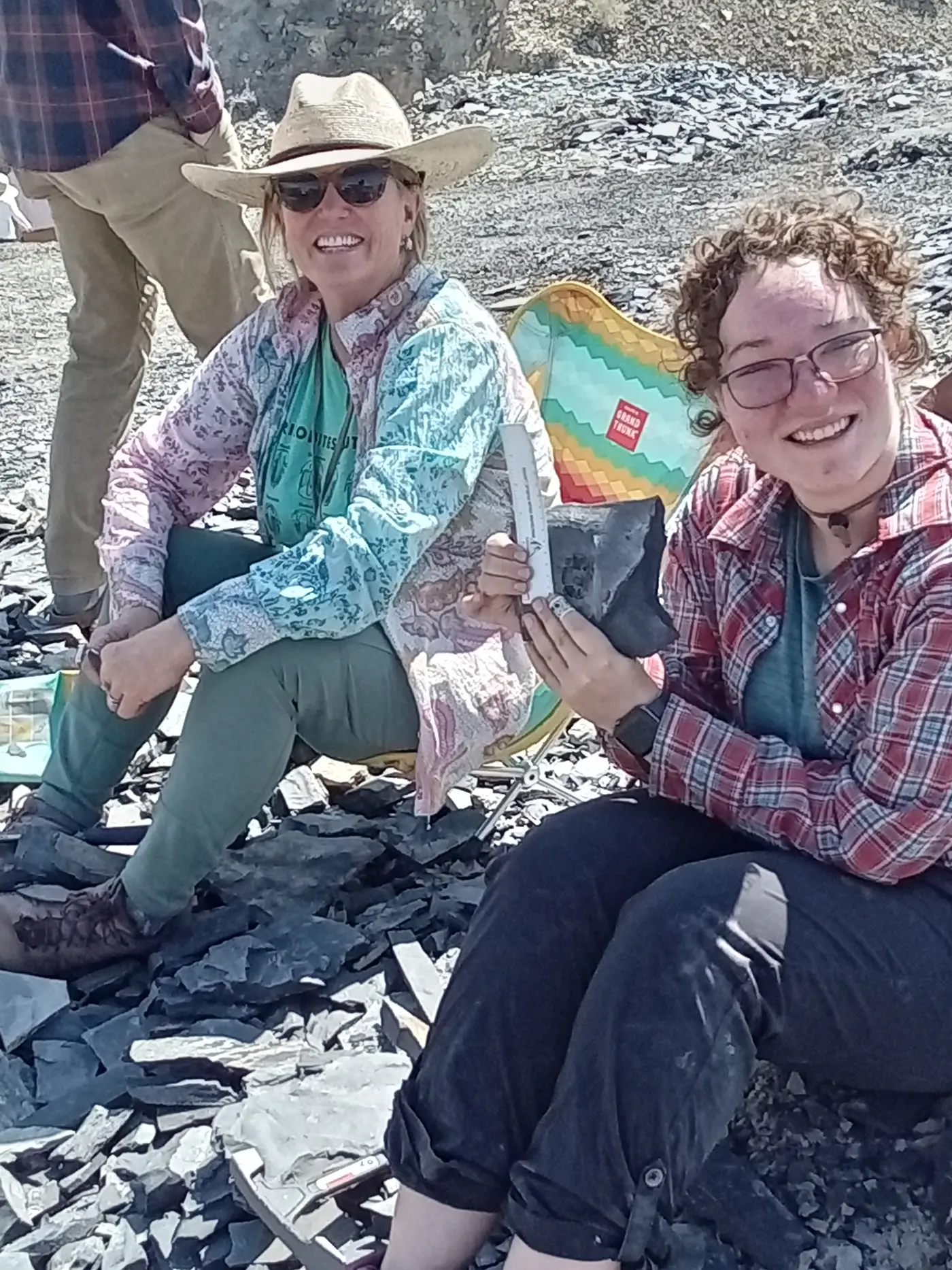
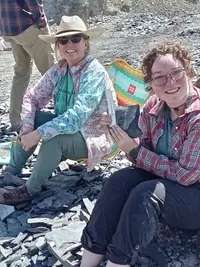
Holman sits with the visitors, shows them which rocks to work, and demonstrates how to split them. A July 2026 post shows his method: hold the slab at an angle, never straight up at 90 degrees. Not every split holds a fossil. The quarry’s advice is to turn each piece at sharp angles and watch for lumps, which are trilobites still under a skin of rock. Fresh, unweathered shale is hard and dark gray, and it can yield plates a couple of feet across. Rock left out for several months cracks and pops, and loose trilobites drop out of it more easily.
Rain does the same work faster. After a storm in August 2026, by the quarry’s account, “trilobites were EVERYWHERE.” Holman handed them to a Florida family on a road trip about as fast as he found them, while the children went off hunting on their own. That summer’s posts also mention two women from a Helena, Montana, rock club and a digger named Martin who filled his bucket in a few hours.
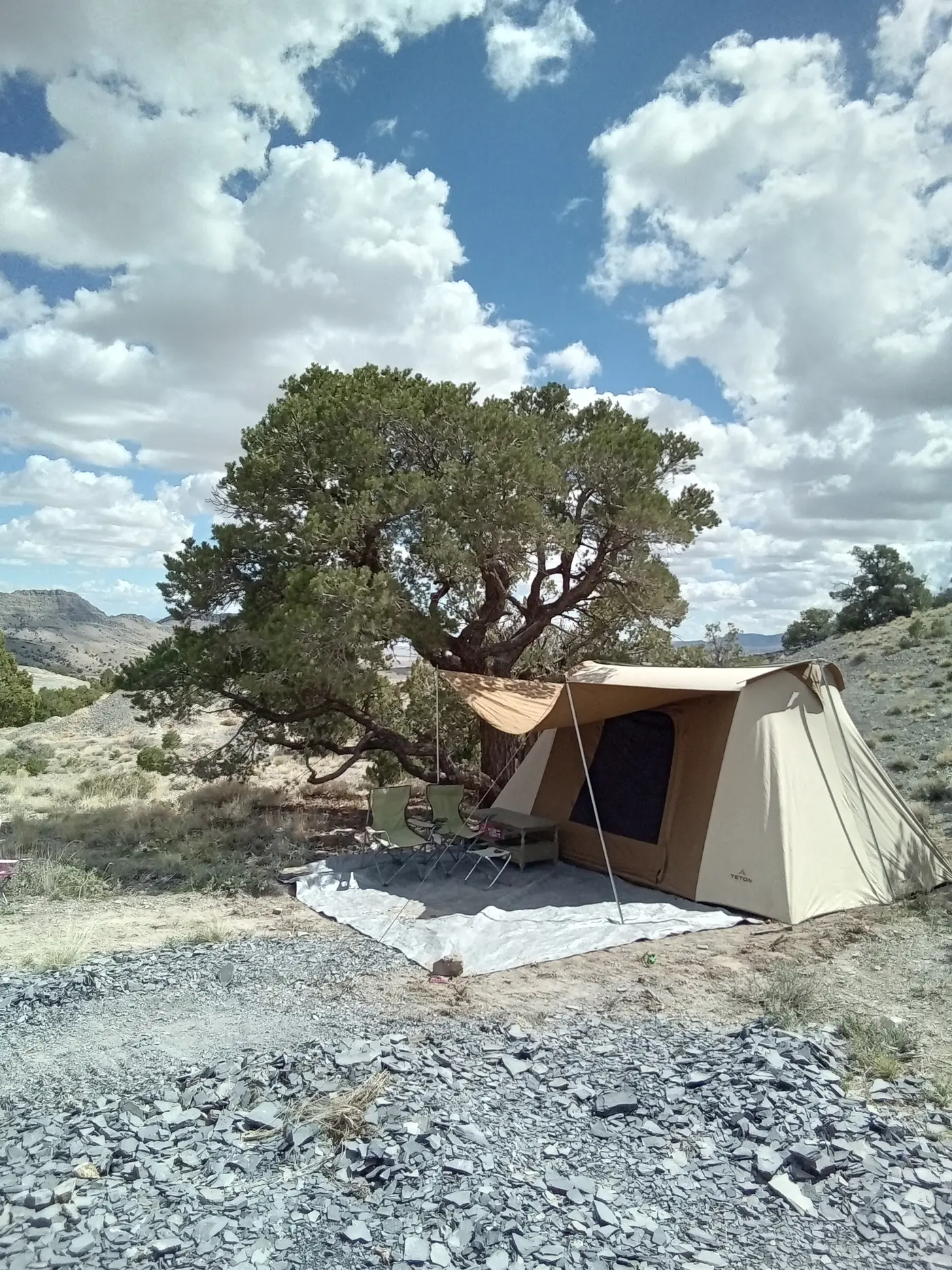
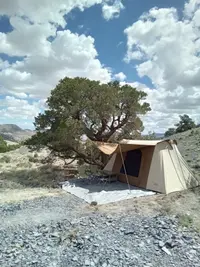
In the heat of summer the crew eats lunch in what the account calls the excavator’s “ten inches of shade.” The account compares it to the Ragtown photographs of Hoover Dam workers’ families crowded beside their tin shelters. The quarry is open any day of the year, weather permitting, and visitors must call or text a day or two ahead. Visitors may dry camp or park an RV at the quarry and, in the site’s words, “sleep under the milky-way.” A newer furnished site comes with a large canvas tent, sleeping pad, and camp stove. According to the account, Holman has been splitting shale for half a century.
Elrathia and stranger animals
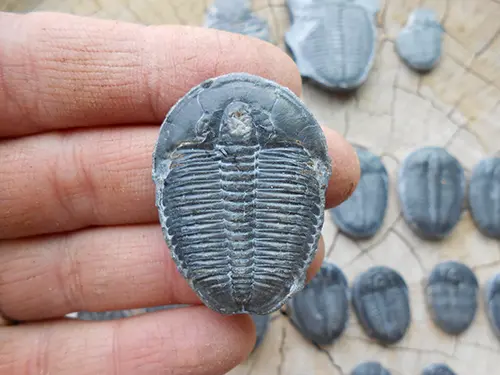
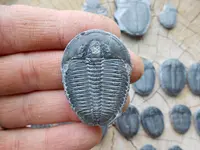
The most common find is Elrathia kingii. Trilobites shed their cheeks when they molted, so most specimens are empty shells. The quarry counts a fossil as complete only when the cheeks are still in place.
The same layers yield Asaphiscus, Peronopsis, Bathyuriscus, Olenoides, Bolaspidella, and Altiocculus harrisi, along with brachiopods, the alga Margaritia, worms, and worm burrows. Rarer still are animals without hard shells. These include the grasping appendages of the radiodonts Anomalocaris and Cariosyntrips, Pahvantia hastata, Isoxys, phyllocarids, and what may be a Leanchoilia. In June 2026 the quarry posted an oral cone tooth about two centimeters long, lying beside an Elrathia molt. The account reckoned the whole mouth might have been the size of a palm.
The quarry describes its Elrathia as black and jewelry grade. In July 2026 a parcel went to Zion Prospector’s rock shop in Springdale. The University of California Museum of Paleontology reports that Elrathia is common enough at some Wheeler Shale sites to be quarried commercially and made into bolo ties, earrings, and belt buckles. Randall Irmis, curator of paleontology at the Natural History Museum of Utah, says millions have come out of these rocks. “This trilobite really should be Utah’s state fossil,” he says. A trilobite in a rock shop or a school fossil set, he adds, is likely an Elrathia kingii from western Utah.
Cleaning them is slow work. A September 2026 post describes the method: needle-nose pliers and a low-rpm rotary tool with an extra-fine steel brush, barely touching each trilobite. One small batch took about an hour, and at least a thousand more were waiting. “I don’t want to destroy 500 million years of preservation!” the account wrote.
The only Thelxiope holmani
The quarry’s rarest find came from Holman himself. In April 2020 the journal PeerJ published a revision of Thelxiope by Rudy Lerosey-Aubril and Javier Ortega-Hernández of Harvard and Jacob Skabelund of Wellsville, Utah. Thelxiope is a soft-bodied animal with long spines down its midline: one on the head shield, one on each segment of the thorax, and three on the tail. The paper named a new species, T. holmani, from a single specimen collected in the upper Wheeler Formation at the quarry. Its relatives carry one or two oversized spines. T. holmani has none, and the tips of its thoracic segments are blunt.
The quarry’s account says no second specimen has turned up. The animal was about the size of an average palm, with a head shield of a couple of centimeters. A photograph of it covered the 2020–2021 annual report of Harvard’s Museum of Comparative Zoology. The account ended its post: “(I hope he finds another one!)”
A bay of the Cambrian sea
The quarry’s layers are more than half a billion years old, from about the time of the Cambrian explosion. Laurentia, the continent that became most of North America, then lay near the equator and was turned about ninety degrees from its present position. The Utah Geological Survey explains that the land subsided between about 540 and 500 million years ago, moving the shoreline east across Utah. Western Utah collected a fairly complete sequence of Cambrian sediment as a result.
In the middle of the period the sea entered central Utah through a broad bay, the House Embayment. Near shore, limestone formed in warm shallow water. Farther out, fine mud settled in deeper water, sometimes all at once when undersea landslides carried sediment off the limestone platform. The Berkeley museum credits that sudden burial for the fine preservation. The Harvard authors place the Wheeler strata probably closer to shore than the Burgess Shale of British Columbia, though both are deep-water shales.
The Wheeler Shale is named for the Wheeler Amphitheater, a great bowl in the House Range. Its beds form the slopes of Swasey Peak, and the Marjum Formation caps the summit. Irmis notes that the Wheeler, Marjum, and Weeks formations each record a different slice of Cambrian time, separated by hundreds of thousands, even millions, of years. “The House Range in Millard County preserves perhaps the best record of ancient life from the Cambrian Period anywhere in the world,” he says. The quarry makes its own comparison: it calls the soft-bodied preservation in its layers as world-class as the Burgess Shale and Chengjiang in South China.
Springs, surveyors, and a permit
Water is scarce in the range, and Antelope Springs is one of the few places to find it. The quarry’s history suggests the spring may have been the main draw for the first inhabitants, the Pahvant Ute, and later for the surveyors. By the same account, the Pahvant Ute collected trilobites, presumably believed they held magical or supernatural power, and wore them as amulets and necklaces for protection.
Geological exploration of the range began in 1859 with Army Captain James Simpson. Lieutenant George Wheeler carried it on through 1889, Charles Walcott made paleontological surveys around the turn of the century, and the work went on until 1950. The Natural History Museum of Utah dates the first published descriptions of House Range fossils to the 1850s.
Commercial trilobite digging began in the late 1960s, when the first excavation permit was issued. In August 2026 the quarry sold a parcel of its jewelry-grade Elrathia kingii to a silversmith, to be made into jewelry.
Notable Events
- 1859Geological exploration of the House Range began, with an early mission led by Army Captain James Simpson. anewdigfossils.com
- 1960sCommercial trilobite production started when the first excavation permit was obtained. anewdigfossils.com
- 2020A new species was described from a sole holotype collected in Drumian strata of the upper Wheeler Formation at New Dig Quarry. peerj.com
People
- Charles Walcott, Led paleontological surveys in the House Range (around the turn of the century).
- Clay Holman, A New Dig owner who found the new species Thelxiope holmani at the quarry.
- George Wheeler, Army lieutenant who continued House Range geological exploration (through 1889).
- James Simpson, Army captain who led an early House Range geological exploration mission (1859).