Buffalo
Johnson County, Wyoming. County seat.
Buffalo, the Johnson County seat, began as a trading center for Fort McKinney and in 1892 was the town a cattle barons’ invasion rode toward.1,2
Details
- Founded
- Buffalo began as a village supplying Fort McKinney, just outside the fort’s military reservation, and the county marker dates its first buildings to 1879.2,3,4
- Name
- The name Buffalo was drawn from a hat and offered by a native of Buffalo, New York.3
- County seat
- Buffalo has been the seat of Johnson County since the county government formed on May 10, 1881.3
- Last checked
- October 6, 2026.
Point at a dot to see the place.Tap a dot to see the place. Road map of Buffalo.
In Buffalo
- Cloud Peak SkywayBuffalo · Paved scenic driveThe Cloud Peak Skyway carries U.S. 16 over the Bighorn Mountains from Buffalo to Ten Sleep, crossing 9,666-foot Powder River Pass on a road finished as gravel in 1922.
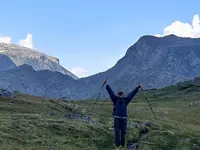
- Klondike RanchBuffalo · Dude and guest ranch
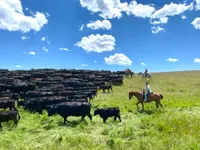
- Mountain Meadow Wool MillBuffalo · Wool millWool mill at the foot of the Big Horn Mountains in Buffalo, Wyoming, with a self-guided mezzanine tour over a working production floor; visitors see the full process from shorn raw wool to hand-dyed finished yarn and can shop natural products made with the mill yarn.
- Paradise Guest RanchBuffalo · Wyoming guest ranchFamily-owned Wyoming guest ranch with horseback riding across sage meadows, fly fishing for cutthroat trout, hiking among wildflowers, a kids' program, heated pool and hot tub, French Creek Saloon, weddings, and adults-only weeks; in operation over 100 years.
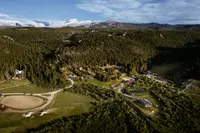
- Pole Creek CabinBuffalo · CabinTwo room cabin that can sleep 4-6 people in two sets of bunk beds; main room has wood stove heat, kitchen cabinets and counter, table, chairs and benches.
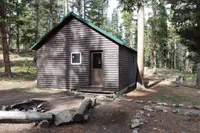
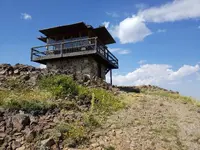
- Sheep Mountain Fire LookoutBuffalo · LookoutConstructed in 1950 by the Civilian Conservation Corps (CCC) atop Sheep Mountain at an elevation of 9,600 feet, the lookout was historically occupied as a fire lookout until the early 1970s.
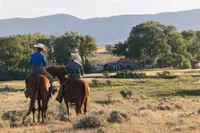
- TA RanchBuffalo · All-inclusive guest ranch and working cattle ranchDude Ranchers' Association member ranch; guest capacity 26
- Wednesday MarketBuffaloThe Wednesday Market is one of the marquee events Buffalo Wyoming hosts as local vendors and farmers are selling their goods to the public
The Calendar
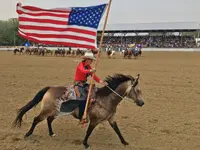
History
Fort McKinney on Clear Creek
Clear Creek runs under Main Street in Buffalo, and the state historic preservation office calls it the original impetus for locating the town at this site.5 In the 1876 campaign the army located Cantonment Reno at the Bozeman Trail crossing of Powder River and renamed it Fort McKinney for an officer killed in Mackenzie’s attack on the Dull Knife village.3 In 1878, for better supplies of water, forage and wood, the fort moved 45 miles northwest to a site on Clear Creek where it spilled out of the Bighorns.3 A village to supply and service the fort sprang up downstream, just outside the boundary of its military reservation.3 The courthouse marker gives a different account, saying Buffalo started as a trading center for Fort McKinney, two miles west of town, which it says was founded July 18, 1887.2
The community was soon dubbed Buffalo, a name drawn from a hat and offered by a native of Buffalo, New York.3 To feed the fort’s 300-plus soldiers and its cavalry horses, ranchers and farmers raised cattle, hay and food crops, and merchants, traders, lawyers, teachers, miners and preachers filtered in with their families.3 Saloons entertained all comers, one of them in the Occidental Hotel, which the county encyclopedia dates to 1880 and the county marker to 1869, when it was set up as a tent alongside Clear Creek.3,4 Johnson County, named for Cheyenne attorney E. P. Johnson, held its organizational election on April 19, 1881, and its government formed on May 10 of that year, seated in Buffalo.3 Buffalo was incorporated as a town in 1884, chartered on March 3 by the courthouse marker’s account, and the courthouse built that year is listed in the National Register of Historic Places.2,3 The county marker says an 1888 hydro plant made Buffalo one of the first towns west of the Mississippi to have power.4
The Invasion and the TA Ranch
The 1880s brought a cattle boom on capital from New York, Boston, London and Edinburgh, and by the end of the decade many ranchers had gone broke after the winter of 1886-87.3 Buffalo was by then becoming headquarters for small homestead ranchers who drew the ire of Cheyenne-based cattle barons, and other Wyoming papers called it “the most lawless town in the country.”1,3 On April 5, 1892, 52 armed men rode a private train north from Cheyenne with a list of 70 men to shoot or hang, carried by Frank Canton.1 They killed Nate Champion and Nick Ray at the KC Ranch, where Champion fought the 50 men for hours, wounding three, until they torched his cabin on the afternoon of April 9.1,3 Warned of armed resistance in town, the invaders holed up at the TA Ranch south of Buffalo, where local citizens surrounded them in a posse that grew to more than 400 men.1,6 After three days under siege they surrendered on April 13 to federal troops from Ft. McKinney, and all charges against them were eventually dismissed.6 The state marker there says the confrontation marked the end of the open range cattle era, and the state preservation office calls the TA the only remaining battle site of the war that keeps its buildings, the marks of the battle still in the barn and ranch house.6,7
The Duffy and Main Street
The army abandoned Fort McKinney in 1894, the state converted it into the State Soldier and Sailor Home in 1903, and it continues to operate as the Wyoming Veterans Home.3 The railroad dropped plans for a Buffalo spur over uncertainties about local politics and stability during the Johnson County War, and Buffalo promoters finally built their own line from Clearmont, called the Duffy, which ran from 1913 to 1918.3 The county marker records a flood in downtown Buffalo in 1912 and gives 1918 as the year the first train arrived.4 The Buffalo Main Street Historic District runs a block and a half along Main Street, its buildings dating mostly from 1900 to 1932 and representative, in the state’s reading, of the cattle industry’s recovery from the weather and political battles of the 1880s and 1890s.5 Most of its buildings are brick, a few are stone, and some have been stuccoed, while the Union Congregational Church and Parsonage was listed in the National Register in 1985.5,8 In the 20th century Buffalo-area sheep outfits recruited Basque herders from northern Spain who settled in the community, and for 40 years station KBBS broadcast a Sunday Basque Hour for them.3
Gatchell’s Drugstore and the Greenbelt Trail
In 1900 Jim Gatchell opened a drugstore, the Buffalo Pharmacy, and it became a stopping place for cowboys, lawmen, settlers, cattle barons and army scouts.9 After Gatchell’s death in 1954 his family gave his collection to the people of Johnson County on condition that a museum be built, and the museum was dedicated in 1957 in a Carnegie Library building of 1909.4,9,10 In 1983, after Mayor Hecht suffered a heart attack and was prescribed exercise, he and Emerson Scott advertised in the local newspaper for volunteers to build the city’s first trail.11 When no one else came, the two men staked and bladed the trail from Klondike Drive to the Wyoming Veterans’ Home Pasture in 96 hours with the city backhoe and dump truck.11
Within 30 Miles
Measured in a straight line from the town, nearest first.
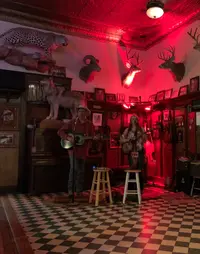
- Occidental Saloon Thursday Night Bluegrass JamBuffalo, Wyoming · MusicWeekly Thursday evening bluegrass, western and folk jam in the Occidental Saloon at the Historic Occidental Hotel in Buffalo, Wyoming; started in 2006; open to the public; never a cover charge; visiting musicians welcome to sit in.
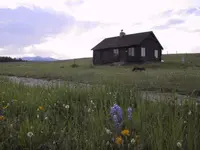
- Muddy Guard CabinBighorn National Forest · Guard station cabin rentalMuddy Guard Cabin dates back to the late 1930s and offers views of wildflower-topped meadows and snow-capped mountains. Originally used as a Forest Service guard station, the quaint cabin appeals to those looking for a peaceful getaway with hiking, horseback riding and fishing.
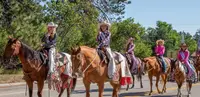
- Story DaysStory · Annual community celebrationStory Days is a three-day end-of-summer celebration in Story, Wyoming, at the base of the Bighorn Mountains, with a Saturday parade that follows the volunteer firemen's breakfast.
- Clearmont DayClearmont · Family-friendly eventClearmont Day is a one-Saturday celebration in a Sheridan County, Wyoming, railroad town on old Highway 14; the 2026 program added Dachshund and Corgi races.

All the towns of Wyoming. More of Wyoming: Scenic Drives and Fairs & Rodeos.
Sources
- The Johnson County War: 1892 Invasion of Northern Wyoming wyohistory.org/encyclopedia/johnson-county-war-1892-invasion-northern-wyoming
- Johnson County Courthouse (historical marker) hmdb.org/m.asp?m=91499
- Johnson County, Wyoming wyohistory.org/encyclopedia/johnson-county-wyoming
- Historic Buffalo, Wyoming (historical marker) hmdb.org/m.asp?m=244120
- Buffalo Main Street Historic District (wyoshpo.wyo.gov) wyoshpo.wyo.gov/index.php/programs/national-register/wyoming-listings/view-full-list/600-buffalo-main-street-historic-district
- TA Ranch (historical marker) hmdb.org/m.asp?m=91560
- Near Buffalo wyoshpo.wyo.gov/index.php/programs/national-register/wyoming-listings/locations-search/195-near-buffalo
- List View (U.S. National Park Service) nps.gov/state/wy/list.htm?program=all
- Directory of History of Medicine Collections hmddirectory.nlm.nih.gov/hmddir/print_collection/250
- Jim Gatchell Memorial Museum (Buffalo) whichmuseum.com/museum/jim-gatchell-memorial-museum-buffalo-13531
- Greenbelt Trail–Klondike Access (historical marker) hmdb.org/m.asp?m=244225