Tonto Creek Fish Hatchery
Payson, Gila County, Arizona. Fish hatchery.
Details

- Where
- Payson, Gila County, AZ. No street address stated. Directions
- When
- 7 days a week, 7:30 a.m. to 3:30 p.m.
- Season
- Open 7 days a week from 7:30 a.m. to 3:30 p.m.; closed on Thanksgiving and Christmas; frequently closes to the public during winter months due to snow and icy conditions.
- Getting there
- Tonto Creek Hatchery is located near the headwaters of Tonto Creek beneath the Mogollon Rim in the Tonto National Forest, approximately 21 miles east of Payson off of Highway 260. Turn north from SR 260 at the signed road near Kohl's Ranch Resort and travel four miles to the end of the road. The road is paved to the facility.
- Access
- The last five miles of road are along a narrow double-lane road with a minimum 7-percent grade that can be snow covered in winter; under normal conditions, the roads are clear within 48 hours of a storm. The hatchery frequently closes to the public during winter months due to snow and icy conditions.
- Walk-in or reserve
- Self-guided tour; no reservation required.
- Phone
- 928 478-4200
- Website
- azgfd.com
- Managed by
- Property owned by the U.S. Forest Service (Tonto Forest), operated by the Arizona Game and Fish Department's Hatchery Program.
- Established
- 1937.
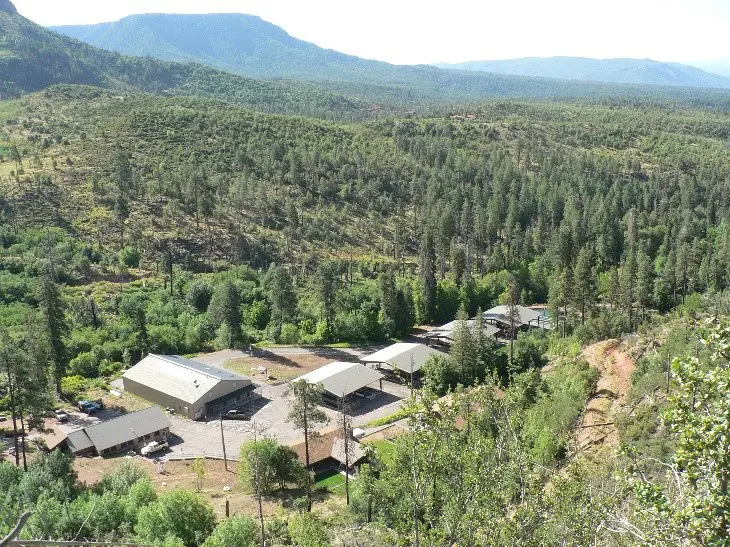
The paved road leaves State Route 260 near Kohl’s Ranch and runs north along Tonto Creek to its end at the hatchery. The hatchery sits 6,100 to 6,400 feet up beneath the Mogollon Rim, about 21 miles east of Payson. The last stretch is a narrow two-lane road with grades of at least 7 percent in places. In winter that road can lie under snow, and the hatchery frequently closes to the public during those months.
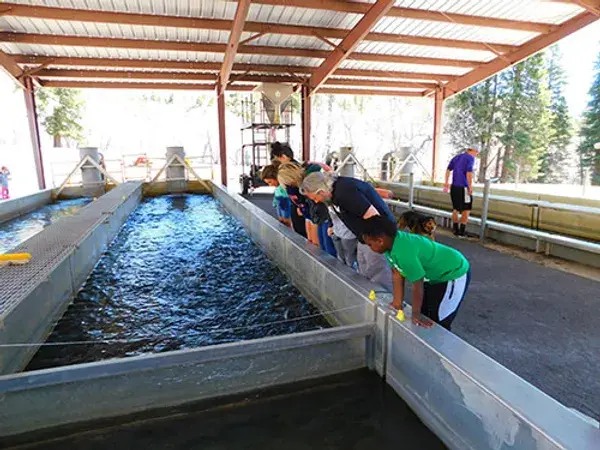
At the end of the road is the show pond, where visitors throw feed to trout. The large office building beside it holds a small visitor center with indoor tanks and public restrooms. The tour is self-guided. In June 2023 New Zealand mudsnails were found downstream. Since then the outdoor rearing units have been enclosed and the public kept out of the fish-rearing areas, though the grounds next to the show pond and the visitor center remain open. Game and Fish puts annual visitation at 50,000 to 60,000, with 400 to 500 people a day in summer.
Herons, belted kingfishers, and osprey work the wetlands and streams around the grounds. Raccoons, the department says, have been known to stop by and try to sample the trout. Elk, whitetail and mule deer, turkey, fox, coyote, and black bear range the country around. West of the hatchery road, the Highline Trail passes south of the old site of Zane Grey’s cabin and the homestead of A.L. “Babe” Haught, one of Grey’s guides. The Babe Haught Trail, which Haught used, climbs to the top of the Rim.
Trout from Tonto Spring
Four full-time employees live on the property. Besides the office building it holds four residences, a shop and garage, and several smaller working structures. Average production is 50,000 pounds of trout a year, 15 percent of all the trout stocked in Arizona. The department lists Apache, rainbow, brook, cutthroat, tiger, and brown trout among the fish raised. Its yearly figures are about 165,000 catchable rainbows, 400,000 brook and cutthroat, and about 150,000 Apache trout, the state fish.
“We raise four different species of trout here. Mostly rainbow trout. We also raise some tiger trout and some YY brook trout. And then we are also responsible for all of the state’s hatching of our native Apache trout,” hatchery manager Bryce Sisson said in September 2026. Historically, about half of hatchery Apache trout survived. Tonto Creek has raised that figure above 80 percent in the last few years. The Payson Roundup credits improvements developed here as the main reason Apache trout came off the federal endangered and threatened list in September 2024.
The water is the trouble now. “The hatchery is designed to run on a maximum of 1,800 gallons a minute of spring flow. Right now, we’re at 700 gallons a minute,” Sisson said. That is too little to use all the rearing units in the tank room. The plumbing from the last renovation was expected to last about 25 years, and its failures are becoming more frequent.
Earthen ponds under the Rim
Tonto was not the first hatchery under the Rim. In 1928, under pressure from local trout enthusiasts, a small hatchery building and nursing troughs were built at the headwaters of Horton Creek, a tributary of the Tonto. A washout damaged them in 1932. They were never rebuilt, because the spring had proved too erratic. Rearing ponds at Indian Gardens, between Kohl’s Ranch and Payson, then served Rim Country streams until the Tonto hatchery was finished.
At Tonto the draw was the spring. According to Arizona Highways in April 1967, it rises at 6,600 feet in a wooded glen below Promontory Butte, a thumb-like bulge in the Rim. Ponderosa pine shade it, ferns and columbines cover the ground, and its water stays frigid winter and summer. The department’s 2015 hatcheries report gives two dates for its Forest Service special-use permit: it obtained the permit in 1936, and in another passage the report says the program has operated the property under permit since 1935.
The hatchery was built in 1937 as a series of earthen ponds in the stream channel. Flash floods kept threatening them, so circular ponds and raceways were built on higher ground and stream water was pumped in. Game and Fish dates aquaculture on the property from 1938, when it covered two acres. It was expanded in 1954 and in 1987 and now covers 50.
In 1967 Arizona Highways found the place in the keeping of manager Al Fuller. He lived with his wife and a ten-year-old Boston terrier a stone’s throw from the ponds. Assistant fish culturists Bob Daymude and Wendell Russell lived on the grounds as well. Feeding went on seven days a week, twelve months a year, and in winter the men sometimes shoveled four-foot drifts to reach the ponds. Summer crowds came to feed the fish and look at the king-size trout Fuller kept to tantalize visiting anglers. He would direct visitors to the foot trail that wound several hundred yards through the forest to the spring. The magazine had him beaming as he said it was all worthwhile when the first hatchery truck pulled out in late spring, past campgrounds filling with anglers. A program then under way aimed to replace all the old circular ponds with raceways.
Fires on the Rim
In 1967 the drive up the hatchery road passed a forest of blackened tree stubs. They were left by the man-caused Roberts fire of 1961, which burned 2,500 acres and killed three aerial firefighters.
On June 25, 1990, dry lightning started the Dude Fire beneath the Rim about 10 miles northeast of Payson. It was controlled ten days later, after burning more than 24,000 acres, destroying 63 homes, and killing six firefighters. The National Wildfire Coordinating Group lists the Zane Grey Cabin and the Tonto Creek Fish Hatchery among the structures destroyed.
Game and Fish dates the next major renovation to 1993. That work converted the hatchery to 12 covered raceways and a show pond and paved all the surface roads. The department’s 2015 report and the Payson Roundup place it in the late 1980s and early 1990s.
In June 2017 the Highline Fire burned more than 7,000 acres and came close to the hatchery. Sisson told FOX 10 that damage to the spring pipelines would probably have cost all the fish in the hatchery, which usually holds two years’ worth of stock. “The decision was made to stock out as many fish as we could,” he said. “All told, I think we got rid of 450,000 fish.” Most were fingerlings sent to other hatcheries. Another 50,000 or 60,000 catchable trout went out, many into Rim waters. Woods Canyon and Willow Springs lakes normally take 2,500 to 3,000 fish a week; that week each got 11,000 to 12,000. “We’re probably the only game and fish truck that everyone’s excited to see,” Sisson said.
A congressman at the show pond
The U.S. Forest Service owns the ground, and the Arizona Game and Fish Department’s Hatchery Program runs the hatchery on it. The department has proposed a trade. It would give the Forest Service its 160-acre Sunflower Flat Wildlife Area in Coconino County. In return it would take the land under the Tonto Creek, Canyon Creek, and Sterling Springs hatcheries, just shy of 80 acres together.
By 2024 both agencies had agreed to prioritize the swap under the 2018 Small Tracts Act. Forest Service staffing shortages then put it on hold, and the state is now asking Congress to act. On Thursday, September 10, 2026, officials from the department, Trout Unlimited, and the Payson Fly Casters walked U.S. Rep. Eli Crane through the hatchery for an hour. “The hatcheries that we have now, we are at 100% capacity,” said James Goughnour, chairman of the Game and Fish Commission. When the last details had been laid out, Crane spent the final minutes tossing treats to the trout in the show pond. The Roundup called the pond the last stop for school field trips and congressional visits alike. He finished by photographing the fish in a feeding frenzy.
Notable Events
- 1935The department's hatchery program operated the Forest Service property under special-use permit from 1935. s3-us-west-2.amazonaws.com
- 1937The hatchery was constructed using a series of earthen ponds. s3-us-west-2.amazonaws.com
- 1938The account reports uninterrupted trout production since 1938, with several expansion programs increasing rearing capacity. arizonahighways.com
- 1954The hatchery property was expanded in 1954. azgfd.com
- 1980sThe hatchery was last renovated from the late 1980s through the early 1990s. paysonroundup.com
- 1987The hatchery property was expanded again in 1987. azgfd.com
- 1990NWCG includes Tonto Creek Fish Hatchery among the structures destroyed in the Dude Fire. nwcg.gov
- 1993A major renovation converted the facility to 12 covered raceways and a show pond. azgfd.com
- 2017June's Highline Fire came close to the hatchery, prompting thousands of fish to be brought to Woods Canyon Lake. fox10phoenix.com
- 2023After New Zealand Mudsnails were discovered downstream in June 2023, outdoor rearing units were enclosed and public access to fish rearing areas was prohibited. Areas adjacent to the Show Pond and the indoor visitor center remained accessible. azgfd.com
- 2024Arizona Game & Fish and the Forest Service had worked out details and agreed to prioritize a land exchange intended to transfer control of the hatchery property to the state. paysonroundup.com
- 2024Apache trout were removed from the federal endangered and threatened list in September 2024. The newspaper attributes this largely to improvements developed at the hatchery. paysonroundup.com
- AZGFD, Trout Unlimited and Payson Fly Casters met with U.S. Rep. Eli Crane at the hatchery to ask for help with the proposal, which was pitched during an hourlong tour. paysonroundup.com
People
- Al Fuller, Hatchery manager who kept large trout for visiting anglers.
- Bob Daymude, Assistant fish culturist living on the hatchery grounds and watching over the fish.
- Wendell Russell, Assistant fish culturist living on the hatchery grounds and watching over the fish.
- Bryce Sisson, Tonto Creek Hatchery manager.
- Eli Crane, U.S. representative who met with officials at the hatchery to hear the proposed land exchange and their request for help.
- James Goughnour, AZ Game and Fish Commission Chairman, pictured during the hatchery visit.
- Nathan Rees, Trout Unlimited’s Arizona State Director, pictured during the hatchery visit.
Sources
- azgfd.com/fishing-2/hatcheries-fisheries-management/fish-hatcheries/tonto-creek-hatchery
- discovergilacounty.com/blog-categories-adventure/raising-trout-at-the-tonto-fish-hatchery
- discovergilacounty.com/blog-categories-adventure/raising-trout-at-the-tonto-fish-hatchery
- paysonroundup.com/news/azgfd-calls-on-crane-to-help-expedite-hatchery-land-exchange/article_7b2ea134-fa4c-488f-bc28-2757840cb5c6.html
- s3-us-west-2.amazonaws.com/azgfd-portal-wordpress-pantheon/wp-content/uploads/archive/State-of-the-Hatcheries-Report_07-02-2015.pdf