The Dalles Lock & Dam Visitor Center
The Dalles, Wasco County, Oregon. Visitor center.
Details

- Where
- 3545 Bret Clodfelter Way, The Dalles, OR. Directions
- When
- Open Memorial Day to Labor Day, Friday-Monday, 9am-4pm; weekends only before Memorial Day and after Labor Day.
- Season
- Memorial Day to Labor Day; weekends only before Memorial Day and after Labor Day.
- Getting there
- From The Dalles, 2 miles east on I-84.
- Access
- Patterson and Seufert parks nearby offer picturesque picnics and Mount Hood views; the eastern end of The Dalles Riverfront trail and the historic Seufert Rose Garden are within those parks.
- Phone
- (541) 296-9778
- Website
- corpslakes.erdc.dren.mil
- Managed by
- U.S. Army Corps of Engineers.
- Established
- 1980.
- Coordinates
- 45.61500000000000, -121.13833000000000.
The visitor center for The Dalles Lock and Dam stands on the Oregon shore two miles east of the city of The Dalles, at the end of Bret Clodfelter Way off exit 87 of Interstate 84. The ground under it belonged to Seufert’s Fish Cannery, and the cannery’s foundation is still there, along with the sluiceways of its fish wheels.
Inside, the U.S. Army Corps of Engineers keeps interactive displays on the dam’s work, a short film on its benefits and its impacts, a place to watch fish climbing the fish ladder, and a Discover Your Northwest bookstore. Park rangers answer questions about the project and the region. In 2011 The Oregonian found rangers and volunteers on duty, a live-camera view of the ladder, and a 250-gallon cold-water aquarium stocked with fish from the Columbia.
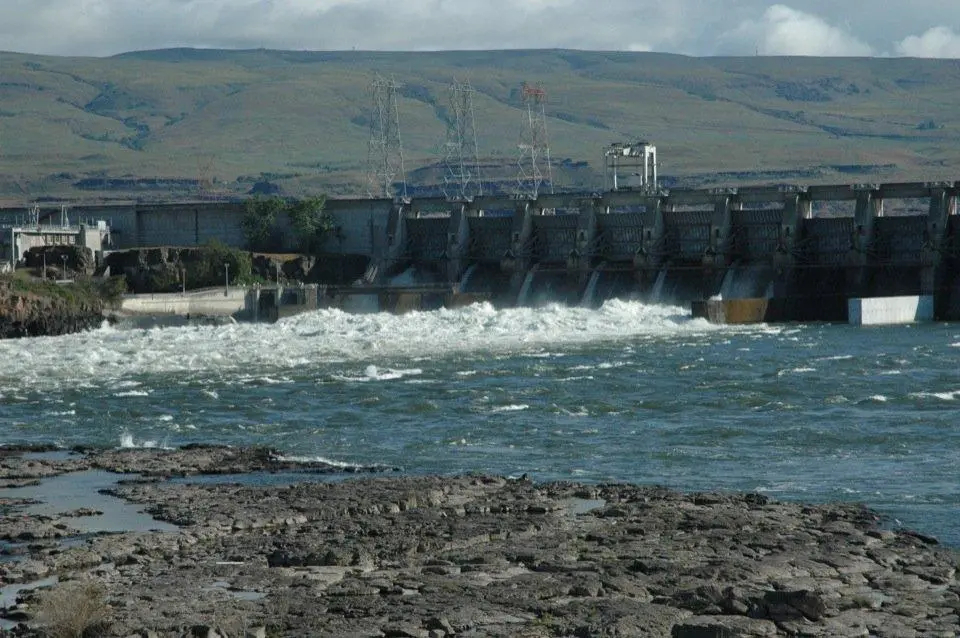
The dam runs about a mile and a half across the river, from the Oregon bank to a navigation lock on the Washington shore. The state line follows the river’s original channel, which runs close to the Oregon side here, so most of the dam lies in Washington while the visitor center sits in Oregon. From the Oregon end the structure begins beside Patterson Park and curves until it runs parallel to the current. HistoryLink likens the plan to the letter L, with the 2,089-foot powerhouse along the long stroke and the spillway, with its 23 radial gates, across the river. Two fish ladders, the North and the East, carry fish past it. Behind it lies Lake Celilo, 24 miles long. Public tours of the dam resumed in 2008 with restrictions. In 2011 they lasted an hour, cost nothing, and were open only to U.S. citizens.
Roses, picnic shelters and winter eagles
Seufert Park takes its name from the cannery. The Corps lists a picnic area there, a group picnic shelter, interpretive hiking trails and multipurpose trails. The historic Seufert Rose Garden holds more than 90 varieties. The eastern end of The Dalles Riverfront Trail starts in Seufert and Patterson parks, where picnic tables face Mount Hood.
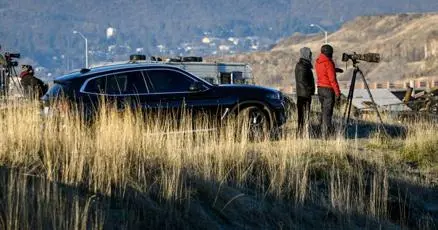
In winter, bald eagles come south from northern feeding grounds as the rivers there freeze. They eat nonnative shad and other fish. The Columbia Gorge News reported in January 2026 that they favor the sheltered trees and the turbulent water below the dam, full of dazed fish floating out of it. Sometimes they perch in Seufert Park on the Oregon side, near enough to see without binoculars. “And if you have patience and luck you may even see them grab hold of a fish,” the photographer Gary Elkinton told the paper. The 2026 Eagle Watch, held Jan. 17, included outdoor viewings in The Dalles and Lyle, some hosted by the Corps.
Wheels on the river
Fish wheels came to the Columbia in 1879. Fixed to the bank or mounted on scows, they scooped salmon from upstream rapids where traps, seines and gillnets could not work. When the Northern Pacific Railroad reached The Dalles in 1883, packers hurried to set up canneries there. Francis A. and Theodore J. Seufert were already in town. They were New York City natives and sons of the German immigrant John Seufert. Francis had traveled to San Francisco by way of Panama in 1872 and reached The Dalles in 1881, and Theodore followed in 1882. The finding aid for the company’s records says that in 1883 the brothers shipped the first Oregon salmon east by rail.
In 1884 they built their first wheel on land they had bought three miles east of town. The Oregon Encyclopedia says they leased part of that property to a partnership, Everding and Farrell, which built a salmon cannery there in 1886. Ten years later, by that account, Seufert Brothers bought the cannery for $2,500. The finding aid gives a different story: in 1886 the brothers bought the Whitcomb Fishery interests near The Dalles, a small salmon cannery among them, and added a fish house and an ice house. By either route, the company came to own four canneries, more than a dozen fish wheels, and much of the riverbank between The Dalles and Celilo Falls, about fifteen miles upriver. It was the leading salmon packer on the Middle Columbia from the mid-1890s to the mid-1950s. Its output helped make canned salmon Oregon’s second largest export in the early twentieth century, and it contributed to the sharp decline of the fish runs in the same years.
Organized labor resented the company for hiring Chinese butchers, and its employment records list “China Crews.” Seufert Brothers blasted tribal fishing sites to make room for wheels and tried to drive off Native competitors. One of them was Sam Williams, an enrolled Yakama who ran a scow from a moorage on company land. In the 1919 lawsuit that followed, company attorneys argued that the Yakama Nation held no fishing rights south of the Columbia. The company lost the case, but in the end it forced Williams to work for it.
Oregon outlawed fish wheels in 1926 and Washington followed in 1934. After that the canneries depended more on Native fishers. The company sold them supplies, extended credit, gave scrap lumber for scaffolding, and let them camp on its land. In 1930 it began building aerial cableways out to the islands at Celilo Falls. Fishers who rode the cables had to sell their catch to Seufert Brothers, and some complained about low prices. That arrangement gave the company a stake in the fishery, and it became one of the few non-Indian organizations to protest the building of The Dalles Dam.
Francis bought out Theodore in 1909. He served briefly as mayor of The Dalles around 1904 and ran the company as president and general manager until his death in December 1929. His four sons, Arthur, Francis Jr., William and Edward, ran it after him until it was liquidated on June 1, 1954. Francis Jr. carried on a successor firm, Francis A. Seufert and Company, and kept the old company’s papers. They later went to the Oregon Historical Society.
Six tons of dynamite
The French name Dalles came from narrow, rocky river channels. The French Canadian fur traders of the Hudson’s Bay Company called the great rapids here Les Grandes Dalles de la Columbia. In July 1931 Colonel Gustav Lukesh of the Corps’ Portland District proposed a series of Columbia dams that included a high dam at The Dalles, nearly four miles long. In 1934 the Corps dropped it for a smaller one. Plans stalled until 1948, when heavy snow runoff and late spring rain brought one of the most financially devastating floods in the river’s history. Congress authorized the dam in 1950.
Formal groundbreaking took place on a sunny March 13, 1952. “The whole city of The Dalles turned out to see the sight,” The Seattle Times reported the next day. Schools and businesses closed, a parade led thousands to the river, and drivers stopped along Highway 30 to watch. Six tons of dynamite went off along the Washington shore and threw columns of water and dirt more than 100 feet into the air. Guy F. Atkinson Company built the dam in a joint venture with Ostrander Construction Company, and the Portland District under Colonel Ralph Tudor oversaw the work.
At 10 a.m. on March 10, 1957, the gates closed, and Lake Celilo formed within hours. Television crews from KGW in Portland and KING in Seattle covered it, and an estimated 10,000 people came by during the day. They watched the Big Eddy whirlpool, the Long Narrows, and Celilo Falls go under. When William Clark passed in 1806 he called the Long Narrows “the great mart.” HistoryLink says Native people had fished the reach from The Dalles to Celilo for at least 10,000 years. The Oregon Encyclopedia says families had used the falls for at least 9,000. A photograph from 1956 in the Oregon Historical Society’s collection shows members of the Yakima, Umatilla and Wyam tribes at a farewell ceremony to the falls.
HistoryLink puts the government’s settlement with several tribes for the lost fishing grounds at $26.8 million. The Oregon Encyclopedia gives $23.5 million paid to extinguish treaty fishing rights. The government also built a new village near the drowned one. In the mid-2000s Congress funded rebuilding it, and that work was largely done by 2019.
Vice President Richard Nixon dedicated the dam on October 10, 1959, and started its tenth generator. The fourteenth went online on October 28, 1960. Construction cost about $286 million, and accidents during the work killed 16 people.
The tour train and the depot
In 1973 the Corps began running a tour train from Seufert Park to the dam. It was free, it ran every half hour, and riders could get on and off all day. North Wasco County Parks and Recreation helped operate it. Its visitor areas included Patterson Park, Westrick Park, and the east end of Probstfield Foyer, which looks onto the powerhouse and the east fish ladder. In 1976 the train was painted red, white and blue for the bicentennial.
The Oregonian dates the visitor center to 1980. HistoryLink says the Corps added a depot for the train at Seufert Park in 1981. During those same years the cannery was coming down. Terray Harmon recalled that one of its buildings housed the Winquat Museum through the late ‘60s and ‘70s, curated for years by his mother, and that the cannery was torn down in the late 1970s.
The two sources also differ on how the train ended. The Oregonian says it broke down in 2000 with engine and track trouble, and that soon afterward 9/11 closed public access to the dam’s grounds. HistoryLink says security concerns and deteriorating rails ended the railway in 2005, and that the depot then became the visitor’s center.
Notable Events
- 1884Francis A. and Theodore J. Seufert built their first wheel on land purchased east of The Dalles. oregonencyclopedia.org
- 1886The brothers purchased Whitcomb Fishery interests, including a small salmon cannery, and added a fish house and ice house. archiveswest.orbiscascade.org
- 1886Everding and Farrell built a salmon cannery on property leased from the Seuferts. oregonencyclopedia.org
- 1905Construction began on the Dalles-Celilo Canal; completion opened river travel as far east as Lewiston. historylink.org
- 1909Francis A. Seufert purchased his brother Theodore's company interests. archiveswest.orbiscascade.org
- 1919Seufert Brothers argued that Yakama fishing rights did not extend south of the Columbia River, lost the case, but ultimately forced Williams to work for the company. oregonencyclopedia.org
- 1926After Oregon and then Washington outlawed fish wheels, Seufert Brothers relied more heavily on Native fishers. oregonencyclopedia.org
- 1927Congress ordered the Corps to survey the Columbia and its tributaries for combined water-resource development. oregonencyclopedia.org
- 1929The company's president and general manager died; his sons subsequently served as company officials. archiveswest.orbiscascade.org
- 1930The company began building aerial cableways for access to Celilo Falls islands. oregonencyclopedia.org
- 1931Division engineer Gustav Lukesh submitted recommendations for a series of Columbia River dams. historylink.org
- 1932The Corps Board of Engineers rejected Lukesh's proposal in favor of three dams between The Dalles and the Snake River. oregonhistoryproject.org
- 1934The Corps dropped the large-dam plan and proposed a smaller Dalles dam plus other mid-Columbia dams. historylink.org
- 1948Snow runoff and heavy spring rain caused a financially devastating flood. historylink.org
- 1949An OHS image caption identifies new housing at the relocated village. oregonencyclopedia.org
- 1950Congress gave the go-ahead for construction of The Dalles Dam, primarily for hydropower and navigation. oregonencyclopedia.org
- 1952Formal start-of-construction ceremonies followed preliminary excavation begun a few weeks earlier. historylink.org
- 1952The United States Army Corps of Engineers constructed The Dalles Dam between 1952 and 1957. oregonencyclopedia.org
- 1953Following completion of the cofferdam, the first concrete was poured in December. historylink.org
- 1953A temporary cofferdam was completed and powerhouse excavation had also finished. historylink.org
- 1954The company liquidated; a successor firm, Francis A. Seufert and Company, was operated by Francis A. Seufert, Jr. archiveswest.orbiscascade.org
- 1954Work began on the navigation lock; parts of the project ran ahead of schedule during the following year. historylink.org
- 1954Seufert Brothers opposed The Dalles Dam but lost the fight and shut down. oregonencyclopedia.org
- 1954Yakama Indians and the Corps negotiated over loss of fisheries. oregonencyclopedia.org
- 1956A second substructure with empty bays for additional generators was completed in June. historylink.org
- 1956The initial substructure had room for fourteen generators. historylink.org
- 1956Yakima, Umatilla and Wyam Tribe members held a farewell ceremony. oregonencyclopedia.org
- 1956A final large blast removed rock during dam construction. oregonencyclopedia.org
- 1956Chief Tommy Thompson was relocating to the new Celilo Village. oregonencyclopedia.org
- 1957Gates closed during a celebratory event; Lake Celilo formed behind the dam within hours. historylink.org
- 1957The first regular generator began producing power; the second followed on Halloween. historylink.org
- 1957Marker text says the dam widened the river and drowned the Short and Long Narrows and village sites. hmdb.org
- 1957Oregon's Gov. Holmes and Washington's Gov. Rosellini attended the locks opening. oregonencyclopedia.org
- 1957Completion allowed the Corps to close the gates and fill the reservoir known as Lake Celilo. oregonhistoryproject.org
- 1958The section designed to house the first fourteen generators was completed. historylink.org
- 1959Vice President Richard Nixon dedicated the dam and activated its tenth generator. historylink.org
- 1960The fourteenth generator began operation. historylink.org
- 1969Empty bays were modified to install the planned additional generators. historylink.org
- 1970sTerray Harmon said the cannery near today's visitor center was torn down. columbiagorgenews.com
- 1970The Corps added several small parks at the dam. historylink.org
- 1972The newer generators were installed, with the final generator online in October 1973. historylink.org
- 1973An emergency crane was added to support the original forebay crane. historylink.org
- 1973The Corps began giving train tours originating at Seufert Park. historylink.org
- 1973A tour train began carrying visitors from the visitor center to the dam in 1973, predating the visitor center. oregonlive.com
- 1973The Corps fact sheet dates completion of units 15-22 to Phase II. usace.contentdm.oclc.org
- 1976The train was painted red, white and blue in honor of America's bicentennial. historylink.org
- 1980The Oregonian says the visitor center has been open since 1980. oregonlive.com
- 1981A depot was added for the tour train. historylink.org
- 2000sCongress funded rebuilding of the replacement village to address structural, water and sewage problems. oregonencyclopedia.org
- 2000The tour train broke; its engine and track had problems. oregonlive.com
- 2005Increased security concerns and deteriorating rails ended the tour railway; the depot subsequently became the visitor's center. historylink.org
- 2008After the tour train era ended and access was restricted, visitor access to the dam via public tours was reinstated in 2008, with some restrictions. oregonlive.com
- 2019The replacement-village rebuilding work was largely completed. historylink.org
- According to Terray Harmon, a former cannery building housed the Winquat Museum, curated by his mother for years. columbiagorgenews.com
- A small generator went online but produced less than twenty percent of the power planned for the larger generators. historylink.org
- Ten years after Everding and Farrell built the cannery in 1886, Seufert Brothers bought the facility for $2,500, beginning an expansion to four canneries and more than a dozen fish wheels. oregonencyclopedia.org
People
- Arthur, Francis Seufert's son and a company official after his father's death until liquidation (June 1, 1954 (company liquidation)).
- Edward, Francis Seufert's son and a company official after his father's death until liquidation (June 1, 1954 (company liquidation)).
- Francis A. Seufert, Jr., Collected and maintained the predecessor company's records before transfer to the Oregon Historical Society.
- Francis A. Seufert, co-founder of Seufert Brothers; built the company's first fish wheel on purchased land east of The Dalles (1884).
- Theodore J. Seufert, co-founder of Seufert Brothers; built the company's first fish wheel on purchased land east of The Dalles (1884).
- William, Francis Seufert's son and a company official after his father's death until liquidation (June 1, 1954 (company liquidation)).
- Richard Nixon, Vice president who dedicated The Dalles Dam and activated its tenth generator (1913-1994; October 10, 1959 dedication).
- Colonel Gustav Lukesh, Corps Portland District division engineer who submitted Columbia River dam recommendations (1878-1949; July 1931 recommendations).
- Sam Williams, Enrolled Yakama fisher operating a scow from company land; challenged Seufert Brothers' restriction of treaty fishing (1919 (lawsuit)).
- Chief Tommy Thompson, Relocated to the new Celilo Village (c. 1956).
- Colonel Ralph Tudor, Led the Portland District when it had responsibility for building The Dalles Dam.
- Gov. Holmes, Oregon governor at the locks opening (1957).
- Gov. Rosellini, Washington governor at the locks opening (1957).
- Col. William J. Barden, Spoke for the Board of Engineers on its preference for progressive power-market development.
Sources
- traveloregon.com/plan-your-trip/oregon-welcome-centers/the-dalles-lock-dam-visitor-center
- explorethedalles.com/attractions
- recreation.gov/gateways/234
- corpslakes.erdc.dren.mil/visitors/projects.cfm?ID=G204400
- oregonlive.com/terryrichard/2011/04/the_dalles_dam_opens_visitor_c.html
- columbiagorgenews.com/news/eagle-watch-2026-approaches/article_53da28a6-f5c1-41cd-a6c7-92dfb7561609.html
- columbiagorgenews.com/2025-eagle-watch/image_8694e21e-dd01-11ef-a40b-1b54d5dc162a.html
- oregonhistoryproject.org/articles/historical-records/the-dalles-dam
- columbiagorgenews.com/history-page-for-dec-28-29/article_2366b2d3-5577-559a-9506-6f0b8a52bd4c.html
- oregonencyclopedia.org/articles/the_dalles_dam
- archiveswest.orbiscascade.org/ark:80444/xv72048
- historylink.org/file/21191
- oregonencyclopedia.org/articles/seufert_brothers_cannery
- oregonencyclopedia.org/articles/the_dalles
- usace.contentdm.oclc.org/digital/api/collection/p16021coll11/id/2892/download
- hmdb.org/m.asp?m=158329
- columbiagorgenews.com/gorge-life/looking-back-on-february-17-2019/article_b65e2e7b-a5c6-53ad-9cd3-650cd9afb00f.html