Sweet Bee Vintage Market
Helena, Lewis and Clark County, Montana. Vintage Markets.
Details

- Where
- 340 Neill Ave, Helena, MT 59601. Directions
- When
- Winter market: Friday, January 30, 2026 | 05:00 PM - 08:00 PM; Saturday, January 31, 2026 | 09:00 AM - 04:00 PM.
- Getting there
- Helena Civic Center Ballroom.
- Fees
- Early Bird Shopping $10; general admission $5; kiddos 12 and under free.
- Hours
- Friday 5-8 pm early bird; Saturday 9-4 general admission.
- Access
- The founders called this fall market their 12th and final market.
- Walk-in or reserve
- Early bird tickets closed; tickets available at the door.
- Website
- sweetbeevintagemarket.com
- Managed by
- From 2027 the markets run as Fox Trot Vintage Market (Kallie and Josh of Hoot Owl Vintage).
- Coordinates
- 46.5948352,-112.0404305.
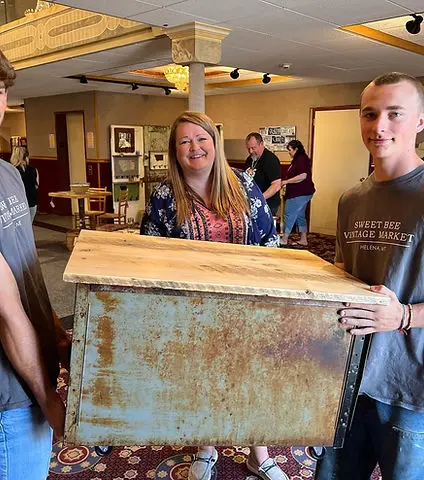
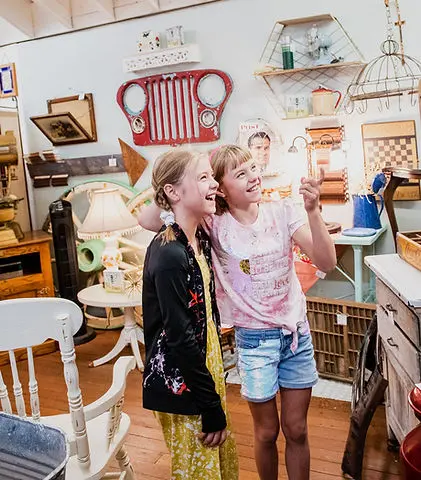
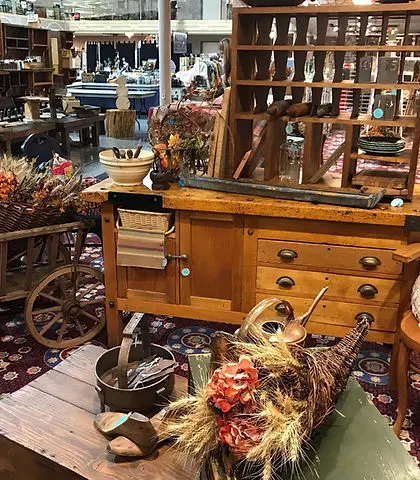
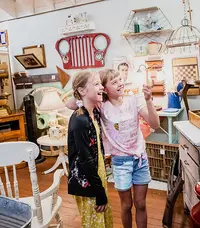
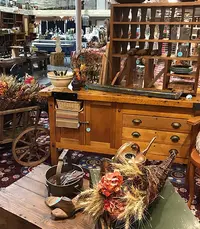
The market takes over the ballroom at the rear of the Helena Civic Center. The room has a maple dance floor 75 by 150 feet, raised aisles down the sides and a raised stage at the east end. The building’s 1987 National Register nomination says the floor will hold 1,500 people at an exhibition. Twice a year, once in winter and again in late September, vintage dealers and Montana makers set up across it. The market’s website lists what they bring: “vintage, rusty, industrial, repurposed, junk, farmhouse, handcrafted, retro, rustic, antiques, and much more.” Above the list it says, “We Love Junk!”
A September weekend in the ballroom
The 2026 fall market, the sixth annual, ran September 25 and 26. It opened Friday from five to eight with the Early Bird VIP Sip & Shop. The Southwest Montana travel listing promised wine or hot cocoa while shopping and counted over 80 local vendors, artisans, and vintage and antique curators. Regular shoppers treated the Friday as the quiet night. A paid post by the Instagram account roaminghelenamt said the winter early bird had been “so much more pleasant to shop with less people crowding the Civic Center ballroom.” Saturday ran from nine to four, with live music and a free craft area for children.
The Jitter Buggy coffee truck poured a fall special, a Spiced Maple Chai Latte of chai, pure maple syrup and fall spices. Change it Up Food Truck, Grindy’s Cheeseballs, Pie Fries, jakesbakesmt and Stiff Peaks & Little Feet, a maker of gluten-free macarons, served both days. On Saturday dearpotatomt, Helena Mountain Berry Bowls and Rocky Mountain Nut Company joined them, the last selling German roasted almonds by the cone. The vendors’ handwork showed up in a giveaway basket the week before: a Big Sky Fir candle, a handwoven towel, goat milk soap, and a bear sewn from a vintage quilt.
The featured nonprofit was Big Brothers Big Sisters of Central Montana. A raffle for $400 in restaurant gift certificates raised $300, and the market added $700 to make $1,000. On Friday night Cindy, who signs the market’s posts, wrote, “Oh my goodness Helena! You came, you conquered!” On Sunday she wrote, “Late last night we helped load out our vendors for our 12th and final market.” A day later the market posted the pieces left over: two vintage wash basins on red and green legs, each planted with a giant mum, at $90 apiece; an antique English flower cart at $280; and a Royal Flyer wagon at $40.
Cabin Fever, Sweet Bee, Fox Trot
Cindy Loacker and Rob ran the markets. In September 2026 they traced the business in a single post: “From our very first Fall Market 6 years ago - to taking over the Cabin Fever Market from Tori - to now handing the reins over to Josh & Kallie with Fox Trot Vintage Market.” The winter sale they took over carried the older count. Sweet Bee presented its January 30 and 31, 2026 market as the 44th annual Cabin Fever market. The new operators describe it as a vintage market that has been held in the Civic Center Ballroom for 44 years.
Josh and Kallie, of Hoot Owl Vintage, worked the fall 2026 market “learning the ropes,” according to Cindy, who added that “they’re going to bring a fun, hip vibe.” From 2027 the markets run as Fox Trot Vintage Market. The Montana Antiques & Vintage Directory lists a market for February 5 and 6, 2027. Sweet Bee keeps booths at Golden Girls Antique Mall on North Last Chance Gulch and at Bella Peacock Vintage on Prospect Avenue.
A temple for the Nobles of the Mystic Shrine
The ballroom is the back half of the Algeria Shrine Temple. Excavation began in the autumn of 1919, and contractor N.T. Lease of Great Falls finished that work in the spring of 1920. On June 19, 1920, W.L. Parmelee, Grand Master of the Grand Lodge of Montana, laid the cornerstone. W. Freeland Kendrick, Imperial Potentate of the Shrine, attended the ceremony, and Edward C. Day gave addresses. The sources date the building differently. The Southwest Montana listing says it was built in 1919, the City of Helena says 1920, and helenahistory.org says 1920–21. The nomination and the state’s historic marker both say it was completed in 1921, at a cost of nearly $200,000, according to the nomination.
George S. Carsley and Charles S. Haire, both local members of the order, drew the plans, and Roscoe Hugenin supervised. The nomination says Carsley meant the temple to serve as Helena’s civic center from the start, with a public auditorium and “an ample ballroom and banquet hall.” More than a million bricks face the concrete walls. Of these, 245,000 come in three colors laid in intersecting diamond patterns. A minaret rises 175 feet by the nomination’s measure, and a stairway of 140 steps climbs to an observation platform near the top. Its dome was covered with blue terra cotta tiles and topped with a metal crescent and star. The Independent Record put the height at some 170 feet and noted that modern Helenans call it the spire, though “a Muslim would identify the spire as a minaret.”
The ballroom’s first public use was the inaugural ball for Governor Joseph M. Dixon, in January 1921. That year John Philip Sousa’s band came to town to open the auditorium. With 2,608 seats, it ranked ninth-largest in the nation, and the temple was then the only Shrine Temple between Minneapolis and Seattle. Over the next decades the building hosted inaugural balls, presidential addresses and political conventions, along with professional wrestling, boxing tournaments and big band dances.
October 1935 and a copper dome
A series of earthquakes in October 1935 broke the building. The October 18 shock ripped a 40-foot section of coping off one wall. On October 31 the upper east wall fell in a single strip, leaving a four-foot gap below the roof. The nomination adds: “Contrary to popular perception, the 175’ minaret did not topple.” The Shrine could not pay for repairs estimated at more than $40,000.
The ballroom apparently came through with little damage and kept working. The Fireman’s Ball was held there on March 17, 1936, and fundraisers for repairing the building followed. In 1937 Jack Haytin chaired a citizens’ committee whose money, donated labor and materials repaired the ballroom in 34 days. Rentals of the room gave the Shriners income while they negotiated with the city.
The sources disagree on when the city took over. The nomination says the Algeria Shrine Temple Association sold the building to the City of Helena in July 1938 for $46,500. The Southwest Montana page says the city bought it the year after the earthquake. The Helena High junior prom was held in the ballroom in 1938, the same year the city removed the blue tile dome. After protests, a sheet copper dome replaced it in 1939. That March the city finished a fire station on the northeast corner, matching the old diamond brickwork. City offices stayed in the building until 1976, by helenahistory.org’s account, or 1979, by the state marker’s. The building was listed on the National Register of Historic Places in 1988.
In July 1977 Clem Meyer, a Helena entrepreneur, told an Independent Record reporter how he had sheathed the dome. “It’s 208 feet to the top,” he said. “I had to cut the copper to fit like barrel staves, then carry it up the stairs to the balcony.” From the balcony he climbed scaffolding to the peak. “I used to be able to walk a 2 X 4 joist. Now I can’t walk on a plank. DON’T GET OLD.”
Notable Events
- 1919Excavation for the Algeria Shrine Temple began in autumn 1919 and was completed by contractor N.T. Lease of Great Falls in the spring of 1920. npgallery.nps.gov
- 1919The Helena Civic Center was originally built in 1919 and served as a meeting hall for the Algeria Shriners and hosted civic functions. southwestmt.com
- 1920An elaborate celebration was staged on June 19, 1920, attended by W. Freeland Kendrick, Imperial Potentate of the Shrine. npgallery.nps.gov
- 1921The ballroom was designated as the site of the inaugural ball honoring Governor Joseph M. Dixon the following January. npgallery.nps.gov
- 1921In 1921 'The March King' John Philip Sousa's band came to town to celebrate the opening of the Auditorium. southwestmt.com
- 1935The building suffered substantial damage in the 1935 earthquakes, and the City of Helena purchased it from the Shrine shortly thereafter. helenahistory.org
- 1935The Algeria Shrine Temple experienced considerable structural damage as a result of a series of severe earthquakes of October, 1935. npgallery.nps.gov
- 1936The ballroom apparently escaped extensive damage, and public events including fundraisers for building repair were held there in 1936 and '37. helenahistory.org
- 1937Repairs on the Temple concluded in December of 1937. helenahistory.org
- 1938The City of Helena removed the blue tile dome in 1938 and replaced it with a sheet copper dome in 1939 following protests. helenahistory.org
- 1938The City of Helena purchased this structure in 1938, when it became the Civic Center, housing city government departments until 1979. historicmt.org
- 1938A contract between the Algeria Shrine Temple Association and the City of Helena was reached in July, 1938 and the Temple was sold for $46,500. npgallery.nps.gov
- 1939By March 1939, the City of Helena had completed the construction of the fire station addition on the northeast corner of the building. npgallery.nps.gov
- 1976The building was the home of City offices until 1976, when they were removed to the renovated 1904 Federal Building. helenahistory.org
- 1988The Helena Civic Center was listed on the National Register of Historic Places. southwestmt.com
- 2024The fourth annual fall market was held Friday and Saturday at the Helena Civic Center, with the 2024 market featuring vendors such as SnoCap Designs. helenair.com
- 2027Sweet Bee Vintage Market passes the baton to Kallie and Josh of Hoot Owl Vintage, and from 2027 Sweet Bee's markets will be known as Fox Trot Vintage Market. facebook.com
People
- Josh, with Kallie, takes over the markets from Sweet Bee's operators; the pair are K&J of Hoot Owl Vintage.
- Kallie, with Josh, the incoming operator of the markets, continuing what the post calls a vintage market that has been happening at the Helena Civic Center Ballroom for 44 years.
- Tori, former host of the Cabin Fever Market, which Sweet Bee took over.
- Clem Meyer, Helena entrepreneur who recalled covering the restored dome with copper, cutting the copper to fit like barrel staves and carrying it up to the balcony (1977).
- Charles S. Haire, architect of the era who, with George S. Carsley, designed the Moorish Revival building.
- George S. Carsley, architect of the era who, with Charles S. Haire, designed the Moorish Revival building.
- Cindy, hosts the market and signs its own posts.
- Rob, runs the markets with Cindy; the market's 12th and final market was the last they ran before handing it to Josh and Kallie.
- Cindy Loacker, Organizer of Sweet Bee Vintage Market, listed in the Montana Antiques & Vintage Directory.
- Edward C. Day, delivered addresses at the cornerstone ceremony; Sovereign Grand Inspector General of the Scottish Rite in Montana.
- Joseph M. Dixon, Governor honored by the ballroom's inaugural ball, the first public use of the new ballroom.
- Marilyn Evans, Manager, Helena Civic Center, City of Helena; prepared the National Register nomination form (10/15/87).
- N.T. Lease, contractor of Great Falls who completed the temple's construction (1919-1920).
- Nobel J.J. (Jack) Haytin, proposed that repair of the temple building be made a community project and became chairman of the citizens' committee for that purpose (1937).
- Roscoe Hugenin, supervising architect of the Shrine Temple.
- W.L. Parmelee, laid the temple cornerstone; Grand Master of the Grand Lodge of Montana.
- John Philip Sousa, band leader whose band came to town to celebrate the opening of the Civic Center Auditorium (1921).