Razor Clam and Shellfish Festival
Long Beach, Pacific County, Washington. Festival; April.
Details

- Where
- Veterans Field, 111 3rd St SE, Long Beach, WA 98631. Directions
- When
- Last held April 17–18, 2026; next year’s date not yet stated.
- Getting there
- Chowder Taste-off tent: city parking lot behind Veterans Field.
- Fees
- Free admission.
- Hours
- Vendors and food trucks: Saturday 11am-5pm, Sunday 10am-4pm.
- Access
- Free clam digging lessons hosted each morning along the Bolstad beach approach.
- Walk-in or reserve
- Call ahead to reserve a beach wheelchair.
- Phone
- +1 360-777-1226
- Website
- longbeachmerchants.com
- Managed by
- Long Beach Merchants Association.
- Established
- 1940.
- Coordinates
- 46.3503, -124.0535.
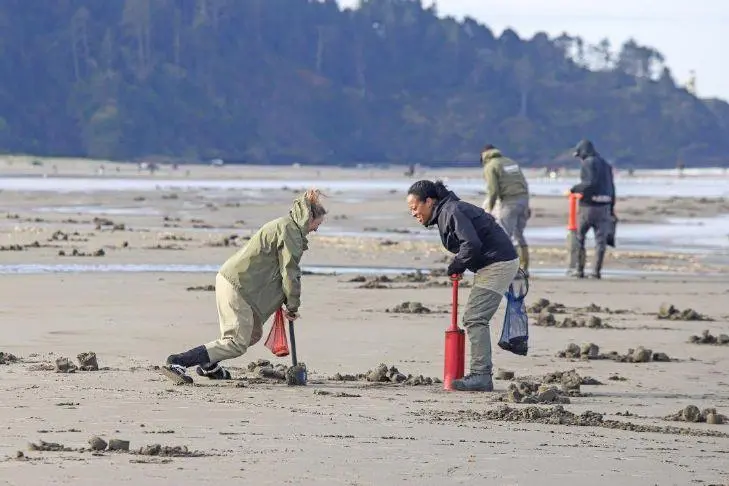
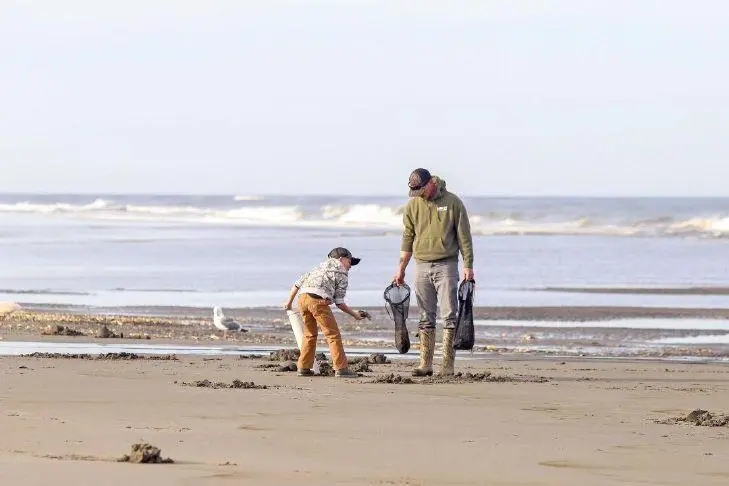
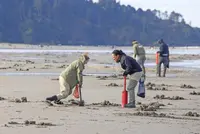
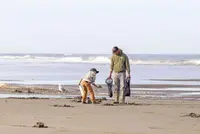
At 8:30 on the morning of April 18, 2026, Lachere England of Burien and Lauren Kinneman of Bay Center were digging on the sand at Seaview, well on their way to a 15-clam limit. “It’s awesome,” said England, a first-time clammer. Kinneman planned to make clam ceviche. The Chinook Observer reported a peak low tide of -1.5 just before 8 a.m., with sun and calm wind. Thousands of recreational diggers were out on the peninsula beaches, and many filled their limits in less than 20 minutes. To the south, Beard’s Hollow drew its own crowd. Tyler Shumate of Olympia and Colt Shumate, 8, dug together and meant to fry their clams and make chowder. That weekend, Friday and Saturday, April 17 and 18, the Razor Clam & Shellfish Festival was held in Long Beach, Pacific County. The Observer counted it as the 86th edition.
Lessons at the Bolstad approach
The Long Beach Merchants Association organizes the festival with its sponsors and volunteers, and the mornings belong to digging. Experienced clammers give free lessons each morning along the Bolstad beach approach. “The digging was absolutely phenomenal this year,” said festival co-organizer Dianna Knight. “Yesterday and today, everyone had their limit in about 20 minutes. The digging lessons were popular, too; it’s a lifetime tradition that helps support our community.”
The rules come with the lesson. A dig opens only on tides the state fish and game department has approved. Every digger 15 or older needs a license. Licenses expire March 31, and new ones run from April 1. The limit is 15 razor clams a day, and diggers must keep the first 15 they take, each digger’s clams in a separate container. Each person brings a clam shovel or clam gun and a bucket or net. The association recommends rubber boots and pants the wearer does not mind getting dirty, “at least on one knee.” Before the 2026 dig, a festival post explained the negative tide: the ocean drops below an ordinary low, more of the beach is exposed, and the clams are often closer to the surface. The Downtown Welcome Center lends all-terrain beach wheelchairs for the sand.
The quarry is Siliqua patula, the Pacific razor clam. According to Project Razor Clam, it grows to about six inches in Washington and can dig down as fast as nine inches a minute in soft sand. Diggers can carry their catch to festival headquarters for the biggest- and smallest-clam contests. In 2026, Don E. took Friday’s biggest at 5.68 inches and Kevin R. the smallest at .65. On Saturday the winners were Rob at 5.74 inches and Tyler at .48.
The tent behind Veterans Field
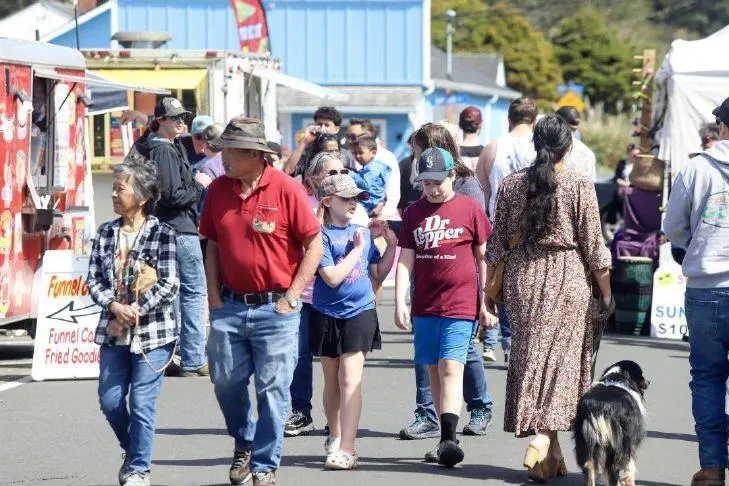
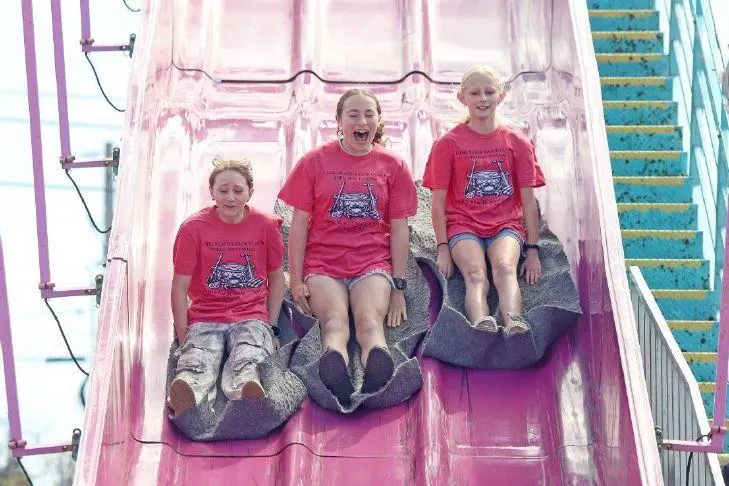
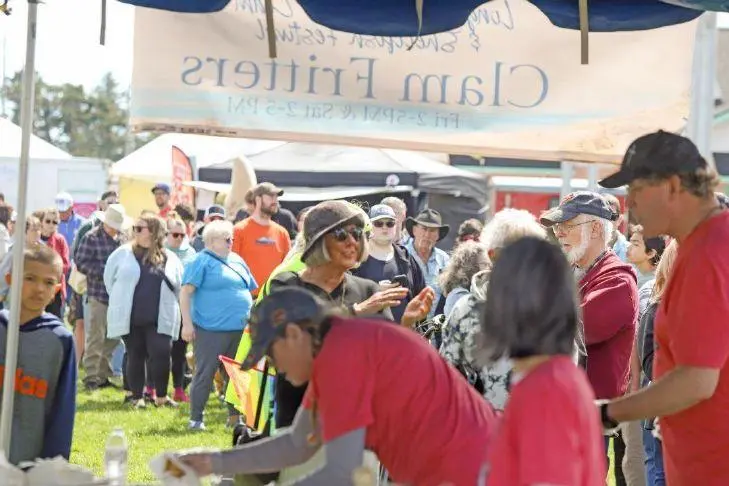
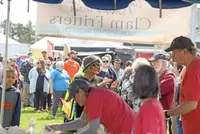
The rest of the festival happens at Veterans Field on 3rd Street SE. The field holds vendors’ booths, food trucks, a beer and wine garden, kids’ activities, and local musicians on the Veterans Field stage. Ilwaco middle school students rode the Super Slide in 2026. The Lewis and Clark Trail listing mentions pirates and mermaids moving through the crowd. The oyster shucking contest set a new record in 2026: 1 minute and 6 seconds. The crab boil served steaming Dungeness crab with corn on the cob, red potatoes, smoky sausage, and hot butter. In 2026 the crab came from Tre-fin. Volunteers handed out free clam fritter samples. A few days before the festival opened, Bill Rose of Sandsations was at work on a sand sculpture for it.
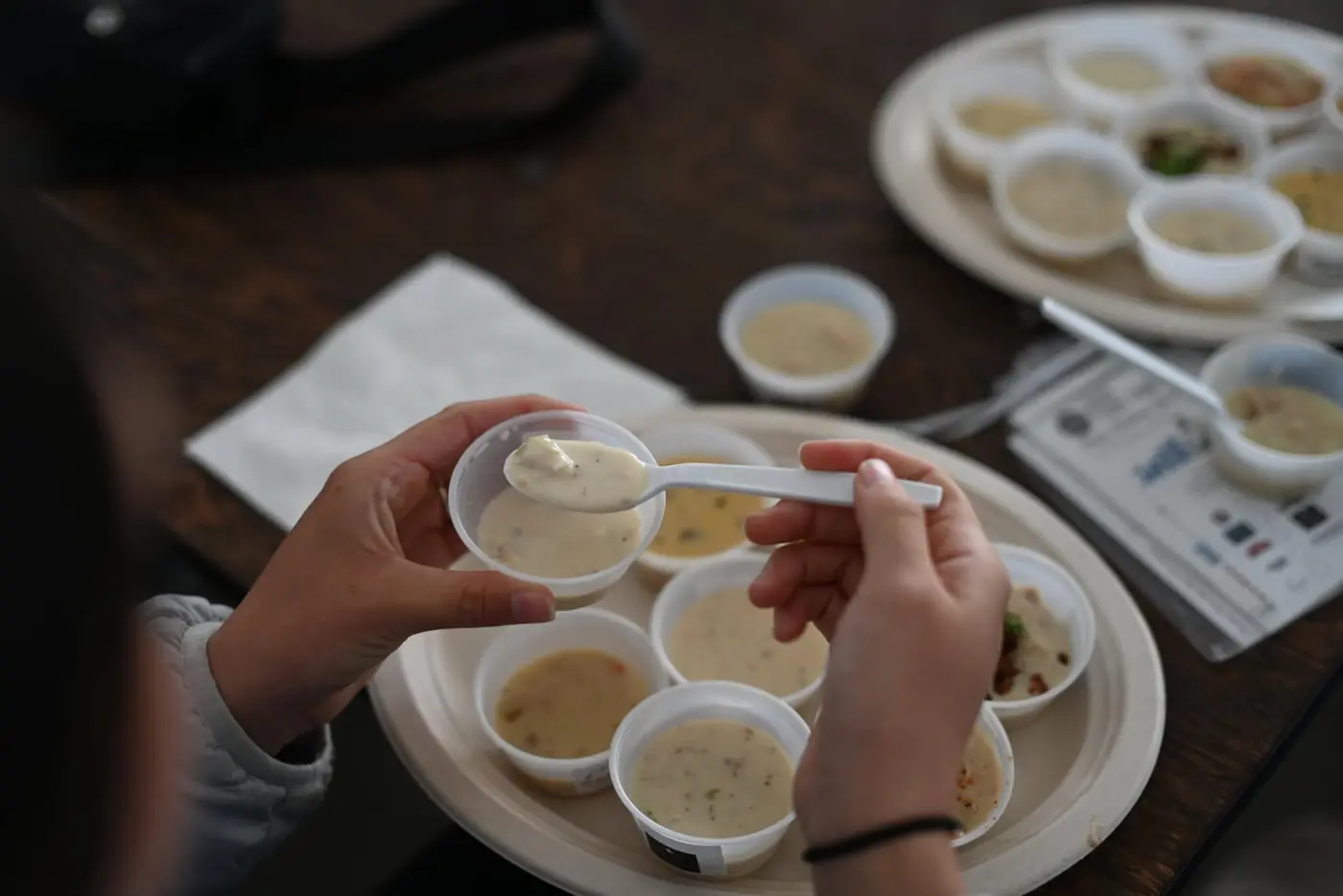
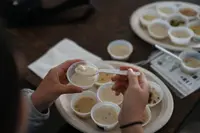
Knight calls the chowder taste-off “always our biggest event.” It is held Saturday from noon to four in a large tent in the city parking lot behind Veterans Field. A ticket buys a 2-ounce sample from each restaurant, a beverage, a vintage postcard, a magnet, a ballot, and a tide book. “The tent was packed,” Knight said of 2026. About ten entries came in from restaurants and about ten from amateurs, and more than 500 people voted.
Seafood Fiesta, at 1917 Pacific Ave. South, won the hand-carved wooden clam trophy for the second year running. Ana Avelar, Alexa Avelar, and Shayla Flores accepted it before a cheering crowd at Veterans Field on Saturday evening. “I’m really proud of my parents, they’ve come really far,” said Alexa Avelar, whose parents, Ana and Fernando Avelar, own the restaurant. Shayla Flores said, “It’s awesome to represent (our people) and culture. It’s very dear to my heart.” Drop Anchor Seafood & Grill placed second and B&D’s Food Hut third. Harry Smith won the amateur competition, where first place pays $250 in cash and a clam trophy.
The Merchants Association’s program also lists clam fritters at 2 p.m. on each festival day. The festival committee fries them in a replica of the “Largest Fry Pan,” and visitors can take the fry mix home. The association’s festival page gives the next dates as Saturday and Sunday, May 8 and 9, 2027.
Two hundred pounds of clams and a borrowed pan
Razor clams fed the Northwest coastal tribes and, later, early settlers. Project Razor Clam records that around 1900 an entrepreneur near the Columbia River found a better way to can them, and canneries followed. Commercial diggers worked with narrow-bladed shovels called clam guns. After the Second World War the canning trade petered out, but recreational digging went on.
The Merchants Association’s history page tells the rest. In 1940, Wellington Marsh, Sr., and the people of Long Beach organized the first Clam Festival. Thousands came to dig, eat chowder, and sample the “World’s Largest Clam Fritter,” made in the “World’s Largest Frying Pan.” That first pan was on loan from the city of Chehalis. The recipe took 200 pounds of razor clams, 20 dozen eggs, 20 pounds each of flour, cracker meal, and corn meal, 10 gallons of milk, and 13 gallons of salad oil. Ralph Smith and other locals dug the clams and donated them. The volunteer cooks included Earl Coughman of Coughman’s Bakery; Red O’Connell of the Siberian Café, commonly called Red’s Sandwich Shop; and Wellington W. Marsh, founder of Marsh’s Free Museum, home of Jake the Alligator Man.
The stories hold that a couple of girls greased the pan by “skating on large slabs of butter” across it. The cooks turned the fritter with garden hoes and two-foot-square shovels. The first feasts were held at 3rd Street North and Pacific, across from the Dennis Company and next to the Redman Hall. Later the event moved to 3rd Street South, between the Long Beach Tavern and the Long Beach Pavilion, a stretch then called “Whiskey Alley.”
In 1941 Long Beach unveiled a pan of its own, arranged through the Chamber of Commerce and built by Northwest Copper and Sheet Metal Works of Portland. It measured 14.6 feet from base to handle and was used from 1941 to 1948.
The Clam Bed Express
In April 1948 the Long Beach Chamber sent the festival on the road. The big pan was towed behind the Peninsula Dairy truck, which became known as the Clam Bed Express, with local man Herb Johanson driving. Live razor clams rode along in a bed of sand built into the truck, with seawater brought to keep them alive. Frances (Winn) O’Neil and Cis (Swanson) Bittner, the Bathing Clam Beauties, wore clamshell swimsuits made by Claudia Wilson.
The caravan ran to thirty cars, and half a dozen carried wooden clams strapped to their roofs. Among the drivers and riders were Bert, Red, and Smokie O’Connell, Jack Smith, Art Strand, Marion Jacobson, and Wilson herself. They stopped in South Bend, Raymond, Olympia, Seattle, Yakima, Spokane, and Lewiston, Idaho. They went south to Pendleton, Oregon, then back west through Portland and Longview to home. In Seattle the police department gave the clam entourage a motorcade escort.
From Fish Alley back to the fire
The 1948 festival was the last of the original run. The history page says the end is believed to have come from the decline of the razor clam. Beaches had been overdug, and the Washington State Director of Fisheries warned that coastal populations could not withstand the harvest. It was estimated that in 1946 diggers took six million pounds of clams from the beaches of Copalis, Grayland, and Long Beach. The same page records a second line of speculation: the festival drew crowds but collected no participation fees. Visitors also ate so well on fritter, chowder, and fried clams that they did not go on to local restaurants. The Lewis and Clark Trail listing attributes the long absence to razor clam conservation concerns.
The pan came out again for the city’s Main Street Dedication in 1994, and city leaders found its bottom almost completely rusted out. The City of Long Beach repaired it with fiberglass, which left it unfit for cooking. It then commissioned a welding company in Astoria to build a new aluminum pan, which cooked a giant fritter at the 1994 dedication. Afterward the aluminum pan sat in Fish Alley downtown and served as a small stage.
The festival was revived in 2013. In 2014, its second year back, the aluminum pan was refurbished, and the history page says students still use it for the giant fritter cook-off. The original 1941 pan stands downtown at 5th Street South and Pacific, beside the wooden Giant Squirting Clam. The history page’s directions for the clam: twenty-five cents brings it to life, “just make sure to bring an umbrella!”
Notable Events
- 1940Wellington Marsh, Sr., and the people of Long Beach organized the first of many Clam Festivals. longbeachmerchants.com
- 1941A new frying pan was unveiled, manufactured by Northwest Copper and Sheet Metal Works of Portland, measuring 14.6 feet from base to handle. longbeachmerchants.com
- 1948The Long Beach Chamber sponsored a tour across the state of Washington and into Oregon to promote the Razor Clam Festival, towing the World's Largest Frying Pan behind the Peninsula Dairy truck. longbeachmerchants.com
- 1948The Festival's final year was in 1948, believed to have been due to the decline of the Razor Clam population. longbeachmerchants.com
- 1994The City of Long Beach restored the rusted-out pan with fiberglass and commissioned an aluminum pan inaugurated at the Main Street Dedication. longbeachmerchants.com
- 2014In 2014, the second year of the Annual Long Beach Razor Clam Festival's revival, the pan was refurbished and is still used for the giant fritter cook-off. longbeachmerchants.com
People
- Earl Coughman, Of Coughman's Bakery, volunteer cook of the feast.
- Herb Johanson, Local driver of the Clam Bed Express, towing the World's Largest Frying Pan across Washington and Oregon.
- Red O'Connell, Of the Siberian Café (Red's Sandwich Shop), volunteer cook of the feast.
- Wellington Marsh, Sr., Organizer of the first Clam Festival in 1940.
- Wellington W. Marsh, Founder of Marsh's Free Museum (home of Jake the Alligator Man) and volunteer cook of the feast.
Sources
- simpletix.com/e/2026-long-beach-razor-clam-and-shellfish-f-tickets-260758
- longbeachmerchants.com/contact
- simpletix.com/e/razor-clam-and-shellfish-festival-crab-boi-tickets-261544
- evergreencoastwa.com/razor-clam-shellfish-festival-2026
- facebook.com/LongBeachRazorClamFestival
- longbeachmerchants.com/razor-clam-festival-history
- longbeachmerchants.com/clamming-lessons
- facebook.com/LongBeachMerchants
- longbeachmerchants.com/razor-clam-festival
- lewisandclark.travel/listing/long-beach-razor-clam-festival
- evergreencoastwa.com/annual-small-town-events
- longbeachmerchants.com/beach-wheelchairs