
Montana State Fair
Great Falls, Cascade County, Montana. State fair.
Details

- Where
- Montana ExpoPark, 400 3rd Street NW, Great Falls, MT 59404. Directions
- When
- Last held July 24–August 1, 2026; next year’s date not yet stated.
- Fees
- Gate: adults $10, seniors 60 and older $7, youth 6-17 $7, children 5 and under free; rodeo general admission adult $25, youth 3-12 $15 at the box office only, reserved seating $33.
- Hours
- Friday, July 30th - 5pm to Midnight; Weekends - Noon to Midnight; Weekdays - Noon to 11 pm.
- Access
- Free showers, open 24 hours, in the Livestock Pavilion.
- Walk-in or reserve
- Walk-up gate admission; Big Sky Pro Rodeo and night-show tickets can be purchased online.
- Phone
- 406-727-8900
- Website
- cascadecountymt.gov
- Managed by
- Cascade County.
- Established
- 1931.
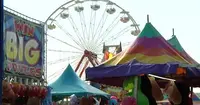
Just inside the 3rd Street NW gate at Montana ExpoPark, on the loop of the Central Park, stands an information booth built in the shape of a grain elevator. Fairgoers stop there for maps and to rent wheelchairs, strollers and wagons before setting out across the grounds. For nine days each summer the Montana State Fair fills this park in the northwestern part of Great Falls, and Cascade County runs it. The rest of the year the same grounds book arena concerts, gun shows, horse sales and dog races. The 2026 fair ran July 24 through August 1 under the theme “Red, White and Fair.” KRTV reported a forecast of triple-digit heat for the first two days and the mid to upper 90s after. Through that week the ExpoPark’s own posts told visitors to drink water, take breaks in the shade and refill their bottles. The 2027 fair is set for July 30 through August 7, 2027.
A Viking and a Cow Pie
The Great Falls tourism office names two foods as particular to this fair. The Sons of Norway Viking is, in its description, a huge fried meatball. The Cow Pie is a deep-fried burger. Alicia Bateman, owner of Stuffed International Cuisine, had been coming for 11 years when a NonStop Local reporter found her on opening day of the 2026 fair. “This by far our biggest event of the year. 10 straight days of serving amazing food is definitely a challenge but fun,” she said.
Newcomers that year included the Electric City Volleyball Academy, selling cold drinks, specialty sodas and energy drinks so its players would not have to pay to play. “They’ll come here, they’ll volunteer their time, and that will all go towards their monthly tuition to be able to play,” said its director, Alax Grundy.
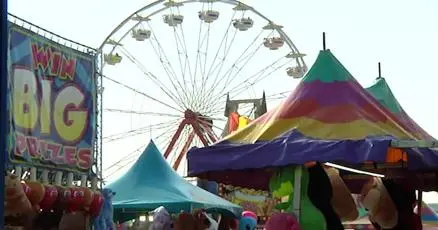
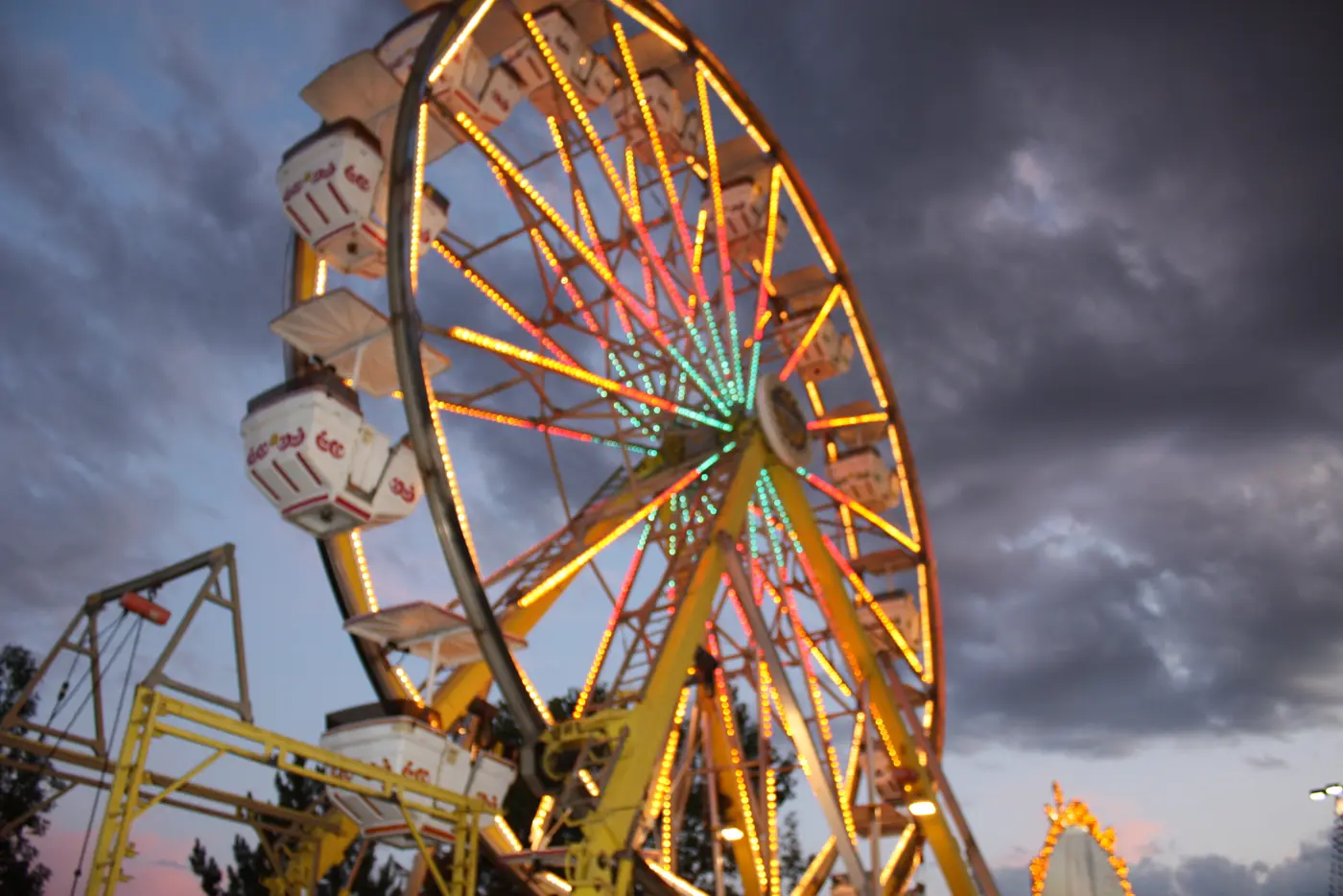
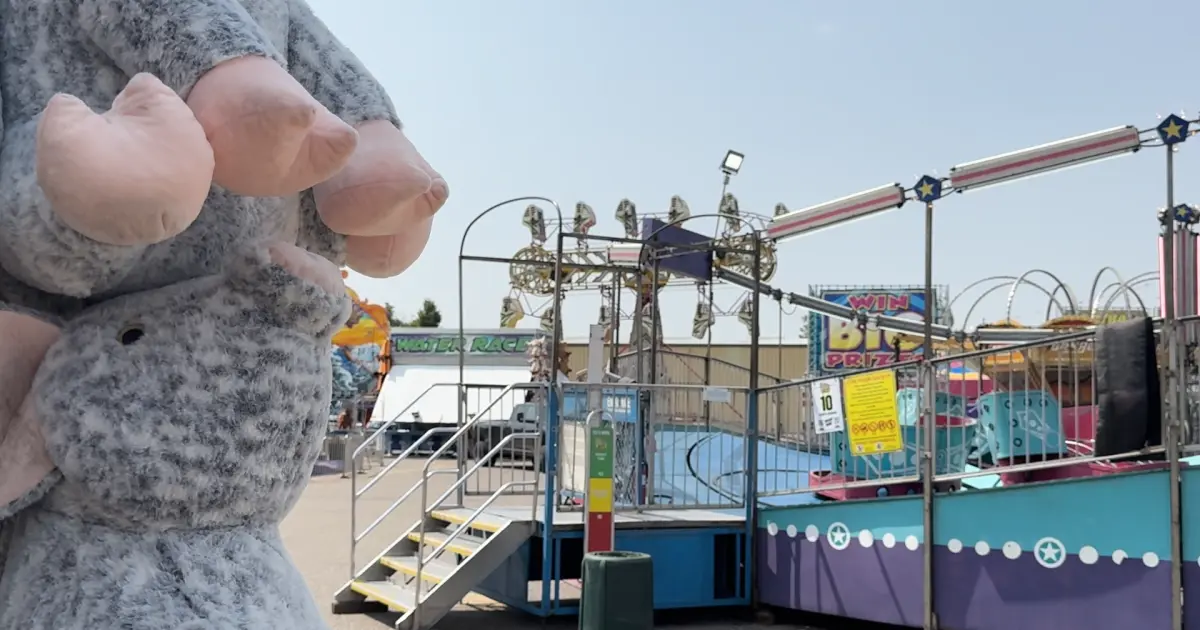
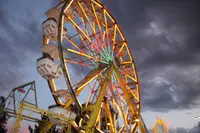
Past Food Alley runs the midway of the Mighty Thomas Carnival. Art B. Thomas founded the show in 1928 in Lennox, South Dakota, and it now winters near Austin, Texas. Its page counts 51 events in 12 states in a season and 28 straight years at ExpoPark. One hundred fifty traveling workers, joined by local hires, set it up, run it, and take it down when the fair closes. The carnival keeps a corner general store on the midway for personal items a fairgoer forgot to bring. By the show’s own account, its ticket sellers answer hundreds of questions a day.
Between the rides and the barns the county books free acts. There is bingo on the 3 Rivers Stage, a strolling piano played by Blake Guyre, and a strolling DJ, along with acts billed as AmirrorCAN MEN, FUNKANOMETRY and MOTIONaire. Two people movers run the grounds daily.
Rodeo nights and the arena
At 7:00 in the evening the grandstands fill for the PRCA Big Sky Pro Rodeo, four nights of eight major rodeo events. The nights carry names: Patriot Night, Family Night, Tough Enough to Wear Pink Night and Pepsi Night. The rodeo also crowns its own Rodeo Royalty. In 2026 it ran July 29 through August 1, and for 2027 the county lists August 4 through August 7.
Horse racing appears in the tourism office’s list of the 2025 fair’s attractions. KRTV reported there would be none in 2026, though the Little Shell Tribe would host Indian Relays on July 25 and 26. Evening headliners play the Pacific Steel & Recycling Arena. The 2026 bill held Third Eye Blind, Kansas, Ian Munsick and the comedian John Crist.
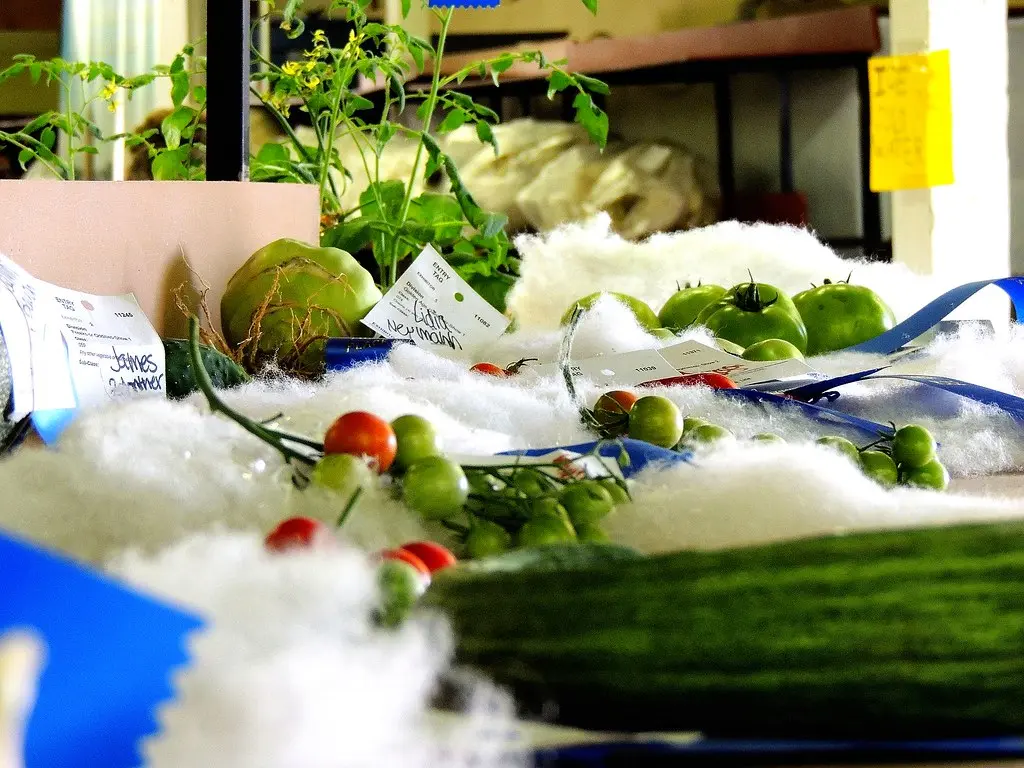
The competitive departments fill the exhibit halls and barns. They cover beef, dairy goats, poultry, rabbits, ponies and junior livestock, and also culinary, floriculture, fine arts, photography, quilting, hobbies, and weaving and wool. School entries, 4-H, FFA and a miniature horse show round out the list. The county counts thousands of classes, with entrants from children to senior citizens. Winners take ribbons and, in some classes, premium money.
A tower on the Mercantile
The exhibits sit in buildings older than nearly everything else at the fair. They stand on a triangle of nearly 22 acres at the southernmost corner of the 102-acre grounds. A “wall” of exhibition buildings, 3rd Street NW and the Milwaukee Railroad right-of-way form its sides. The street follows the Burlington Northern tracks, which in turn follow the curve of the Missouri River. This is the North Montana State Fairground Historic District, which the National Park Service record spells “Northern.” Its National Register registration was published on January 13, 1989. Ellen Sievert of the Cascade County Historical Society prepared the nomination in October 1988, and it names George M. Shanley and Gordon G. Cottier among the architects.
Her survey describes ten historic exposition buildings and two support buildings on formally landscaped grounds. Visitors enter through cut-stone gates and pylons and, at the 3rd Street NW pedestrian entrance, a canopied gate. Walks lead to a semicircular central park shaded by mature deciduous trees, with conifers among them.
Most halls follow what the form calls Exposition or Pavilion architecture, a style it traces to the 1893 World’s Columbian Exposition in Chicago. These are large clear-span buildings, mostly wood frame with stucco, each fronted with a scaled-down classical entry and flagpoles. The same front was applied even to barns, to invite the public “to step in and view the world of prized livestock.”
Three buildings are Art Deco. The block-long Mercantile anchors the base of the central park and divides the exhibit halls from the midway to the north. It rises to a highly sculptural central tower of 60 feet, and First Aid is kept there during the fair. North of it, the Administration building is the only two-story building on the grounds and “overlooks” the fairgrounds. The Fine Arts building bends in a rounded L around the corner at the main entrance, its front painted in “ice cream” pastels. Historic photographs show the halls were first white; by 1988 most had gone to cream.
Other buildings depart from that pattern. Near the southwestern tip, the dark wood “Nature’s Den” looks like a log cabin and held exhibits from the USDA Forest Service and Montana Fish, Wildlife and Parks. A former sheep barn was once open beneath the roofline for air. It was probably closed in during the 1940s, and by 1988 it held, in the form’s words, “less odorous commercial enterprises.” The form also listed what it counted against the district:
- the stage and gazebo added to the central park in 1971
- the concession booths spilling over from the midway
- a 172-by-300-foot metal building on the site of a large livestock pavilion that had burned and been torn down
The North Montana Fair of 1931
Montana’s fairs began in Helena, where residents gathered for Territorial Fairs before statehood. By 1909 the capital held the first State Fair, “The Montana Agricultural, Mineral and Mechanical Exhibition.” The legislature stopped funding the Helena fair in 1925.
In 1926 the Chamber of Commerce started a movement for a permanent fairground to “forward the upward progress” of agriculture in north central Montana. Cascade County bought the land that year, along with an existing pavilion; the Montana Livestock Pavilion, established in 1919, became part of the complex in 1926. The Chamber raised $30,000 by public subscription, matched by a county tax levy. The county commissioners and a five-member fair commission built the grounds. Oliver Sherman Warden, publisher of the Great Falls Tribune, played a significant role. Francis A. Robinson of Pearse-Robinson in Des Moines drew the site plan, and in October 1930 Harold F. DePue was hired as secretary-manager.
After five years of planning, the first North Montana Fair opened in 1931. The nomination puts the first-day crowd at 129,617 and calls it the only major fair held in Montana that year. NonStop Local, drawing on the county’s historic preservation office, reported in 2022 that the first fair drew over 129,000 people. Samantha Long, the Great Falls Cascade County Historic Preservation Officer, told the station the grounds were planned from the start but built pay-as-you-go over several years. Changing trends and designs show from building to building as a result. “We have it because folks almost 100 years ago, around 1926 decided they value this and wanted this in the county,” she said.
Building went on through the Depression with Public Works Administration money, which gave work to local contractors and architects. In 1937 the fair began to be called the North Montana “State” Fair, and the Mercantile and Future Farmers’ pavilions went up with PWA help. In 1938 a Fish, Wildlife and Forestry building was added, and the Art Deco Fine Arts building, in the form’s phrase, “rounded out” the exhibition grounds. Dan Thurber was secretary-manager in 1941. Around 1965 the fair assumed the “State Fair” title outright. The nomination records this as a friendly rivalry with Billings, which also proclaims “State” status.
Notable Events
- 1919The Montana Livestock Pavilion was established in 1919 and in 1926 became an integral part of the fair complex. npgallery.nps.gov
- 1926Cascade County bought the fairgrounds originally in 1926. montanarightnow.com
- 1926The Chamber of Commerce initiated the movement to create a permanent fairground facility to "forward the upward progress" of agriculture in north central Montana. npgallery.nps.gov
- 1931The first North Montana Fair opened to a first-day crowd of 129,617; it was the only major fair held in Montana in 1931. npgallery.nps.gov
- 1937The local fair began to be designated the North Montana "State" Fair; the Mercantile and Future Farmers' pavilions were added with Public Works Administration assistance. npgallery.nps.gov
- 1938A Fish, Wildlife and Forestry exhibition building was added and the Art Deco Fine Arts building "rounded out" development of the exhibition grounds. npgallery.nps.gov
- 1965The fair assumed the "State Fair" title, in friendly rivalry with Billings, which also proclaims "State" status. npgallery.nps.gov
- 1989The National Park Service published the Northern Montana State Fairground Historic District's National Register registration under reference number 88003143. npgallery.nps.gov
People
- George M. Shanley, Architect of the Northern Montana State Fairground Historic District.
- Gordon G. Cottier, Architect of the Northern Montana State Fairground Historic District.
- Dan Thurber, Secretary/manager of the fair (1941).
- Francis A. Robinson, Landscape architect, Pearse-Robinson of Des Moines, contracted to design the site plan.
- Harold F. DePue, Secretary/manager of the fair (hired October 1930).
- Oliver Sherman Warden, Publisher of the Great Falls Tribune; played a significant role in the development of the fairground.
Sources
- cascadecountymt.gov/213/2027-Montana-State-Fair
- cascadecountymt.gov/221/Carnival
- cascadecountymt.gov/224/Competitive-Exhibits
- cascadecountymt.gov/229/General-Information
- cascadecountymt.gov/214/PRCA-Big-Sky-Pro-Rodeo
- npgallery.nps.gov/pdfhost/docs/NRHP/Text/88003143.pdf
- montanarightnow.com/great-falls/montana-state-fair-brings-rides-food-and-concerts-to-great-falls/article_47f75959-a40a-47ac-a737-d35d772def59.html
- krtv.com/news/montana-state-fair-returns-to-great-falls-july-24-through-august-1
- visitgreatfallsmontana.org/event/montana-state-fair
- flickr.com/photos/tracyelizabeths/8126795843
- instagram.com/montana_expopark
- npgallery.nps.gov/AssetDetail/NRIS/88003143
- montanarightnow.com/great-falls/91-years-of-history-with-the-montana-state-fair/article_313b4d08-0fa9-11ed-8cfe-cf1d20c1c759.html