

Last Chance Stampede & Fair
Helena, Lewis and Clark County, Montana. Fairground.
Details

- Where
- 98 W Custer Ave, Helena, MT 59602. Directions
- When
- Last held July 21–25, 2026; next year’s date not yet stated.
- Fees
- Free fairgrounds gate admission; night show and rodeo tickets sold separately.
- Hours
- Fair opens Tuesday at 4pm; Dreamland Carnival opens at 5pm; opening concert begins at 7:30pm.
- Walk-in or reserve
- Free gate admission; night show tickets on sale at lccfairgrounds.com; rodeo tickets went on sale June 1st at lccfairgrounds.com.
- Phone
- (406) 457-8516
- Website
- lccfairgrounds.com
- Managed by
- Lewis & Clark County Fairgrounds.
- Established
- 66th annual edition as of 2026.
The Lewis and Clark County Fairgrounds cover 160 acres on the northwest side of Helena, among mature cottonwoods in the valley below Mount Helena and the Scratchgravel Hills. For five days at the end of July the grounds hold the Last Chance Stampede & Fair, a county fair and professional rodeo run by the fairgrounds itself. Gate admission is free. The 66th edition ran July 21–25, 2026. On its last day, at noon, the Stampede parade stepped off through downtown Helena.
Five days on West Custer Avenue
The 2026 fair opened on a Tuesday at 4 p.m. with the concession stands, the commercial exhibits, and the Open Class Indoor Fair, whose entrants are told to “Bake it. Take it. Grow it. Show it.” The Dreamland Carnival started its rides at 5. On the following days the gates opened at 11 in the morning. More than 20 food and beverage concessionaires sell everything from ice cream to steak sandwiches. The commercial booths run from face painting and artisan wares to farm equipment and RVs, and the annual 4-H Fair fills its own share of the grounds.
Comedians, jugglers, hypnotists, magicians and balloon artists stroll the fairgrounds and play free stages in the Exhibit and Entry Halls. The fairgrounds sends visitors to those halls “when you need to cool off.” The 2024 bill listed Tyzen, a comedy hypnotist; Adam the Great, a magician; and Marcus, whose one-man circus called for juggling, a bowling ball and a yo-yo. Mutton bustin’ is billed as an event of its own.
The first two nights belong to music in Cool Alley Arena. In 2026 Daughtry played Tuesday, July 21, on a bill with Tim Montana. Travis Tritt and his band played Wednesday, July 22, with Downtown Avenue as special guest. Both shows opened their gates at 6:30 and started at 7:30.
Rodeo nights in Cool Alley Arena
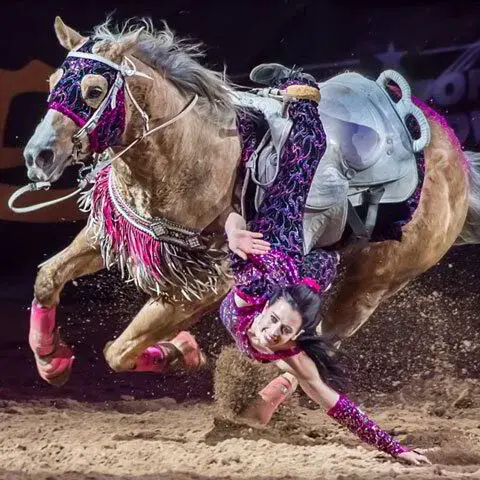
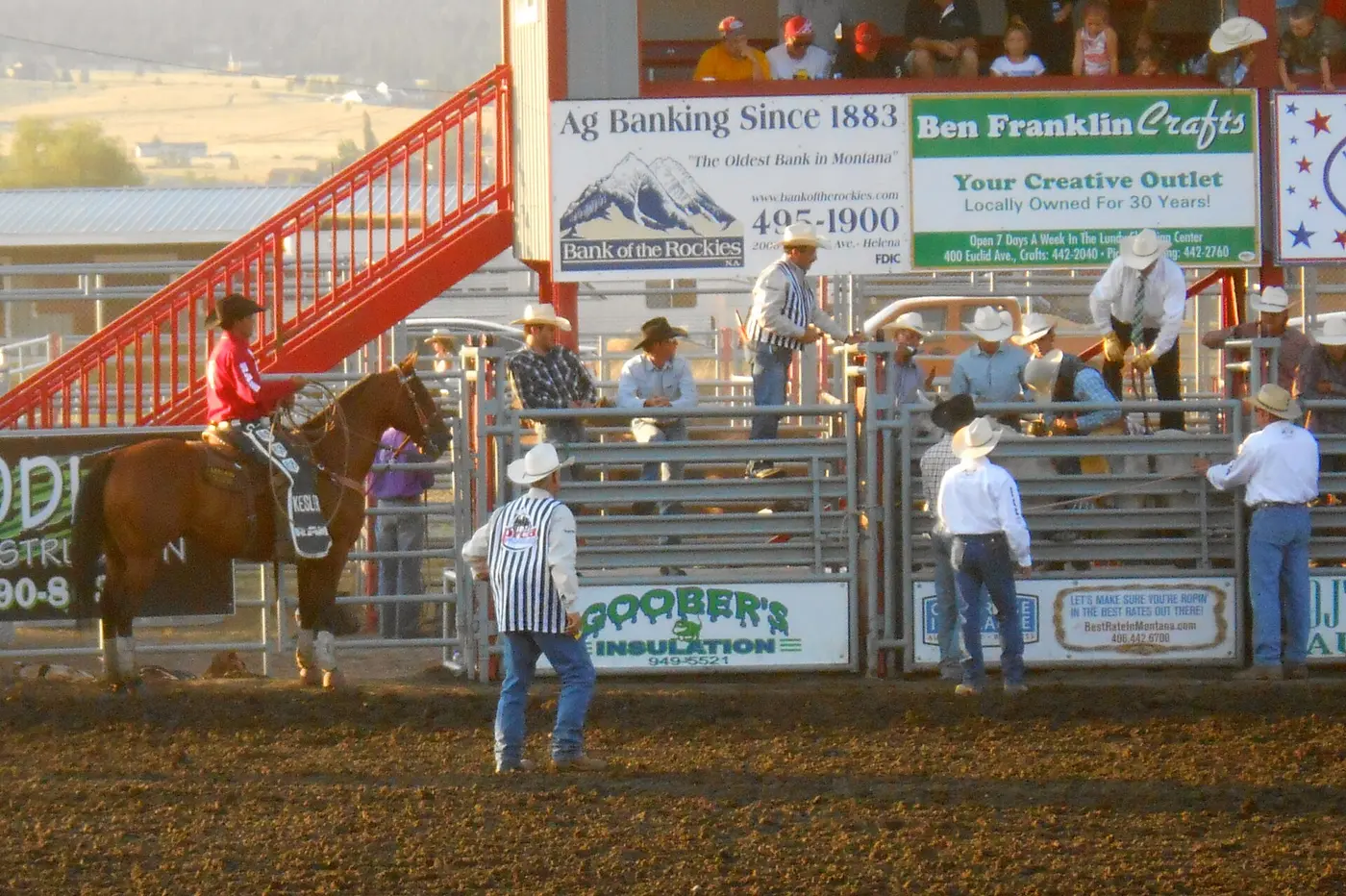
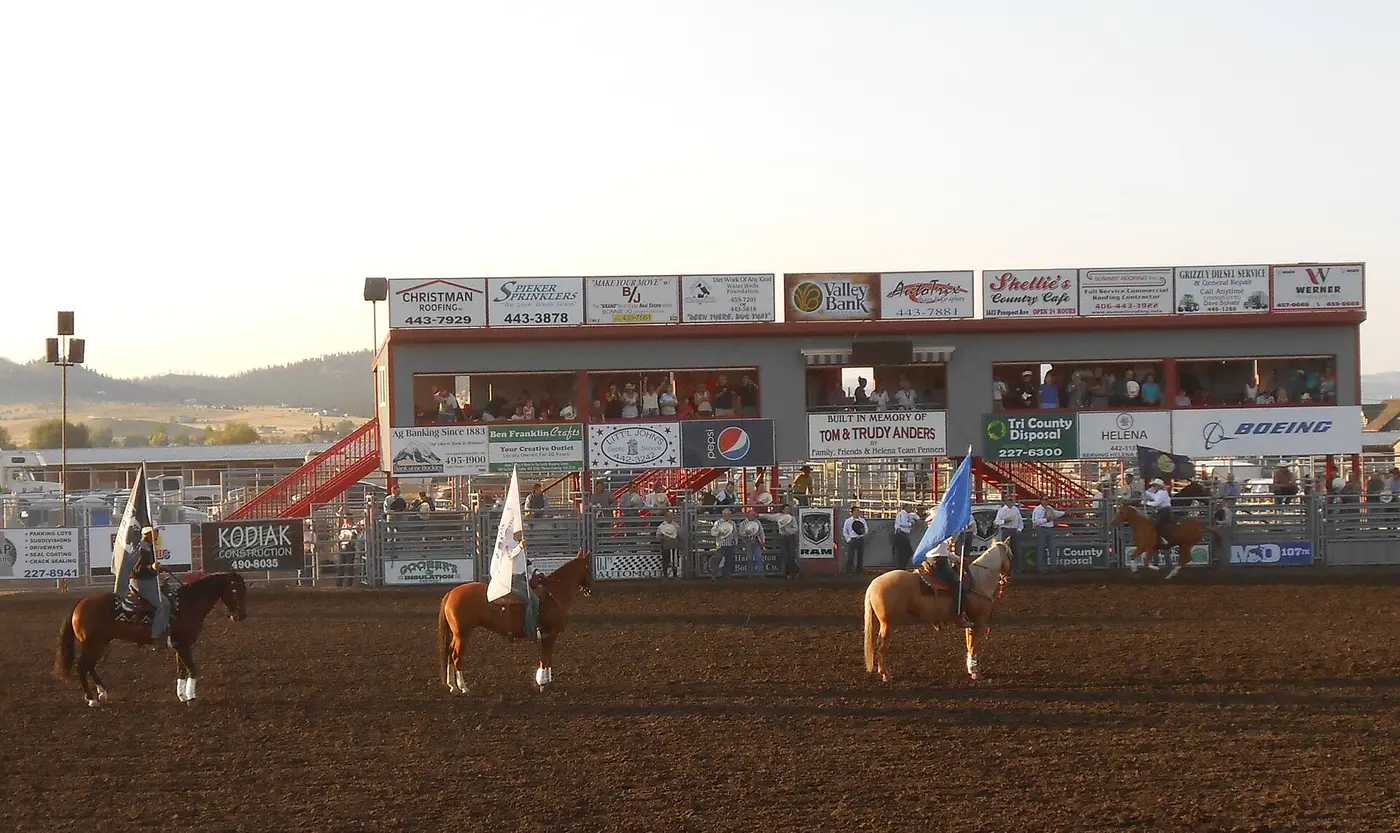
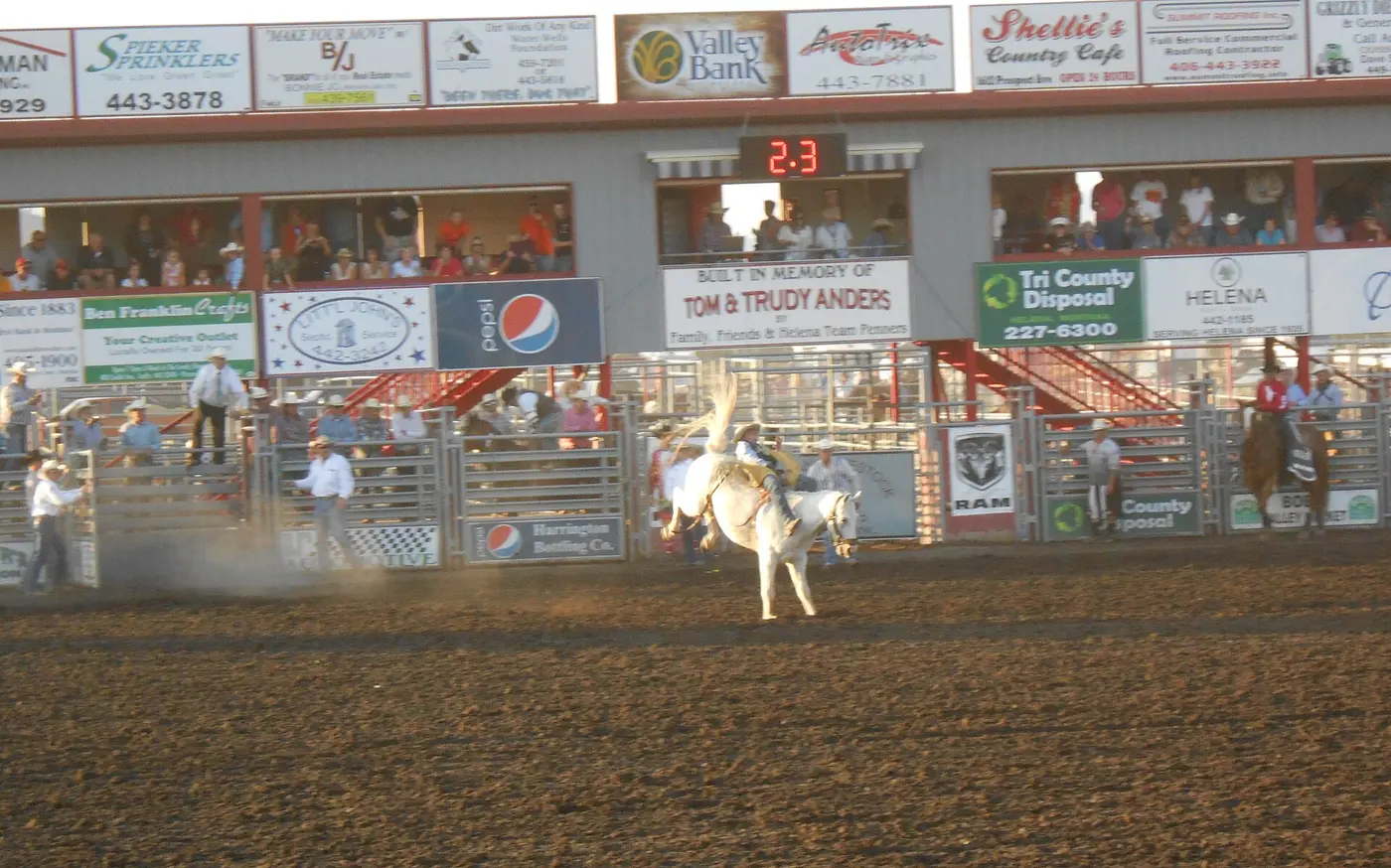
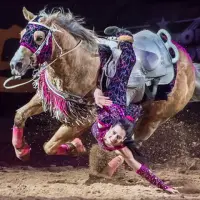
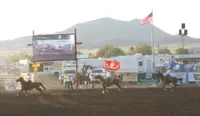
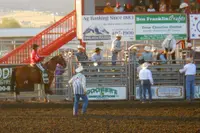
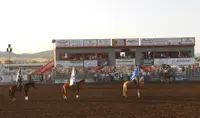
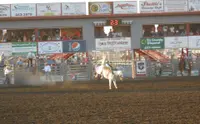
Thursday, Friday and Saturday nights at 7:30 are given to PRCA rodeo, which the fair says draws contestants from across the nation. The PRCA voted the Stampede its Medium Rodeo of the Year in 2017. The bucking stock comes from C5 Rodeo, a company based in Helena and in Lac La Biche, Alberta, which owns the bareback horse F13 Virgil. Wayne Brooks, the “Voice of Rodeo,” calls the action. He has been a PRCA member since 1994 and has five times been named its announcer of the year. Matt Merritt, named 2025 PRCA Rodeo Clown of the Year, works as clown and barrelman. The trick rider Madison MacDonald-Thomas has performed at the National Finals Rodeo 11 times. Before each performance SkyDance Skydiving, which has flown patriotic parachute displays since 1987, comes down out of the sky to honor the flag.
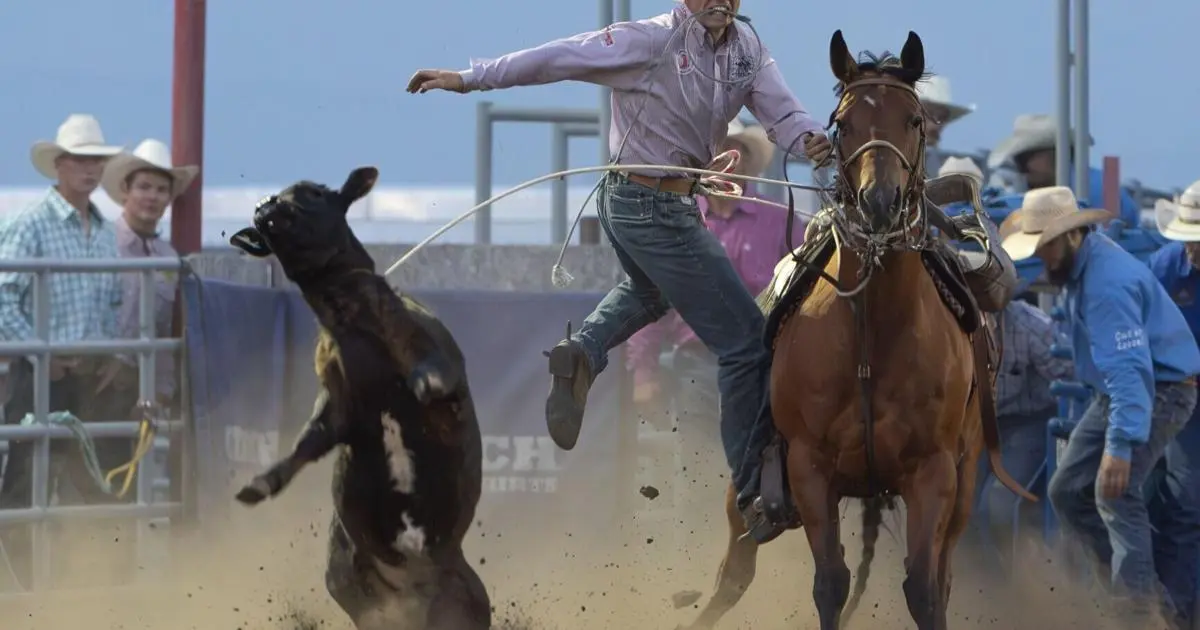
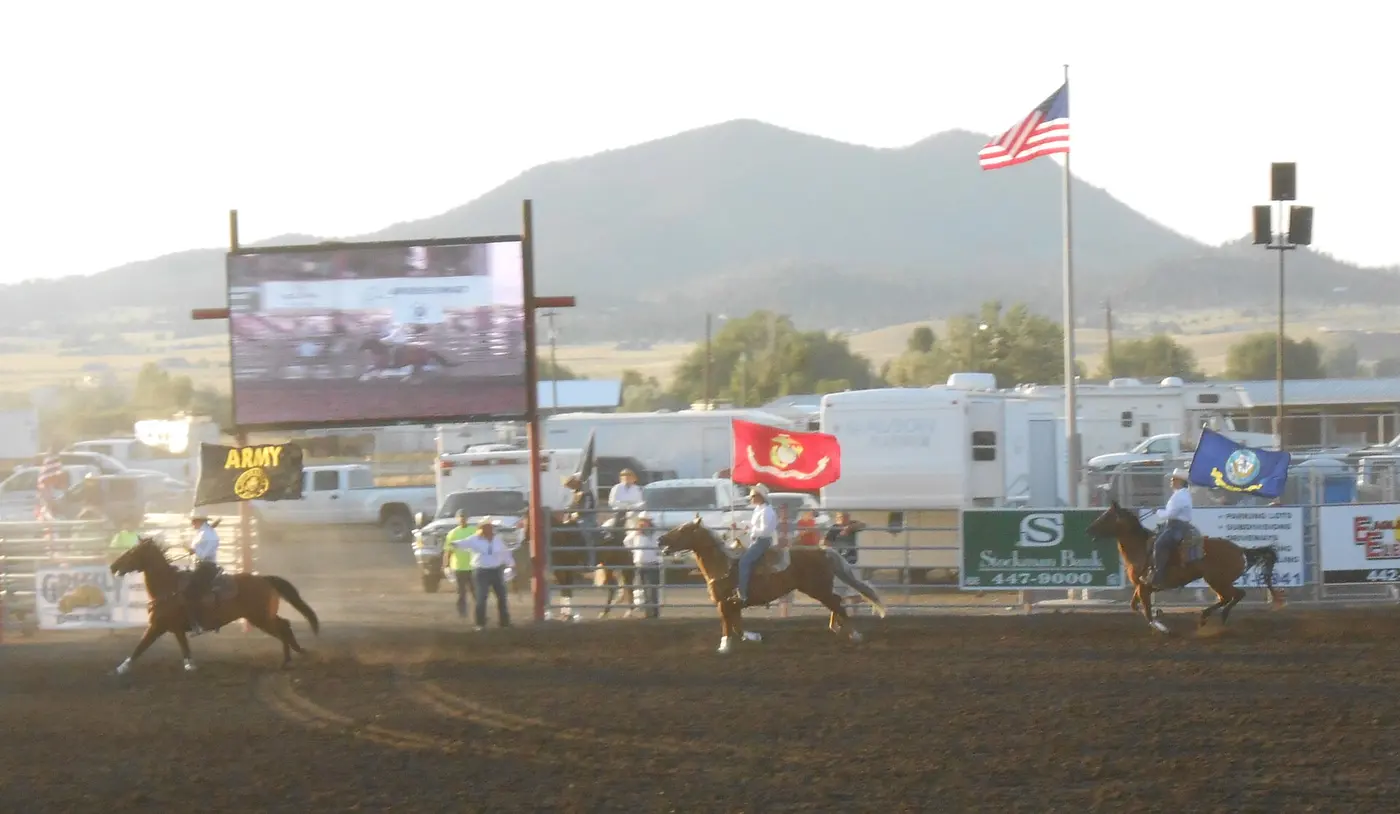
The Independent Record reported that dozens of riders took over the arena on Thursday, July 23, 2026, for the opening rodeo night: bucking horses, bulls and cattle ropers. Its photographs show a flag bearer riding the arena, Logan Smith leaping from his horse in the tie-down roping, Ryan Zurcher swinging his lasso after a calf in the team roping, and Chase Brooks holding on in the saddle bronc.
A mare’s name on the arena
The arena takes its name from Cool Alley, a 1,600-pound mare owned and raised by the Kesler family of Helena. She bucked at the Last Chance Stampede and on the national stage, and she held five world titles in combination as PRCA Bareback Horse of the Year and PRCA Saddle Bronc Horse of the Year. At the Wrangler National Finals Rodeo in 2003, Billy Etbauer rode her for 93 points, an arena record. He drew her again in 2004 and scored another 93.
When the Lewis and Clark County Commission approved the renaming unanimously, Fair Board chairman Phil Porrini said, “Helena should become the first rodeo arena in Montana, maybe across the nation, to have a named arena after a horse.” Mike Gurnett, chairman of the rodeo committee, said, “We want contestants to view ‘Cool Alley’ in Helena as hallowed ground of those that came before them.” The new name was to be a featured part of the Stampede’s 60th anniversary in 2020.
The arena itself was new. The fairgrounds’ own history says an engineering report in 2000 condemned the historic grandstand as unsafe. The Helena history website and the racetrack’s National Register form both say the original grandstand was demolished in 1999 and temporary metal-framed seating set up in its place. A temporary 1,800-seat stand and a rodeo arena built by volunteers kept the Stampede going. In 2005 metal stands blocked off about an eighth of the old racetrack, the track surface was turned, and part of the infield was stripped of grass to make a square arena. In June 2004 the county’s voters approved an 8.18-mill ten-year levy and a 2.91-mill permanent levy to pay for a plan expected to cost more than $6 million. That plan called for a grandstand and outdoor arena joined by an Entry Hall to a 36,000-square-foot Exhibit Hall.
The site of the new buildings was contested. In 2006 historic preservationists and horseracing enthusiasts, organized as the Save the Track Foundation, filed injunctions against the county and then sued it over plans to build in the infield of the historic track. The foundation claimed the county had “bamboozled voters during a 2006 levy election” by naming the infield site only after the vote. In March 2008 State District Judge Thomas Honzel found for the county. The two halls opened in November 2008. The grandstands and arena opened in July 2009 for the 49th annual Stampede and Fair. The central south portion of the old track was removed for parking.
The anniversary planned for 2020 did not take place. That year the fairgrounds canceled the Stampede and Fair for the first time in its 60-year history, citing the COVID-19 pandemic and uncertainty over Montana’s reopening. Fairgrounds manager Kevin Tenney explained that the fairgrounds depends on its own event revenue: “If we lose $200,000, that’s a big hit.” The county 4-H went ahead with its show and auction. In 2021 the Stampede and Fair drew record attendance, and the Friday and Saturday night rodeos sold out.
A mile of track from 1870
The racetrack still circles the northwest side of the grounds. It is an oval a mile around, laid east and west, with the backstretch on the north and a quarter-mile homestretch on the south. It is about 75 feet wide, which the National Register form describes as room for six to eight sulkies abreast. A rail of 4-by-4s painted white marks its edge. From the south side a spectator looks across the Helena valley to the Sleeping Giant, also called Beartooth Mountain, on the northern skyline. Local tradition holds that carloads of Kentucky earth were brought in for the track. A rail spur made that possible, but the shipments have never been documented. The track was listed in the National Register of Historic Places on a 2006 registration form written by Ellen Baumler.
Accounts of the fairs before the track differ. The Helena history website places the first and second Montana Territorial Fairs of 1868 and 1869 at Mrs. Coady’s resort on Ten Mile Creek, beside a racetrack called the Fashion Course, about a mile and a half southwest of the present grounds. No trace of either has been found. The fairgrounds’ own history credits those years to a group called the Helena Valley Organizers, who rented land northwest of town for an exposition. In 1870 the Montana Agricultural Mineral and Mechanical Association bought the present site, put up the first buildings, and held the first territorial fair there. The Register form calls the track the location of the first organized and regulation races in the state. By 1890 its races drew about 100 horses, among them entries from the Denver Trotting Stables, which arrived on special Montana Central cars built for racehorses and ran for an aggregate purse of $15,000.
Helena citizens later bought the land and buildings from the association for $10,000 and turned the property over to the state legislature. The legislature reorganized it as the Montana State Fair, which opened its gates to 20,000 visitors in 1903. A second grandstand went up in 1906. It was 260 feet long and seated 5,000.
On September 30, 1911, the fair watched Cromwell Dixon, a nineteen-year-old aviator from Columbus, Ohio, take off from the fairgrounds in a bamboo-and-fabric airplane. Thirty-four minutes later he landed in a field near Blossberg, some 17 miles west, on the far side of the Continental Divide. He wired the fair officials that he was safe, refueled, and flew back. Strong tail winds carried him home, and he circled the fairgrounds twice before landing. The fairgrounds history puts the crowd at 25,000. Governor Edwin Norris proclaimed him “The World’s Greatest Aviator” and handed him a check for $10,000. Two days later Dixon died when his plane crashed in Spokane.
The State Fair reached its height in 1915, when exhibits numbered 15,000 and attendance reached 50,000. At that fair Ralph B. Adams demonstrated the first wireless radio used by U.S. Forest Service lookouts. Automobile racing began in 1914, and a car track was laid inside the horse track in 1916. In 1927 carloads of thoroughbreds came in on the Northern Pacific and Great Northern, and racing fans hung on the fence to watch the morning workouts. Charles A. Lindbergh visited the grounds on September 6 of that year. By July 21, 1930, more than 250 horses “from the best circuits in Canada, Mexico, and the United States” were stabled at the grounds, and a new pari-mutuel machine “added zest” to the betting. Nearly 25,000 people came to that fair.
Falling farm prices, the Depression and drought cut attendance through the following years. The last State Fair at Helena was held in 1932. In 1933 the Depression forced its cancellation, and the National Register form gives the reason: “Most people simply could not afford the price of admission.” The earthquakes of October 1935 damaged buildings and water mains and brought down the Horticultural Hall, which had stood since 1914. A man was killed in its collapse. The State Fair moved to Great Falls, and for the next 20 years much of the grounds stood closed.
Bill Carson’s volunteers
Rodeo had come to the grounds before the Stampede. The Treasure State Rodeo was held there from 1944 to 1947, and in 1953 the Capital City Racing Association built a quarter-mile stock car track inside the old automobile track. In 1958 Bill Carson organized a group of citizens to repair the run-down property. A county-supported board formed, and volunteers did the work. A 20,000-square-foot Multi-purpose building with a dirt floor went up in the late 1950s. In 1959 the Lewis & Clark Fairgrounds Association formed to open all of the grounds to public use.
With the first Last Chance Stampede in 1961, horseracing returned to the old track, which stayed in use until its last race in 1998. A derelict starting gate from that era, stenciled for Helena Downs, survives in Ellen Baumler’s photograph. The first Stampede also crowned its first queen. The 1961 candidates were photographed at the Nite Owl, and the crown went to Kitty Ann Quigley, who had entered as “Miss Frontier Town.” The Helena Fairgrounds Foundation now gives scholarships to Miss Last Chance Stampede queens. Kayla Seaman, queen in 2018, Clancy Olson in 2022, and Amber LaCross in 2023 have gone on to be Miss Rodeo Montana.
The 1963 Stampede ran a chariot race, and the Helena artist Irvin “Shorty” Shope drew the 1964 poster. In 1968 the parade color guard was photographed at Main and 11th. The fairgrounds dates the joining of the Lewis & Clark County Fair to the Stampede weekend at the end of July to 1969. The Helena history website says a fair was reinstituted at the grounds in 1990.
The day the Stampede began is told in Curt Synness’s history for the Independent Record. On the morning of July 30, 1961, Bill Carson and Homer Phillips climbed to the top of the grandstands, both of them nervous, and looked south down Henderson Street to see how many people would come.
Notable Events
- 1868The group rented land northwest of Helena and held expositions promoting local goods and services. lccfairgrounds.com
- 1870The Montana Agricultural Mineral and Mechanical Association raised money, bought the current fairgrounds site, and erected the first buildings. lccfairgrounds.com
- 1903After Helena citizens transferred the property to the legislature, the reorganized Montana State Fair opened its gates to 20,000 visitors. lccfairgrounds.com
- 1911Nineteen-year-old Cromwell Dixon took off from the fairgrounds, landed atop the Rocky Mountains, and returned before a crowd of 25,000. lccfairgrounds.com
- 1915Exhibits reached 15,000 and attendance reached 50,000. lccfairgrounds.com
- 1932Declining agricultural prices, the Depression, and drought preceded the final State Fair at the grounds. lccfairgrounds.com
- 1935October earthquakes damaged buildings and water mains and destroyed the new horticultural building; much of the grounds then closed for 20 years. lccfairgrounds.com
- 1958Carson organized concerned citizens; a county-supported board formed and volunteers repaired the dilapidated property. npgallery.nps.gov
- 1959The association formed to open all 160 acres to public use. lccfairgrounds.com
- 1961The first Last Chance Stampede took place July 30, 1961, the brainchild of Bill Carson and Homer Phillips. helenair.com
- 1969The county fair joined the annual last-weekend-in-July events. lccfairgrounds.com
- 1990A fair was reinstituted and the grounds were reestablished as a center for community activities. helenahistory.org
- 1998The track continued in use until its last race. npgallery.nps.gov
- 1999Temporary metal-framed stadium seating was introduced in lieu of the original grandstands. npgallery.nps.gov
- 2000An engineering report declared the grandstand unsafe; a temporary 1,800-seat stand and volunteer-built rodeo arena kept the Stampede operating. lccfairgrounds.com
- 2004Voters approved mill levies in June 2004; construction of new facilities began in 2007. lccfairgrounds.com
- 2005A small shed-roofed building moved into the infield west of the rodeo building. npgallery.nps.gov
- 2005Metal-framed stands blocked off approximately one-eighth of the track surface, east of the homestretch and west of the first turn. npgallery.nps.gov
- 2008The two halls opened for public use in November. lccfairgrounds.com
- 2009The new grandstands and outdoor performance arena opened in July for the 49th annual Last Chance Stampede and Fair. lccfairgrounds.com
- 2020The fairgrounds canceled the Stampede and Fair for the first time in its 60-year history because of the COVID-19 pandemic and reopening uncertainty. krtv.com
- 2021Friday and Saturday night PRCA rodeo performances sold out. lccfairgrounds.com
People
- Cromwell Dixon, Aviator who made the first flight across the Continental Divide from the fairgrounds (1911).
- Kitty Ann Quigley, Selected as Miss Last Chance Stampede (1961).
- Bill Carson, Co-originator of the first Last Chance Stampede (1961).
- Homer Phillips, Co-originator of the first Last Chance Stampede (1961).
- Mike Gurnett, Rodeo Committee Chairman, describing the arena renaming as a tribute to rough stock.
- Phil Porrini, Fair Board chairman advocating the arena's horse namesake.
- Kitty Ann Quigley (Taaler), First Miss Last Chance Stampede (1961).
Sources
- lccfairgrounds.com/last-chance-stampede
- helenamt.com/event/last-chance-stampede-fair-6/2026-07-24
- billingsgazette.com/news/state-regional/article_6687315e-cee6-56be-a8ac-1d99d51bb303.html
- facebook.com/lewisandclarkcountyfairgrounds
- lccfairgrounds.com/about-us
- helenahistory.org/the_fairgrounds.htm
- krtv.com/news/helena-news/last-chance-stampede-and-fair-canceled