Jack Creek Guard Station
Saratoga, Carbon County, Wyoming. Guard station.
Details

- Where
- Saratoga, Carbon County, WY. No street address stated. Directions
- Season
- mid-June through October, weather permitting.
- Getting there
- From Saratoga, travel west on County Road 500 approximately 16 miles to junction with County Road 405. Stay left and travel 3 miles to the forest boundary. The road changes to Forest Service Road 452. Travel on Forest Service Road 452 for 6.5 miles to Jack Creek Campground and the guard station.
- Access
- Water is available during the summer months from a hydrant just outside or a hand pump at Jack Creek Campground, one mile away. There is no indoor plumbing, but a vault toilet is located nearby. A picnic table and campfire ring are also outside the cabin. Please use propane side of stove for cooking and heat. There is no trash service; this is a pack-it-in, pack-it-out facility.
- Website
- recreation.gov
- Managed by
- Medicine Bow-Routt National Forests.
- Established
- 1934.
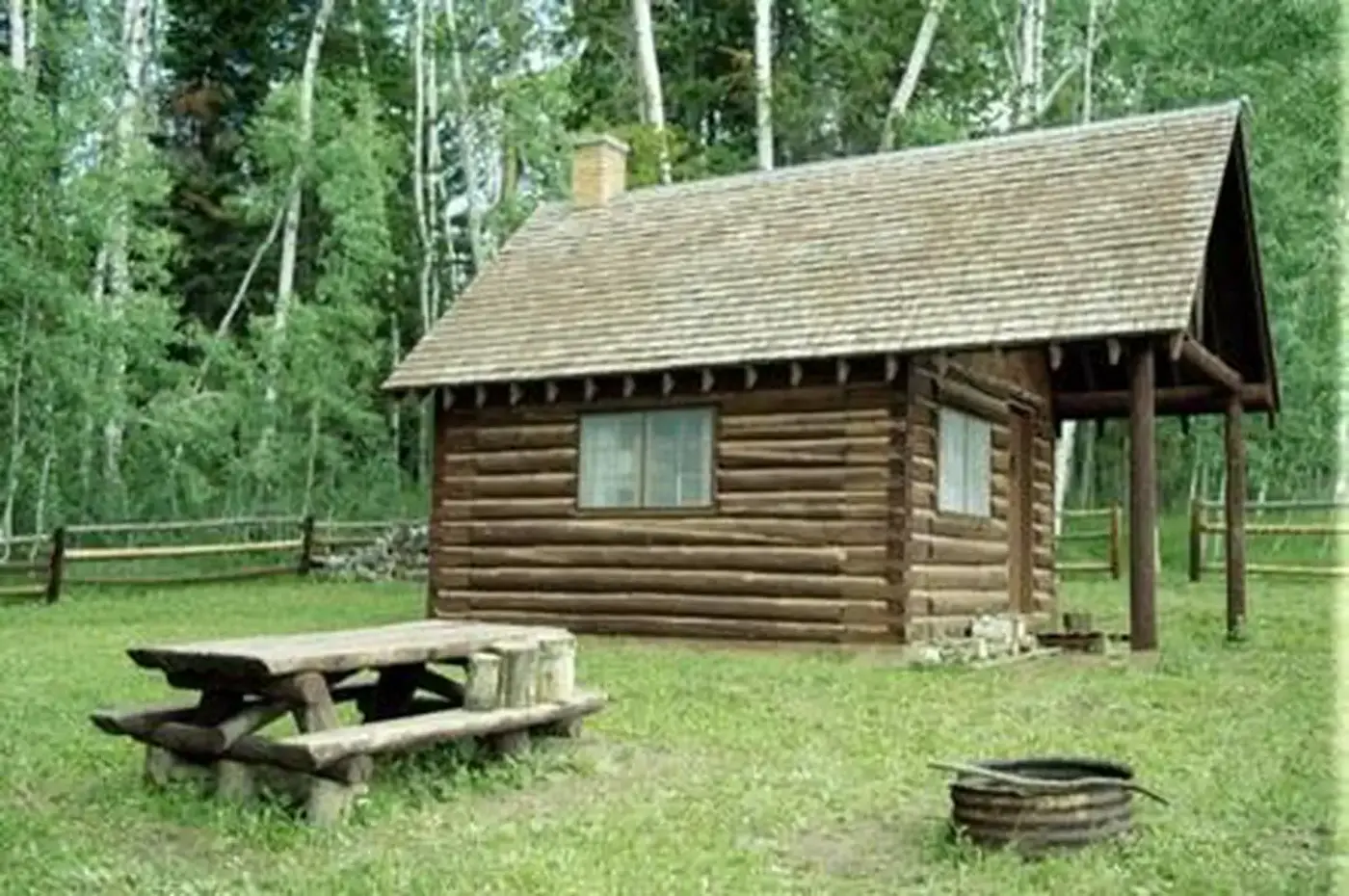
The cabin faces east, toward open park. Behind it, on the west, the forest closes in: lodgepole pine, aspen, and mixed conifer around a clearing at 8,500 feet in the Medicine Bow-Routt National Forests. Forest Service Road 452 passes about 20 yards to the south. The ground slopes gently that way toward Jack Creek. Across the creek, according to a 1985 survey of the site, the meadow climbs south for a considerable distance and is rimmed by forested mountains, with the Continental Divide to the southwest. Elk, deer, bear, and moose range through the country. The way in runs west from Saratoga on County Road 500 for about 16 miles, then left on County Road 405 for 3 miles to the forest boundary, where the road becomes 452, and 6.5 miles more to Jack Creek Campground and the guard station.
One room, four bunks
The Forest Service rents the Jack Creek Guard Station from mid-June through October, weather permitting. The single room holds two sets of bunk beds for up to four people, a table and chairs, and a combination wood and propane cook stove. The stove also heats the cabin, and the Forest Service asks guests to use the propane side. Propane lights and basic cooking and eating utensils are supplied. Instructions for lighting the stove and lights are kept inside, and guests open the valve on the propane tank when they arrive and close it when they leave.
There is no indoor plumbing. In summer, water comes from a freeze-proof hydrant just outside or from a hand pump at Jack Creek Campground, a mile off. A vault toilet stands within walking distance, and a picnic table and a campfire ring sit outside. There is no trash service: food and garbage leave with whoever brought them, and guests clean the cabin before they go. Tents, campers, and trailers may not be set up, and saddle and pack animals may not be kept at the site. Cell phone coverage is unreliable. A host stays at the Jack Creek Crew Quarters.
Plan A-4 in sawn logs
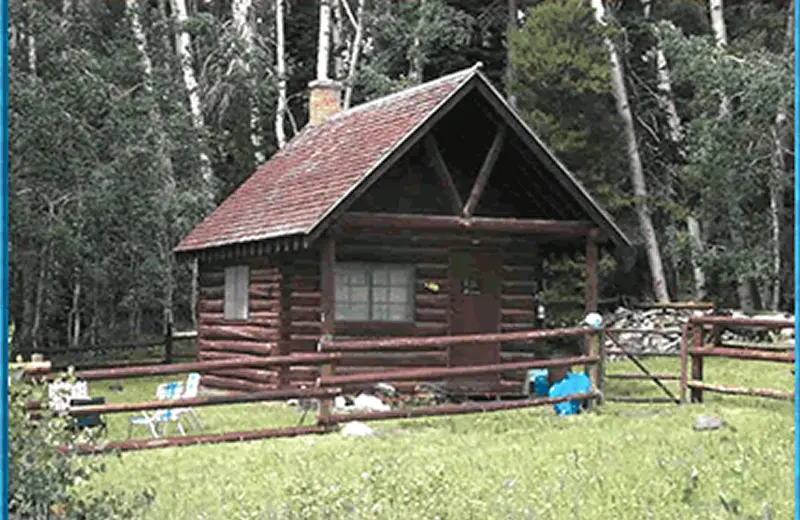
The building was recorded closely in 1985 by Judy A. Rose, Wyoming Zone Archeologist for the Medicine Bow National Forest. It measures about 14 by 16 feet and was built to a standard Forest Service plan, A-4, on a concrete foundation. The logs are sawn at the ends and joined with half-dovetail notches. For about a foot and a half at each end they were hewn flat with an axe to make square corners, then spiked in place with wire nails. The outside chinking is concrete; inside, split poles are wedged between the logs. The gabled roof of wood shakes runs out over the front to cover a porch 7 feet deep, which in 1985 had no floor beyond some makeshift boards. A single door opens at the right side of the east end. Small multi-paned sliding windows are set in the north, east, and south walls. A yellow-brick chimney, built separately for the combination wood and gas stove, stands against the back wall inside and passes through holes cut in floor and ceiling. The floor is tongue-and-groove lumber. The exterior is stained what Rose called “typical Forest Service California redwood.” In 1985 a heavy picnic table of the old Forest Service style, painted to match, stood on the south side. A well about 7 yards in front of the cabin had a modern spigot made in an old-fashioned pump style.
Rose classed the building in the Rocky Mountain Cabin style, a vernacular log style the Forest Service popularized in the West. She wrote that few of these old guard stations remained: many had been razed, and others had deteriorated through neglect. No other structure of comparable style or construction period stood on the Medicine Bow National Forest. A similar log guard station stood on the Routt National Forest, just south in Colorado.
Seventy-five dollars over
The builder was Evan John Williams, the Encampment District Ranger, known as Evy; the Forest Service’s rental pages spell the name Evie. He entered the Forest Service on May 24, 1916, and retired December 29, 1950, and he served his whole career on the Medicine Bow National Forest. He began in the years when rangers spent weeks in the woods, isolated, riding horseback or hiking to do their work. Williams built the Jack Creek cabin for that work, as an overnight camp, and it became the northern ranger cabin of the Encampment Ranger District.
The nomination dates the building 1933/34. Williams bought lumber and cement and had them delivered, then hired a team and men to fell and gather the logs. Those first chores ran him $75 past his $500 allocation, and he had to build the cabin essentially on his own. Another ranger helped him finish it in 1934, the year the Forest Service now gives for its construction. The Forest Service’s account adds a piece of oral history: Williams spent most of his construction money on material for the foundation and chimney, and used his own funds to finish the windows and roof.
The cabin went on serving as an administrative site for managing grazing, fish and wildlife habitat, and timber harvesting. By 1985 it held storage and housed summer seasonal workers. Williams’s own work ranged across the Medicine Bow and Sierra Madre mountains. Besides Jack Creek, he built, or helped build or reconstruct, five ranger stations, two fire lookouts, 100 miles of trail, 50 miles of telephone line, and 50 miles of boundary fence. He lived in the area for 35 years and raised a large family there.
A proposal for removal
Rose’s March 1985 report was titled “A Cultural Resource Evaluation for Proposed Removal of the Jack Creek Guard Station.” She found the cabin in excellent condition, with its repairs matched to the old fabric except for a fiberboard ceiling patched together over insulation. Repairs to the roof, in wood shakes, were already planned. A new log bunkhouse stood about 100 yards north, and she judged that it blended with the historic scene. Rose also prepared the nomination, and the cabin was added to the National Register of Historic Places on May 15, 1986.
A stone north of the cabin
Williams’s grave lies about 20 yards north of the cabin, where his ashes were buried in 1970. The 1985 site plan labels the spot “Evie Williams.” On the ground it is marked by a triangular pole fence and a large natural stone with nothing written on it.
Notable Events
- 1933Williams purchased lumber and cement, hired a team and men to gather logs, exceeded his $500 allocation by $75, largely built the cabin himself, and received help from another ranger to finish it in 1934. npgallery.nps.gov
- 1934Ranger Evie Williams built the northern ranger cabin for the historic Encampment Ranger District in 1934. fs.usda.gov
- 1970The gravesite north of the cabin contains Evan John Williams's ashes, buried in 1970. npgallery.nps.gov
- 1986The National Register of Historic Places asset page gives a publication date of 5/15/1986. npgallery.nps.gov
- 1986SHPO records the property's addition to the register. wyoshpo.wyo.gov
People
- Evie Williams, ranger who constructed the guard station (1934).
- Williams,Evan J., architect.
- Evan John Williams, Encampment District Ranger and builder of Jack Creek cabin; familiar name Evy (Medicine Bow National Forest service May 24, 1916 to December 29, 1950).