


Heber Valley Railroad
Heber City, Wasatch County, Utah. Historic railroad.
Details

- Where
- 450 South 600 West, Heber City, UT 84032. Directions
- When
- 2026: departs 1pm (returns about 2:30pm) and 3:30pm (returns about 5:00pm).
- Season
- Deer Creek Express runs most Mondays & Thursdays-Saturdays until June 1st; from June-September Wednesdays are added.
- Fees
- $30.00 Adult (age 12+) Coach General Admission; $20.00 Child (age 2-11); First Class $90.00.
- Hours
- Ticket office generally open 9 am to 5 pm Monday-Saturday; most Monday and Friday nights until 8:30 or 9:00 pm.
- Access
- No wheelchair access aboard the historic rail cars; call ahead for additional information.
- Walk-in or reserve
- Many trains sell out; tickets can often be bought at the ticket window, but advance purchase via website or phone is suggested.
- Phone
- (435) 654-5601
- Website
- hebertrain.com
- Managed by
- Heber Valley Historic Railroad Authority, a state agency created by the Utah legislature in 1992.
- Established
- 1899 (first Rio Grande Western train arrived in Heber September 21, 1899).
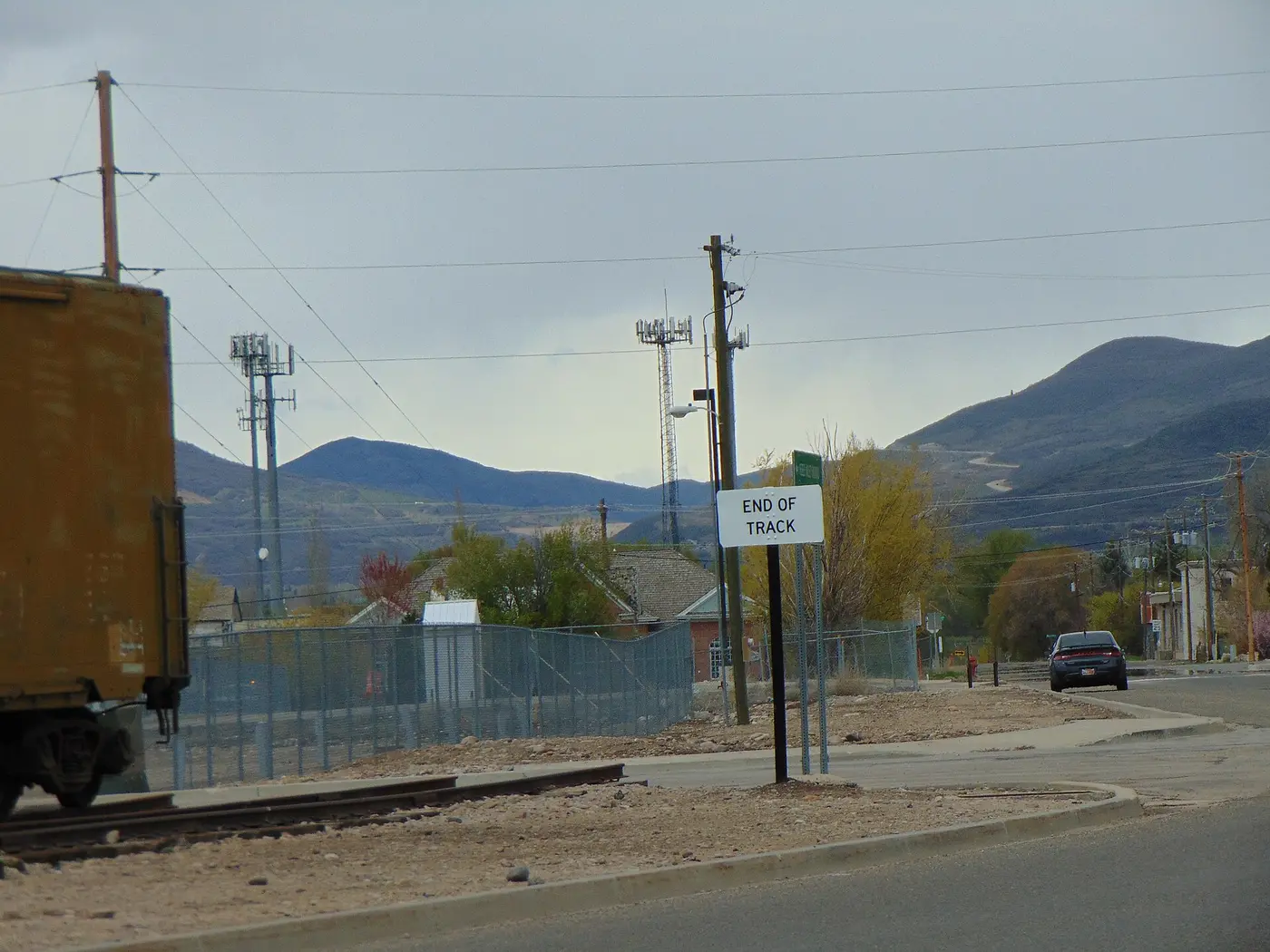
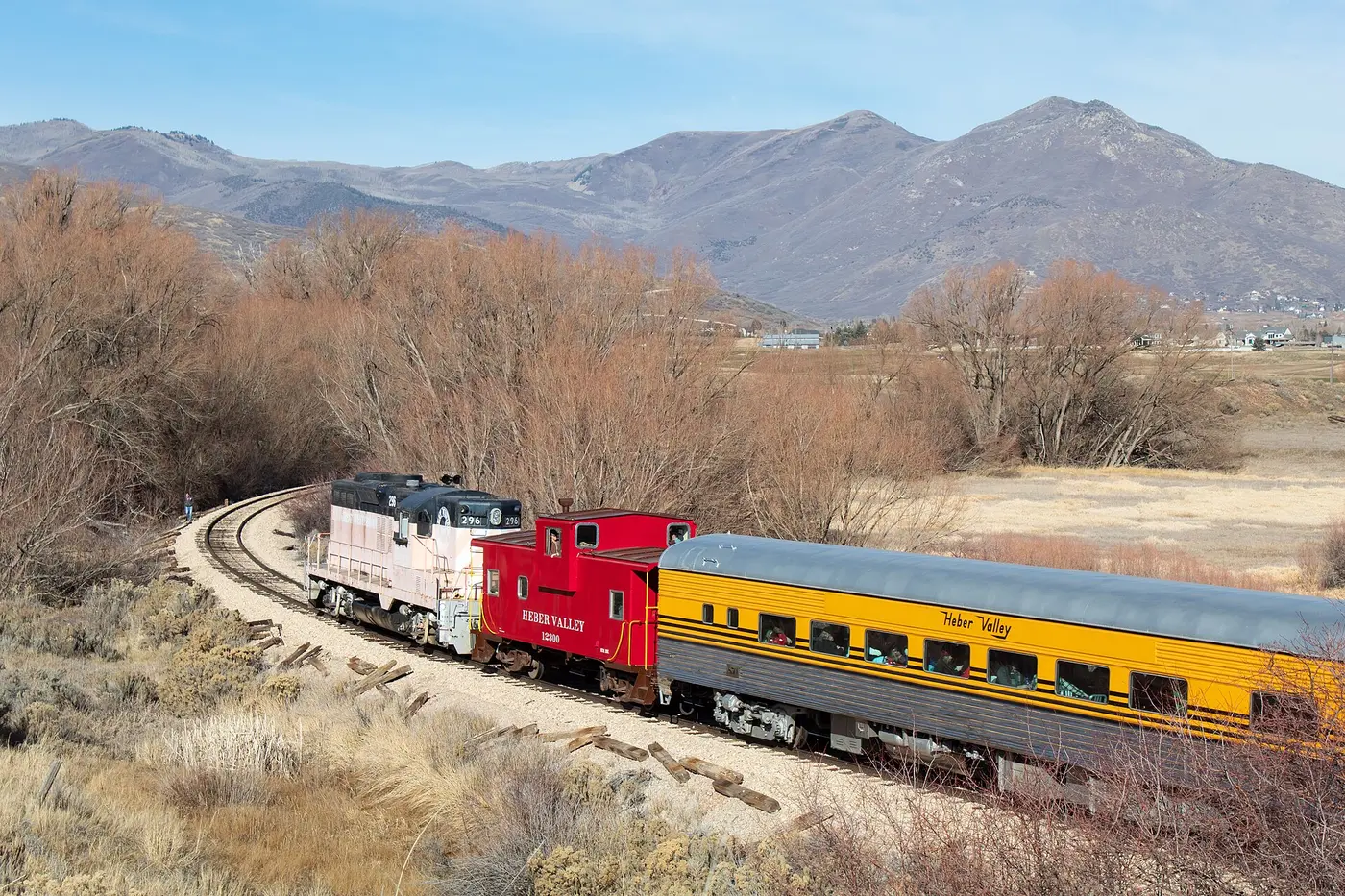
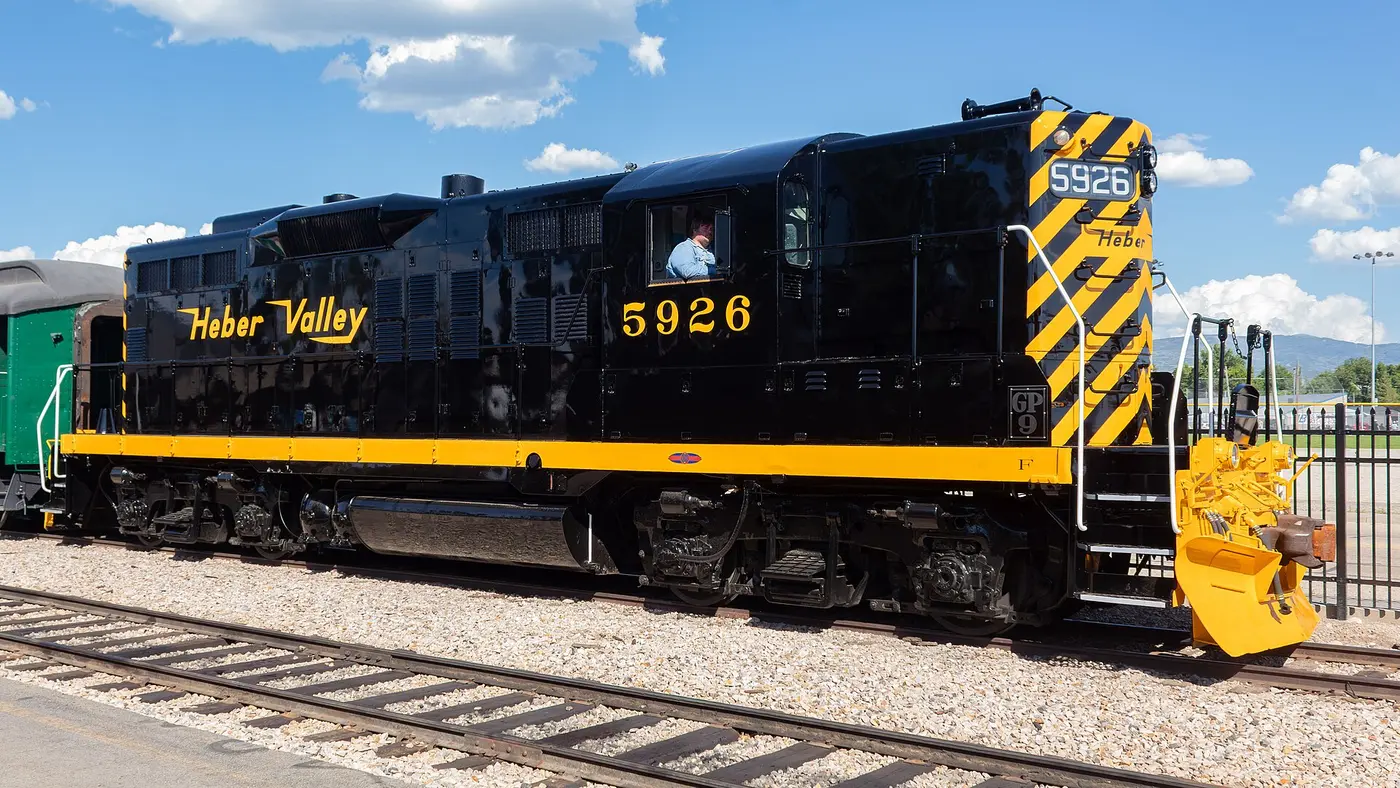
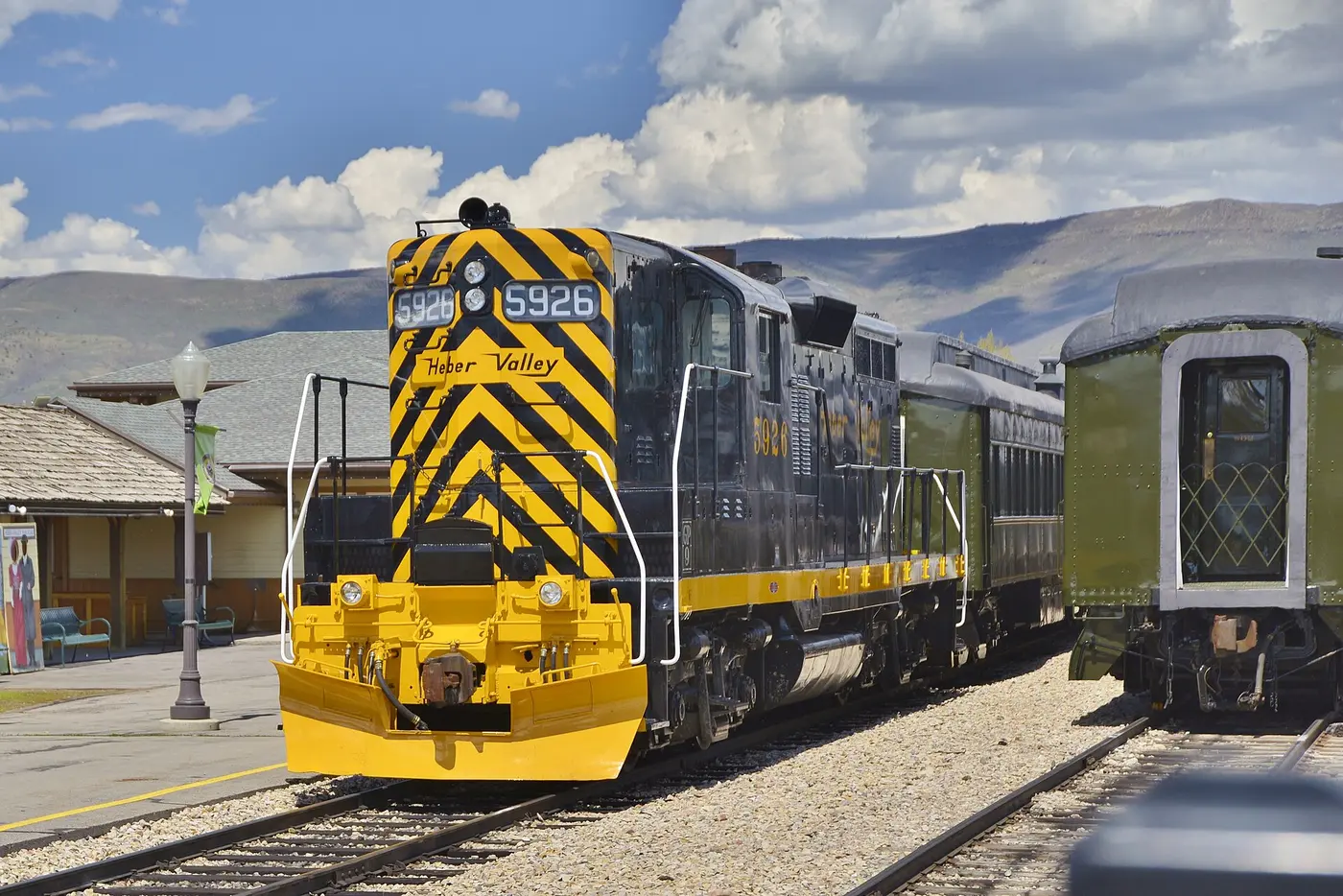
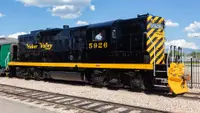
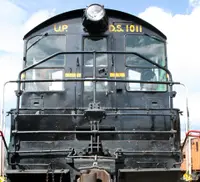
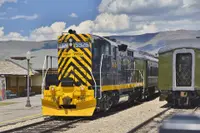
Trains leave from the Heber Valley Railroad depot at 450 South 600 West in Heber City. The ticket office, restrooms, and a snack car stand at the platform, and just north of the depot a marker erected by Heber City gives the line’s beginning as October 1899. Diesel-electric locomotives pull the vintage and restored coaches through the valley. In winter the coaches are heated, and the train carries a snack car and a gift shop. The historic cars have no wheelchair access. The railroad’s steam locomotives and cars have appeared in many motion pictures, and the line is often hired for filming and commercial work.
The track is the original Denver & Rio Grande Western line. It follows US Highway 189 across the valley floor and runs beside the Provo River to Vivian Park in Provo Canyon. The operator is the Heber Valley Historic Railroad Authority, which the railroad describes as an independent agency of the State of Utah, run essentially as a nonprofit for tourism, education, and the restoration of old railroad equipment. Mark Nelson is its executive director. A 2014 Deseret News report said the agency receives no financial assistance from the government and could be sued, bankrupted, or closed.
The Deer Creek Express and the October trains
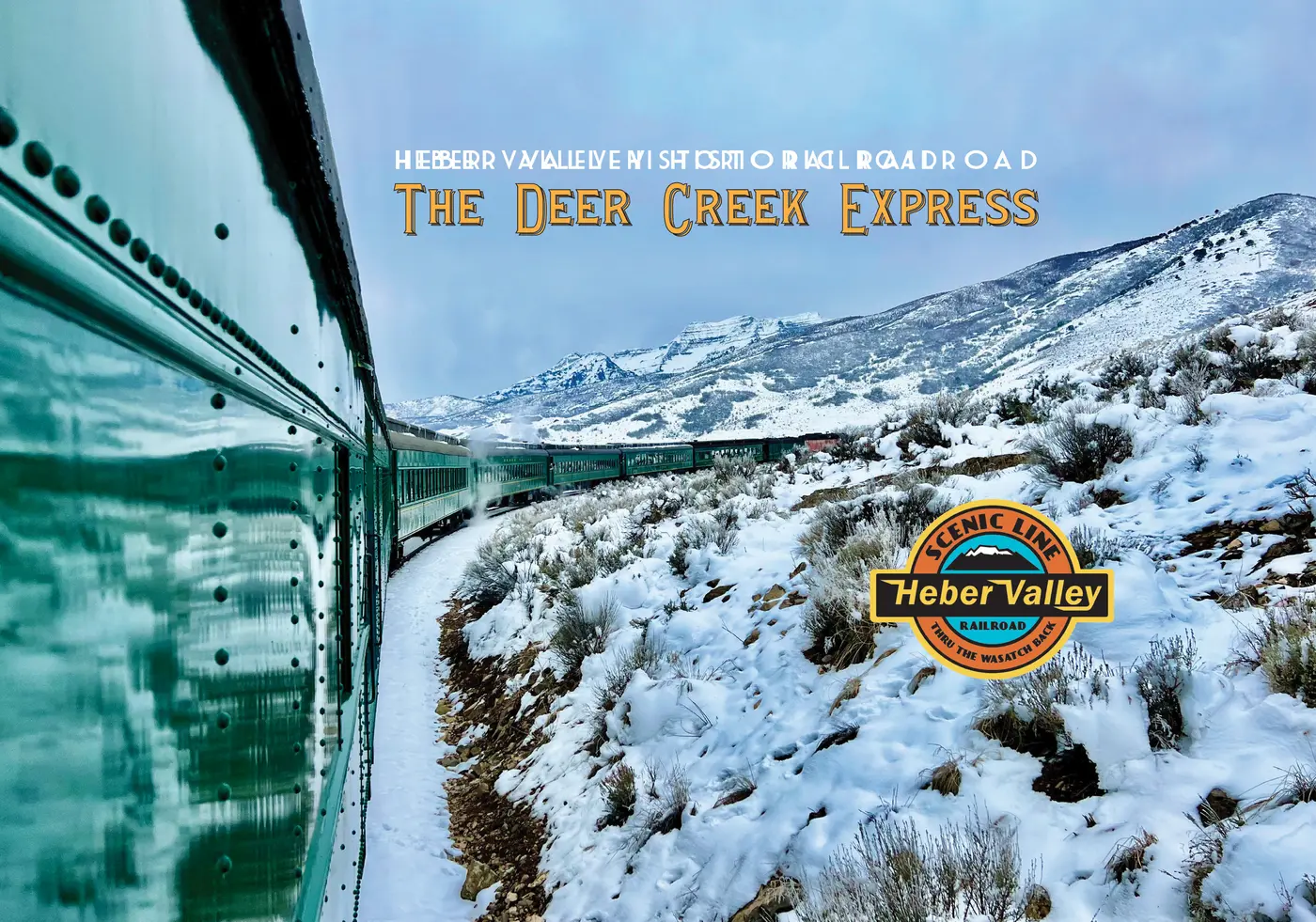
The regular run is the Deer Creek Express, a 90-minute round trip. It leaves the depot, follows the shore of Deer Creek Reservoir to Decker Bay, about seven track miles out, and returns. On the 2026 schedule it departs at 1 p.m. and 3:30 p.m. Riders on the early train can order a boxed lunch a day ahead: a sandwich or lettuce wrap, a cookie, chips, and water. First Class riders are served cheeses, meats, seasonal fruit, and jams with a soft drink, wine, or beer. A red caboose seating twelve can be rented whole.
In October the schedule fills with Halloween trains. The Pumpkin Train is a 40-minute ride with hosts aboard. Each child gets a pumpkin chocolate chip cookie and picks a pumpkin from the railroad’s patch to take home. On Monday, Thursday, and Friday evenings through October, the Halloween Express makes a 90-minute trip to a haunted station called Grim Hollow, with a cast of characters working the cars. The railroad’s notice reads: “The Halloween Express is FUN AND NOT SCARY!” Witches Night Out rides in the table and bar car of the same train. It serves poured tea, English scones, Halloween desserts, and one more drink, mocktails included, and riders are invited to come dressed “in your Witches best.”
No. 618 in the shop
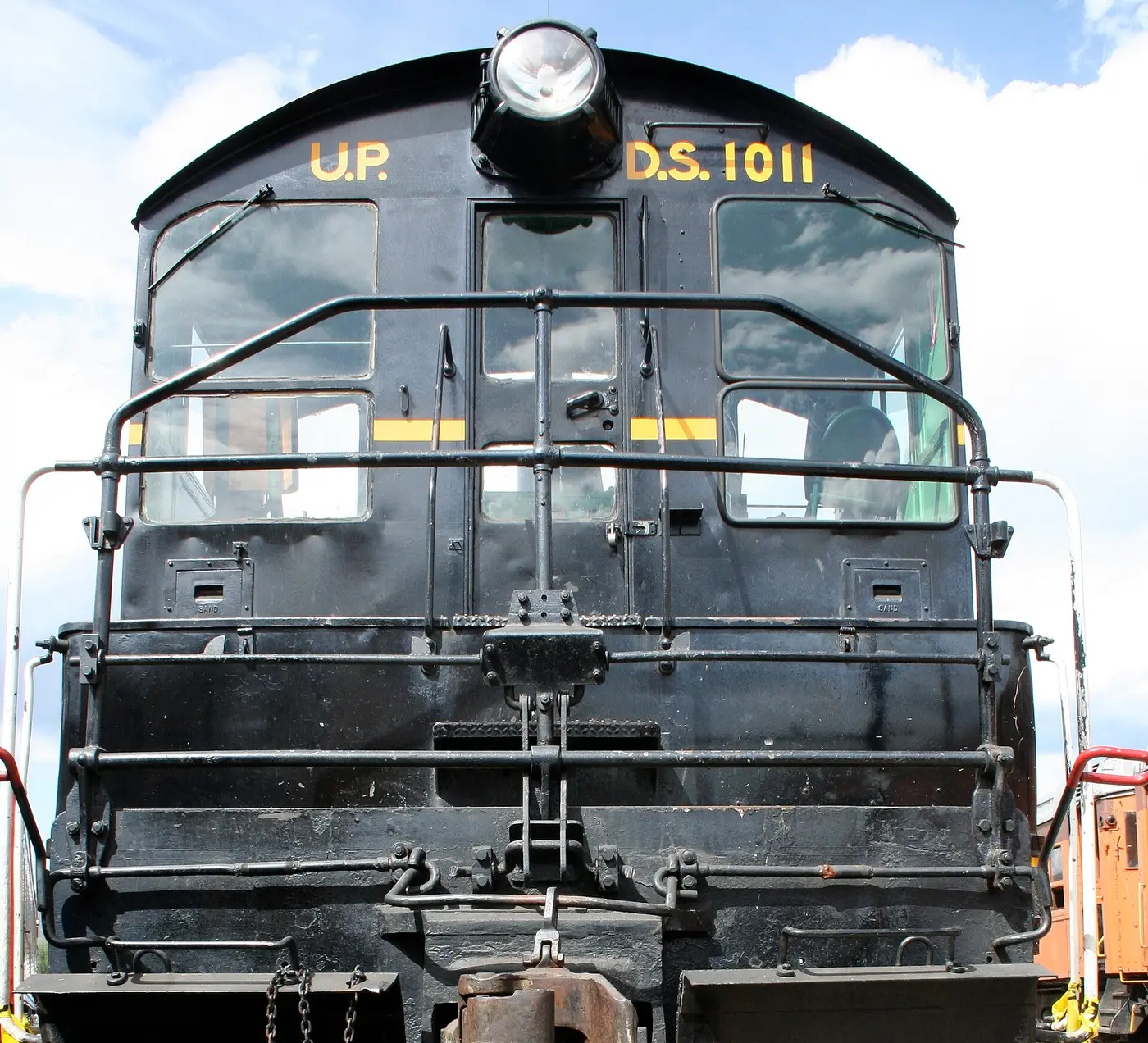
None of these trains is pulled by steam. Locomotive No. 618, a coal-burning 2-8-0 Consolidation, is being restored and rebuilt in the railroad’s workshop, and the railroad lists it as waiting for boiler inspection. Baldwin Locomotive Works built it at Eddystone, Pennsylvania, in July 1907 as Oregon Short Line No. 1068, and it became Union Pacific No. 618 around 1915. It hauled freight, most likely on the main line toward Pocatello. During the Second World War it worked out of a stall in the Ogden roundhouse, carrying supplies to the Army’s Defense Depot Ogden. After the war it ran on the Cache Valley Branch between Mendon and Logan. Diesels made it obsolete by 1955, and it spent its last working years at Ironton, moving bottle cars of molten iron to the Geneva Steel plant. In 1958 it was donated to the State of Utah and set on display at the State Fairgrounds in Salt Lake City.
In 1970 the fair needed the land the engine stood on. Legend has it, the railroad says, that one idea was to dig a hole and bury the locomotive, and that this came close to happening. The Promontory Chapter of the National Railway Historical Society instead persuaded the state to give the engine to the group. Beginning September 26, 1970, volunteers moved it across the fairgrounds on short sections of temporary track. On Thanksgiving Day, November 26, they took it across North Temple, a busy four-lane street. Union Pacific turned it on the turntable at its North Yard and carried it south to Provo in the Provo Local. On December 5 it was steamed up for the first time since 1958. Two days later it ran up the canyon from a paved-over road crossing at Nunns, near Bridal Veil Falls, into Heber City with a borrowed Union Pacific caboose. About seven thousand people were on hand. The first fireman was Hollis “Holly” Neilsen, an engineer on Kennecott’s copper railroad between Bingham and Magna. His son Charles “Chick” Neilsen was one of the enthusiasts who got the project started. According to the Deseret News, the men behind the move spent $5,000 of their own money.
No. 618 pulled the Heber Creeper from 1971 to 1976 and again from 1986 to 1990. It was overhauled in a new shop in 1994 and 1995 and returned on May 13, 1995, pulling the season’s first train to Deer Creek Dam and back. It has pulled the Olympic flame. For its hundredth birthday in 2007 it was relettered for a time as Oregon Short Line No. 1068. It has been off the tracks since 2010 and went into the shop in October 2013, before any funding for the job existed. “We think that we’ll have it back on the tracks by July,” Nelson said in April 2014. “Kind of the heart and soul of this historic railroad, and most historic railroads, are steam locomotives.” According to Nelson, the Heber shop is one of only five or six in America that still build and repair steam locomotives. Michael Manwiller, the chief mechanical officer, comes from a family that has worked for railroads for four generations. “It’s a time machine,” he said. “A steam locomotive allows a sort of time travel. It’s this living, breathing thing you can experience.” The shop also holds No. 75, which came in 1999 with the ten-car Movie Train bought from the estate of producer Everett Rohrer in Hudson, Colorado. It has been retired since 2002, and in 2014 it needed $1 million in repairs.
Surveyors up Provo Canyon
Before the railroad, the Provo Canyon Toll Road was the only way Heber Valley ranchers could get hay, sheep, cattle, and dairy goods to market. The trip took three days in good weather and longer in winter, when snow slides blocked the road. Provo Canyon was surveyed in the 1850s as a route for the transcontinental railroad, but Weber Canyon was chosen. In April 1896 the Salt Lake Tribune reported “a gang of surveyors” in the canyon who were “exceedingly mum” about their employer. They turned out to work for the Rio Grande Western. L.L. Nunn’s Telluride Power Company claimed the same ground for a high dam, and two court cases followed before the railroad won the right of way.
In Provo the railroad asked to run its tracks down 200 West, and the town argued over it. The Daily Enquirer mocked the plan to divide the city with “a living, rumbling, smoking, rattling, tooting line.” The council granted the franchise in 1897, and rail-laying began in Provo on August 30 of that year. According to the railroad, grading up the canyon began on March 20, 1899, once the snow allowed. UtahRails cites a source saying work began in February. The first 52-pound rail, surplus from the old main line, was spiked down on April 24. On paper, the upper part of the line belonged to the Utah Eastern Railway, a Rio Grande Western subsidiary incorporated in 1897 to build toward Colorado. The Provo Canyon branch was the only project it ever financed.
The first train reached Heber on September 21, 1899, with nearly the whole valley watching. Mayor Abraham Hatch of Heber and Mayor L.O. Taft of Provo drove the last spike together at the new wooden depot, and the celebration lasted the weekend. A circular set the official opening for October 1. The trains were mixed, passengers and freight cars together, and stopped several times on the 27-mile run to take on water. A 1972 Wasatch Mountain Railway brochure explained the nickname that soon followed: “No one is certain just when the term ‘Heber Creeper’ came into use, but the legend is that the narrow twisting canyon made the trip so slow people began to talk of the train just ‘creeping.’” A 2006 Provo Daily Herald history says the engine crawled over some stretches at 20 miles per hour or less.
Sheep, a dam, and a Christmas tree
Freight came first on the branch. In 1915 the Heber depot shipped 60 cars of sugar beets, 40 of cattle, 280 of hay, and 360 of sheep. By the railroad’s account, more sheep left Heber by train in the 1920s and 1930s than from any other station in the United States, and the railroad kept large stock pens at Heber and Wallsburg. Automobiles cut the passenger trains to a single daily mixed run in the 1920s, and a paved US-189 reached Heber in the 1930s.
In 1938 the Army Corps of Engineers and the Bureau of Reclamation came to build Deer Creek Dam, and the tracks ran straight through the dam site. Ellis L. Armstrong, a young engineer fresh out of college, led the work of moving the line onto a ledge on the west side of the valley. The railroad says trains began using the new line in 1940. UtahRails, citing another source, dates the relocation to 1941. The dam was finished in 1942. By 1947 the coach was coupled to the Heber Local only when someone wanted to ride, which was seldom.
By the mid-1960s the largest shipper left was a lumberyard beside the Heber depot owned by Lowe Ashton (UtahRails calls him Lowell). Trains ran once a week in 1966 and a few times a month in 1967. The Provo library dates the branch’s end to 1967. The railroad says the last Rio Grande freight left Heber in 1968. In November 1968 the idle line was reopened one more time to haul the National Christmas Tree, cut in nearby Daniel’s Canyon, out of Heber on a specially equipped flatcar bound toward Washington, D.C. Afterward, farmers built fences across the rails. The old Rio Grande depot still stands without its tracks, used by a private business on 6th West at Center Street.
The Creeper, saved twice
In 1969 the State Road Commission bought the right-of-way for $264,000 to improve the highway through the canyon. On September 22 of that year the state rejected bids to tear up the rails. Rail enthusiast Jeff Terry later wrote that Chick Neilsen and Rodney Edwards had bought a logging locomotive, Rayonier 110, and needed somewhere to run it. Neilsen told him the abandoned branch was perfect. The 110 never ran at Heber. Ashton and other Heber businessmen joined the Promontory Chapter to form the Wasatch Mountain Railway, and in 1970 the Rio Grande sold it the 19.3 miles from Olmstead to Heber.
The inaugural run on January 3, 1971, part of the state’s Statehood Week, failed when the train derailed on its way to pick up the governor and legislators. Public service began on July 11, 1971, and 26,000 people were said to have ridden by the end of that season. The line changed hands and names over the next two decades but was always called the Heber Creeper. Under Ashton it carried about 45,000 riders a year. Around 1980 he sold it to the Timpanogos Preservation Society, which ran it until bankruptcy court dissolved the society in 1983. The Deer Creek Scenic Railroad, under Murl Rawlins Jr., restarted the trains that July. The same year a flood washed out the tracks between Vivian Park and Bridal Veil Falls, and those rails came up for good in 1996. The Ashton family bought the railroad back in 1986. In 1990 the state withdrew its $1,130,150 bid to purchase it, and the Heber Creeper made its last run as a private railroad at noon on October 27, 1990. In 1992 nearly all its engines and cars were sold to the Nevada State Railroad Museum. No. 618 and a small Davenport diesel stayed.
A committee formed by Heber City mayor Scott Wright pressed to keep the line. In 1992 the legislature created the Authority and appropriated $1 million. Under Ken McConnell the agency found three surplus passenger cars in North Carolina, a diesel at Hill Air Force Base, and a caboose in Salt Lake City. The revived Heber Valley Historic Railroad made its debut run on May 8, 1993. The track to Vivian Park was rebuilt in 1993 and 1994, and the present depot was finished in 2001 at a reported cost of $550,000. In February 2002 a Nevada Northern steam locomotive was trucked in from Ely, Nevada, and borrowed cars carried spectators to the Olympic venue at Soldier Hollow.
Notable Events
- 1897The Rio Grande Western began laying rail in Provo for its line in Provo Canyon, with Heber as the destination. utahrails.net
- 1897Rio Grande Western interests incorporated the Utah Eastern Railway, the company that on paper owned the upper part of the branch. utahrails.net
- 1899Track gangs went to work grading the line up Provo Canyon as soon as the winter snows had melted. hebertrain.com
- 1899The first Rio Grande Western train arrived in Heber amid great fanfare; with nearly the entire valley in attendance, the mayors of Heber and Provo together drove the final spike at the new Heber depot. hebertrain.com
- 1899The line opened and was popular for shipping freight. ksl.com
- 1899The last rail was laid and General Superintendent Welby's circular gave notice that the branch would be officially opened October 1, 1899. utahrails.net
- 1938The U.S. Army Corps of Engineers and the Bureau of Reclamation came to build Deer Creek Dam, and the tracks that ran through the dam site were moved to a ledge on the west side of the valley. hebertrain.com
- 1940Trains started using the new line into Heber and the old line was torn up and salvaged. hebertrain.com
- 1941D&RGW relocated a 10-mile portion of the Heber City Branch between Vivian Park and Charleston because of the Deer Creek Reservoir construction. utahrails.net
- 1943D&RGW sold the alignment along the Provo River to the U.S. government to allow construction of Deer Creek dam and reservoir. utahrails.net
- 1967The Denver & Rio Grande branch line between Provo and Heber continued running until 1967. provolibrary.gov
- 1967Operation of the D&RGW's Heber Branch came to an end in that year; the Utah Public Commission then heard the railroad's application to close its Heber City agency station. utahrails.net
- 1968The ICC approved the D&RGW's abandonment of the branch, and the last Rio Grande freight train rolled out of the Heber depot. hebertrain.com
- 1968Trains went from multiple daily runs to once a week in 1966, a couple of times a month in 1967, and were gone in 1968. ksl.com
- 1968The inactive Provo Canyon Branch was reopened to haul the National Christmas Tree, harvested in nearby Daniel's Canyon, from Heber toward Washington, DC. utahrails.net
- 1969The Utah Department of Transportation, then the State Road Commission, bought the right of way of the Provo Canyon Branch from D&RGW, meaning to improve the highway through Provo Canyon. utahrails.net
- 1969D&RGW applied to abandon its branch line to Heber City from Olmstead at the mouth of Provo Canyon to the terminus at Heber. utahrails.net
- 1969The state rejected bids to dismantle the tracks of the abandoned Provo Canyon Branch and gave the historical group a deadline to move its equipment. utahrails.net
- 1970Local citizens and train enthusiasts saved the line; a new railroad led by Lowe Ashton, other Heber City businessmen and the Promontory Chapter of the National Railway Historical Society was established to run steam tours to Bridal Veil Falls. hebertrain.com
- 1970After a few years of uncertainty, a group of citizens purchased the lines in 1970 and it remained open until 1990. ksl.com
- 1970Union Pacific No. 618 made its first run into Heber City from a paved-over road crossing in Provo Canyon, with about seven thousand people on hand. utahrails.net
- 1971At midnight the D&RGW disconnected the tracks to the Provo Canyon Branch and the route to Heber, after the federal Interstate Commerce Commission approved discontinuance. utahrails.net
- 1971The intended first operation, part of the state's anniversary Statehood Week, failed when the train derailed en route to pick up its guests, who included the governor and state legislators. utahrails.net
- 1971First operation for the public began, after equipment arrived in Heber City in December 1970; by the end of that first season thousands had ridden the new train. utahrails.net
- 1972The Wasatch Mountain Railway & Development Company was authorized by the Utah Public Service Commission to operate as a common carrier. utahrails.net
- 1979The Timpanogos Preservation Society received a federal grant for the construction of a railroad-themed park and museum in Heber City. utahrails.net
- 1983Tracks between Vivian Park and Bridal Veil Falls were washed out by a flood. utahrails.net
- 1983The previous owners were bankrupt and the state condemned the track; Deer Creek Scenic Railroad started operations that July. utahrails.net
- 1990Despite an attempt by the State of Utah to purchase the railroad, it went out of business. hebertrain.com
- 1990The Utah State legislature passed the Heber Creeper Procurement Appropriations bill, appropriating money to purchase the equipment and upgrade the right-of-way. utahrails.net
- 1990The Heber Creeper made its last run as a private railroad, operated by New London Railroad and Village, leaving the Heber station at noon with passengers aboard. utahrails.net
- 1992The Utah state legislature created a state agency to operate the train and appropriated $1 million for locomotives, cars and track repair. hebertrain.com
- 1992Heber Valley Railroad operations began after state funding was received; a committee to save the railroad had earlier been formed by the mayor of Heber City. utahrails.net
- 1995After a complete overhaul inside the railroad's new building, the engine debuted with fanfare pulling the first train of the season to Deer Creek Dam and back. hebertrain.com
- 1996Due to safety concerns, the rails running between Vivian Park and Bridal Veil Falls were removed. provolibrary.gov
- 1999The Heber railroad purchased the ten-car Movie Train, including a steam engine, from the estate of the late producer Everett Rohrer in Hudson, Colorado. utahrails.net
- 2001The railroad's new depot was completed, its total cost reported as $550,000. utahrails.net
- 2002A Nevada Northern locomotive was trucked from Ely, Nevada to Heber City and borrowed cars carried spectators to the Olympic venue at Soldier Hollow. utahrails.net
- 2010The No. 618 locomotive has been off the tracks since that year and was moved into the workshop to be restored, though funding for the project was unavailable. deseret.com
People
- Mark Nelson, executive director of the Heber Valley Historic Railroad Authority.
- Michael Manwiller, chief mechanical officer for the Heber Valley Historic Railroad Association, from a family that has worked for railroads for four generations.
- Abraham Hatch, Mayor of Heber; drove the final spike with the Mayor of Provo.
- Ellis L. Armstrong, young construction engineer who headed the Deer Creek relocation project.
- Ken McConnell, directed the railroad as it slowly came to life again.
- L.O. Taft, Mayor of Provo; drove the final spike with the Mayor of Heber.
- Lowe Ashton, Heber City businessman who led the new railroad established to run steam train tours from Heber City to Bridal Veil Falls.
- Charles "Chick" Neilsen, one of the Utah rail enthusiasts whose work got the Heber Creeper project off the ground; later the engineer aboard the first run into Heber (1970-1971).
- Craig Lacey, executive director, Heber Valley Railroad (since 1997).
- Doug Brown, engineer involved with the Heber project very early (1970-1971).
- Gordon Wheeler, one of the three rail enthusiasts whose work got the Heber Creeper project off the ground (1970-1971).
- Hollis "Holly" Neilsen, Kennecott copper-railroad engineer who was the first fireman when No. 618 was first put into operation (1970).
- J. Rodney "Rod" Edwards, founder of the Wasatch Railway and Museum Foundation and its president for 30 years (died June 14, 2005).
- John Rimmasch, chief mechanical officer of the railroad.
- Lowell Ashton, Heber City businessman who organized the Save The Heber Creeper Committee and operated the Heber Creeper train (1968-1980).
- Monte Bona, instructor at Brigham Young University and director of the Timpanogos Preservation Society, organized to preserve railroad history for the enjoyment of the public (1981).
- Murl Rawlins Jr., took over the operation of the historic Heber Creeper after the court lifted its injunction (1983).
- R. R. Green, vice president of the for-profit Wasatch Mountain Railway (1970).
- Scott Wright, Heber City mayor who formed the committee to save the railroad before the Authority began operations.
Sources
- hebertrain.com
- hebertrain.com/about-us
- hebertrain.com/ourtrain-2/ourhistory
- hebertrain.com/contact-us
- hebervalleyrr.antix.io/event/deercreekexpress
- utahrails.net/drgw/rg-provo-canyon-branch.html
- utahrails.net/utahrails/heber.html
- newspapers.lib.utah.edu/details?id=23593012&hl=%22Long+and+Short+of+the+Heber+Creeper%22
- deseret.com/2014/4/23/20539954/heber-valley-historic-railroad-authority-working-to-save-historic-steam-locomotives
- hebertrain.com/steamlocomotives/steam618
- provolibrary.gov/historicalplaceshebercreeper
- ksl.com/article/news/utah/looking-back-at-the-history-of-the-heber-creeper/42786176
- hmdb.org/m.asp?m=275947