Grimes Point Archaeological Area
Fallon, Churchill County, Nevada. Archaeological site; open to the public year-round.
Details

- Where
- Grimes Point Rest Area, US Highway 50, Fallon, NV 89406. Directions
- When
- The BLM gives free public tours of Hidden Cave on the second and fourth Saturdays of each month with the exception of any three day weekend where the Friday or Monday is a federally recognized holiday, like Memorial Day, Thanksgiving, and Labor Day.
- Getting there
- From Fallon, head east on US Highway 50 approximately 12 miles until you see the archaeological site sign on the left (north side).
- Fees
- The BLM gives free public tours of Hidden Cave.
- Access
- No overnight camping.
- Walk-in or reserve
- Hidden Cave can only be accessed through taking a scheduled tour.
- Phone
- (775) 885-6000
- Managed by
- Bureau of Land Management.
- Established
- February 23, 1972.
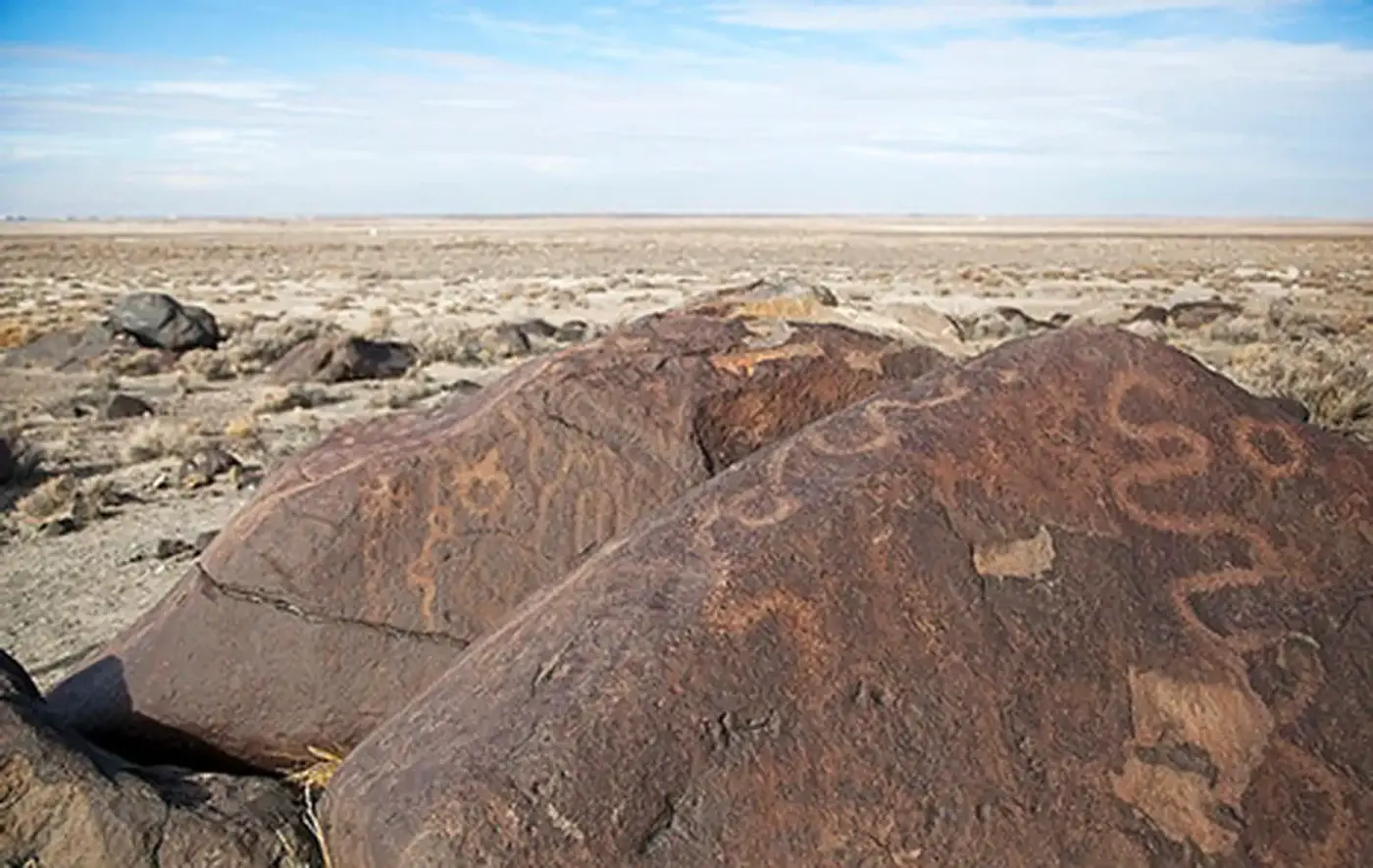
About twelve miles east of Fallon on U.S. Highway 50, a sign on the north side of the road marks the Grimes Point turnout. Past the restrooms and picnic tables lies a field of basalt boulders coated with a glossy black patina, commonly called desert varnish. Many of the boulders are pecked or carved. The State Historic Preservation Office counts about 150 boulders carrying more than 1,000 petroglyphs. On many of them, the Bureau of Land Management notes, the varnish has completely repatinated the carved surfaces, which is evidence of their age.
The quarter-mile through the boulders
A self-guided interpretive trail a quarter mile long threads the field. The Youth Conservation Corps built it, and in 1978 it was named Nevada’s first National Recreation Trail. The BLM manages the 720-acre site from its Carson City District Office and keeps it open year-round. It asks visitors to stay on the trail and not to touch, chalk, or make rubbings of the rock. Hundreds of the boulders bear cupules, small pits dug out of the stone surface. Archaeologists Robert Heizer and Martin Baumhoff used Grimes Point as the primary locality in defining the “Pit and Groove Style,” which many consider the oldest rock art in Nevada. Its engraved lines are deeper and wider than those of rock art types that appear more recent.
Grimes Point was listed on the National Register of Historic Places on February 23, 1972, for its potential to yield archaeological information. The listing covers a larger landscape of rock shelters, petroglyph sites, and burial locations.
A lakeshore and the hunt
A prominent bench, or wave-cut platform, is visible throughout the area. The waters of Lake Lahontan cut it. During the Pleistocene that lake covered most of northwestern Nevada. Over the last 10,000 years its level fluctuated widely, and at times it dried up completely. When this ground stood above water, according to the BLM, it would have been marshland with a wide variety of wetland plants and animals. Native Americans first came to Grimes Point perhaps 8,000 years ago or more.
The text of State Historical Marker No. 27 ties the carvings to hunting. It says Nevada petroglyphs held magico-religious significance, insuring the success of large game hunts, and were placed near seasonal migration routes. By the marker’s account, making a petroglyph was a ritual performed by a group leader before each hunt, and evidence suggests “a powerful taboo against tampering” by anyone not directly associated with the hunt. On the hill above the petroglyphs, running east and west along the ridge, is evidence of an aboriginal drift fence for driving deer or antelope. The marker dates the petroglyphs as probably between 2500 and 500 years ago. Archaeologist Karen Nissen included Grimes Point in her analyses of western Nevada rock art and concluded that rock art was generally associated with hunting locales. Wikipedia calls that idea popular at the time but somewhat less so today.
Saturdays at Hidden Cave
Hidden Cave lies within the same archaeological area and is reached from the same turnout, but only on a scheduled tour. The BLM gives free public tours on the second and fourth Saturdays of each month. It skips any three-day weekend where the Friday or Monday is a federal holiday. Each tour begins at 9:30 a.m. at the Churchill County Museum in Fallon with a video. The group then caravans out and walks up the trail to the cave entrance, and the tour ends by noon. The half-mile loop trail is not handicapped accessible, and the BLM warns that the weather here “can change in a hurry during every season.” According to the American Museum of Natural History, BLM engineers have reworked the entrance so that visitors no longer crawl in and barely have to bend over.
The BLM and the AMNH both say rising Lake Lahontan’s waves gouged the cave about 21,000 years ago. Another account puts it at about 20,000. The cave sits beneath the cemented surface gravels of the Stillwater Range. Its floor was alternately flooded and exposed until shortly after 10,000 B.C. Afterward, during brief intervals, American Indians crawled inside. Deposits built up until a debris cone virtually sealed the entrance.
Four schoolboys found the cave in the mid-1920s, the first people of the 20th century to do so. The BLM lists three excavations: 1940, 1951, and a large one in 1979-1980 by the American Museum of Natural History. The AMNH dates its own work, led by David Hurst Thomas, to the 1978 and 1979 field seasons. The museum describes dust and darkness that made working conditions abysmal for Archaic people and archaeologists alike. Nobody could have lived inside, so the AMNH concludes the artifacts were deliberately stored away. The BLM points to a high proportion of unbroken artifacts arranged in concentrations. From that it concludes that 3,500 to 3,800 years ago people used the cave as a cache rather than a dwelling. The AMNH places this use in the late Archaic, from about 2000 BC to AD 0. Another account credits the ancestors of the Toi-Ticutta, today the Fallon Paiute-Shoshone Tribe, with starting the practice around 3,800 years ago.
Diggers there found thousands of artifacts and dozens of coprolites, which are desiccated human feces. These showed that Archaic people ate pinion nuts, bulrush seeds, and fish. The coprolites and the pollen record indicate the cave was used in all seasons. In 2013 a documentary on the cave’s history was made with @One Digital Media of the University of Nevada, Reno Libraries, the BLM, and the Nevada Department of Transportation.
A child in plaited matting
In 1939 guano miners took material from a small rock shelter on Grimes Point and gave it to Margaret Wheat, who reported it to Wheeler. Sydney and Georgia Wheeler were then doing salvage archaeology among the dry caves of western Nevada for the Nevada State Parks Commission. In 1940 Sydney injured his leg dodging a rattlesnake, and the couple changed their plans. They looked instead at a shelter they had noticed from the road near Grimes Point, and it turned out to be Spirit Cave, with its mummy.
Accounts differ on which Wheeler handled the miners’ shelter. Wikipedia credits Georgia Wheeler. Amy Dansie, writing in the Nevada Historical Society Quarterly in 1997, describes the work as “his.” Whoever it was examined the shelter and found only a few more fragments. The site was recorded as 1-1C (Cave no. 16) and named Grimes Burial Shelter. The matting and human bone went to the Nevada State Museum in the early 1940s.
The matting sat in plain sight in the museum collections for decades. In 1985 Stacy Goodman had noted a small piece of the same plaited weave in Hidden Cave, and nobody pursued it. In 1995, while searching the collections for plaiting samples, Dansie and her colleagues came on the large fragment of matting. They sent a piece to the University of California at Riverside, which dated it to 9,470±60 years, slightly older than the Spirit Cave dates. With the matting were the well-preserved remains of a child about ten years old and small fragments of an older individual. Richard Jantz and Douglas Owsley later took up their study. The old records described the child’s cranium as broken by the guano miners, but Dansie found it only cracked. The mandible and about half of the rest of the skeleton were never found, by the miners or by Wheeler.
Notable Events
- 1920sThe cave was found by four school boys, the first 20th century humans to do so. blm.gov
- 1939Material collected from a small rock shelter on Grimes Point near Spirit Cave was given to Margaret Wheat, who reported it to Wheeler. onlinenevada.org
- 1940The cave was excavated by archaeologists the first of three times. blm.gov
- 1940sWheeler examined the shelter, recorded it as l-1C (Cave no. 16), and transferred matting and human bone to the Nevada State Museum. onlinenevada.org
- 1951The cave was excavated by archaeologists the second time. blm.gov
- 1972Grimes Point was listed on the National Register in 1972; Hidden Cave was listed the same year as part of Grimes Point. blm.gov
- 1978David Hurst Thomas and a crew excavated the cave during two field seasons, finding it was used for temporary storing food, tools and other materials. amnh.org
- 1978The interpretive trail, originally constructed by the Youth Conservation Corps, was named Nevada's first National Recreation Trail. blm.gov
- 1979The third and final excavation of the cave was a large one carried out by the American Museum of Natural History. blm.gov
- 1995During a search for additional plaiting samples, a large matting fragment was found in the collections and a small piece submitted to VCR, as the OCR states. onlinenevada.org
- 2013The museum partnered with @One Digital Media of the University of Nevada Reno Libraries, the Bureau of Land Management, and the Nevada DOT to create a documentary on the history and importance of Hidden Cave. ccmuseum.org
People
- David Hurst Thomas, excavated Hidden Cave with a crew during the field seasons (1978 and 1979).
- Douglas Owsley, Analyzing the Nevada State Museum collections associated with the Grimes Burial Shelter child; further studies were forthcoming.
- Margaret Wheat, Received the guano miners' Grimes Point shelter material and reported it to Wheeler (1939).
- Richard Jantz, Analyzing the Nevada State Museum collections associated with the Grimes Burial Shelter child; further studies were forthcoming.
- Stacy Goodman, Noted a small piece of plaiting in Hidden Cave at Grimes Point (1985).
- Wheeler, Examined and named Grimes Burial Shelter; transferred its collections to the Nevada State Museum (early 1940s).
Sources
- blm.gov/visit/grimes-pointhidden-cave-archaeological-site
- onlinenevada.org/sites/default/files/EarlyHoloceneBurials_Dansie_1997.pdf
- ccmuseum.org/visit/hidden-cave
- shpo.nv.gov/nevadas-historical-markers/historical-markers/grimes-point
- amnh.org/research/anthropology/curatorial-research/north-american-archaeology/projects/hidden-cave-nv