Gold Bug Park / Mine
Placerville, El Dorado County, California. Historic mine and park.
Details

- Where
- 2635 Gold Bug Lane, Placerville, CA 95667. Directions
- When
- April thru October 10:00 AM to 4:00 PM daily; November thru March 12:00 noon to 4:00 PM weekends only; arrive before 3:30 PM for the mine tour; closes at 4 PM.
- Season
- April thru October (daily); November thru March (weekends only).
- Getting there
- From Sacramento: Take HWY 50 E to Placerville. Continue to the 3rd stoplight on HWY 50 at Bedford Avenue. Turn left at Bedford Ave., then vear to your left up Spring St. Turn right on Pleasant St., then left onto Bedford Ave. Continue about one mile to the park entrance. Turn right on Gold Bug Lane into the park.
- Fees
- Adults (18+) $12.00; Seniors 55+/Military $10.00; Youth (6-17 yrs) $6.00; kids 5 and under free.
- Access
- Leashed dogs are allowed on the trails; there is also a short ADA paved trail near the gift shop and the parking lot.
- Phone
- (530) 642-5207
- Website
- goldbugpark.org
- Managed by
- City of Placerville.
- Established
- 1888.
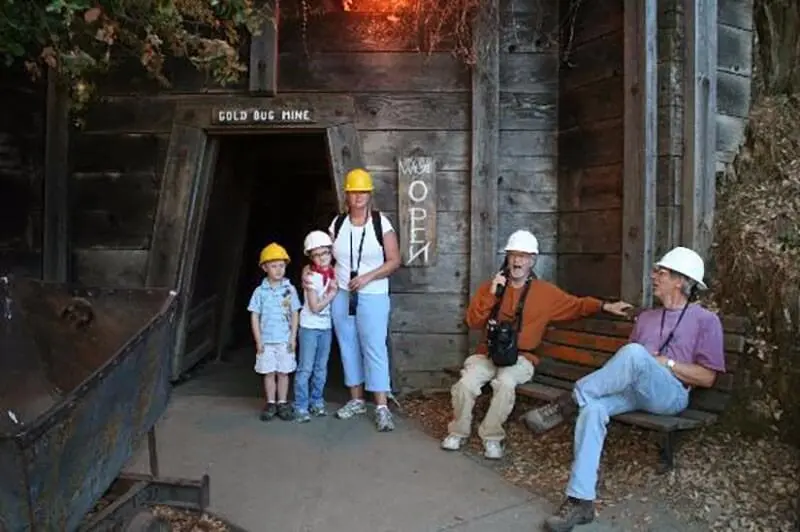
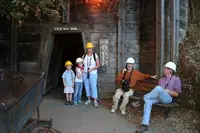
At the mouth of the Gold Bug Mine, on a hillside above Big Canyon Creek a mile north of Highway 50, each visitor gets a hardhat and a recorded guide and walks into a 352-foot drift. The floor is solid wood and, depending on the season, often damp. Lights run the length of the tunnel, and an air shaft keeps the air cool. Massive old beams and timbers, set close together, hold up the roof. Along the walls are drill holes where miners packed blasting powder and fuse, crusts of minerals left by dripping water, and an ore car on narrow-gauge rails. In small mines like this one the cars were pushed by hand over scrap-iron rails laid on wooden ties. The ore went out the entrance and was dumped down the hill toward the creek. In December 2013 the Mountain Democrat photographed icicles hanging from the mine’s roof.
The narrator of the audio tour is a ghost. He passes on a miners’ saying, that gold rides an iron horse, because the brown, iron-stained quartz is the promising kind.
A marker at the entrance calls the Gold Bug a neighborhood mine, one of the thousands of small mines that once dotted the Sierra foothills. Men worked such mines in small partnerships, with little money or equipment and no formal knowledge of geology. They took what picks, shovels and blasting powder could easily remove from the quartz veins. Owners often held other jobs and worked their claims only enough to keep them. Most of the digging here, the marker says, was done in the 1920s and 1930s. The City of Placerville’s history of the mine holds that no more than two or three men likely worked it at a time. After a day’s work the air took 24 hours to exchange before the men could start again. How much gold came out is not known, because no records were kept.
The stamp mill, the forge and Hattie’s
About 600 feet from the parking area stands the stamp mill building. The mill inside is on its original site and can be seen from several points within the building. It has two sets of four stamps and is patterned after a design by the Joshua Hendy Ironworks. Hendy made ornamental balcony railings and street lamp fixtures in San Francisco and moved his business to Sunnyvale after the 1906 earthquake. A working scale model shows how the ore was reduced. Writing of the model in 2013, Peter Tyner of the Mountain Democrat advised: “nonetheless cover your ears.” The Cornwall Mineral Collection, with specimens from around the world, is shown in the same building.
The blacksmith shop occupies the upper part of the mill building. The original smiths there made mining tools and repaired ore carts. In 2013 Pete Kielty or John Hewitt could be found at the forge turning horseshoe nails into tiny souvenir spoons with fire, an anvil and a hammer. By 2025 the shop belonged to Pat Layne, 82, of Shingle Springs, the park’s maintenance worker, blacksmith and historian.
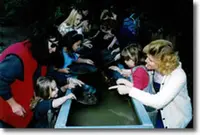
Back near the mine entrance, the museum building holds Hattie’s Gift Shop on the ground floor. It sells books, photographs, rock specimens and real gold, along with cold soda, water, candy and chips. Gem panning is arranged at the counter for $2.00 an hour with the pan included, at troughs that close for winter and typically reopen in early April. Upstairs, Hattie’s Museum shows tools and artifacts from the locale, most of them donated, with drawings of mining methods and a table of rocks to handle. Admission to the museum is free.
Trails among the old claims
The Liberty Claim Pavilion, named for one of the park’s original mining claims, gives shaded seating for 80. More picnic tables sit along the stream bed. The National Register nomination describes Big Canyon Creek, first known as Little Big Creek, as spring-fed. It runs heavy in winter and spring and goes almost dry in late summer and fall. The hillsides grow manzanita, oak and pine.
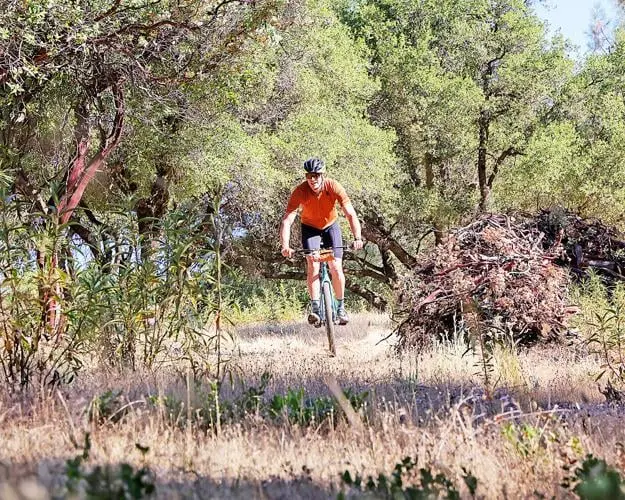
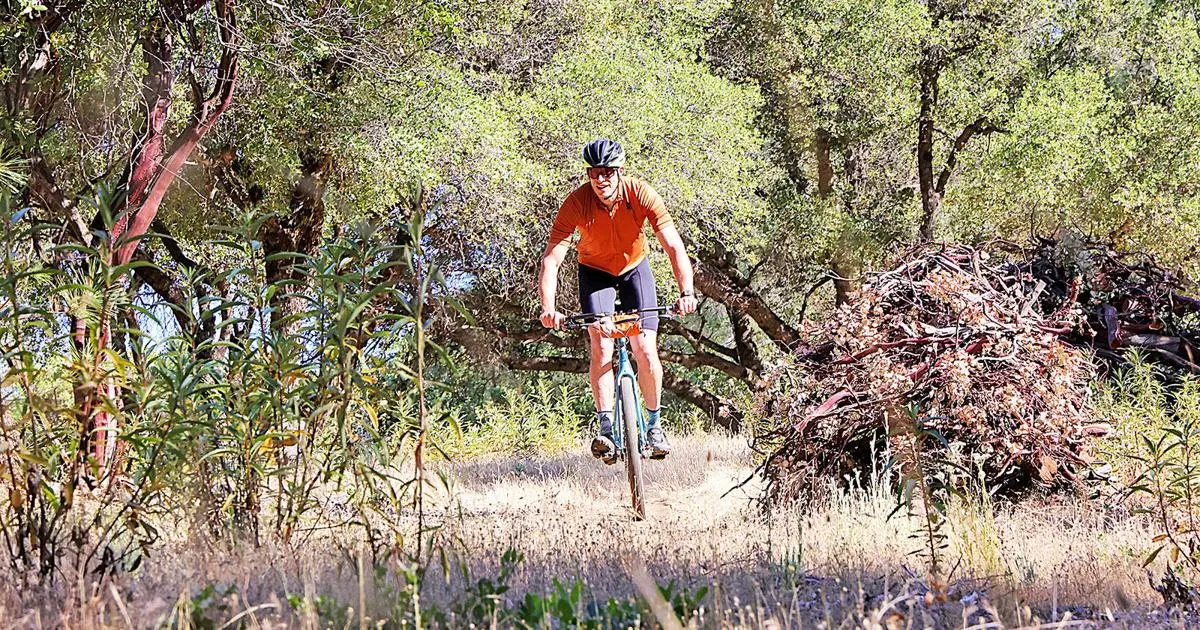
Trails named Stamp Mill, Spring Hill, Deer Hollow, Big Canyon and Vulture Claim cross the park. Beginning in May 2024, Cal Fire hand crews from the Ponderosa Fire Center thinned brush and hazard trees, cut about another half mile of trail and set steps into steep pitches. The trail system now totals around 2.5 miles. Earlier treatment had come from masticating machinery and then from goats. Of the goats, Layne said they did a good job but “also provided fertilizer and the weeds came back bigger and better.” He says trail walkers come early in the morning to get their two or three miles in before the heat. Leashed dogs are allowed, and a short paved ADA trail runs near the gift shop and parking lot.
Along the way are ore-car tracks running from the cut of the collapsed Silver Pine Mine to the back door of the stamp mill. Hikers also pass exploratory pits, outcrops of quartz that may not be mined, and closed-off shafts posted with warnings. The city asks hikers to keep to the trails, since poison oak grows there and a hidden mine is possible, and to watch for mountain lions, bears and rattlesnakes. Wildflowers bloom along the trails in spring. The gift shop sells a map of points of interest for 25 cents.
Up the hill is the Priest Mine, open only on guided tours. It was dug entirely by hand in the early 1850s, and thousands of pick marks remain in its walls. The city’s page says it was named for a miner who may have held Sunday services for miners in the area. One area inside might have held a board that served as an altar. An air shaft at the back drops to the Gold Bug below. According to the nomination, the shaft was sunk from the top of the mountain in 1925 to bring fresh air into the Gold Bug and to drop quartz from the Priest.
Hattie, the Vulture and the Gold Bug
Gold was found at Coloma, eight miles off, on January 24, 1848, and prospectors were soon panning Big Canyon Creek. The nomination says some of the first gold panned in the area was taken by Chileans. Prospector huts lined the creek. Every spring the Mother Lode streams yielded a new crop of gold, washed from quartz veins that outcropped into them. The marker by the parking lot says that in one week in the summer of 1848 three men took out $17,000 in gold, with gold valued at $16 to $19 an ounce. By 1852 all but the heartiest miners had left, along with the easy pickings. In 1860, by the city’s account, hard rock mining took hold, and miners drove drifts into the hills along the veins.
The sources differ on when the Hattie began. The city dates it to 1888, when William Craddock and John Dench opened it. The nomination says Craddock and Dench began mining the area in 1882, joining the Vulture and Hattie claims into one. The mine was named for Craddock’s eldest daughter, recorded in the nomination as Hattie Craddock Bennett. The first workings across the canyon played out. Larger veins were noted on the south side, and a new drift was started there. The partners dissolved in 1897, and in 1902 the claim was sold to Thomas Bishop and Frank Monaghan.
The next owner was John McKay, a fruit grower born in Coloma in 1864 who had earlier held mining interests in Amador County. He lived on Bedford Avenue until 1930. The El Dorado County Historical Society says he filed a location notice on the Vulture Mine in 1926 and renamed it the Gold Bug. The nomination says he bought the claim in 1930 and renamed it then. The entrance marker gives the name Gold Bug from 1924. McKay turned the drift at an angle in search of a stronger vein and laid tracks for the ore cars. The tunnel visitors walk today is his work. The marker says the mine closed for good in 1942 because of the war. The nomination says McKay worked it until 1940. During World War II President Franklin Roosevelt ordered the mines of the Mother Lode closed, since gold mining was judged non-essential and men were needed for the war.
The stamp mill has its own lineage. The marker at the mill says George Cozens built the first mill on the site in the 1890s for the Silver Pine Mine. It ran as the Schiff Mill through the 1920s, and Horace P. Moulton rebuilt it entirely in the mid-1930s and opened it to local and regional custom. Loads of a few tons to hundreds of tons were usually processed there. The city’s page instead describes the mill as built around the turn of the century as a community crusher and rebuilt in the 1930s. When the stamps ran at full operation they could be heard in Placerville a mile away. The marker records that local residents remember the “thunderous crashing staccato” carrying for miles in the narrow canyon. Tyner cites written accounts comparing the noise to shotgun blasts going all day and into the night, often too loud for ordinary talk. Many miners lost their hearing to the stamps.
Moulton was also among the owners who filed on the Silver Pine claim in 1930, with O.B. Gede, Henry Van Sickle and William G. Meagher. The nomination says Fred W. Mayer and Ben Federer may have owned it from 1900 to 1920, though this is believed and not documented. The Silver Pine’s entrance was blown shut in a quarrel among its owners, and the mine is believed to still hold an ore cart loaded with ore.
From Bureau land to city park
William Meagher, owner of the Independent Iron Works in Oakland, was the last private holder of the park’s claims. He worked the mines to keep his title. In late 1948 he dammed Big Canyon Creek to make a swimming hole for his family, who swam and hiked while he worked. The dam and its pond are still there. His summer cabin stands at the end of Gold Bug Lane.
The Bureau of Land Management took over the claims in 1949. In 1965 the City of Placerville received a 25-year lease on the land, on the promise that it would not be sold, divided or used for anything but recreation. The parking-lot marker says the city acquired the property that year. The squatter and miner cottages along the creek, dating from the 1920s, were removed. The only road was a dirt track 8 to 10 feet wide through blackberries, and it was widened and paved. For safety, most of the old excavations were blasted shut.
The park association later described the ground as it was then. It lay under prickly vines and poison oak, over forgotten mines, coyote holes, water ditches and “the massive, rusting hulk of an abandoned stamp mill.” Hangtown’s Gold Bug Park Development Committee formed in April 1980 to clean up the property and defend it for public use. Its president, Patricia Ann Cook, prepared the National Register nomination. That document counts four claims on 61.45 acres, with some 250 additional mining sites. The marker counts six claims on 61 acres, once part of the Poverty Ridge Mining District. The park was approved for the National Register and as a California Point of Historical Interest on February 1, 1985. The listing carries the date November 15, 1985.
The city says Placerville is the only municipality in California that owns a gold mine. In 2016 the California Park and Recreation Society gave the development committee its Champion of the Community Award of Excellence. Charlie Basham, the committee’s president, said its vision for the 61 acres was “to preserve and promote the park’s mining legacy.”
Restoration of the Meagher cabin has begun, but more funding is needed before the planned education center and small classroom can open there. In 2009 several generations of the extended Meagher family gathered at the house for a reunion.
Notable Events
- 1800sThe marker dates the start of hardrock mining in the hillsides above the creek to the late 1800s, peaking during the Depression but continuing until World War II. hmdb.org
- 1848Prospectors were panning in the stream running through Gold Bug Park following the gold discovery in Coloma on January 24, 1848, only eight miles away. cityofplacerville.org
- 1848The on-site marker says that during one week in the summer of 1848 three men extracted $17,000 in gold, when gold was valued at $16 - $19 an ounce. hmdb.org
- 1850sThe Priest mine on the park is a hard rock mine of the early 1850s that was all hand dug; its air shaft at the back of the mine connects to the Gold Bug Mine below. cityofplacerville.org
- 1852By 1852 all but the heartiest miners had disappeared, along with the easiest pickings along the creek. hmdb.org
- 1860Once panning stopped turning up much gold, hard rock mining came into being: small mining companies and miners dug their own drifts following the veins into the sides of the hills. cityofplacerville.org
- 1882The nomination says the Vulture claim and the Hattie claim became one when William A. Craddock and John Dench mined the area starting in 1882. npgallery.nps.gov
- 1888William Craddock and John Dench opened the Hattie Mine, the working that became the Gold Bug Mine. cityofplacerville.org
- 1890sGeorge Cozens erected the first mill on the site for the Silver Pine Mine. hmdb.org
- 1897Craddock and Dench dissolved their partnership in 1897. npgallery.nps.gov
- 1902The nomination records that the claim was sold again in 1902 to Thomas Bishop and Frank Monaghan. npgallery.nps.gov
- 1920sSurprisingly enough, most of the digging in this mine occurred in the 1920s and 30s, and not during the Gold Rush. hmdb.org
- 1920sThe stamp mill on the site was operated as the Schiff Mill through the 1920s. hmdb.org
- 1924The claim, earlier named the Hattie, carried the name Gold Bug from 1924. hmdb.org
- 1925In 1925 an air shaft was sunk from the top of the mountain into the Gold Bug mine for fresh air, and it was also used to drop quartz from the Priest Mine above. npgallery.nps.gov
- 1926John McKay took over and turned the drift at an angle searching for a more prominent vein structure; the working visitors see today is the result of his work, with tracks laid for the ore cars. cityofplacerville.org
- 1930sThe mill was rebuilt in the 1930s; its two sets of 4 stamps, in full operation, could be heard in Placerville just one mile away. cityofplacerville.org
- 1930sHorace P. Moulton completely rebuilt the stamp mill and opened it for local and regional use. hmdb.org
- 1930The nomination says the claim was sold in 1930 to John McKay, who renamed the mine Gold Bug, the name it keeps today. npgallery.nps.gov
- 1930The nomination dates the California Division of Mines and Geology record of the Silver Pine Claim to a filing in 1930, and adds that prior to that time it is believed, but not documented to this date, that Fred W. Mayer and Ben Federer may have owned the claim in 1900 to 1920. npgallery.nps.gov
- 1940The nomination says McKay worked the mine until 1940 and then closed it down. npgallery.nps.gov
- 1947The Sunnyvale iron works whose design the park's stamp mill follows was purchased by Westinghouse Electric Corporation in 1947. cityofplacerville.org
- 1948In late 1948 W. G. Meagher of the Independent Iron Works built a dam on the creek to hold water for a swimming hole; the dam and resulting pond are still there. npgallery.nps.gov
- 1949The district's boundaries follow the last recorded claim boundaries for the area when the Bureau of Land Management took over in 1949. npgallery.nps.gov
- 1965The City of Placerville received a 25 year lease on the land, with the promise that it would not be sold, divided or used for any other purpose than recreation, and prepared to create a park. cityofplacerville.org
- 1965Squatter and miner cottages along the creek, themselves dating back to the 1920s, were removed after the area became a park in 1965. npgallery.nps.gov
- 1980Hangtown's Gold Bug Park Development Committee, Inc was formed in April 1980 to clean up, protect and defend the property for public use. cityofplacerville.org
- 1985On February 1, 1985 the park was approved for listing in the National Register of Historic Places and also as a State Point of Interest on the California registry. cityofplacerville.org
- 1985The combined property 'Hattie (Gold Bug), Priest and Silver Pine Mines and Stampmill', Placerville, El Dorado County, carries a registration date of 11/15/1985. ohp.parks.ca.gov
- 2016The California Park and Recreation Society gave Hangtown's Gold Bug Park Development Committee its 2016 Champion of the Community Award of Excellence for the committee's years of work on the park. mtdemocrat.com
- During World War II the mines throughout the Mother Lode were closed by order of the President, gold mining being judged a non-essential industry while men were needed for the war. cityofplacerville.org
- The original mill was built as a community crusher for area miners. cityofplacerville.org
- The association dates the genesis of the park to about 35 years before its own article: 61 acres of undeveloped land less than a mile from Main Street given to the City of Placerville by the Bureau of Land Management, overgrown with vines and poison oak above long-forgotten mines, coyote holes, water ditches and the rusting hulk of an abandoned stamp mill. mtdemocrat.com
People
- Hattie, William Craddock's eldest daughter, for whom the mine was first named the Hattie.
- John Dench, Opened the Hattie Mine with William Craddock (1888).
- John McKay, Fruit grower with earlier mining interests in Amador County who filed a location notice on the Vulture Mine, renamed it the Gold Bug Mine, discovered a more prominent vein and laid the ore tracks whose workings visitors see today; no records were kept of the gold extracted during his ownership (born in Coloma in 1864).
- William Craddock, Opened the Hattie Mine, which became the Gold Bug Mine, with John Dench; one of the claim's original owners, and the mine's first name came from his eldest daughter (1888).
- William Meagher, Last owner of the four mining claims of the park area; owner of the Independent Iron Works in Oakland, CA, who worked the mines to keep his title, dammed Big Canyon Creek for his family's swimming, and built the summer cabin that still stands at the end of the road.
- Joshua Hendy, Gave the park's stamp mill its name: the mill is patterned after a design by his ironworks, and he was a prominent San Francisco iron worker who moved the business to Sunnyvale after the 1906 earthquake.
- George Cozens, Erected the first stamp mill on the site, for the Silver Pine Mine (1890s).
- Horace P. Moulton, Completely rebuilt the stamp mill and opened it for local and regional use (mid-1930s).
- Charlie Basham, President of Hangtown's Gold Bug Park Development Committee, the citizen-run nonprofit that guided the park's development.
- Frank Jacoby, Park manager, overseeing a small crew and a staff of volunteer docents, or guides.
- Franklin Roosevelt, President of the United States, whose World War II order closed the mines throughout the Mother Lode (World War II).
- John Hewitt, Worked the park's blacksmith shop, turning horseshoe nails into tiny souvenir spoons with fire, an anvil and a hammer.
- Pete Kielty, Worked the park's blacksmith shop, turning horseshoe nails into tiny souvenir spoons with fire, an anvil and a hammer.
- Ben Federer, Believed, but not documented, to have owned the claim that became the Silver Pine mine (1900 to 1920).
- Frank Monaghan, Bought the Gold Bug claim with Thomas Bishop in 1902 (1902).
- Fred W. Mayer, Believed, but not documented, to have owned the claim that became the Silver Pine mine (1900 to 1920).
- Hattie Craddock Bennett, The nomination's source list names Craddock's eldest daughter, for whom the mine was first called Hattie, and puts her among the William Craddock family who developed the mine.
- Henry Van Sickle, Named in the nomination with Moulton, Gede and Meagher as an owner of the Silver Pine mine on the park.
- O.B. Gede, Named in the nomination with Moulton, Van Sickle and Meagher as an owner of the Silver Pine mine on the park.
- Patricia Ann Cook, President and Chairman of the Board of Hangtown's Gold Bug Park; the National Register nomination form was prepared by her.
- Thomas Bishop, Bought the Gold Bug claim with Frank Monaghan in 1902 (1902).
Sources
- mtdemocrat.com/news/new-trails-add-more-recreation-space-at-gold-bug-park/article_5d7be9e4-9787-425c-8cd1-d9935971d049.html
- cityofplacerville.org/maps/location/GoldBugPark/Mine
- cityofplacerville.org/visitor-info
- cityofplacerville.org/history
- cityofplacerville.org/directions
- cityofplacerville.org/tours
- cityofplacerville.org/priest-mine
- cityofplacerville.org/joshua-hendy-stamp-mill
- cityofplacerville.org/hatties-gold-rush-museum
- cityofplacerville.org/gift-shop
- cityofplacerville.org/gem-panning
- cityofplacerville.org/hiking
- cityofplacerville.org/liberty-pavilion
- cityofplacerville.org/meagher-house
- cityofplacerville.org/Field-Trips
- cityofplacerville.org/gold-bug-park-mine
- mtdemocrat.com/prospecting/gold-bug-park-receives-statewide-recognition/article_a37e8100-77df-5b13-951e-0a538cbf1cfc.html
- ohp.parks.ca.gov/ListedResources/Detail/N1404
- visit-eldorado.com/activity/gold-bug-park-mine
- instagram.com/goldbugpark
- facebook.com/100093524504437
- sfgate.com/travel/article/california-gold-mine-tour-on-way-to-tahoe-19841895.php
- npgallery.nps.gov/pdfhost/docs/nrhp/text/85003522.PDF
- npgallery.nps.gov/AssetDetail/NRIS/85003522
- cityofplacerville.org/city-historic-resources
- edchs.org/2025bedford-clay-streetshistoric-home-tour/blog-post-title-four-nnbsk-m8824-x6mmf-re7zj-rwz6z-ggry9-w5h4d
- mtdemocrat.com/specialpublications/secrets_of_success/gold-bug-mine-keeps-past-alive/article_dda3af02-87dd-5d2c-943b-6d72a09d891c.html
- hmdb.org/m.asp?m=69861
- hmdb.org/m.asp?m=69863
- hmdb.org/m.asp?m=69864