Giant Head of Abraham Lincoln
Laramie, Albany County, Wyoming. Monumental bronze sculpture.
Details

- Where
- Laramie, Albany County, WY. No street address stated. Directions
- Getting there
- This Rest Area is located near mile marker 323 on Interstate I 80. Accessible from Wyoming Interstate 80 with East and Westbound access.
- Access
- Viewed by thousands of motorists each day while traveling through Wyoming along I-80, the monument is one of Wyoming's most high-profile works of public art.
- Established
- 1959.
- Coordinates
- 41.23693, -105.43626.
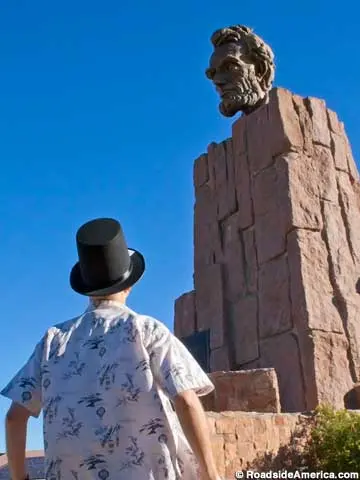
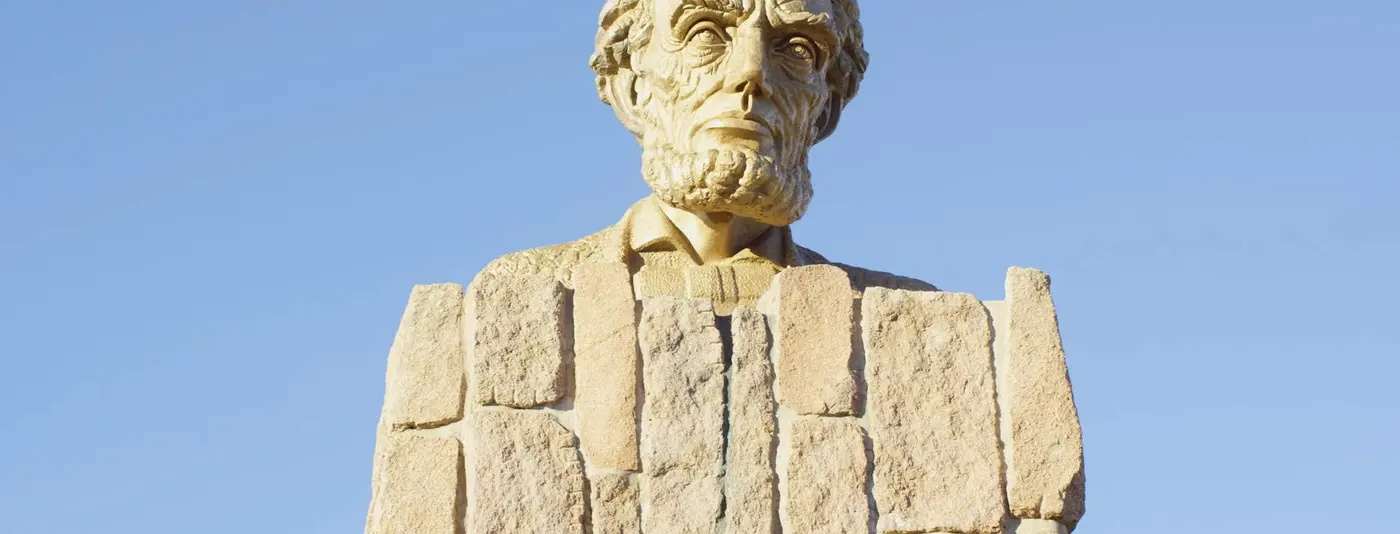
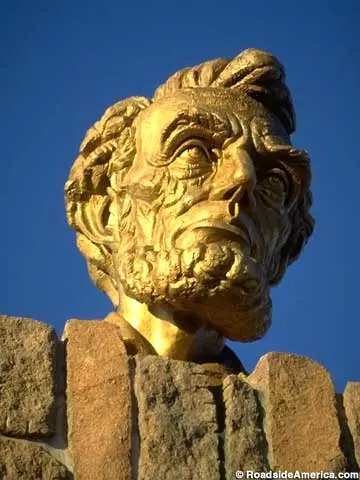
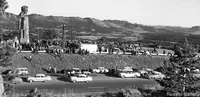
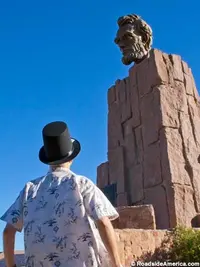
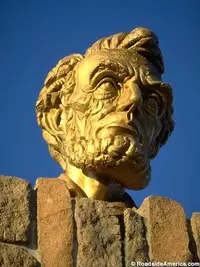
On Interstate 80 between Laramie and Cheyenne, exit 323 leads to the Sherman Summit Rest Area. Above its parking lots stands a bronze head of Abraham Lincoln, 12½ feet high, on a granite pedestal 30 feet tall. The Wyoming State Historic Preservation Office gives the elevation of this summit of I-80 as 8,686 feet. Roadside America describes the pedestal as hollow concrete faced with 120 tons of Wyoming granite and filled with lightning rods that ground the bronze against strikes. The sculptor, Robert Isaiah Russin, an art professor at the University of Wyoming, modeled the face rough and craggy to answer the country around it. At the 1959 unveiling he described how he had matched the work to its setting: “Towards the east the vertical cliffs are reflected not only in the vertical stress of Lincoln’s face, but in the upward thrust of the granite base.”
The rest area has separate parking for trucks and cars, a picnic area, restrooms, and displays inside the building. Wikipedia gives a 2013 estimate of 200,000 travelers a year who view the sculpture. The official Summit Rest Area brochure, as quoted by Roadside America, calls it “the only monument to Abraham Lincoln along the Lincoln Highway” and “the largest bronze head in the U.S.”
Two men who wanted to stay on the road
Just south of the monument is a small memorial to Robert and Adele Russin, where the Wikipedia entry places their ashes. Other accounts say some of his ashes went into the hollow base, or into a pedestal beside it. Adele Russin photographed nearly all of her husband’s work, and the 2026 National Register application credits her with much of his lasting success.
A fence on the grounds encloses another monument, surrounded by four Lincoln Highway concrete markers, which Roadside America calls replicas. It honors Henry B. Joy, president of the Packard Motor Car Company and the first president of the Lincoln Highway Association. A sign beside it says Joy called his work on the highway “the greatest thing I ever did.” It also says he chose a spot far to the west where he “saw the most beautiful sunset he’d ever witnessed” and asked to be buried there. His family buried him in Detroit instead, but they put up the monument at his chosen place.
The sources disagree on when and where that was. Visit Laramie says west of Rawlins in 1936. WyoHistory.org says it stood on U.S. 30 west of Creston and was dedicated in 1938 by Payson Spaulding, an Evanston attorney and the only state consul the association ever named for Wyoming. Roadside America also gives 1938, and puts the original site 140 miles west of here. The monument came to the rest area in 2001.
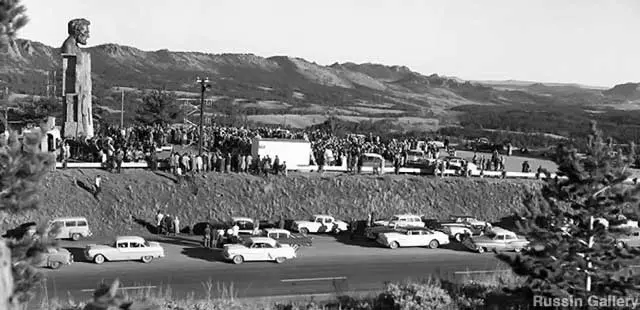
The Lincoln head also stood somewhere else at first. From the rest area, a driver can cross the bridge over I-80 and continue straight up the hill onto old U.S. 30. About a mile on is a gravel turnout on the Lincoln Highway where the head stood until 1968. Visit Laramie gives that summit as 8,835 feet; Roadside America gives 8,878. A stone culvert from the old highway lies down the hill, a couple of hundred feet west of the road.
A tavern on Sherman Summit
Russin came from a family of Eastern European immigrants who had arrived in New York in the early 1900s. He grew up on their stories of Lincoln, and as a young artist on the East Coast he made and sold small figurines of him. “I’ve always loved Lincoln. One of my sons was named Lincoln long before I did the statue,” he once wrote. “The best of America resides in his philosophy.”
In 1947 he moved his family from New York to Wyoming to teach at the university. They came over the Lincoln Highway, the country’s first transcontinental road for cars, completed in 1913. Crossing Sherman Summit near Vedauwoo, Russin settled on the place for a monument. Of “the mountains and the valleys which summoned up the meaning of Lincoln,” he said, “I knew that some day the monument would come into being.”
The summit already held the Summit Tavern, a restaurant, rest stop, and old ski area. “No other place seemed right for the statue and when I saw there wasn’t room for it there, I just put it out of my mind,” Russin wrote. The tavern burned in 1955. He then sought permission from the Medicine Bow National Forest, the Air Force, and the state highway department for a 2-acre allotment, with roads and a park around the planned monument.
The Wyoming Parks Commission wanted to mark Lincoln’s 150th birthday in 1959 with a giant bronze. As its reason it cited the Pacific Railway Act of 1862, which Lincoln signed and which brought the transcontinental railroad, and later towns like Laramie, to what became Wyoming. The money came from Charles W. Jeffrey, a Rawlins physician and oil speculator and Russin’s longtime patron. He gave $40,000, paid to the State over four years. That covered materials and shipping and left the sculptor unpaid for his labor. “Since this just about covered my costs for creating the bronze statue and the granite base, the project was as much my gift to the State as it was Dr. Jeffrey’s,” Russin said.
Out through the foundry roof
Work began in 1958, against a deadline: the backers wanted the statue unveiled in the 1959 commemoration year. Russin worried that clay would shrink and swell in the temperature swings of the Wyoming plains. He moved the whole family to Mexico City and worked with the foundry Fundición Artística, S.A. There he modeled the head from a 15-foot platform while Adele photographed the work. The sources give the weight of clay as more than 5 tons (Cap City News), some 10 tons (Wikipedia), and 70 tons (Roadside America). Wikipedia says the job took 11 months. The lost-wax process produced a 4,500-pound bust in more than 30 bronze pieces made to bolt together. Cap City News gives the head alone as 12 feet tall and 3.5 tons.
The castings would not fit through the door. “Like the fellow who built the boat in his basement, I forgot to measure the doors on the foundry,” Russin wrote. “We had to take the completed bronze casting out through the roof.”
The bust went north by rail. “The statue came up from Mexico with armed guards from the Mexican Army, because they were afraid that someone was going to steal it,” the sculptor’s son, Joe Russin, told the Laramie Boomerang. Cap City News has the soldiers riding with it as far as El Paso. Wikipedia says the train took it to Denver and a truck carried it from there to Laramie. Russin had checked the clearances along the rail lines, but not in town. “My dad hadn’t thought about how low the wires were over Grand Avenue,” Joe Russin recalled. “So they had to move it through Laramie really early in the morning and they cut the electric and telephone wires for each block as they went through.”
Snow at the unveiling, October 1959
A separate crew had been hired to build the granite base and did not finish it in time. Russin completed it himself and oversaw the final assembly in an early-season snowstorm. The monument was unveiled on Sunday, October 18, 1959. The speakers included the president of the university, Governor J.H. Hickey, Senator Gale W. McGee, U.S. Representative Keith Thomson, and Jeffrey.
Russin also spoke. “In creating the statue, I have tried to depict a brooding, contemplative Lincoln in the last years of his life, his great heart sorrowing over the rent nation,” he said. “In the surge of the valley to the south and in the upland on every horizon, I have tried to make Lincoln at one with his surroundings.” He told the crowd, “We are all better people in the contemplation of Lincoln.”
Down the hill to the interstate
For about a decade the head watched over U.S. 30. Then Interstate 80 drew nearly all traffic off the old Lincoln Highway alignment. The state preservation office and the Visit Laramie tour date the move to 1968; Wikipedia and WyoHistory.org give 1969. Russin initiated and oversaw the relocation, less than a mile, to a similar vantage at the interstate’s summit. Bill Ainsley, Deputy Chief Engineer of the Wyoming Highway Department, worked on the planning. The bronze weathered in its new place. In 1992 Russin was dismayed to learn that the Wyoming Department of Transportation had tried to restore the oxidized surface.
Russin taught at the university for nearly 40 years. He died in 2008 by the state’s account, in 2007 by Cap City News and Roadside America. He had called the Lincoln his “most favorite” work. In early 2025 the Albany County Conservancy brought the idea of a National Register listing to the county preservation board and the state preservation office. Megan McDonald, an architectural historian with Post Oak Preservation Solutions, spent months reconstructing Russin’s career to make the case. The National Park Service listed the monument on July 16, 2026, as a work of art and a significant example of Russin’s work. “I’ve never listed something before that was just a piece of art,” McDonald said.
Notable Events
- 1947While moving across the country from New York to Wyoming in 1947, Russin identified the location for his Lincoln sculpture as his family traveled the Lincoln Highway. capcity.news
- 1955The Summit Tavern, a restaurant that occupied the summit, burned down, leaving the summit vacant for the statue. capcity.news
- 1958Everything was in place for Russin to start work on the statue in 1958, under a time crunch to unveil it in the 1959 Lincoln commemoration year. capcity.news
- 1959The completed monument was unveiled on Sunday, October 18, 1959. capcity.news
- 1959The bust traveled along railroad and highway under armed guards to Sherman Summit, where it stayed for a decade before moving above I-80. laramielive.com
- 1959Russin's monumental bust was unveiled at the summit of U.S. 30 to commemorate Lincoln's 150th birthday. wyohistory.org
- 1968After I-80 diverted almost all traffic off the original Lincoln Highway, the sculpture was moved to the Sherman Summit Rest Area in 1968, less than a mile from its original location. capcity.news
- 1992In 1992 Russin was dismayed to learn that the Wyoming Department of Transportation tried to restore the oxidized monument. capcity.news
- 2008Following Russin's death in 2008, a small memorial to Robert and Adele Russin was placed just south of the monument, where their ashes were interred. capcity.news
- 2026The National Park Service listed the Abraham Lincoln Monument at the Sherman Summit Rest Area to the National Register of Historic Places. wyospcr.wyo.gov
People
- Megan McDonald, architectural historian with Post Oak Preservation Solutions, chosen to make the case for the National Register listing.
- Adele Russin, wife of the sculptor; her ashes interred with his in a small stone pedestal beside the sculpture.
- Bill Ainsley, Deputy Chief Engineer of the Wyoming Highway Department during the planning of the move to the new rest area.
- Charles W. Jeffrey, donor; a physician and oil speculator of Rawlins who provided $40,000, paid to the State over 4 years.
- Gale W. McGee, Wyoming Senator; speaker at the unveiling.
- J.H. Hickey, Wyoming Governor; speaker at the unveiling.
- Keith Thomson, U.S. Representative; speaker at the unveiling.
- Robert Isaiah Russin, sculptor; designed the monument and oversaw its relocation (in Wyoming from 1947 until his death in 2008).
- Robert Russin, Creator of the monumental Lincoln bust (1959).