Gallatin Beach, Eagle Lake
Susanville, Lassen County, California. Day use area near Aspen campground; May 15 - September 30.
Details

- Where
- Susanville, Lassen County, CA. No street address stated. Directions
- When
- Day use only: open sunrise to sunset.
- Getting there
- From Susanville travel north on Highway 139 for 30 miles.
- Fees
- No fee.
- Access
- No lifeguard on duty.
- Phone
- 530-257-4188
- Website
- fs.usda.gov
- Managed by
- Eagle Lake Ranger District, Lassen National Forest.
- Coordinates
- 40.557961, -120.770603.
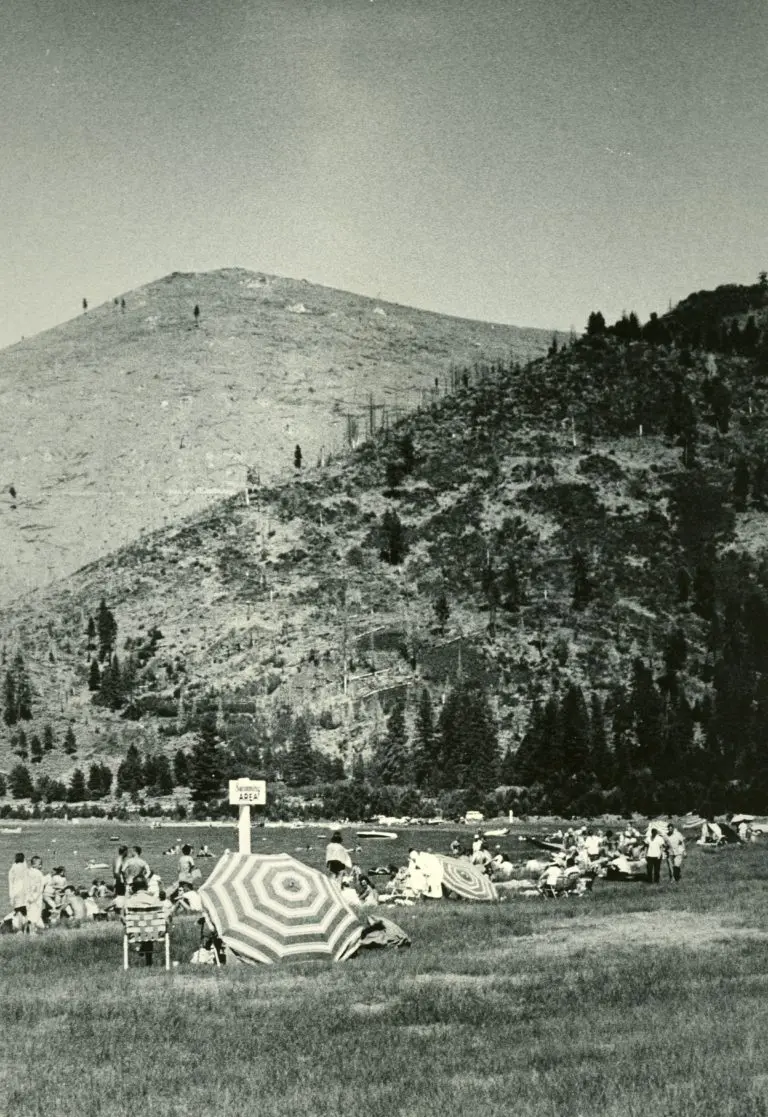
Gallatin Beach is the strip of sand at the south end of Eagle Lake, a day-use area of the Lassen National Forest beside Aspen campground. Looking east across it, Gallatin Peak rises on the right and Black Mountain on the left. The geologist G. C. Gester photographed that view for a California Academy of Sciences paper on the lake. The Forest Service lists the beach for sandcastles, sunbathing, swimming, picnicking and viewing scenery. It is open from May 15 to September 30, sunrise to sunset, with no fee. There is a vault toilet and no drinking water, dogs are kept off the beach, and no lifeguard is on duty. The lake surface warms to about 80 degrees in summer and drops to 32 in winter.
At this end the shore is forested with pine and fir. The Bureau of Land Management notes that the northern and middle sections of the lake are bordered by sagebrush hills. Merrill Creek and Papoose Creek, both short and intermittent, run into the southern end.
A closed basin at 5,100 feet
Eagle Lake lies 5,100 feet above sea level. The BLM puts it about 16 miles north of Susanville; Gester put it about 20. It is the second largest natural freshwater lake wholly in California, and it has no natural surface outlet, so its level rises and falls with inflow. Its surface has ranged between 16,000 and 29,000 acres, with a present area of 26,000. The lake runs 13 miles north to south in three sections joined by channels. The northern section averages six feet deep and the middle ten. The southern section, the end the beach faces, reaches 92 feet.
The country around it is a high semi-arid plateau of basaltic lava flows, volcanoes and cinder cones. Some of the flows are no more than a few centuries old. Earlier writers classed Eagle Lake as a landslide lake. Gester examined the shores and concluded that ancient rocks and basalt flows bar it on the southeast. Gallatin Peak, above the beach, holds old plutonic and metamorphic rock that he found identical to rock of the Sierra Nevada. He called the peaks there “a segment of the Sierra Nevada in a sea of basaltic lavas.” He also noted old beach sands, full of mollusk shells, lying 25 to 35 feet above the present water. Wave-cut terraces sit higher still. He wrote that a great many obsidian arrowheads had been gathered from the shores, the obsidian evidently carried there by Indians.
The lake supports one of the last colonies of nesting osprey. It also holds what the BLM calls the largest nesting colony of western and eared grebes in the western United States, and it is home to the Eagle Lake trout, a fish native only here. Lieutenant E. G. Beckwith saw the lake from a rocky butte on July 2, 1854, and wrote: “It has no outlet. We gave it the name of Eagle Lake.” Gester recorded a difference of opinion over the name. Some say it was given mistakenly for the osprey. Old timers claimed it was named for the eagles still occasionally seen there.
Hardware, sheep and the south shore
The south shore drew summer crowds before anyone owned it. On July 11, 1874, the Lassen Advocate reported: “Quite a number of our citizens spent their fourth at Eagle Lake, where they had fine times, fishing, hunting, sailing, etc.”
Albert Gallatin was born in New York and worked in the hardware business there. In 1860 he came west by way of Panama and settled in Sacramento, clerking in the hardware store of Huntington & Hopkins. He made his fortune supplying hardware to the railroads, then turned to iron and steel, lumber, and the long-distance transmission of hydroelectric power. In 1877 he built a mansion in Sacramento. He sold it in 1887, and in 1903 it was purchased by the State of California and became the Governor’s Mansion.
On August 1, 1886, according to the historian Tim Purdy, Gallatin bought 165 acres on the south shore from George Nelson for $400. Over the next two years he bought 4,962 acres in the Eagle Lake basin, taking in not quite all the shoreline from what is now called Eagle’s Nest to Bucks Point. The land was mostly timber and served as summer grazing for sheep, worked with his larger ranch in Tehama County. Susan Couso, writing from the files of the Lassen Historical Society, gives the price of nearly 5,000 acres as $9,000. The winters were deep. In 1890 everyone at the lake ran out of hay for their livestock. In 1889 Gallatin finished a storage reservoir holding 330,000,000 gallons of water.
Gallatin married his second wife, Malvena, in New York in 1882. He died in San Francisco in 1905. The next year Malvena hired a Mr. Gilliam at $66 a month to oversee her 11,000 sheep. She later accused him of reneging on their deal and sued to recover her money.
Malvena Gallatin’s house at Papoose Creek
Malvena turned the Eagle Lake land into a summer retreat for her granddaughter, Norma Virginia Harvey. In 1913, when Norma was 13, she had a two-story house built where Papoose Creek enters the lake. It was the first summer home at Eagle Lake.
The same year, she invited Leon Bly to the lake. Bly was an electrical engineer and secretary of the Tehama Irrigation & Power Company. The lake had been rising for thirty years and was flooding most of her lands. She paid for his first study. Bly spent a year taking soundings from Oscar Rankin’s boat, the Pelican, and made what SusanvilleStuff calls the first accurate map of the lake bottom. His tunnel to carry Eagle Lake water to the Honey Lake Valley was celebrated at Standish in May 1923. Water first reached the valley in the first week of October that year. By the next spring the lake had dropped below the tunnel entrance, and the irrigation district spent years cutting the intake lower as the water fell. Malvena had supported the tunnel. As the level dropped she came to believe it was devaluing her property, sued to stop the project, and lost.
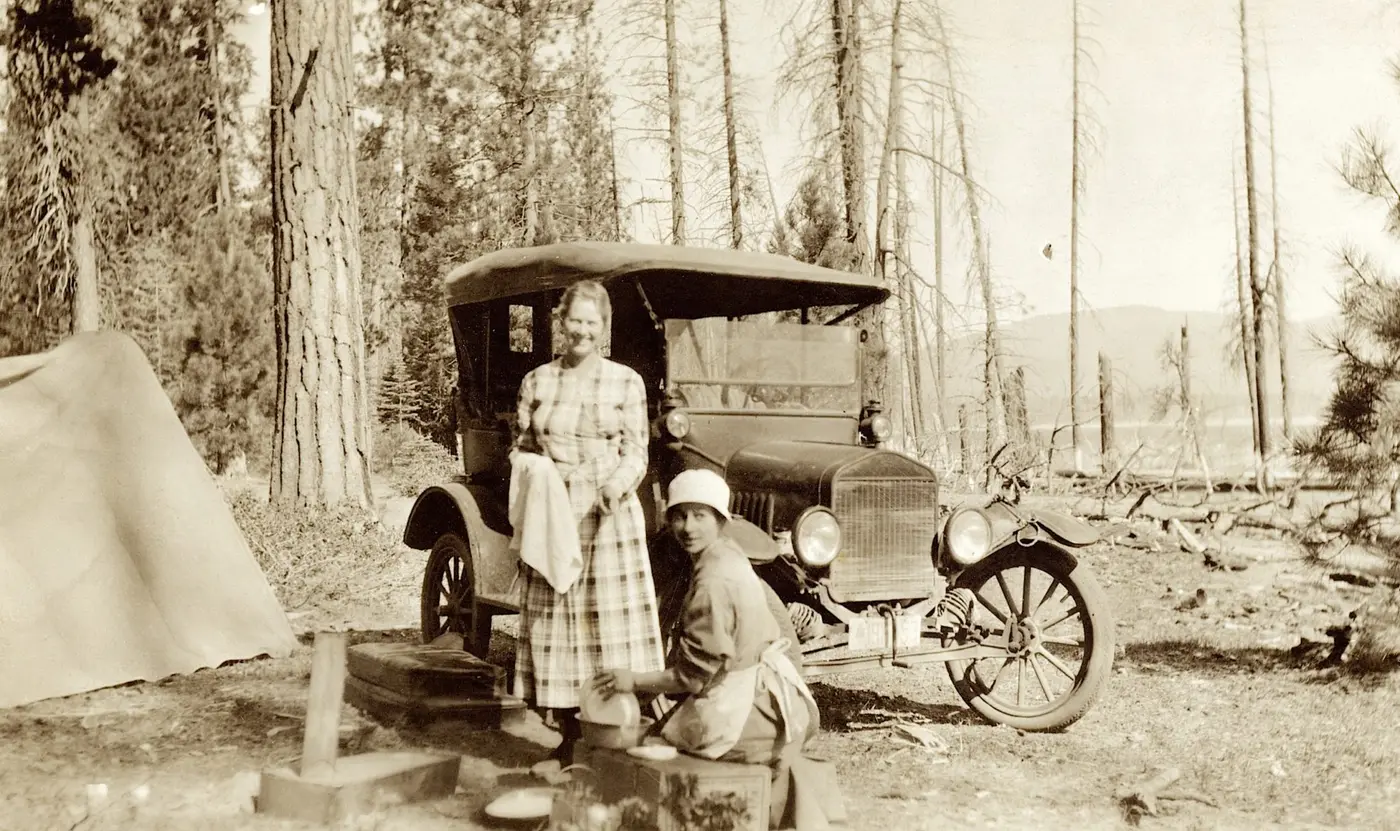
She gave up her summers at the house in 1920, as Norma grew older. In July 1924, protesting a proposed timber tax, she wrote to Lassen County officials: “The public has been allowed access to these lands for camping, bathing, boating, and fishing at all times. The Gallatin Beach and a large part of the shoreline property has been used for years by the public. It might be called a public playground.”
Norma died in 1944. That Christmas Malvena went back to the house, then left John and Alberta Christie as caretakers and never returned. In February 1946, Couso writes, she sold all but about two acres to Lassen Lumber & Box Company. People who wanted the lake kept for recreation objected, and by August the company had agreed to sell to the U.S. Forest Service, keeping the right to log a set amount. A Forest Service project description gives a shorter account: the family owned the lodge for 31 years until the Forest Service acquired it in 1946 for administrative use. Either way, the house then sat idle for many years.
Cedar Lodge and Camp Ronald McDonald
In 1988 Ronald McDonald House Charities Northern California took a special use permit for the site and opened a residential summer camp. Camp Ronald McDonald at Eagle Lake serves campers with emotional, physical and developmental disabilities. According to camp director Vicky Flaig, Robert “Bob” Olson, a retired Lassen National Forest employee, played a key role in starting it. The charity keeps up Malvena’s house, called Gallatin House and also Cedar Lodge, under Forest Service supervision.
By 2012 more than 20 years had passed since the roof was last renovated. Shingles had blown off, and spots of sunlight showed through into the attic. That spring, crews spent more than a month tearing off the old cedar shingles, repairing the decks and laying new cedar on a steep roof some 30 feet off the ground. The workers included HistoriCorps volunteers recruited through the Forest Service’s Passport in Time program, eight AmeriCorps volunteers, and more than a dozen forest employees from archaeology, engineering and fire. District Ranger Ann Carlson worked on the roof herself. She reported the job finished on June 8. “Gallatin House would not have been ready for the arrival of campers if we had not had all the help of both the volunteers and Forest Service personnel,” Carlson said.
The lodge serves as the camp’s office, and campers learn the history of the lake and the Gallatins there. “The House is the first stop on our camp tour and the most asked-about building on the site,” Flaig said.
Notable Events
- 1874The Lassen Advocate reported citizens spending the Fourth at Eagle Lake, fishing, hunting and sailing — the south shore already a summer gathering place. tipurdy.org
- 1886Albert Gallatin purchased 165 acres on Eagle Lake's south shore from George Nelson for $400 and within two years bought 4,962 acres in the Eagle Lake basin. tipurdy.org
- 1889Gallatin finished a storage reservoir which held 330,000,000 gallons of water. susanvillestuff.com
- 1913Leon Bly visited Lassen County while serving as secretary of the Tehama Irrigation & Power Company. susanvillestuff.com
- 1913Gallatin House was built as the family's summer residence on Eagle Lake's southern shore, according to the Passport in Time project description. susanvillestuff.com
- 1924Malvena Gallatin wrote to Lassen County officials protesting a proposed timber tax that the public had used the lands for camping, bathing, boating and fishing at all times, and that Gallatin Beach had been used by the public for years. tipurdy.org
- 1946The lodge was acquired by the Forest Service for administrative purposes. susanvillestuff.com
- 1988Ronald McDonald House Charities Northern California took over site management with a special use permit for a residential summer camp. susanvillestuff.com
- Carlson reported that the project was completed with volunteer and Forest Service help before campers arrived. susanvillestuff.com
People
- Leon Bly, Surveyed the lake bottom using Oscar Rankin's Pelican.
- Malvena Gallatin, Gallatin's widow; built the first summer home at Eagle Lake, now part of Camp Ronald McDonald (1913).
- Med Arnold, Was camping and fishing at Eagle Lake during Lassen's explosive eruption.
- Oscar Rankin, His Pelican was used by Bly for the lake-bottom survey.
- Ann Carlson, District Ranger who helped reroof Gallatin House.
- Robert “Bob” Olson, Retired Lassen National Forest employee who played a key role in initiating the camp, according to Flaig.
- Vicky Flaig, Camp Ronald McDonald director who described the Gallatin House roof funding.
- Albert Gallatin, Sacramento businessman who bought Eagle Lake's south shore and nearly the whole basin shoreline, from Eagle's Nest to Bucks Point (1886).