
-29_(25128286071).jpg)
Feather River Fish Hatchery
Oroville, Butte County, California. Fish hatchery; Open any time of year.
Details

- Where
- 5 Table Mountain Boulevard, Oroville, CA 95965. Directions
- When
- Salmon spawning operations can be observed Monday through Friday from mid-September until mid-November; steelhead spawning can be observed mid-December through mid-February; fish are present in the rearing ponds all year.
- Getting there
- From Highway 70 take the Grand Avenue / Nelson Avenue exit; continue east on Grand Avenue; right onto Table Mountain Boulevard and down the hill toward the river; entrances are just before the river bridge.
- Fees
- No parking fee.
- Hours
- Open 8:00 a.m. to 3:00 p.m.
- Access
- Fish ladder expected to remain open through June 2027 for viewing.
- Walk-in or reserve
- Self-guided visiting, no reservation needed; guided tours by arrangement.
- Phone
- (530) 538-2222
- Website
- wildlife.ca.gov
- Managed by
- Department of Water Resources owns and maintains the facility and funds CDFW; California Department of Fish and Wildlife runs the spawning, rearing, and stocking operations.
- Established
- 1967.
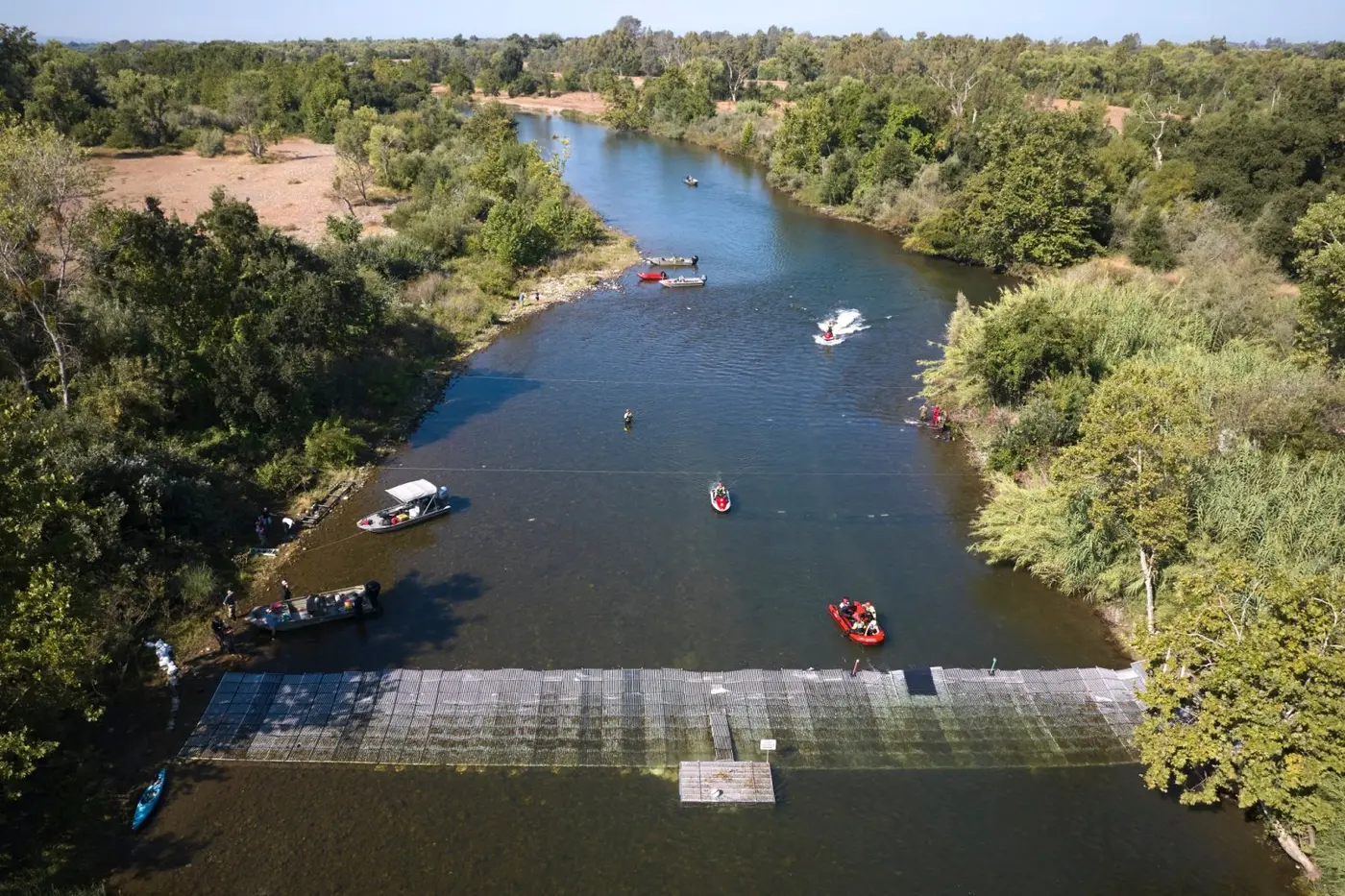
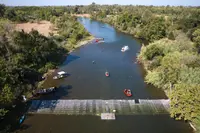
Table Mountain Boulevard runs downhill toward the Feather River and a green bridge. Just before the bridge, the road divides the Feather River Fish Hatchery into two halves. East of the pavement are the fish barrier dam, an observation platform, and an underwater viewing window set into the fish ladder. West of it are the spawning room, the hatchery building, and the rearing ponds. The site is in Oroville, Butte County, about four miles downstream of Oroville Dam, and it takes all of its water from the river.
The ladder, the window, and the ponds
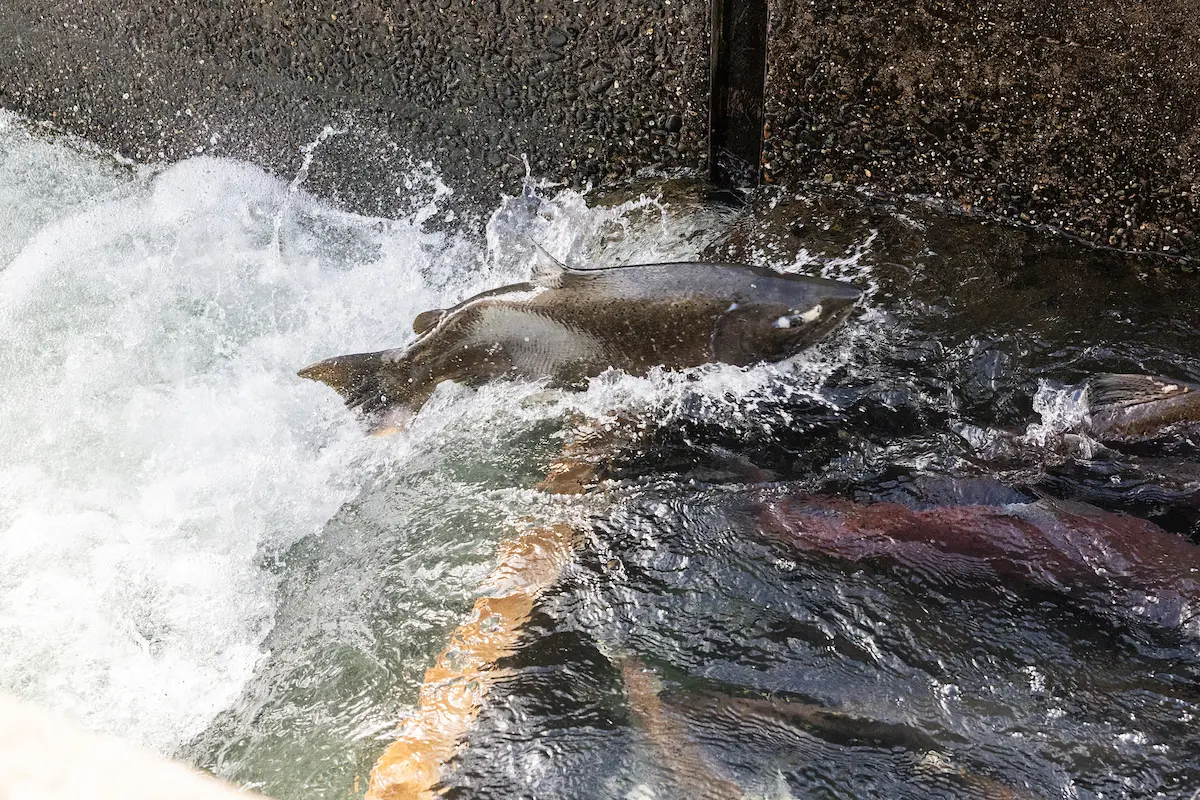
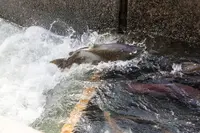
In early fall the Chinook gather below the barrier dam. From the overlook a visitor can watch them jump in the river, then walk a few steps to the window and see them swimming up the ladder at eye level. Explore Butte County mentions “the sights and sounds of the barrier dam” at the main platform. On September 25, 2026, the Department of Water Resources reported that the ladder was open and spawning had begun. It expected the ladder to stay open for viewing through June 2027. The Department of Fish and Wildlife gives the window’s season as roughly mid-September through June. Explore Butte County divides it into Chinook from mid-September to mid-November and steelhead from mid-December to mid-February. Between March 4 and September 14, 2026, DWR’s monitoring station on the river counted 8,509 spring-run Chinook, 9,573 fall-run Chinook, and 73 steelhead moving upstream.
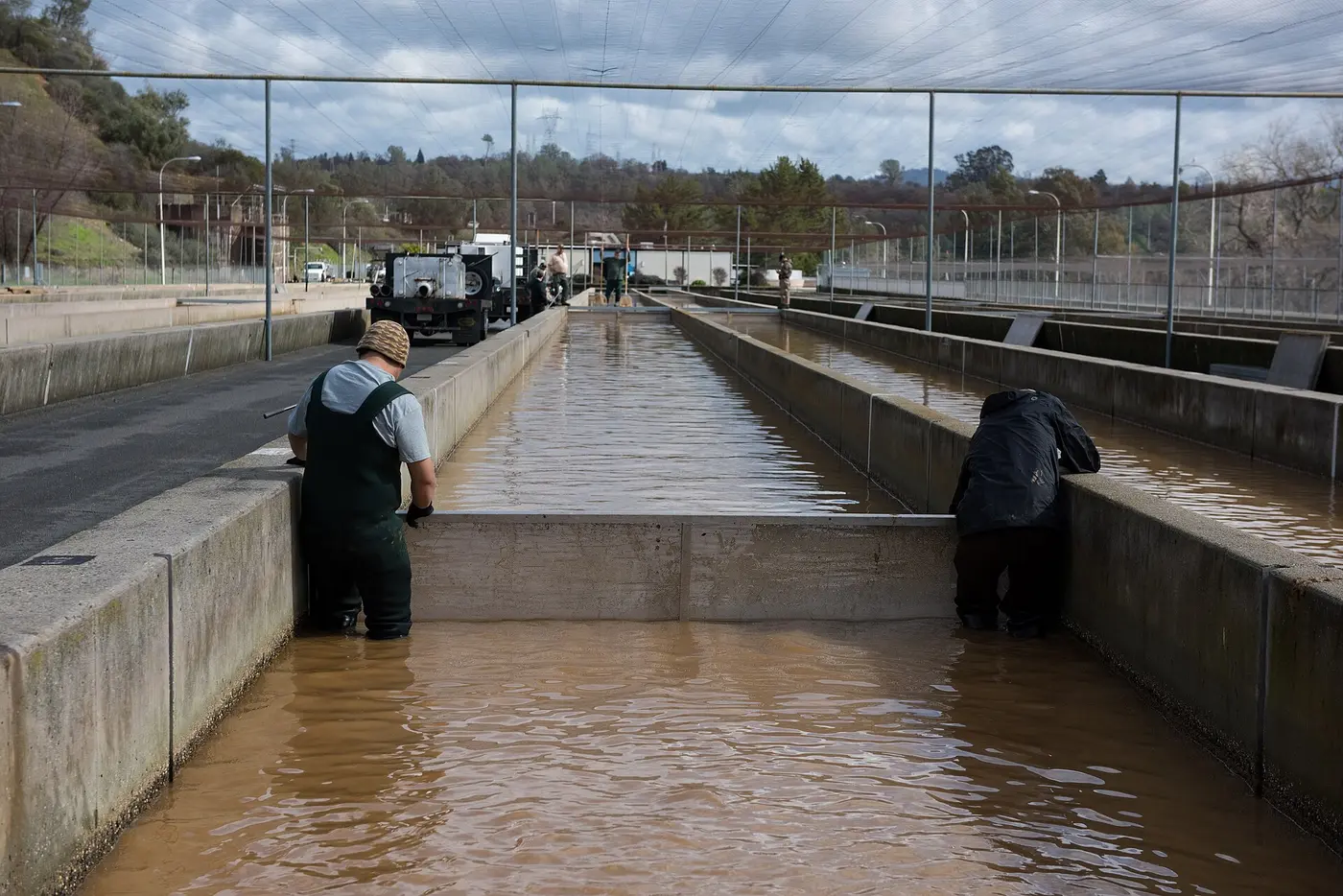
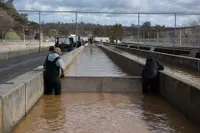
On the west side, salmon spawning can be watched Monday through Friday from mid-September until mid-November. The Department of Fish and Wildlife lists steelhead spawning from mid-December through mid-February. The California Watchable Wildlife program, which lists the hatchery as viewing site #299, gives late November to February 1. A DWR release describes the process. Eggs from returning females are fertilized with milt from returning males and kept in incubators for about 85 days. The fry then go either into the river or into long ponds called raceways. A self-guided walk runs beside the rearing channels, which hold hundreds of thousands of young fish. The ponds hold fish in every month of the year, and in the peak fall and winter months visitors can watch the tagging crews at work. Interpretive panels stand along the way, and guided tours can be arranged.
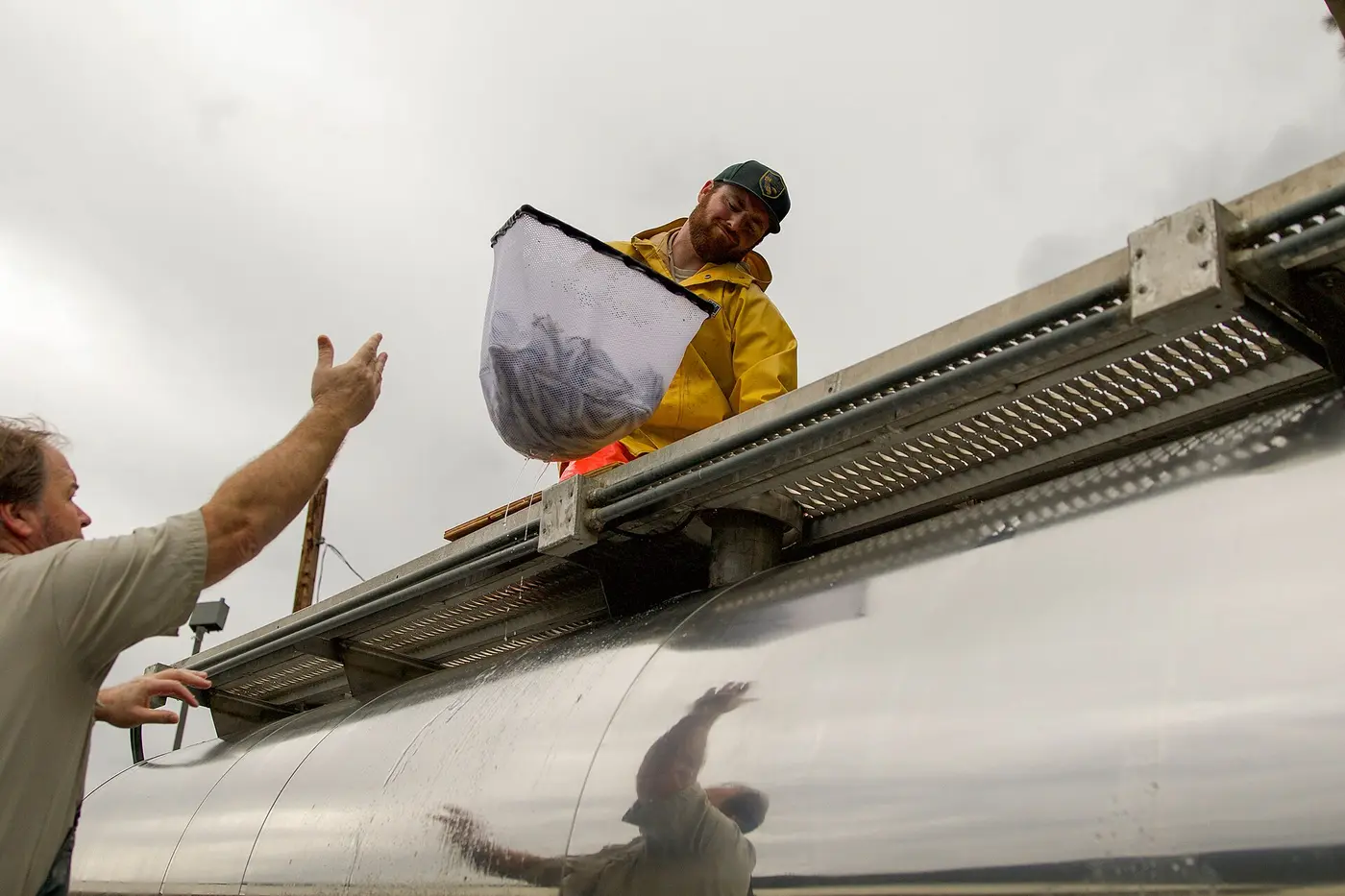
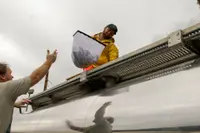
The fingerlings leave between March and June. From March to June 2022 the hatchery released over 11.3 million young Chinook into the Feather River, San Pablo Bay, and San Francisco Bay. Smolts bound for the bays travel in specialized trucks. DWR says transport improves their survival, especially in drought years, and that crews track tides and water quality, release at night, and hold the fish in net pens to get them used to salt water. The fish then spend two to five years feeding in the Pacific before they return to the Feather River to spawn. Other fish never reach the sea. The hatchery treats some fall Chinook eggs on site so the fish cannot reproduce, and plants them in Lake Oroville for anglers. In May 2022, 128,000 of these fingerlings went into the lake.
The Watchable Wildlife listing says the hatchery handles 30 million eggs, 15 million fingerlings, and 17,000 adult fish a year, and that about 20 percent of the ocean sport and commercial catch originates here. The Department of Fish and Wildlife puts the average return at 51,000 fish a year. After the 2024 spawn, the hatchery collected eggs for another 1 million spring-run and 6 million fall-run Chinook beyond its usual goals, in response to declines in Central Valley salmon. DWR owns and maintains the facility and pays the Department of Fish and Wildlife to do the spawning, rearing, and stocking. “The Feather River Fish Hatchery is one of the most productive and successful fish hatcheries on the West Coast of the United States,” said Eric See of DWR’s Oroville Field Division.
Below the hatchery, returning salmon and steelhead also spawn in the river gravels on their own. The river beside the grounds draws waterfowl, wading birds, songbirds, birds of prey, and small mammals.
The fourth Saturday in September
The Oroville Salmon Festival is held on the fourth Saturday of September, at the hatchery and in downtown Oroville. In 2026 it fell on September 26. DWR ran a booth at the hatchery from 9 a.m. to 3 p.m. with water-safety materials, a photo stop, and salmon gyotaku, a method of fish printing. DWR guides gave free tours of the hatchery. Downtown there were the Motor Mania Car Show, the Salmon Run, a food and beer garden, a Kid’s Zone, and vendor booths, and the Oroville State Theater showed videos on salmon habitat and fish health.
The festival weekend also opened the fall season of the Feather River Floating Classroom, a free raft tour through spawning habitat. On the tour, scientists from DWR and the Pacific States Marine Fisheries Commission explain the salmon work. In 2026 the first tour ran on Sunday, September 27, followed by tours each Saturday from October 3 through November 7. Tickets are released on Fridays, about two weeks ahead of each tour.
Hatcheries on the upper river
The Department of Fish and Wildlife says people tried for years to spawn salmon, shad, and trout artificially in the Feather River and its drainages. Most of the old hatcheries stood about 100 miles northeast of the present site. A shad hatchery built near Yuba City in 1916 closed after one season because the run was too light to supply enough eggs. In 1924 a hatchery building with 60 troughs, along with employee cabins, went up four miles from Clio in Plumas County, on the Western Pacific Railroad. It ran for nearly 30 years until 1953, when the work was abandoned as outdated. After that, no hatchery operated on the Feather River for fourteen years.
In 1960 California voters authorized the State Water Project and Oroville Dam, and in 1961 DWR began building the dam. CalFish says the dam blocked salmon and steelhead from their spawning and nursery grounds. During construction, an interim facility near the Upper Thermalito Bridge trapped the fish at the barrier dam and trucked them six and one-half miles upstream, around the work. Between July 1965 and June 1966 the crews hauled 3,932 king salmon and 434 steelhead this way. Geoffrey V. Rice’s annual report for that year says about 73,500 people came to watch. The report also notes that damage from the December 1964 flood had been repaired. In May 1966 a contract was let for the permanent hatchery, and the house trailer, office, and laundry room were cleared off the ground.
The first season, 1967–68
The sources give different starting dates. The Department of Fish and Wildlife gives 1967. A DWR release reprinted in the Gridley Herald says the hatchery was built between 1966 and 1967. A 2022 DWR post says it has operated since 1968. Frederick Groh’s report on the first year of operation supplies the details. The facilities for receiving adult fish were finished by July 1, 1967. Through that spring and summer the spring-run fish waited in a deep hole at the base of the barrier dam. The ladder opened on August 22, and by September 1, 146 spring-run king salmon had come in.
The river was at 73° F, too warm for spawning. Crews trucked the first fish 75 miles to a Fish and Game planting base near Quincy. Many died there even though the tanks were covered with black plastic. Of 158,700 spring-run eggs taken, only 73,600 fry reached the rearing tanks. The fall-run fingerlings were divided into four lots, each fed a different diet: Rangen, Clark, Silver Cup, and Oregon Moist. By the end of the fiscal year, the Oregon Moist lot was doing best. The office and shops were occupied by October 1, and the hatchery was dedicated on October 11, 1967, with several hundred people attending.
The plans included a low-water alarm, a fire alarm, and a burglar alarm. The burglar alarm never worked. Before three men were hired for the night shift, unknown persons came in after dark and shut off the water to the ladder and holding tanks, and 182 adult salmon and 266 adult steelhead died. On December 1 the disease ceratomyxa was found in the adult steelhead, and by the end of the month it had reached the yearlings, 1,150 of which died by June 30, 1968. A shipment of silver salmon fingerlings from Mt. Shasta Hatchery arrived on May 8 and 9 infected with tuberculosis, and all of the fish were destroyed.
The public had been planned for from the start. There was a viewing platform near the barrier dam and six windows in the ladder. Large windows in the spawning room let people watch the whole operation without getting in the employees’ way. Visitors could also press a button at each important stop to play a tape recording about the work there. About 89,000 people came that first year.
Later, the spring-run stock was sent well beyond the Feather River. In 2013 the hatchery was named as the source of fish for returning salmon to the San Joaquin River, which had been dry in parts for more than 60 years. “We’re using the hatchery facility so we can get to the reintroduction goals in the San Joaquin by increasing the numbers in the hatchery,” said Rhonda Reed of the National Marine Fisheries Service.
Liquid mud, February 2017
Record rain in January and February 2017 filled Oroville Reservoir. DWR began spillway releases on January 31, and the emergency began on February 7, when the spillway was found badly damaged. The erosion that followed poured sediment into the river, and the hatchery’s water turned, in the Los Angeles Times account, “the color of chocolate milk.” “Our hatchery, which rears salmon and steelhead, draws all of its water from the river,” said the manager, Anna Kastner. “Suddenly, it was awash in liquid mud.” She remembered that DWR “wondered if letting our fish go in the river would increase their chances of survival.”
The fish stayed in hatchery care. NOAA Fisheries, the Department of Fish and Wildlife, and DWR moved about two million spring-run and about 4.2 million fall-run Chinook downstream to the Thermalito Annex, which draws its water from a spring. “The coordination by California Department of Fish and Wildlife to transport the fish to Thermalito Annex on such short notice was amazing,” said Amanda Cranford, a NOAA Fisheries biologist. The steelhead eggs in the egg stacks were too delicate to move, so staff cleaned the mud off them by hand. NOAA credits that work with saving about 700,000 threatened steelhead. The Times reported that 1 million steelhead eggs survived and that a few thousand salmon fry were lost. Volunteers, Kevin Anfinson among them, shoveled the sediment out of the salmon raceway. On March 20, as the dam increased its releases again, the first million rescued spring-run Chinook were poured from a truck into the Feather River.
Notable Events
- 1960California voters authorized construction and operation of the State Water Project and construction of Oroville Dam on the Feather River. calfish.org
- 1961The Department of Water Resources began building Oroville Dam, the rock fill project that altered the flow of the Feather River and led to the hatchery. wildlife.ca.gov
- 1964The report records December flood damage and says it was repaired. nrm.dfg.ca.gov
- 1966A construction contract was awarded and work on the permanent hatchery began. nrm.dfg.ca.gov
- 1967Unknown persons turned off water to the ladder and holding tanks before a night crew was hired, killing adult salmon and steelhead. nrm.dfg.ca.gov
- 1967Ceratomyxa was detected in adult steelhead and had infected yearlings by the end of the month. nrm.dfg.ca.gov
- 1967All facilities for receiving adult fish were complete. nrm.dfg.ca.gov
- 1967Feather River Hatchery was dedicated. nrm.dfg.ca.gov
- 2017With the Oroville Dam spillway damaged and the river fouled with sediment, the hatchery's fish were rescued: about two million spring-run Chinook salmon and about 4.2 million fall-run Chinook salmon were transferred to the Thermalito Annex. fisheries.noaa.gov
- NOAA staff, CDFW and CDWR agreed to rescue hatchery fish and transport them downstream to the Thermalito Annex Hatchery. fisheries.noaa.gov
- The first batch of one million rescued spring-run Chinook was released as Oroville Dam increased water releases again. fisheries.noaa.gov
- Ceratomyxa first appeared in fingerling steelhead; severe losses did not occur until after the end of June. nrm.dfg.ca.gov
- The initial consignment of silver salmon fingerlings from Mt. Shasta Hatchery was found infected with tuberculosis and destroyed. nrm.dfg.ca.gov
- The office and shops were occupied during the first operating year. nrm.dfg.ca.gov
People
- Elif Fehm-Sullivan, Fisheries Service representative commenting on safeguards for taking hatchery fish without harming populations elsewhere.
- Rhonda Reed, Described using the hatchery to increase fish numbers for San Joaquin River reintroduction.
- Amanda Cranford, NOAA Fisheries West Coast biologist describing the coordinated short-notice transfer of hatchery fish to Thermalito Annex.
- Barry Thom, NOAA Fisheries West Coast Regional Administrator describing the coordinated emergency response.
- Anna Kastner, FRFH Manager describing hatchery staff work supporting the Feather River salmon fishery.
- Kevin Anfinson, Volunteer helping shovel muddy sediment from the hatchery salmon raceway.
- Larissa Van Der Linde, Fish and Wildlife scientific aide participating in the mud-removal work.
- Casey Campos, Environmental Scientist for DWR's Feather River Program discussing hatchery salmon's contribution to California fisheries.
- Eric See, Environmental Program Manager for DWR's Oroville Field Division discussing the hatchery's productivity.
Sources
- wildlife.ca.gov/Fishing/Hatcheries/Feather-River
- wildlife.ca.gov/Fishing/Hatcheries/Feather-River/History
- wildlife.ca.gov/Fishing/Hatcheries/Feather-River/Species-Raised
- cawatchablewildlife.org/mobile/view_site.php?display=q&q=1723251360&site=299
- explorebuttecounty.com/places/feather-river-fish-hatchery
- orovillemr.com/2025/08/26/feather-river-hatchery-monitoring-station-making-a-splash
- water.ca.gov/News/Blog/2026/Sep-2026/Lake-Oroville-Update-September-25-2026
- gridleyherald.com/2025/01/02/518569/whats-up-at-lake-oroville-
- sandiegouniontribune.com/2017/02/17/downstream-from-the-stricken-oroville-dam-the-feather-river-fish-hatchery-manages-to-save-millions-of-fish
- chicoer.com/2013/02/07/oroville-feather-river-hatchery-will-spawn-fish-population-in-san-joaquin
- nrm.dfg.ca.gov/FileHandler.ashx?DocumentID=32304
- nrm.dfg.ca.gov/FileHandler.ashx?DocumentID=32306
- calfish.org/ProgramsData/ConservationandManagement/CentralValleyMonitoring/SacramentoValleyTributaryMonitoring/FeatherRiverFishHatchery.aspx
- fisheries.noaa.gov/feature-story/collaboration-time-crisis-responding-oroville-dam-emergency-0
- water.ca.gov/News/Blog/2022/June-22/DWR-and-CDFW-Release-Fish-Into-the-Wild