.jpg)
Dripping Springs Trailhead
Las Cruces, Doña Ana County, New Mexico. Natural area.
Details

- Where
- 15000 Dripping Springs Rd., Las Cruces, NM 15000. Directions
- When
- Summer (March-Nov): 7 AM - Sunset Winter (Nov-March): 8 AM - Sunset.
- Getting there
- The Dripping Springs Natural Area is located 10 miles east of Las Cruces, on the west side of the Organ Mountains. From Exit 1 on Interstate 25, take University Avenue/Dripping Springs Road east to the end.
- Fees
- Day use fee is $5 per passenger vehicle and $15 per commercial bus. Group Picnic Shelters are available for day use only for $50/day.
- Access
- There is no camping and pets are allowed only on designated trails.
- Walk-in or reserve
- Reservations are required for use of the Group Picnic Shelters.
- Phone
- (575) 522-1219
- Managed by
- Las Cruces District Office.
University Avenue leaves Las Cruces and runs east toward the Organ Mountains until it ends. At its end are a parking lot and the Dripping Springs Visitor Center, which holds interpretive displays about the range. The A. B. Cox Visitor Center, as the New Mexico Bureau of Geology names it, stands on the west side of the mountains, about 10 miles from town. The building and its grounds were a resort before they were a ranch. In the 1930s the Hayner family built the property as a weekend retreat with a large swimming pool and an airstrip. The Cox family, the last private owners, later made it the headquarters of a ranching operation that covered most of the private land in the western Organs.
From here the Dripping Springs Natural Area spreads across more than four miles of easy trail through desert scrub and low piñon-juniper and oak woodland. The Bureau of Land Management’s Las Cruces District Office manages it as part of the Organ Mountains–Desert Peaks National Monument, which was designated in 2014. Camping is not allowed. Pets may go only on designated trails. The gate closes at sunset. In fiscal year 2024, about 155,000 people came, according to the BLM.
The trail up Ice Canyon
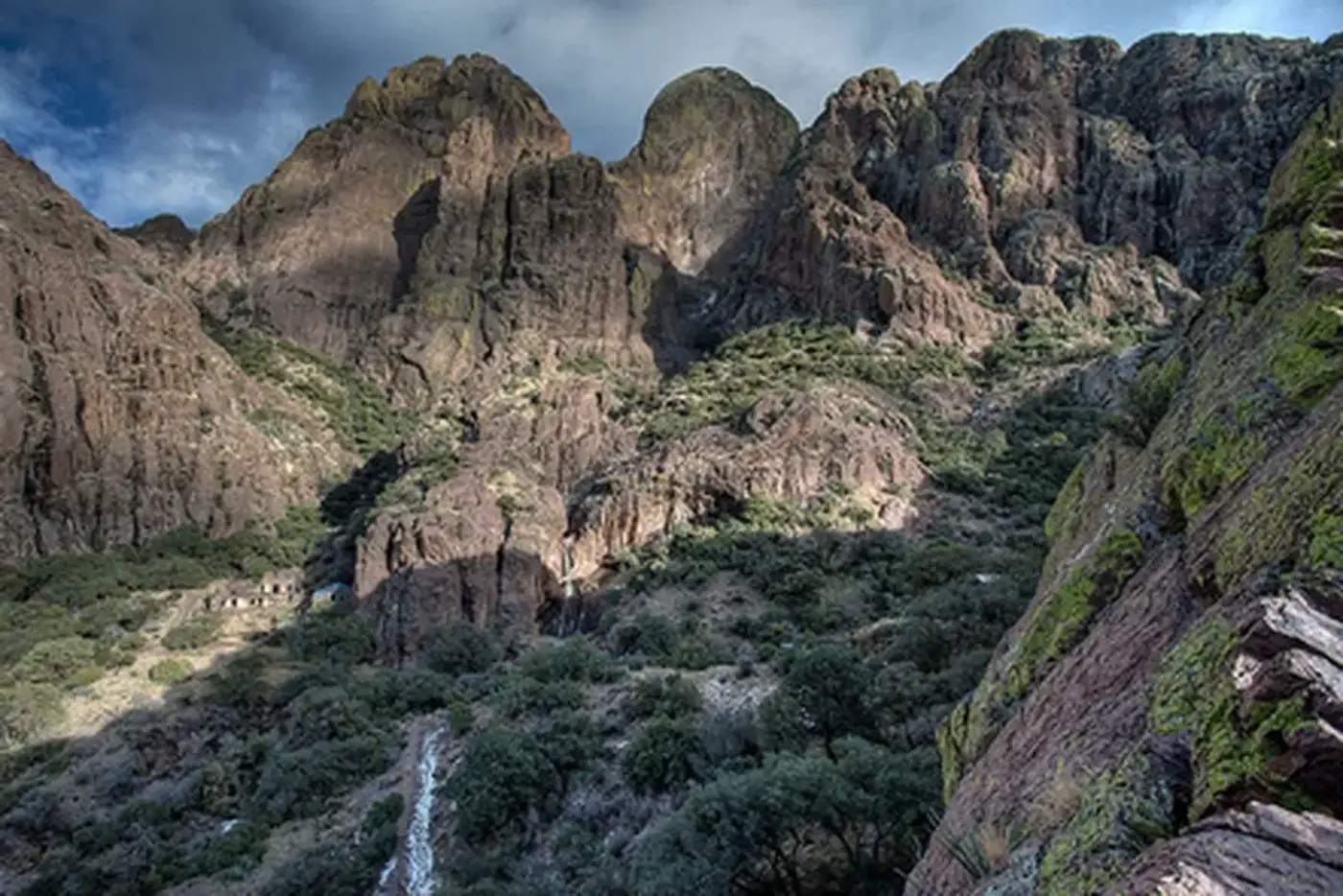
The Dripping Springs Trail runs a mile and a half to the ruins, which sit at 6,000 feet in and near Ice Canyon. Fractured peaks rise above them, and the Chihuahuan Desert lies below. About a quarter-mile short of the ruins is the Livery, a cluster of stabilized wooden buildings that served the resorts. It includes a general store and a grain shed, and the remains of a corral lie beside it. Near the Livery, alligator junipers grow on both sides of the path. Their bark resembles alligator hide.
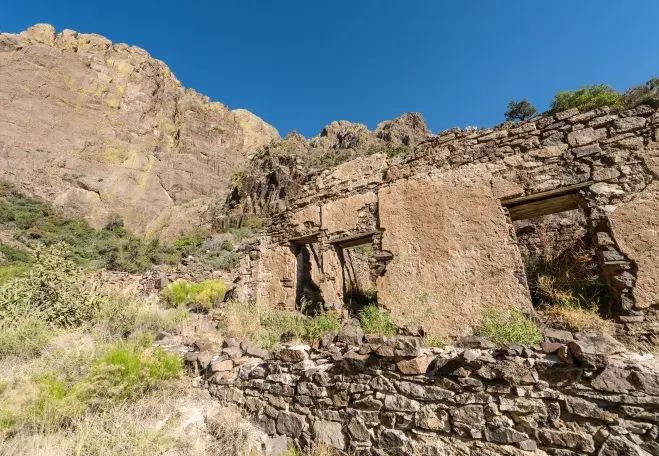
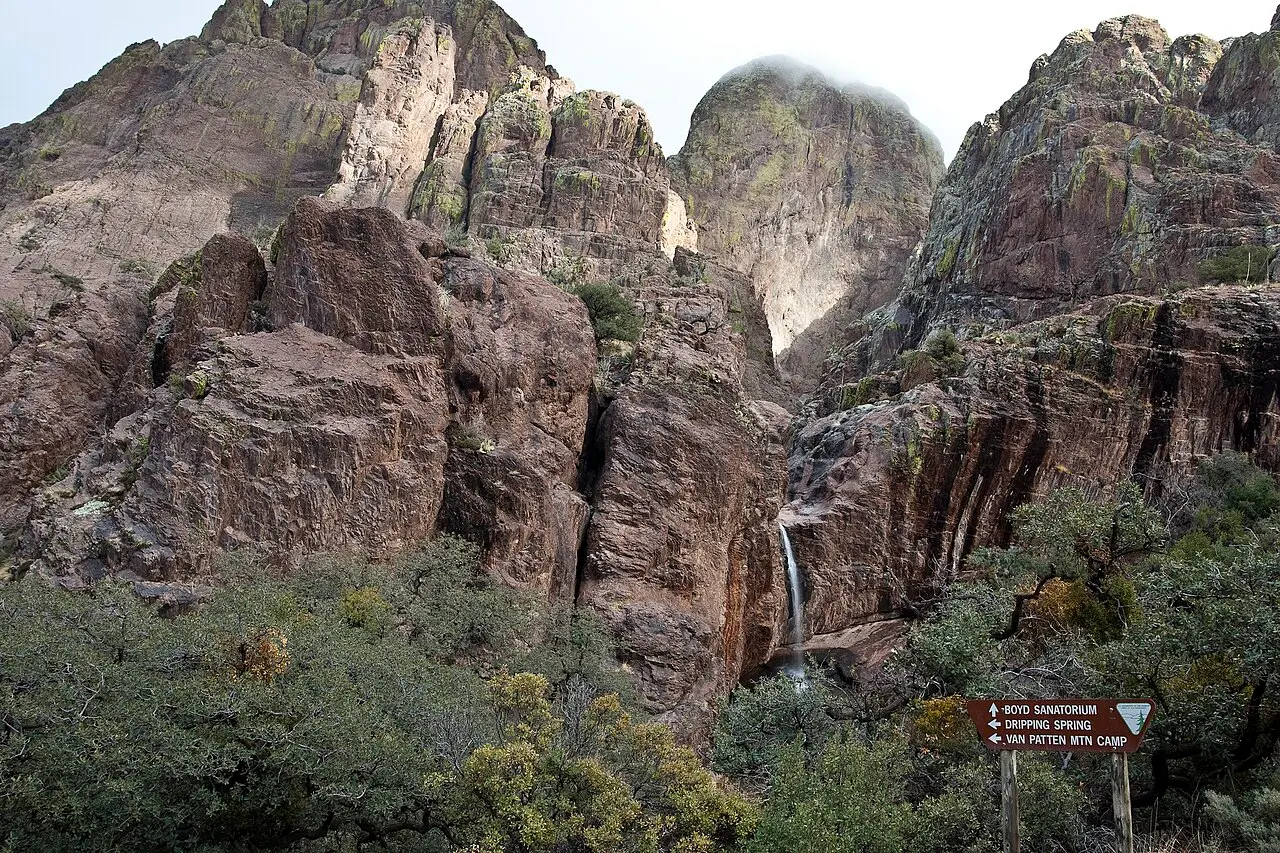
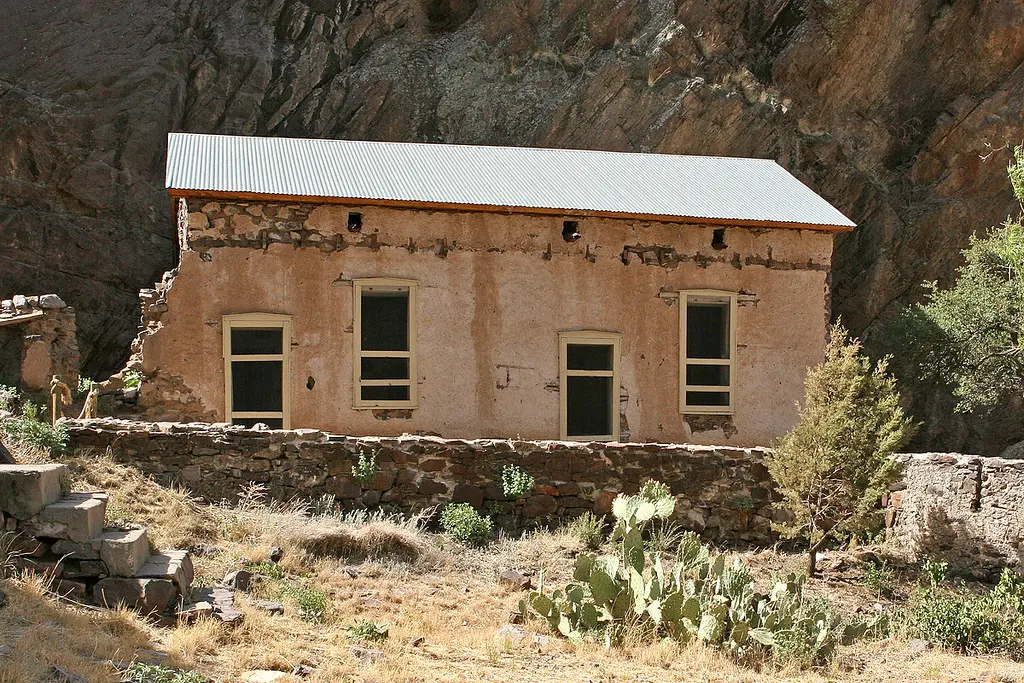
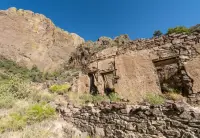
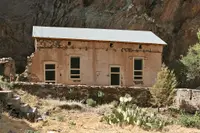
Two sets of ruins lie side by side. At the Van Patten Mountain Camp, a stabilized building from 1906 overlooks walls, foundations, and old pathways. In a side canyon just to the south is the Boyd health resort, which people commonly call Boyd’s Sanitorium. Its kitchen and dining hall and the Boyd residence are built into the slope, facing intermittent springs. Interpretive signs stand along the way. Plants have grown into the empty rooms, and grasses push up through the broken steps.
The canyon also holds gray oak, mountain mahogany, Plank’s catchfly, and the Organ Mountain evening primrose. A 2005–2006 student history of the place says the primrose blooms at night from June through September. Red-tailed hawk, Gambel’s quail, golden eagle, and rock squirrel can be seen year-round, and so can mule deer and coyote. Mountain lions, javelina, and ringtails also live in the range. In spring and summer, the BLM lists cactus wren, verdin, Scott’s oriole, black-tailed gnatcatcher, lesser nighthawk, and collared and tree lizards among the animals to watch for.
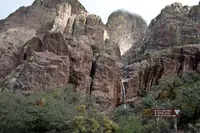
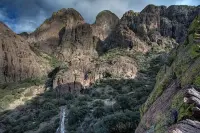
The cliffs above are older than any of this. About 36 million years ago, the Organ caldera erupted three major ash-flow tuffs. These deposits are exposed along the western flank of the range and thicken westward to nearly 10,000 feet. The name “Organ Mountains” is thought to come from the spires and needles, which resemble the pipes of an organ. An earlier name was La Sierra de Soledad, “the mountain of solitude.”
The BLM has led interpretive hikes over the route. In FY2020 the hikes rotated monthly and passed through the former Cox Ranch, Van Patten’s Mountain Camp, and Boyd’s Sanitorium. Garrett Leitermann, the monument archaeologist, has led talks and tours here. “The attraction is the sense of history that’s relayed by the buildings, but also the natural beauty here at the foot of the Organ Mountains,” he told a BLM writer. “There’s a lot of beautiful plant life, a lot of wildlife.”
Van Patten’s
The sources disagree about how the hotel began. The BLM’s account, drawn from historical documents, says the Van Patten Mountain Camp started as a homestead around 1892. By 1895 it had opened as an eight-room resort hotel. By 1906 Eugene Van Patten had expanded it to 32 rooms, with a large dining room for weddings and dances. Sergio Holguin’s student article, published by El Paso Community College, dates the camp to the 1870s. He describes a two-story summer resort with 16 rooms, a dining room, and a concert hall, and says Van Patten added another 18 rooms in 1906.
Both accounts describe a busy place. The BLM writes of an orchard with fruit trees, flower beds, and shrubs, and of an iron gazebo on the lawn where live music played in the canyon’s cool air. Families from the Mesilla Valley came for the day or stayed several nights. They traveled by wagon, buggy, or stage line to get away from the desert heat. The society pages of the Las Cruces and El Paso papers printed lists of guests and schedules of events. People called the resort “Van Patten’s.” Students from New Mexico A & M, now New Mexico State University, went there for picnics and hikes.
Holguin adds a livery, a barn, and a garden at the foot of the camp. According to him, local Indians who lived and worked at the resort tended the garden, milked cows, and raised chickens. They carried water from the spring to the guest rooms in ollas hung from long poles, and they sometimes danced for the guests. He names Kit Carson, Pat Garrett, and Pancho Villa among the resort’s notable guests.
The owner had a long career before the hotel. Holguin says Van Patten was born in New York in 1837 and educated at West Point. He was a nephew of John Butterfield, who ran the Butterfield Stage Line, and he appears to have worked at the line’s Picacho Station. He fought for the Confederacy at Glorieta Pass. He was elected sheriff in 1885 and later became a U.S. marshal for New Mexico, Arizona, and West Texas. He was married to a Piro Indian. He helped pay for the first Catholic church in Las Cruces and for Loretto Academy. His daughter, Emilia Ascarate Van Patten, later owned the resort. In 2017 she was one of the characters portrayed in costume on a BLM hike up this trail.
The doctor in the side canyon
In 1904, Dr. Nathan Boyd opened a health resort in the side canyon immediately south of the Mountain Camp. Before antibiotics, physicians recommended places like his for tuberculosis. In 1905 the Rio Grande Republican reported an American Health Resort Association claim that Las Cruces had one of the healthiest climates for consumptives. Boyd paid Van Patten $25 a year in rent. Van Patten agreed to feed Boyd’s guests for $11 a week per adult, with children at half price, and to handle maintenance and deliver water. A letter of agreement dated June 30, 1904, promised “a reasonably good table (including plenty of fresh milk, fresh eggs, fresh butter, fresh meat, and, when in season, plenty of fresh vegetables and fruit).”
In 1905, Van Patten sued Boyd over unpaid bills. More lawsuits followed over water and land. Boyd argued that Van Patten’s homestead patent did not cover the ground where Boyd had built. Van Patten charged that Boyd had built a dam that cut off the Mountain Camp’s water and diverted it to Boyd’s property. The BLM says the fight ended in 1917, after twelve years, when Van Patten ceded the Mountain Camp to Boyd by quit claim deed for one dollar.
Holguin tells this part differently. In his account, Van Patten went bankrupt in 1917 and sold Dripping Springs to Boyd. Boyd’s wife had recently contracted tuberculosis, and Boyd turned the resort into one of the first tuberculosis clinics funded by the federal government. He writes that only foundations remain of the 1910 patient building, while the caretaker’s house still stands. He also reports rumors of “restless spirits” that have haunted campers and drawn paranormal investigators. According to Holguin, Boyd was a Stanford-trained physician who opened the First National Bank and the Union Bank in Las Cruces. The BLM notes that Boyd was also caught up in separate, costly litigation over water rights for irrigation along the Río Grande.
From Sexton to Cox to the public
Boyd sold the whole site in 1922 to the Sexton family of Las Cruces, the BLM says. Holguin dates the sale only to the 1920s and names the buyer as Dr. T. C. Sexton. In 1940 the Sextons sold the property to Boyd’s son, Robert, who posted it against public use and recreation. Robert Boyd sold it in 1957 to the Cox family, who ran it as a ranch. Holguin says only that the place changed hands at least once more before the A. B. Cox family bought it in the early 1950s. The Coxes were established ranchers on the east side of the Organs. They also bought a nearby ranch from Franklin Hayner and built the combined land into a cattle operation.
The Cox Ranch and Dripping Springs properties were found to hold threatened and endangered species. According to Holguin, the Nature Conservancy bought both and deeded them to the BLM in 1988 in exchange for other BLM land that could be sold. The BLM credits the Cox family, the Nature Conservancy, and the agency, with local public support, for turning the property into a conservation and recreation area. It opened to the public in the summer of 1989 with a large music festival.
The hermit of La Cueva
Another trail leads to La Cueva, a rock shelter of compacted volcanic rock about ten feet high. Holguin says Apaches sheltered there in the 18th and 19th centuries. A picnic area lies not far from it. Local people tell several versions of the story of the man who lived there last, Giovanni Maria Agostini, known as Juan Maria Augustiniani, or El Ermitaño. He was born in Italy in 1799 or 1800. Holguin traces his path through Spain and South America, then to Hermit’s Peak near Las Vegas, New Mexico, and finally to Mesilla. At La Cueva, it is said, he treated local people with herbal remedies.
A plaque outside the cave says he told his friends the Barela family that he would light a fire there every Friday night to show he was alive. One evening no fire appeared. A Las Cruces newspaper reported that sheepherders found him dead in 1868, with a knife in his back and a crucifix in his hand. Other accounts describe the weapon as an Indian lance or a poisoned Italian dagger, and the killer as an Indian or an Italian railroad worker settling an old vendetta. A BLM pamphlet gives the year of his death as 1869. His grave in the Mesilla Cemetery reads, in Spanish: “John Mary Justiniani, Hermit of the Old and New World. He died the 17th of April, 1869, at 69 years and 49 years a hermit.”
Notable Events
- 1870sVan Patten built a resort at the Dripping Springs site that became a popular hotel. epcc.libguides.com
- 1895Van Patten's camp opened as an 8-room resort hotel; by 1906 it had grown to 32 rooms with a large dining room for weddings and dances. blm.gov
- 1904Dr. Nathan Boyd ran a health resort in a side canyon immediately south of the Mountain Camp, attracting people seeking the cool, fresh air of the mountains. blm.gov
- 1905Van Patten sued Boyd over unpaid bills; the dispute escalated into other lawsuits over water rights and land titles. blm.gov
- 1906The resort's popularity spurred Van Patten to add another 18 rooms. epcc.libguides.com
- 1917After 12 years of legal battles, Van Patten ceded the Mountain Camp to Boyd through a quit claim deed for one dollar. blm.gov
- 1917Van Patten went bankrupt and sold Dripping Springs to Dr. Nathan E. Boyd. epcc.libguides.com
- 1920sEncountering financial difficulties, Boyd sold the sanatorium to Dr. T. C. Sexton of Las Cruces. epcc.libguides.com
- 1930sThe Hayner family built the former-ranch/current-visitor-center property with a swimming pool and airstrip. blm.gov
- 1940The Sextons sold the property to Nathan Boyd's son, Robert, who posted it against public use and recreation. blm.gov
- 1950sThe place changed hands at least once more before purchase by the A. B. Cox family, established ranchers east of the Organ Mountains. epcc.libguides.com
- 1957Robert Boyd sold the property to the local Cox family, who ran the property as a ranch. blm.gov
- 1988The Nature Conservancy purchased Cox Ranch and Dripping Spring properties and deeded them to BLM in exchange for other BLM land that could be sold. epcc.libguides.com
- 1989Backed by local public support, the Cox family, the Nature Conservancy, and BLM developed the property into a conservation and recreational area; it opened to the public in summer 1989 with a large musical festival. blm.gov
- 2014The Organ Mountains were designated as part of the Organ Mountains–Desert Peaks National Monument in 2014; the Dripping Springs site is managed as part of the monument. geoinfo.nmt.edu
People
- Dr. Nathan Boyd, ran the Boyd health resort (from 1904).
- Eugene Van Patten, Built Van Patten Mountain Camp, a resort that became a popular hotel (1870s).
- A.B. Cox, Ranching mogul; husband of Florence Cox.
- Emilia Ascarate Van Patten, Daughter of Colonel Eugene Van Patten and owner of the Van Patten Resort.
- Florence Cox, Wife of ranching mogul A.B. Cox, one of the historic characters interpreted at Dripping Springs.
- Garrett Leitermann, LCDO Monument archaeologist speaking to hike participants at Dripping Springs Natural Area.
- Dr. Nathan E. Boyd, Bought Dripping Springs after Van Patten's bankruptcy (1917).
- Dr. T. C. Sexton, Purchased the sanatorium from Boyd (1920s).
- Franklin Hayner, Sold a nearby ranch to the Cox family as they developed the area into a cattle ranch.
- Kit Carson, Named among notable guests at the resort.
- Pancho Villa, Named among notable guests at the resort.
- Pat Garrett, Named among notable guests at the resort.
Sources
- blm.gov/visit/dripping-springs-natural-area
- epcc.libguides.com/c.php?g=754275&p=5406054
- blm.gov/sites/default/files/docs/2021-02/NM_CulturalHeritageReport_2020.pdf
- blm.gov/press-release/blm-offers-glimpse-dripping-springs-history
- blm.gov/blog/2025-07-22/history-and-heritage-among-ruins-dripping-springs-natural-area
- geoinfo.nmt.edu/tour/home.cfml?id=78