.jpg)
.jpg)
.jpg)
.jpg)
.jpg)
.jpg)
Childs Trailhead (Verde Hot Springs)
Camp Verde, Yavapai County, Arizona. Dispersed camping area; Year-round.
Details

- Where
- Camp Verde, Yavapai County, AZ. No street address stated. Directions
- Getting there
- From the White Bridge in Camp Verde, go east on Hwy 260 6.8 miles to FR 708 (Fossil Creek Road); turn right and go 15 miles to the junction of FR 708 and FR 502. Go south on FR 502 for 6 miles of very bad road to the Childs Power Plant and the Verde River.
- Fees
- Free; there is no fee for dispersed camping; there are no amenities at this camping area.
- Access
- High clearance vehicles highly recommended; four-wheel-drive may be helpful.
- Phone
- 928-282-4119
- Website
- fs.usda.gov
- Managed by
- Red Rock Ranger District.
- Established
- 1908.
- Coordinates
- 34.34802, -111.69737.
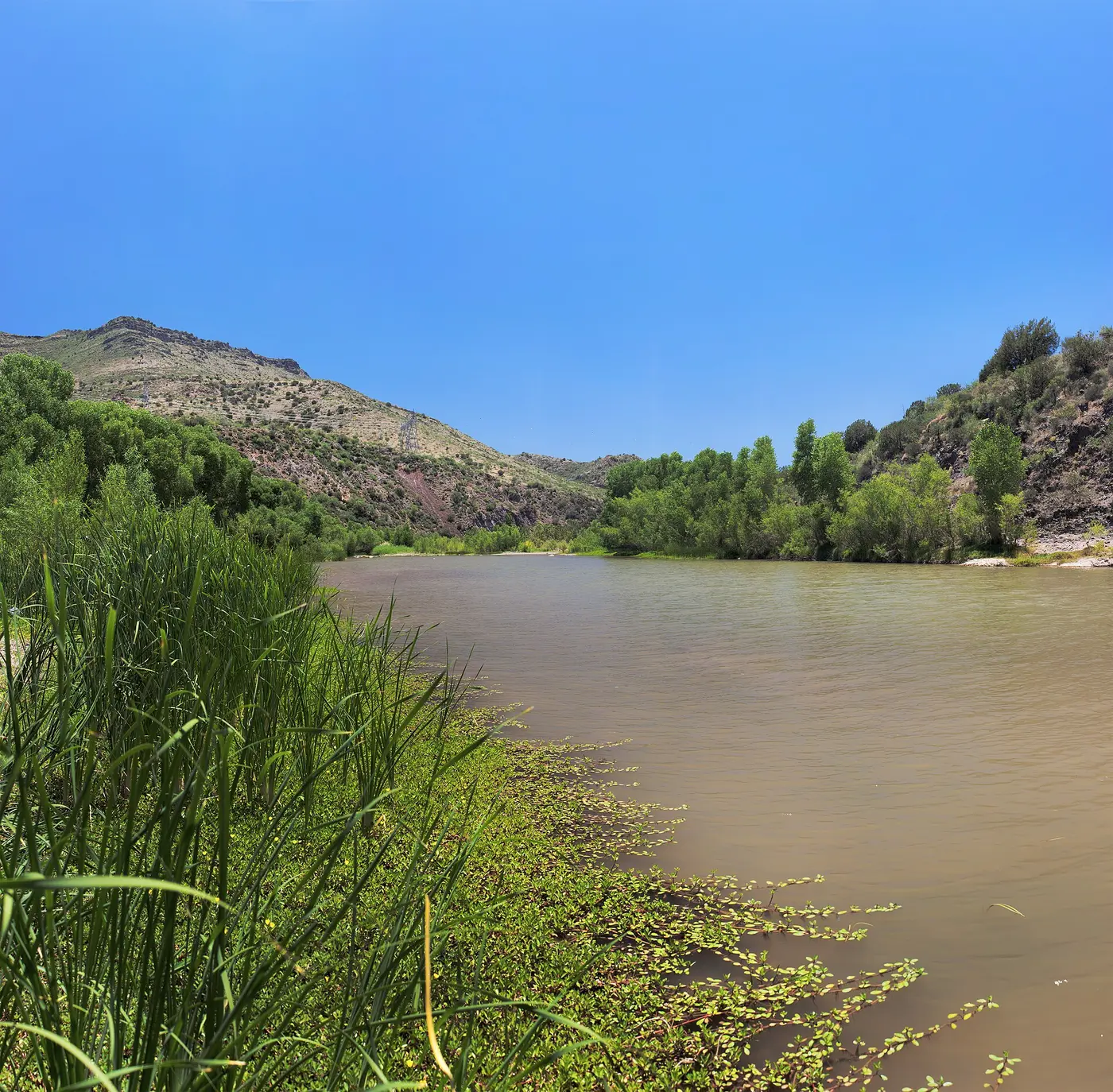
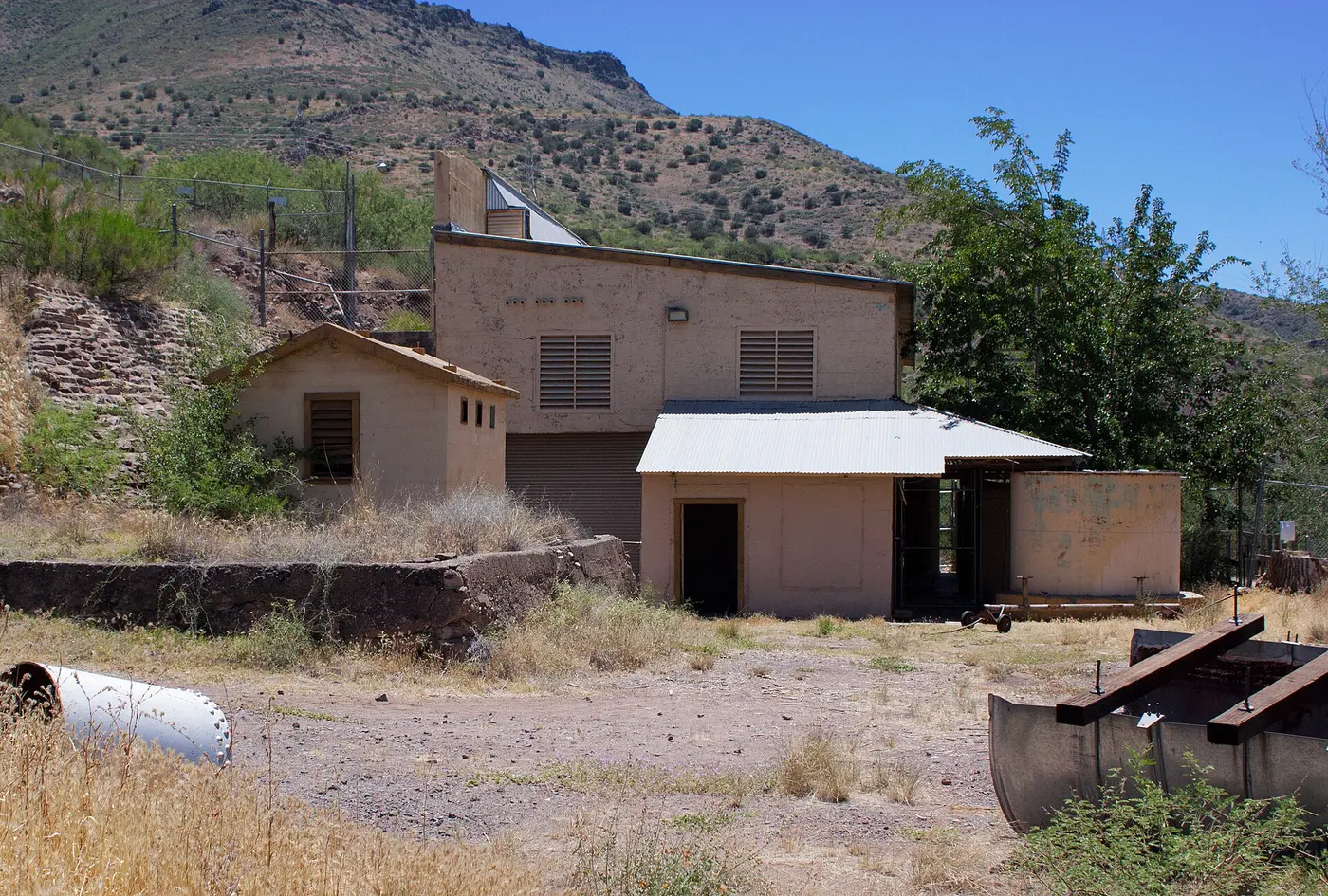
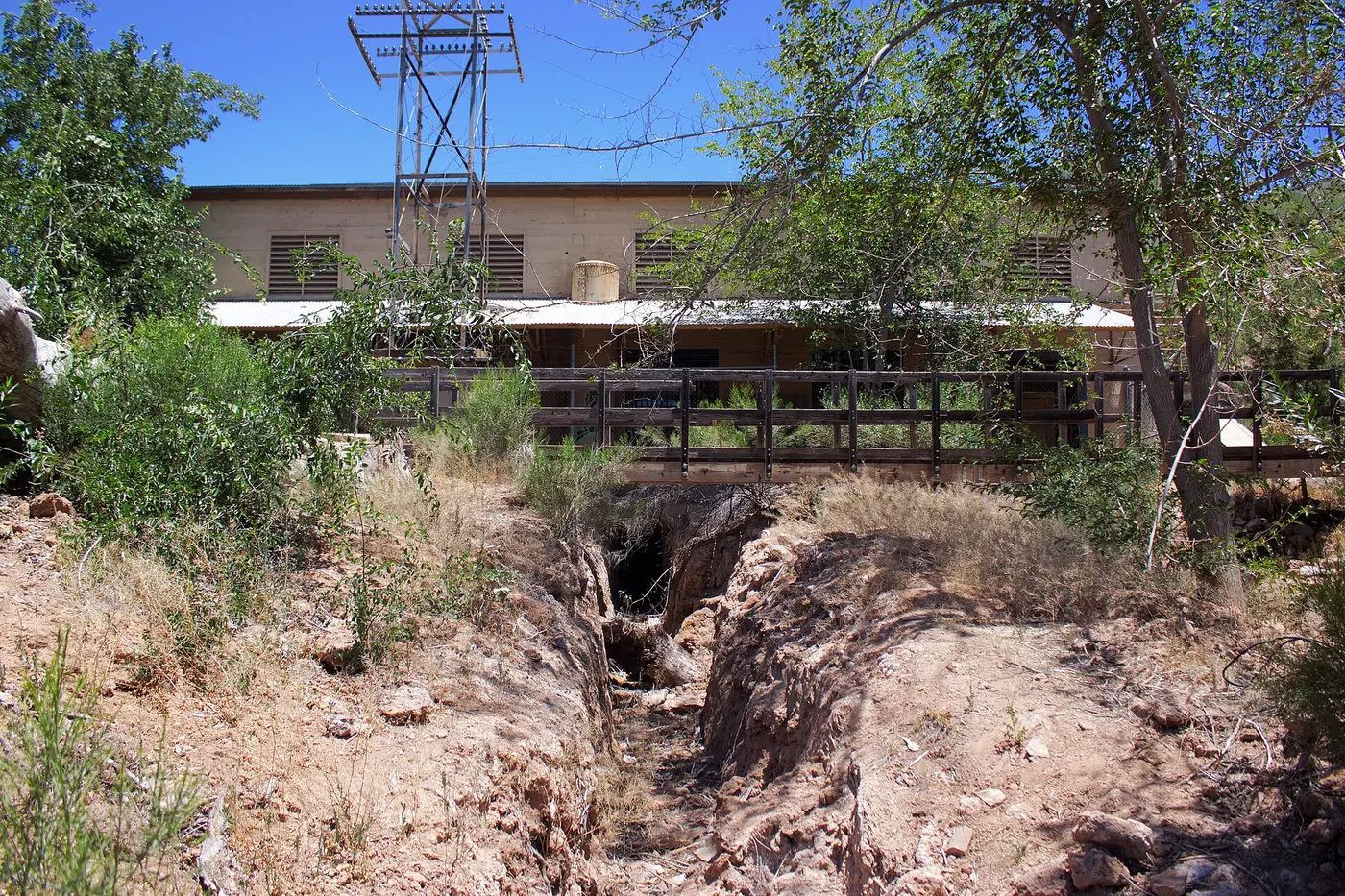
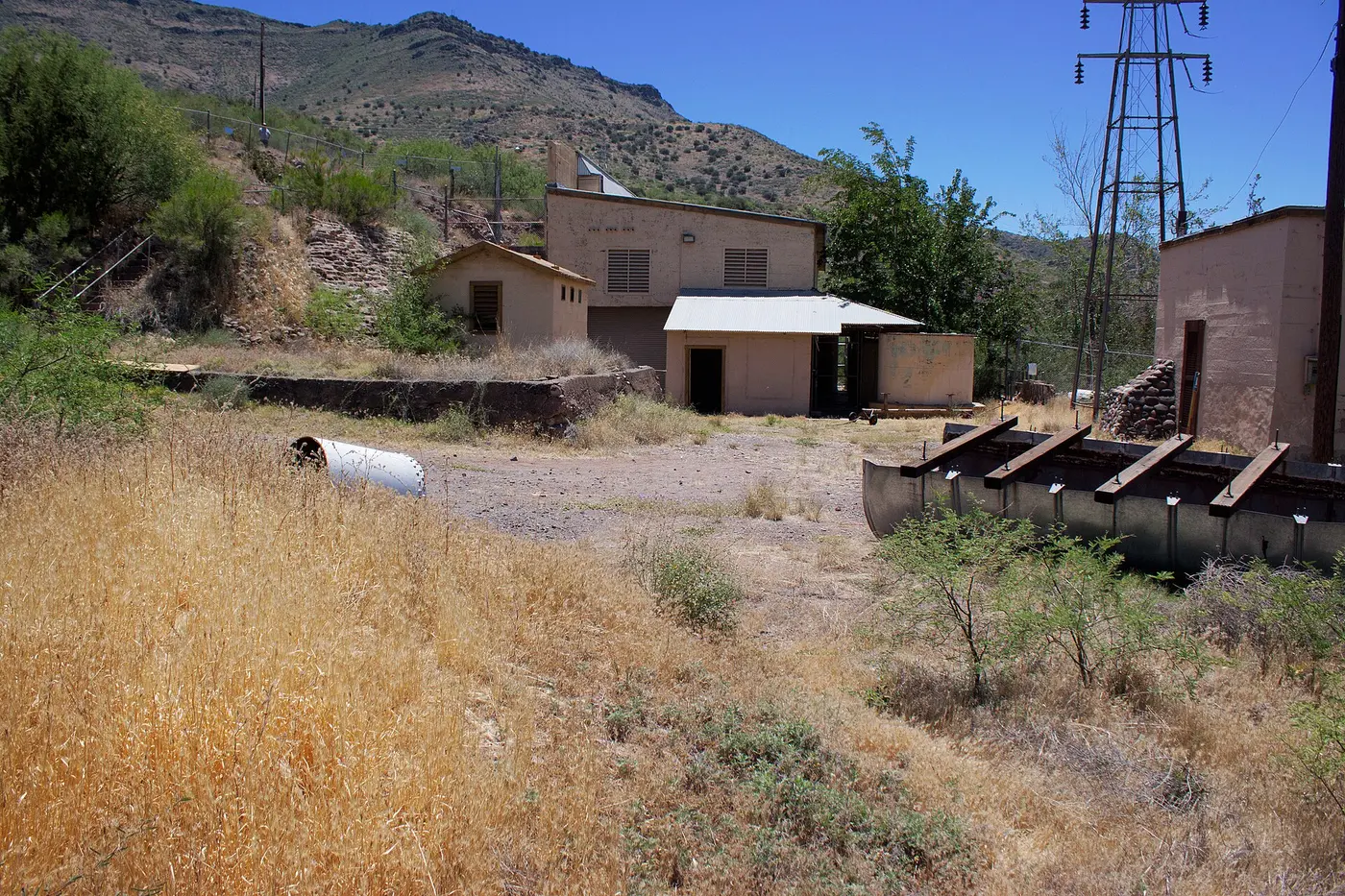
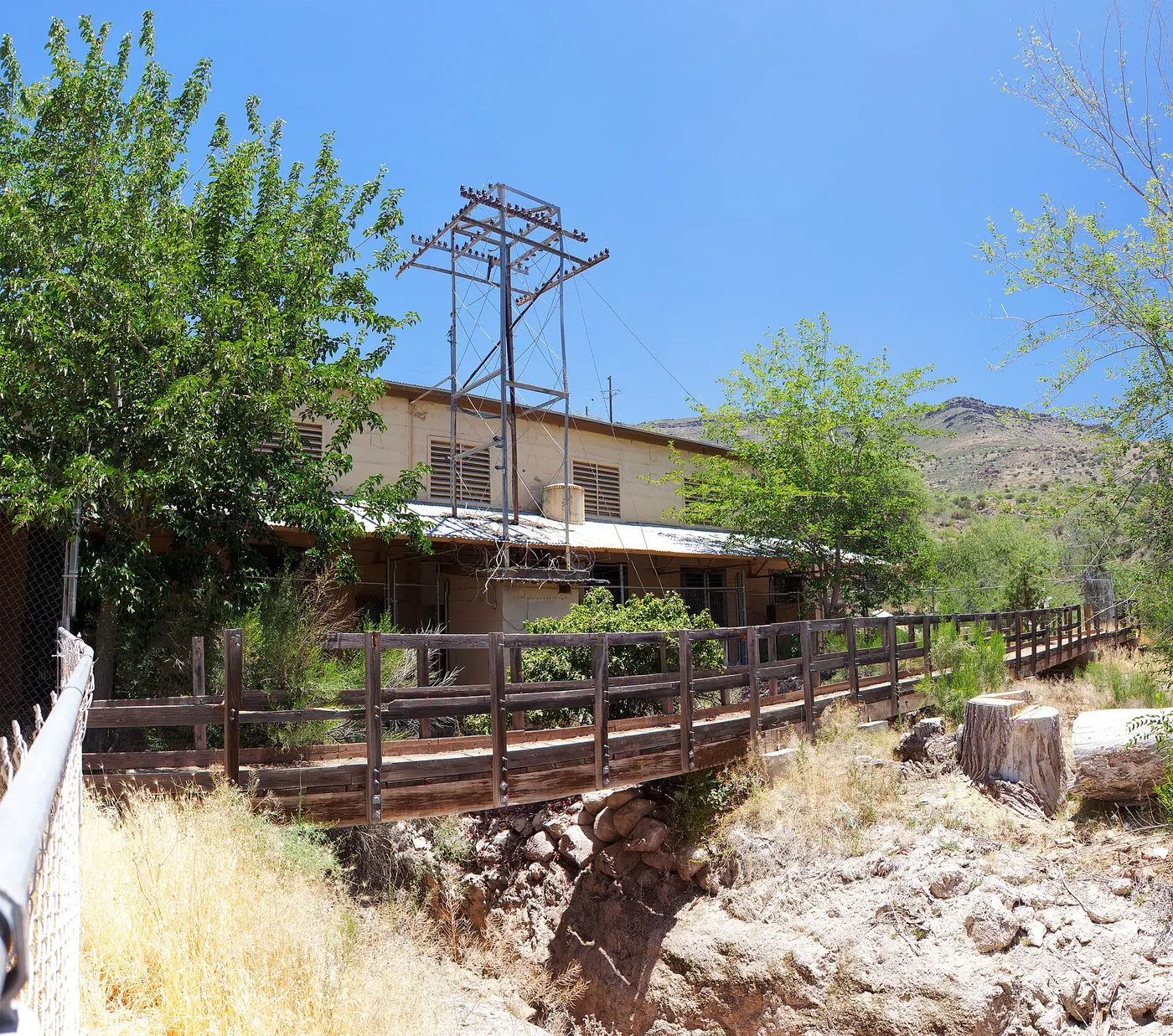
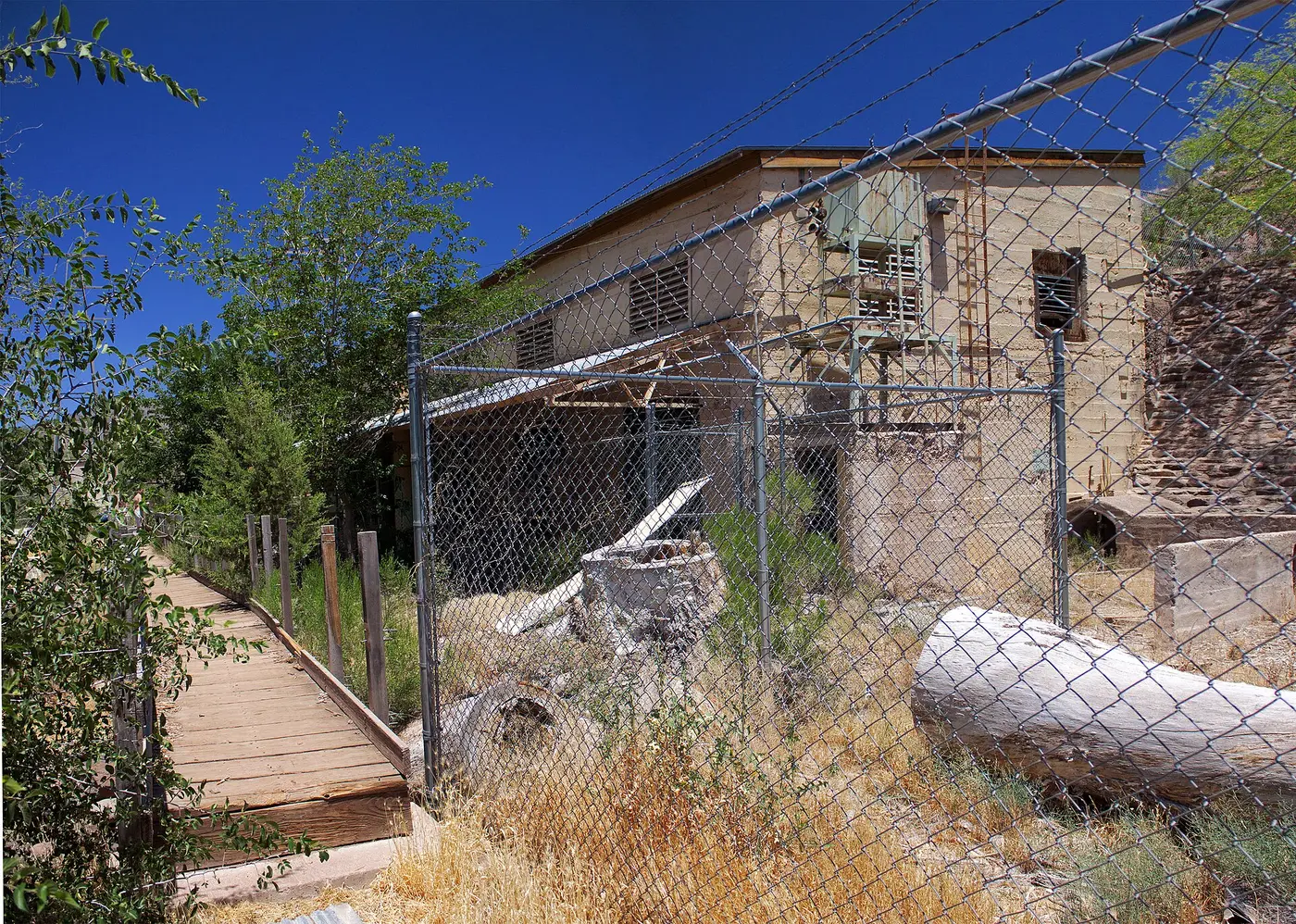
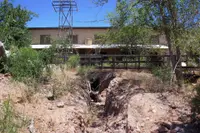
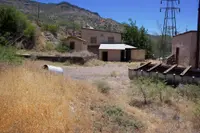
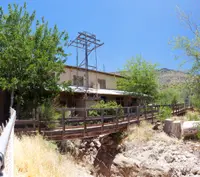
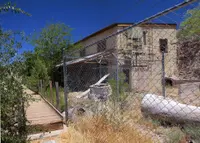
Forest Road 502 runs six miles south from its junction with Fossil Creek Road to the Verde River, and the Forest Service describes it in capital letters: VERY BAD road. High-clearance vehicles are highly recommended, and four-wheel drive may help. The approach from Camp Verde, about 30 miles to the northwest, follows paved and graveled roads, some of them always steep and rough and usually muddy after rains. At the bottom, at 2,626 feet, campers spread out below the remnants of the old Childs Power Plant buildings, on the edge of the river and its riparian growth. The Red Rock Ranger District of the Coconino National Forest manages the ground as dispersed camping. It charges no fee, allows stays of up to 14 days, and provides no drinking water and no garbage service. Campers pack out their own trash. During Stage 1 and Stage 2 fire restrictions, campfires are prohibited, though gas stoves with an on/off switch are allowed. Trails leave the area for hiking and horseback riding.
The hotel that burned in 1962
A short hike upstream, with some wading in the Verde, reaches the ruins of Verde Hot Springs, which the Forest Service calls a once famous resort. In the words of the Arizona Geological Survey, the springs “burble away near the remnants of an old hotel that burnt down in 1962.” The Survey adds that the place was apparently a swank spot in the Jazz Age, and that rumors of Al Capone using it as an occasional hideaway “are pure fiction.”
The resort was developed by Edwin Meek, a Yavapai County businessman who also sold the springs’ waters for curative purposes. Meek was a member of the Prescott Elks lodge and led the bond sale for the Elks building on East Gurley Street. Scientists have had trouble measuring the springs. A 1977 U.S. Geological Survey report produced conflicting estimates of the aquifer temperature beneath Verde Hot Springs and said the gap could result from mixing, from calcium carbonate precipitating out, or perhaps from appreciable magnesium. Years later, when the Arizona Geological Survey sampled thermal springs across the state, its crew attempted Verde Hot Spring and could not reach it because the river was running too high.
Meek was also one of four partners in the power company whose ruins now stand over the campsites.
A creek that turns things to stone
The water that ran the plant came from Fossil Creek, which enters the Verde here. Fossil Springs feeds the creek from the foot of the Mogollon Rim and discharges 20,000 gallons a minute, according to a 2007 Sharlot Hall Museum article by Terry Munderloh. The creek carries so much calcium carbonate that it coats rocks and twigs in travertine. Letters from the party of Arizona’s first governor, which crossed the region in the 1860s, mention “petrifactions.” The deposits look like bone, and that appearance gave the creek its name. An early surveyor for the power company placed the springs “about four miles up the wildest roughest damn canyon there is in Arizona,” with limestone ledges “as sharp as broken glass” and hillsides of catclaw, mesquite, and cactus, “with one or more rattlesnakes in each one.”
Ranchers in the Verde Valley took credit for finding the springs in the 1870s. The museum article notes that Native American ties to the springs, creek, and canyon reach far back through unrecorded time. The Yavapai Apache and San Carlos Apache tribes consider Fossil Creek a sacred place.
On January 26, 1900, rancher L. M. Turner filed for the water rights of Fossil Creek. On February 6, 1901, he filed for the rights to Fossil Springs, the creek’s headwaters, and stated that he meant to divert the water to produce electric power. The Arizona Memory Project names him Lew Turner and says he purchased the rights in 1900. Turner brought in three partners to form the Arizona Power Company. One was Meek. Another was Frank Jordan, who had farmed on the Verde since the early 1870s and was the original owner of what became the Jerome-Verde mine. The third was Iva Tutt, an engineer and businesswoman from Los Angeles. Tutt had invested her savings in an electric light plant in Long Beach, found no one competent to run it, and took the presidency and superintended the plant herself.
Iva Tutt in the saddle
The mines of central Arizona wanted cheaper power than oil and coal hauled to remote sites. Fossil Creek offered steady springs and a fall of 1,575 feet, without waterfalls, from the springs to the Verde. Tutt made field trips over the rough country to engineer the plans for the flumes, tunnels, and powerhouse. In 1903 she told the Jerome Mining News what those trips cost her: “gone for weeks from sight and sound of civilization, with four camp and mess wagons, a buckboard, a train of burros, a Chinese cook, four Negroes, a couple of engineers and a gang of thirteen men, keeping to the saddle for nearly two hundred miles over mountain trails, coming back black-and-blue from head to foot from falling among the rocks and being pummeled by branches through which we forced our way, and oh, tired to death? Success means sacrifice.” She also had her attorney draft a bill exempting her company from taxation for a term of years. According to the museum article, when the bill reached the legislature she put on an elegant dinner dress and persuaded the legislators to pass it. They did.
The partners could not raise money until early 1907, when Francis Viele and Raymond Masson formed the Electric Operating Company and reorganized the venture. William Bonbright & Co. sold $1.5 million in bonds. The project signed its first contract, with the United Verde Mine in Jerome, on March 19, 1907. In March 1908 the merged companies became The Arizona Power Company and began building the Childs Plant, named for S. W. Childs, the Bonbright firm’s bond broker.
Mules, Krupp pipe, and windmill towers
Arizona was still four years from statehood, and the nearest railroad was at Mayer. By May 1907, crews were building a 40-mile road from Blue Bell siding near Mayer toward Fossil Springs. The Sharlot Hall Museum counts 450 to 600 men, 450 mules, and more than 150 wagons. It says the main labor force came from local Yavapai and Apache people, who had been forced from the same land to San Carlos in 1875. The Arizona Memory Project describes crews of 450 primarily Mexican and Native American laborers. In good weather, teamsters took five to six days to haul from the siding to Childs and stopped overnight at boarding houses on ranches such as the Dugas Ranch. Workers lived in camps of wickiups, tents, and rough wooden structures.
The ground would not hold a wooden flume, so the crews built in concrete, mixed in wagon beds and cast near the site. The finished Childs system had 8,800 feet of reinforced concrete flume, 4,888 feet of concrete-lined tunnel, and 1,393 feet of concrete pipe. A good crew laid 120 to 150 feet of flume in a ten-hour day. No American company could make steel pipe strong enough for the lower penstock, so the Krupp Gun Works in Germany built it. The pipe was shipped around Cape Horn to Los Angeles, sent on to Mayer, and carried by mule train to the site. Its construction drawings were in German. In the powerhouse, three 3,000-horsepower Pelton turbines drove General Electric generators, and the spent water ran out through the floor into the Verde.
The transmission towers had to be packed in by burro, and steel towers for power lines did not yet exist. The company adapted a windmill tower from the U.S. Wind, Engine and Pump Company of Batavia, Illinois. The museum article dates the first generator to June 18, 1909, while the Arizona Memory Project gives June 21. Either way, the line ran sixty miles to Jerome and was the first long-distance power transmission in Arizona.
Seventy percent of Phoenix
In 1914 the United Verde Copper Company planned a new smelter at what became Clarkdale and needed more power. The company built a second plant upstream, completed in 1916 and named for Irving Bonbright. A new flume fed it from a dam at Fossil Springs. Its water then fell to Stehr Lake, a reservoir formed by two earth dams across a dry lake bed. The lake held enough water to run Childs for three and a half days while the flumes were under repair. Lines from the two plants reached Camp Verde, Prescott, Mayer, Poland Junction, and Crown King. A 75-mile line from Sycamore to Phoenix followed in 1919. The plants met 70 percent of Phoenix’s power needs, which the Sharlot Hall Museum dates to 1920 and the American Society of Mechanical Engineers to the mid-1920s, when Phoenix had forty-four thousand people. Mike Stewart, manager of the Irving plant in 1999, said the project lit many of Phoenix’s streetlights in the early 1920s. “This whole project at the time was pretty much an engineering marvel,” he said.
As Phoenix grew, larger plants outstripped Childs-Irving. In 1976 the engineers’ society named it a National Historic Mechanical Engineering Landmark. The society notes that the April 1976 ceremony was held at company headquarters in Phoenix because access to the plant was difficult. It lists the plaque on a stone monument outside the plant office on Childs Power Road. In 1991 the facilities entered the National Register of Historic Places as a district running from the east bank of the Verde northeast to Stehr Lake and along Fossil Creek. The nomination describes cottage-style houses at the Childs settlement.
Giving the water back
For more than 90 years, the dam took more than 90 percent of Fossil Creek and sent it into the Verde. In 1999 High Country News described the flume hugging the canyon wall for miles, its water seeming from a distance to run uphill, though it dropped a foot every thousand feet. Below the dam, the Forest Service writes, the creek had shrunk to a trickle, compared with the million gallons an hour that early inhabitants saw.
The diversion license expired in 1992 after Arizona Public Service applied to renew it, and environmental groups asked the company to consider shutting the plants down. The Federal Energy Regulatory Commission began a review in 1994. Negotiations with APS opened in September 1998, and in November 1999 the Center for Biological Diversity protested outside APS headquarters over the delay. By then the two plants employed eight people and produced 4.2 megawatts, one-tenth of one percent of the company’s power. W. L. Minckley, an Arizona State University biologist, said the travertine dams and pools served as fish nurseries and kept out invading species. “You don’t have to manage for non-natives,” he said. “The stream does it for you.” Andrew Falund of the Hydropower Reform Coalition described shutting down the project this way: “We’re talking about replumbing an entire watershed, which is really an amazing idea.”
In 2004, APS agreed to decommission the Childs and Irving plants and restore Fossil Creek to its natural flow.
Notable Events
- 1900Rancher L. M. Turner filed for the water rights of Fossil Creek. archives.sharlothallmuseum.org
- 1908The merged companies became The Arizona Power Company and began construction of the Childs Plant. archives.sharlothallmuseum.org
- 1909The first generator began operating, and the steel-tower line delivered power to Jerome in Arizona's first long-distance power transmission. archives.sharlothallmuseum.org
- 1909The Childs-Irving hydroelectric power plant first went online. azmemory.azlibrary.gov
- 1916The Irving Plant was completed with a single Allis-Chalmers Francis turbine capable of generating 1,560 kilowatts. azmemory.azlibrary.gov
- 1920sAccording to Irving manager Mike Stewart, the project powered many Phoenix streetlights. hcn.org
- 1962The old hotel burned down, leaving remnants beside the Camp Verde hot springs. azgs.arizona.edu
- 1976The landmark ceremony took place in April 1976. asme.org
- 1992The power company's license to divert Fossil Creek water expired. hcn.org
- 1994FERC began a review; the environmental assessment was still under way when this report was written. hcn.org
- 1998Environmental groups began negotiating with APS to decommission the project. hcn.org
- 2004APS agreed to decommission the plants and restore Fossil Creek to its natural flow. fs.usda.gov
- The Center for Biological Diversity protested delays while native species languished. hcn.org
People
- Edwin Meek, Arizona Power Company co-founder who developed Verde Hot Springs as a resort and sold its waters for curative purposes.
- Francis Viele, Co-founder of the Electric Operating Company, which helped reorganize the Arizona Power Company and arrange construction bonds (Early 1907).
- Frank Jordan, Co-founder of the Arizona Power Company.
- Iva Tutt, Engineered design plans for the flumes, tunnels, and power plant.
- L. M. Turner, Filed for Fossil Creek and Fossil Springs water rights (1900-1901).
- Raymond Masson, Co-founder of the Electric Operating Company, which helped reorganize the Arizona Power Company and arrange construction bonds (Early 1907).
- Irving Bonbright, Bonbright co-founder and namesake of the Irving Plant.
- S.W. Childs, Bonbright Company bond broker and namesake of the Childs Plant.
- Andrew Falund, Chair of the Hydropower Reform Coalition discussing Fossil Creek decommissioning.
- Ed Fox, Arizona Public Service contact in the decommissioning report.
- Lisa Force, Center for Biological Diversity Phoenix contact in the decommissioning report.
- Mike Stewart, Manager of the upper Irving plant (nearly three years).
- Mindy Schlimgen-Wilson, American Rivers representative discussing decommissioning negotiations.
- W. L. Minckley, Arizona State University biology professor discussing Fossil Creek's fish recovery potential (since 1963).
Sources
- fs.usda.gov/r03/coconino/recreation/childs-dispersed-camping-area
- fs.usda.gov/r03/coconino/recreation/childs-dispersed-camping-area
- azgs.arizona.edu/verde-hot-spring-central-arizona
- azmemory.azlibrary.gov/nodes/view/210
- archives.sharlothallmuseum.org/articles/days-past-articles/1/harnessing-the-water-power-of-fossil-creek
- asme.org/about-asme/engineering-history/landmarks/13-childs-irving-hydroelectric-project
- npgallery.nps.gov/AssetDetail/NRIS/91001023
- npgallery.nps.gov/GetAsset/04046f94-23ba-45e3-9498-f1291a59572c