
Cheyenne Frontier Days
Cheyenne, Laramie County, Wyoming. Rodeo; Always the last full week in July.
Details

- Where
- 1210 W. 8th Ave., Cheyenne, WY 82001. Directions
- When
- July 23-August 1, 2027.
- Getting there
- Access to the park via Warren Ave. or Carey Ave.
- Fees
- Children, ages 12 and under, will be admitted through the main entrance gate at no charge.
- Hours
- Monday – Friday from 9 a.m. – 5 p.m.
- Access
- Frontier Park public parking is available for $25 per vehicle. Parking will be paid by credit card only. No overnight camping permitted. Parking lots close at 1 a.m.
- Walk-in or reserve
- These are the only authorized ticket-sellers of Cheyenne Frontier Days™ (CFD).
- Phone
- (307) 778-7222
- Website
- cfdrodeo.com
- Established
- 1897.
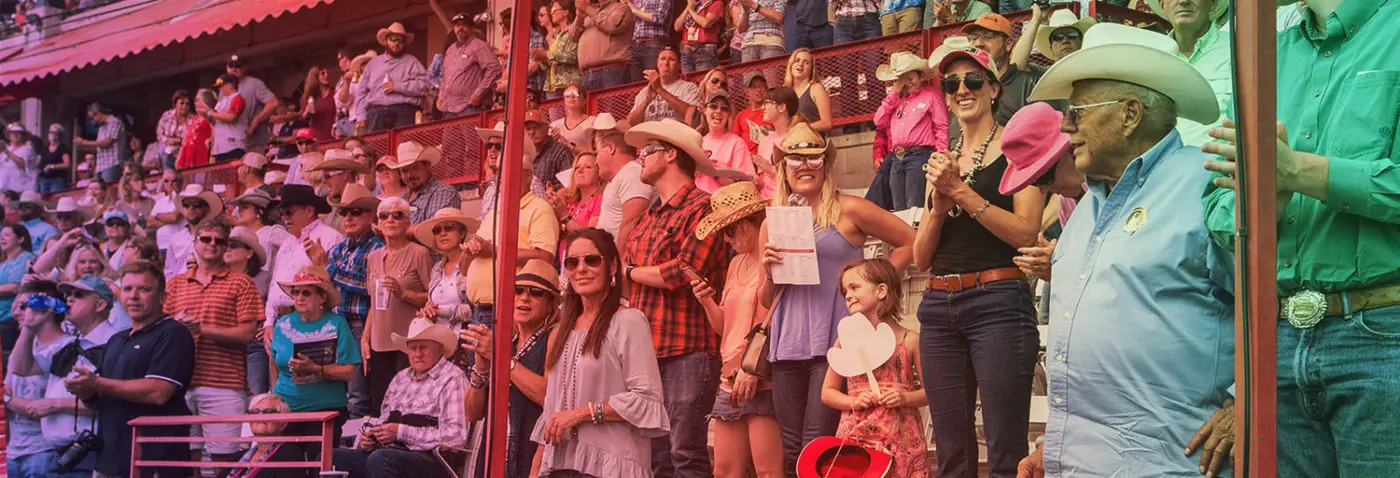
At noon the grandstand seats open around the arena at Frontier Park, on West Eighth Avenue in Cheyenne. A pre-show begins at 12:15, and the rodeo starts at 1 p.m. sharp. At the first Frontier Day, in 1897, a cannon launched the program with “one big boom.” The historical marker that records it stands in front of the Old West Museum on Carey Avenue, and it adds: “The Rodeo starts with this boom even today.”
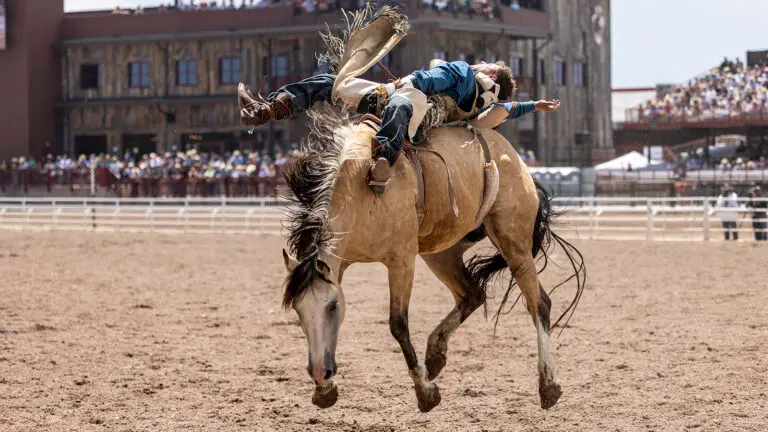
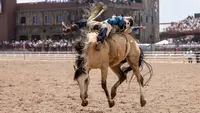
For the next three hours the arena works through bareback riding, saddle bronc riding, bull riding, tie-down roping, team roping, steer wrestling, women’s barrel racing, women’s breakaway roping and the wild horse race. The format is a modified tournament. Timed-event slack is the qualifying round for the performances. Money winners in each daily performance advance to semifinals and finals, and the finals start from a clean slate on Championship Sunday. Professionals compete for more than $1 million in cash and prizes. The Professional Rodeo Cowboys Association has named it Large Outdoor Rodeo of the Year sixteen times. The organizers name the people who carry the afternoon: the contestants, the announcers, “the quick-witted barrelman, and the elite bullfighters who keep everyone safe.”
Ten days on Frontier Park
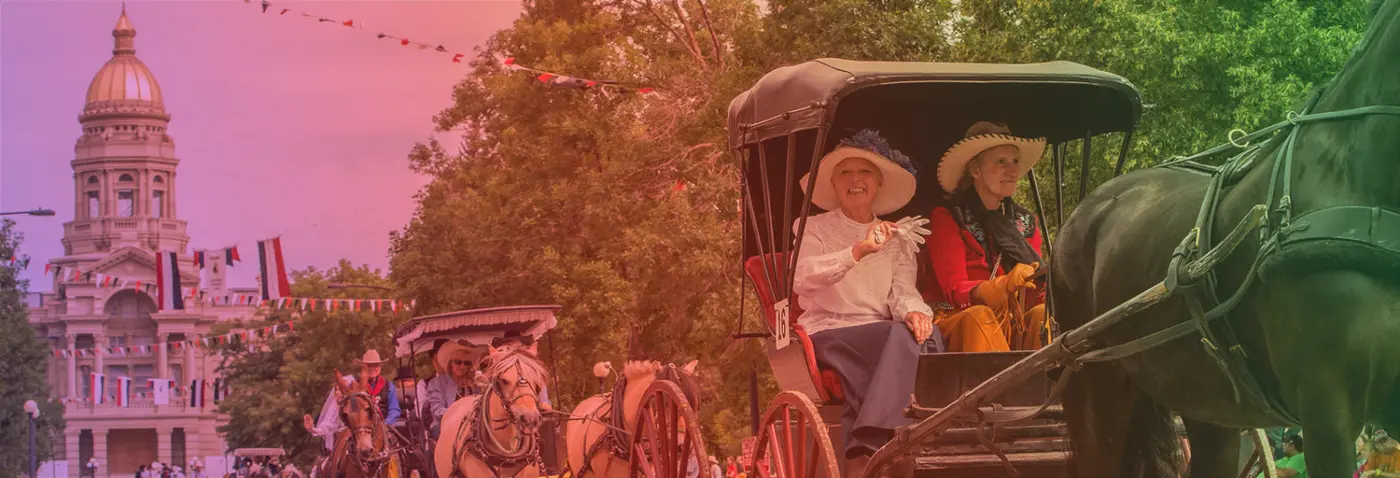
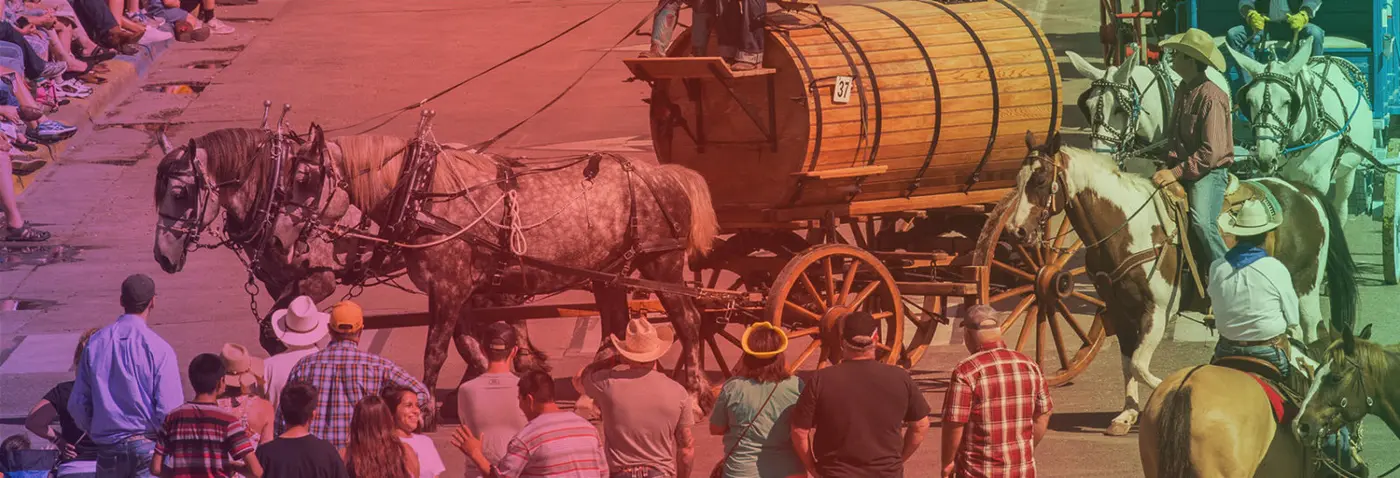
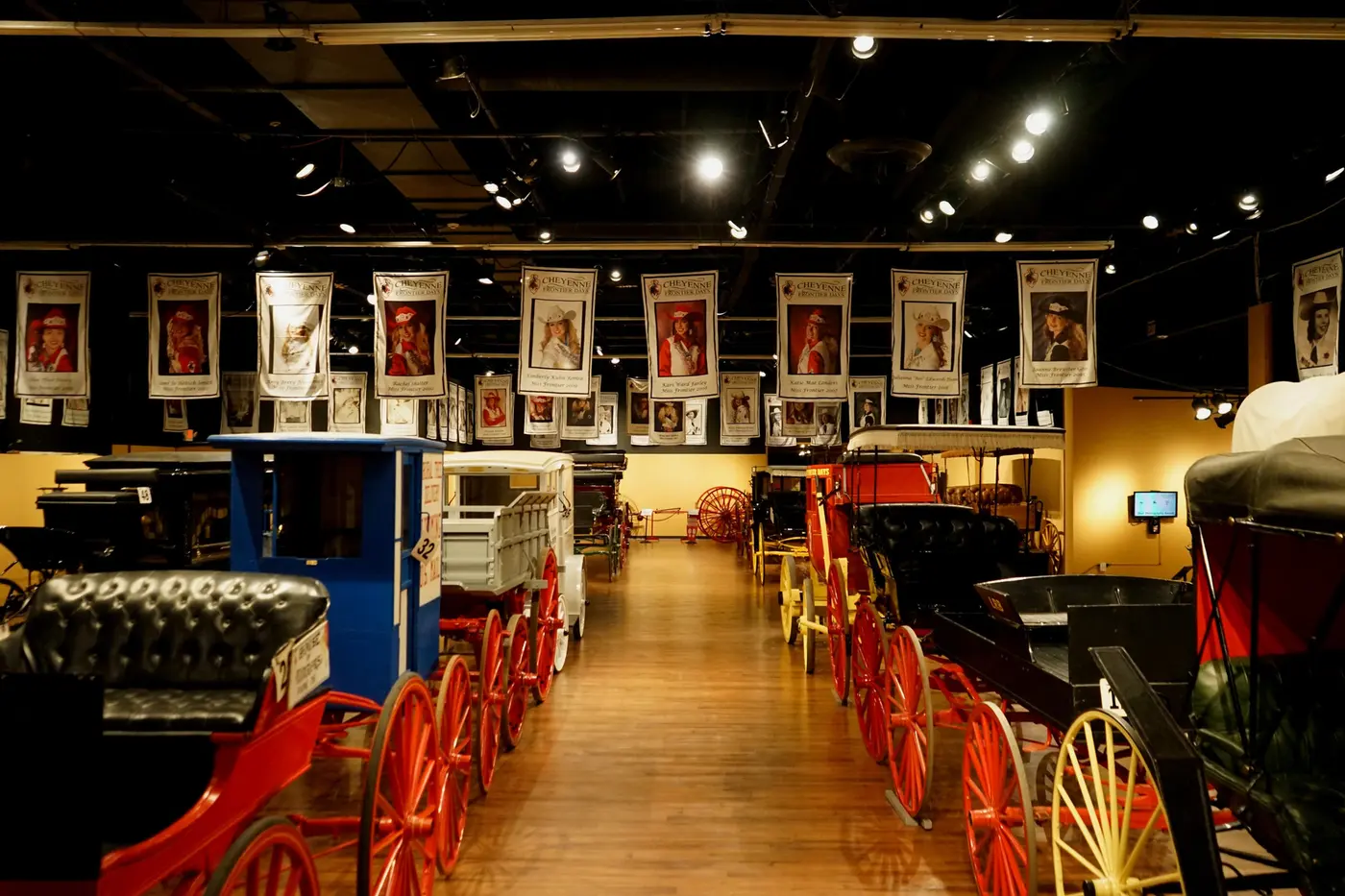
The celebration falls each summer in the last full week in July. The 2026 edition ran July 17 through 26, and the 2027 dates are July 23 through August 1. Mornings begin downtown. The Grand Parade steps off at 9 a.m. sharp on four days of the 2027 schedule, with antique carriages and automobiles in the line. On three other mornings there are free pancake breakfasts from 7 to 9. Amanda Campbell, writing as a Google Local Guide, said the breakfast crew was “very efficient at getting several thousand people through the lines and fed in a short time,” with a small concert playing while people ate.
Indian dancers and music have been part of the celebration since the beginning, according to the marker. On the park today the Morning Star American Indian Village holds Native dance, arts and storytelling from 10:30 a.m. to 7:30 p.m. Mo Brings Plenty served as cultural advisor for its opening, and in September 2026 the organizers reported they were still finishing construction there. Another Local Guide, Tad Rockwell, wrote, “I saw a woman do a hoop dance that blew my mind,” and noted the history narrated during the dances. Rockwell also watched the chuckwagon cooking competition, which in 2027 falls on the morning of July 31.
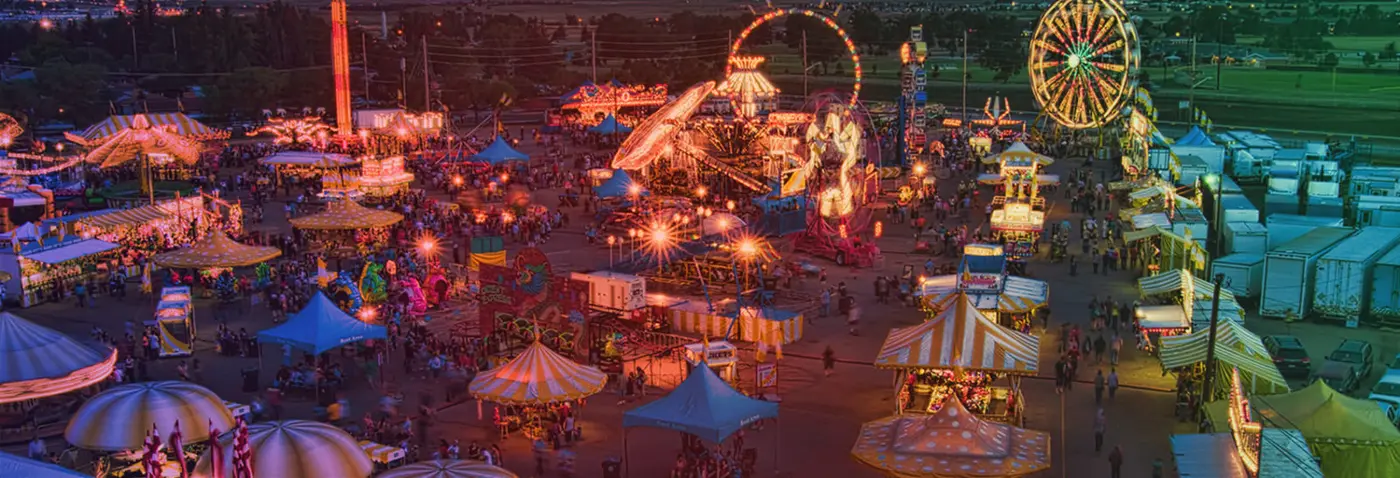
Around the village are Old Frontier Town, the Sidewinder Saloon, a garden, rows of vendors, behind-the-chutes tours and a carnival midway that runs until midnight. Cowboy Church meets on the two Sunday mornings. On Military Monday, holders of a military ID get a free rodeo seat and gate admission. The Buckin’ A Saloon opens at 4 p.m. and closes after midnight.
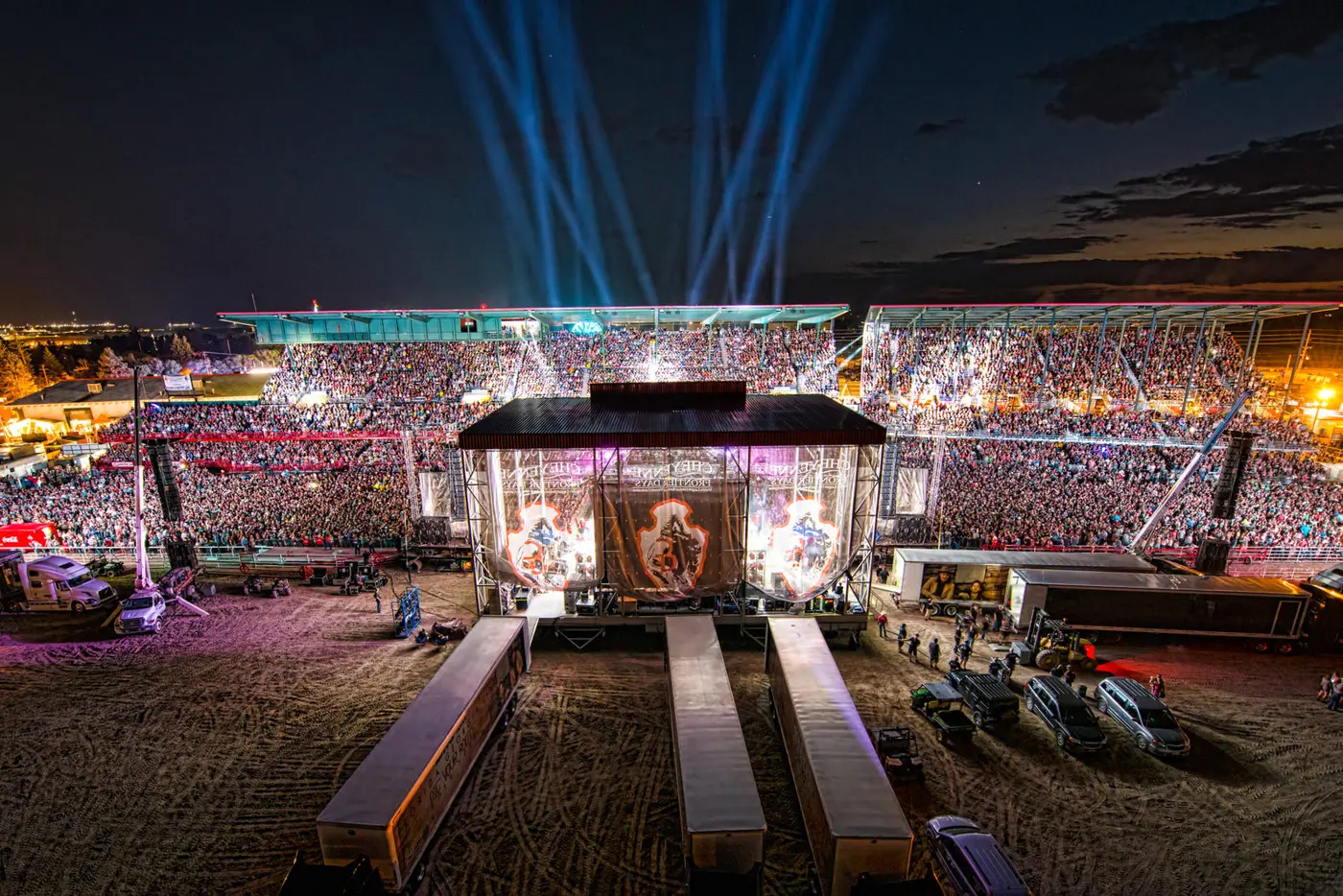
At 8 p.m. the arena becomes Frontier Nights, with concerts and, on two nights of the 2027 schedule, PRCA Xtreme Bulls. A standing-room Party Zone sits on the arena dirt before the stage, and the organizers warn that the surface “may become muddy.” The U.S. Air Force Thunderbirds fly a midweek performance, an association the marker puts at more than fifty years. A four-generation Cheyenne family quoted by the organizers called the Thunderbirds “our favorite.”
Some visitors wear a yellow feather in the hatband. Since 2022 it has marked the “Pick-Up Man” suicide-prevention campaign, begun with Garth Brooks and named for the rider who helps a cowboy off a bucking horse. Recent celebrations have carried themes, among them the Year of the Cowgirl, the Year of the Bull and the Year of the American Indian. During the celebration the Old West Museum, which holds the event’s Hall of Fame, keeps hours from 8 a.m. to 7 p.m.
The park stays in use the rest of the year. In September 2026 it hosted the Horse Nations Indian Relay Council Championship of Champions for the first time, with more than 100 relay teams from 15 Tribal Nations. A farmers market runs there on Saturday mornings into October.
A ticket agent, an editor and the Tivoli Saloon
Who thought of Frontier Days has long been argued. The celebration’s own account credits Frederick W. Angier, Traveling Passenger Agent of the Union Pacific Railroad. To draw travelers out of Denver during the depression of the 1890s, Angier had helped found several Colorado events, Greeley’s Potato Day among them. In 1897 he suggested a festival like it to the editor of the Cheyenne Daily Sun-Leader, and plans for the first Frontier Day were laid in the Tivoli Saloon at Sixteenth Street and Carey. According to Hanesworth, a series of Sun Leader articles in 1911 also gave Angier the credit.
Warren Richardson, the first chairman, told it differently. He credited Col. E.A. Slack, the newspaper’s editor and a son of Esther Hobart Morris, with an idea born on the train between Cheyenne and Greeley, where Slack pictured a western show to rival Potato Day. Mike Kassel has called the story that Slack and Richardson worked it out on the ride back from Greeley a rumor, with no evidence to prove it.
The marker keeps both versions. It has been said that the town’s leading men came up with the idea after a train trip to a Greeley fair. It is also said that Angier stepped off a train from Denver on the morning of August 30 with the mission of founding a fair in Cheyenne. Angier recalled watching cowboys in a corral trying to load range horses into a stockcar, and he believed people would pay to see it. His plan was to stage it with wild broncos at a place on the Union Pacific line and bring the crowds in by rail.
Wyoming was a young state, its economy still reeling. The mayor and leading men wanted outside business, and the marker’s list of them includes Francis E. Warren, Joseph M. Carey, Slack and Richardson. The new Cheyenne Industrial Club lent its support. They had three weeks.
The City’s Pioneer Park, also called Talbot’s Grove, had trees, a grandstand, a racetrack and corrals. Shopkeepers gave just over $500. Slack promoted the show in his paper and printed a colorful program, and the town hung bunting. Angier plastered the line with posters and sold more than 1,600 train tickets out of Denver.
At Fort D.A. Russell, Captain William Lewis Pitcher was in command while General Van Dorn was out on maneuvers. Pitcher pledged the 8th Infantry to march, camp and stage a sham battle, without authorization from the War Department. The military has been part of Frontier Days ever since.
At noon on September 23, 1897, the whistles blew, the church bells rang, and the cannon fired. Cowboys had ridden in from as far as 50 miles, trailing their “worst bucker.” A rancher supplied steers for the roping. Spectators walked out from town or came in the family buggy, rigs lined the arena, and the restaurants and saloons did a land-office business. By the organizers’ count, about four thousand people came.
A peace pipe and a bitten lip
In 1898 the show ran two days and added a parade. Buffalo Bill Cody brought his Wild West show to run alongside it, with his troupe of Sioux and an original Cheyenne-to-Deadwood stagecoach and its drivers. On September 6, 1898, about one hundred Sioux and more than fifty Shoshone and Arapaho sat in a circle on the grounds. After speeches by each nation’s leaders, they declared their old rivalry over, passed the peace pipe and exchanged tobacco and handshakes. The organizers write that historians have found no record of the nations formally making peace outside that moment. The groups then performed together, and the second Frontier Days drew twenty thousand people.
From 1901 to 1914 the bucking horse Steamboat threw riders across North America. He was named for the noise he made after a bone was removed from his nose following an accident as a colt. Most Wyomingites believe he is the horse on the state logo, though arguments continue over who the rider is.
In 1904 Bill Pickett, a Black cowboy of the 101 Ranch, brought bulldogging to Cheyenne. Pickett grabbed the steer’s head and bit its lip until the animal dropped. Other riders took up the event, but for some reason, as the organizers put it, they decided grabbing a steer by the horns was preferable for both the steer and the contestant.
In April 1911 Guy Stoddard tried to fly a plane he had built himself from the arena floor. Local newspapers had asked the committee to open the arena so spectators could watch. The plane did not fly. Later that year Harold Brinker, a local race car driver, did fly from Frontier Park, and he used it as his airfield until 1913, making the arena Wyoming’s first.
Cowgirls in the mud
The Ladies Cowpony Races were first run in 1899, according to the daily programs held by the Old West Museum. The organizers date the first women’s horse race to 1898. Anna McPhee, a ranch girl from north of Cheyenne, won $45 in the first one. These races and the Denver Post Ladies Relay Race were the backbone of the women’s competition for nearly fifty years.
A story tells how Prairie Rose Henderson demanded a ride in the cowboys’ bronc contest in 1901 and was allowed an exhibition ride as a curiosity. She stayed with the rodeo for twenty-five years. In 1912 The Wyoming Tribune reported her “roughriding” in a red velvet divided skirt and high boots. She is best remembered for an outfit of light green chiffon with bloomers to the knee and a fur-trimmed vest.
In 1904 rain turned Pioneer Park to mud, and the cowboys struck, calling it too dangerous. Bertha Kaepernick, a rancher’s daughter from Sterling, Colorado, rode instead. Richardson described the ride: “She mounted one of the worst buckers I have ever seen and she stayed on him all the time. Part of the time he was up in the air on his hind feet; once he fell backwards, and the girl deftly slid to one side only to mount him again as he got up. She rode him in the mud to the finish, and the crowd went wild with enthusiasm.” The cowboys reasoned that if a girl could ride in the mud, so could they, and the show went on.
After World War I the committee named Helen Bonham “Miss Wyoming.” She rode a horse into the Congress Hotel in Chicago to hand Mayor William Hale Thompson an invitation from Governor Robert Carey, and she rode up Fifth Avenue in New York. Leona Trickey, an Oregon ranch owner, dominated relay racing and bronc riding from 1920 to 1924. She won the McAlpin Trophy in 1921 and is credited with the first ride under the belly of a running horse. The National Cowboy & Western Heritage Museum, which displays her 1920 and 1921 awards, gives her name as Lorena. Mabel Strickland won the trophy in 1922 and trick-rode until 1941. In 1926 Bonnie Gray jumped her horse King Tut over a car.
The cowgirls never numbered more than twenty in a year. Bonnie McCarroll was killed competing at Pendleton in 1927, and the marker says ladies’ bronc riding was eliminated that year. Later firsts came slowly:
- 1971: women’s barrel racing became the first women’s championship event since 1947.
- 1988: Jonnie Jonckowski became the first woman to compete in a roughstock event since 1936.
- 2019: breakaway roping arrived.
- 2025: Kassandra Shoemaker became the first woman to rope steers on Frontier Park.
The Daddy of ‘em All
T. Joe Cahill started as a boy selling programs and was committee chairman from 1914 to 1919. While in charge of publicity, he is credited with coining the phrase “Daddy of ‘em All.” It has been said he urged Will Rogers and Douglas Fairbanks Jr. to come, and they did.
In the 1920s Tim McCoy also promoted the town. He is said to have gotten Stetson to make a “50-gallon” hat with a nine-inch crown and six-inch brim, designed at Maxie Myer’s Stetson Shop in Cheyenne.
The first Miss Frontier, Jean Nimmo Dubois, won in 1931 because the American Legion post sponsoring her sold the most tickets. In 1935 the fan dancer Sally Rand came to the night show wearing a white buckskin dress. The committee liked it enough to make it Miss Frontier’s uniform the next year.
The night shows took that name in 1949, and Canadian chuckwagon racing arrived in 1952. Ike Rude, who had first entered in 1923, won steer roping in 1956 at 62, the oldest champion ever named. He competed at Cheyenne 48 times and missed another title by a few seconds at 77.
Chris LeDoux, a Cheyenne Central High graduate, lost the 1974 bareback title by one point. His family sold his music from a booth under the grandstands. Dolly Parton played Frontier Nights in 1978. Five people have died in the arena by the marker’s count: steer roper Eddie Burgess, relay rider Reva Grey, chuckwagon driver Rod Bullock, chariot racer Joseph Creel and bull rider Lane Frost.
Mr. T, a 1,500-pound bull, had gone unridden through 187 tries at rodeos around the country. On July 30, 1989, at Cheyenne, Marty Staneart rode him on the 188th. Before the bull retired, only two other cowboys rode him: Ty Murray and Raymond Wessel.
Notable Events
- 1897On September 23rd the First Frontier Days came to pass at the City's Pioneer Park, also called Talbot's Grove, and has been celebrated every year since. hmdb.org
- 1899Ladies Cowpony Races first run; Anna McPhee won the first race. hmdb.org
- 1901A story tells how Prairie Rose demanded entry to the cowboy broncbusting contest and was allowed an exhibition ride as a curiosity. hmdb.org
- 1904Bull dogging was introduced to CFD by renowned black cowboy Bill Pickett of the 101 Ranch in 1904. cfdrodeo.com
- 1904Bad weather threatened the contest in Pioneer Park; cowboys refused mud and struck. According to Richardson, Bertha took the opportunity to ride. hmdb.org
- 1911The Cheyenne Frontier Days arena was Wyoming's first airfield; in April 1911 Guy Stoddard attempted, unsuccessfully, to fly a plane he built himself from the arena floor. cfdrodeo.com
- 1911A series of news articles published in the Sun Leader in 1911 gave Angier the credit for originating the idea of CFD, according to Hanesworth. wyomingnews.com
- 1921Dominated relay racing and bronc riding and won McAlpin Trophy. hmdb.org
- 1924Tex Allen took cowgirls to England; women abandoned divided skirts and Turkish Trousers for jodhpurs. hmdb.org
- 1927Marker states Bonie McCarroll killed at Pendleton and ladies' bronc riding eliminated that year. hmdb.org
- 1931The first Miss Frontier was selected in 1931 when the CFD committee sponsored a contest; Miss Jean Nimmo Dubois became the first Miss Frontier. cfdrodeo.com
- 1935Cheyenne Frontier Days brought Sally Rand to its night show in 1935; her white buckskin dress so pleased the committee that it became the official uniform of Miss Frontier the next year. cfdrodeo.com
- 1949Frontier Nights (early 1930s) evolved into Night Shows (1949). hmdb.org
- 1952Canadian chuckwagon racing was added in 1952. hmdb.org
- 1956Won the Cheyenne steer roping title and became the oldest champion ever named at age 62. nationalcowboymuseum.org
- 1989Marty Staneart defeated the bull Mr. T, unridden after 187 tries, on his 188th ride on July 30, 1989 at Cheyenne Frontier Days. cfdrodeo.com
- CFD committee launched public relations effort and dubbed Helen Bonham Miss Wyoming. hmdb.org
People
- Frederick W. Angier, Union Pacific Traveling Passenger Agent in charge of excursion trains; plastered the tracks with posters and sold over 1,600 tickets for trains from Denver.
- Bill Pickett, black cowboy of the 101 Ranch who introduced bull dogging to CFD (1904).
- Buffalo Bill Cody, brought his Wild West Show to run concurrently with the second Cheyenne Frontier Days.
- Captain William Lewis Pitcher, left in command of Fort D. A. Russell, pledged the 8th Infantry to march, camp and stage a sham battle for the first Cheyenne Frontier Days.
- Guy Stoddard, attempted to fly a self-built plane from the arena floor (April 1911).
- Harold Brinker, local race car driver who flew his plane from Frontier Park and used it as his airfield (until 1913).
- Jean Nimmo Dubois, first Miss Frontier (1931).
- Marty Staneart, rode the bull Mr. T on his 188th ride (July 30, 1989).
- Sally Rand, performer brought to the night show; her white buckskin dress became the Miss Frontier uniform (1935).
- A.E. Slack, Owner/Publisher of the Cheyenne Leader; ballyhooed the first event in his newspaper and printed its program.
- Tim McCoy, town man ballyhooing Cheyenne (1920's).
- Warren Richardson, CFD Committee Chairman; recounted Bertha's ride.
- Alice, among big-name cowgirls who came.
- Anna McPhee, ranch girl from north of Cheyenne; winner of first Ladies Cowpony Race.
- Bea Kirnan, bronc rider pictured (1916).
- Bertha Kaepernick, rancher's daughter from Sterling, Colorado; seized opportunity to ride when cowboys refused muddy contest (1904).
- Bonie McCarroll, death at Pendleton linked by marker to elimination of ladies' bronc riding (1927).
- Bonnie Gray, trick rider who jumped King Tut over a car at Cheyenne Frontier Days (1926).
- Florence Hughes, bronc rider pictured (1916).
- Fox Hastings, bronc rider pictured (1916).
- Gene Kreig, among big-name cowgirls who came.
- Helen Bonham, Miss Wyoming; selected model for Frontier Days poster (around 1920).
- Hugh Strickland, champion cowboy, Mabel's husband; together pioneered going down the road.
- Kitty Canutt, cowgirl pictured on marker.
- Mabel Strickland, all-around competitor; McAlpin Trophy winner; continued relays and trick riding until 1941 (1922; until 1941).
- Marge Greenough, among big-name cowgirls who came.
- Prairie Rose Henderson, rodeo personality, raced, made exhibition bronc rides and was among first trick riders (25 years).
- Robert Carey, Wyoming governor whose invitation Helen delivered.
- Rose Smith, cowgirl pictured at Cheyenne Frontier Days (1926).
- Ruth Roach, bronc rider pictured and among big-name cowgirls who came (1916).
- Shirley Flynn, author of history supplying marker information and photographs.
- T. Joe Cahill, Public Relations Chairman; guided Helen's invitation delivery.
- Tad Lucas, among big-name cowgirls who came.
- Tex Allen, rodeo promoter who took cowgirls to England, introducing them to jodhpurs (1924).
- Vera McGinnis, among big-name cowgirls who came.
- William Hale Thompson, mayor who received invitation delivered by Helen Bonham.
- Ike Rude, Steer Roping Title winner at Cheyenne; oldest champion ever named (1923; 1956).
- Leonard Stroud, trick rider at Cheyenne Frontier Days (around 1920).
- Lorena Trickey, cowgirl with awards from Cheyenne Frontier Days (1920 and 1921).
- Mert Osness, rodeo competitor pictured riding at Cheyenne (1936).
- Prairie Rose, champion bronc rider known for stylish costumes, pictured at Cheyenne (around 1915).
- Ruth Scantlin Roach, cowgirl pictured at Cheyenne Frontier Days (1926).
- Tom Larson, rode Black Diamond of Knight Stock company at Cheyenne Frontier Days (1971).
- Turk Greenough, World Champion Bronc Rider; won a Union Pacific-sponsored trophy saddle (1933, 1935 and 1936).
- Edward Archibald "E.A." Slack, son of Esther Hobart Morris and editor of the Cheyenne Daily Leader newspaper.
- Warren A. Richardson, a Cheyenne businessman.
Sources
- cfdrodeo.com
- oldwestmuseum.org
- cfdrodeo.com/events-schedule
- cfdrodeo.com/visitor-information/directions-parking
- cfdrodeo.com/visitor-information/contact-us
- cfdrodeo.com/visitor-information/faq
- cfdrodeo.com/about-us-2
- cfdrodeo.com/the-rodeo
- cfdrodeo.com/visitor-information
- cfdrodeo.com/buy-tickets
- cfdrodeo.com/buy-tickets/ticket-policy-guidelines
- facebook.com/cheyennefrontierdays
- instagram.com/chefrontierdays
- hmdb.org/m.asp?m=95378
- nationalcowboymuseum.org/blog/breaking-trail-cheyenne-frontier-days-rodeo
- wyohistory.org/encyclopedia/cheyenne-magic-city-plains
- cfdrodeo.com/about-us-2/125-years-of-history
- hmdb.org/m.asp?m=95344
- wyomingnews.com/news/cheyenne_frontier_days/raising-hell-since-1897-the-birth-of-cheyenne-frontier-days/article_4867ac34-43ae-11ef-a3fe-e7c5bdb736c9.html