Captive Geyser
Soda Springs, Caribou County, Idaho. Captive geyser; 365 days a year.
Details

- Where
- 39 W 1st S, Soda Springs, ID 83276. Directions
- When
- every hour on the hour.
- Getting there
- The geyser is located behind the Enders Hotel, situated on 1st South and Main.
- Fees
- no fees.
- Access
- Picnic tables are available as well as restrooms.
- Phone
- 208-547-2600
- Managed by
- City of Soda Springs.
- Established
- 1937.
On the hour behind the Enders Hotel
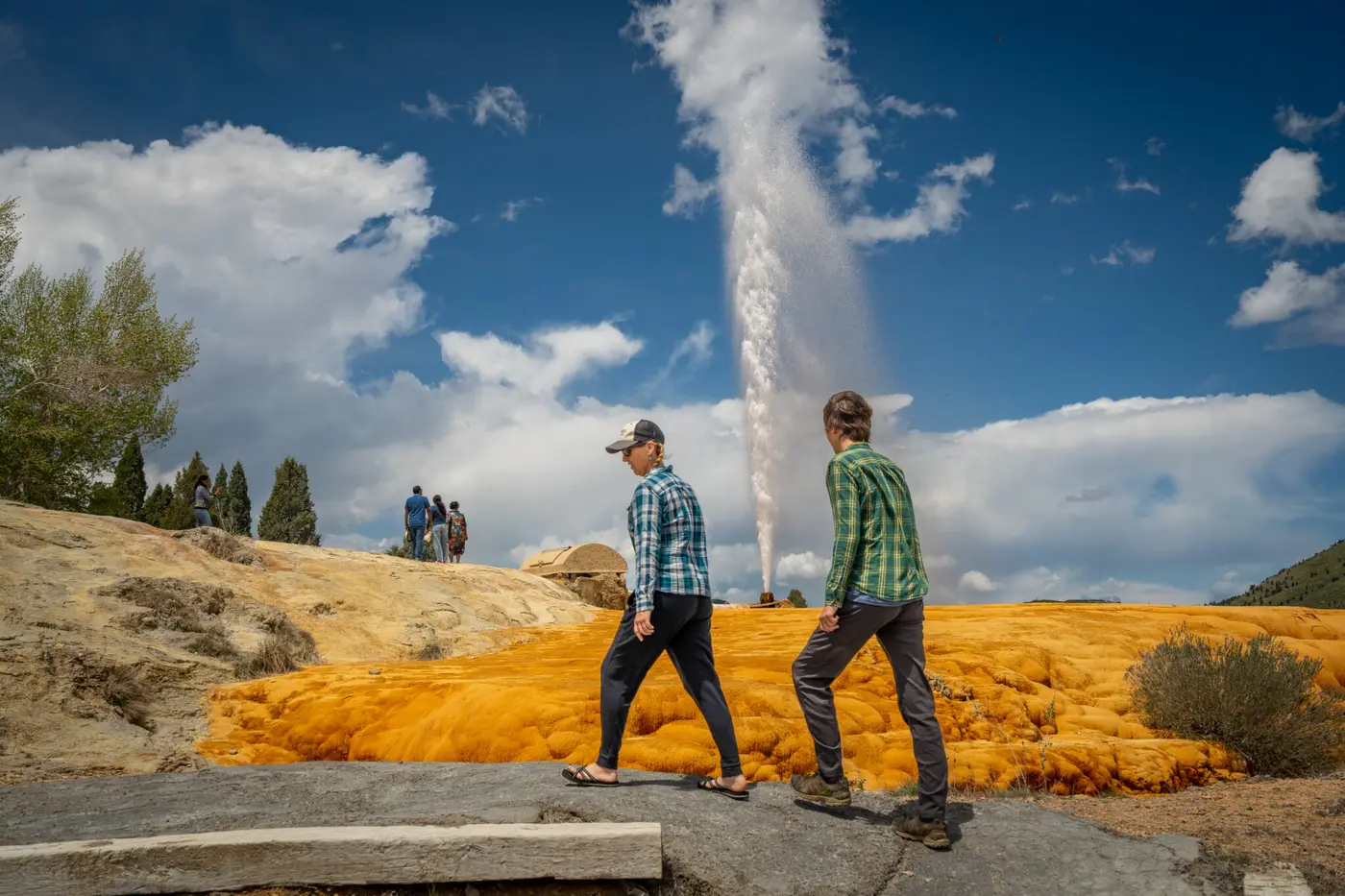
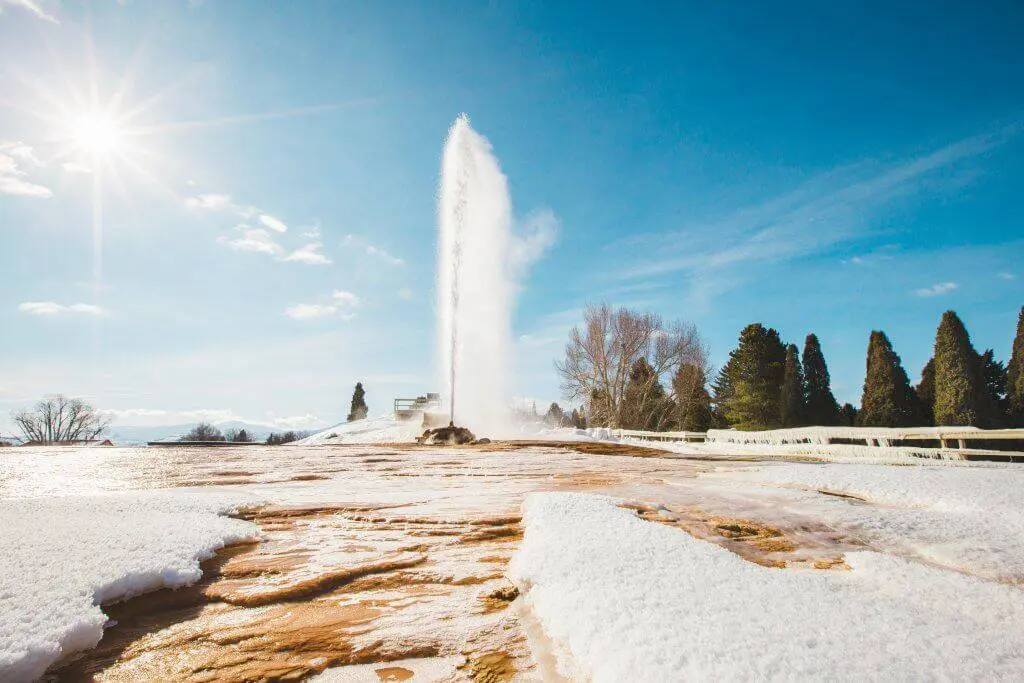
Geyser Park lies behind the Enders Hotel at 1st South and Main. A boardwalk circles a low mound of gray-orange stone, and from that mound, at the top of every hour, a timer on a valve lets the Soda Springs Geyser go. The city that owns it calls it the only captive geyser in the world. It runs year-round. There is no fee. If it fails to go off at the scheduled time, the City of Soda Springs asks visitors to call City Hall.
Accounts of its height differ. The city gives 70 feet. Visit Idaho gives 100 feet, 365 days a year. The Soda Springs Public Library’s page says “up to an awe inspiring 150 feet.” A Brigham Young University history on Intermountain Histories says it usually shoots over 100 feet, at an estimated 2,000 gallons a minute. One visitor, Aaron K., wrote in a review that “the geyser went off for about 10 minutes,” and his family walked the whole way around it while it ran. The National Park Service calls the water “luke-cool.” A caption on one of the park’s markers invites everyone to enjoy the 72-degree geyser water. On the question of what is in that water, the sources split. The BYU account calls it soft, unusual for a region of extremely hard water. The National Park Service marker in the park says that within days of the strike the water had cooled and become hard and mineral-laden.
Grassy ground with picnic tables and benches surrounds the boardwalk. A remodeled historic downtown building serves as the visitor center, with two rooms of large interpretive signs on local natural wonders and history, and accessible restrooms. The Enders Hotel Museum next door shows local artifacts and antiques. The BYU account says donations may be left there. Several markers stand in the park itself. One, “Travertine Terraces – World Famous Water,” explains the mound underfoot. A marker photograph shows the valve mechanism behind it, out in the open. From the park, the Park Service maps a 1.7-mile walk through town and along a canal at the end of Main Street to Hooper Springs.
Fountain Hill and Pyramid Spring
The mound is travertine. In the marker’s account, water and carbon dioxide form carbonic acid, the same weak acid that makes soda water taste slightly sour, and the water carries dissolved calcium carbonate. Where the gas escapes from a thin film of water on the lip of a pool, the water turns less acidic and leaves a layer of stone behind. Over time this builds flights of pools held by little dams.
Emigrants bound for Oregon and California in the mid-1800s wrote in their diaries of white mounds and cones ten to twelve feet high around Soda Springs. According to the “Mad Dragon” marker, one of the first they came to was often Pyramid Spring, and the geyser now stands on top of it. The marker’s photo panel says John C. Fremont, traveling west in 1843, saw the crusty white formation and named it Fountain Hill. An 1878 USGS map on the marker shows Pyramid Spring by that name, and an 1882 photograph shows the mound with the town behind it.
The springs around it drew people for most of a century before the drill came. The marker in the park quotes Sarah White Smith, encamped at Soda Springs in 1838: “This is indeed a curiosity. The water tastes like soda water, especially artificially prepared.” She found it good for bread, which came out “as light as any prepared with yeast.” By the turn of the 20th century the train was bringing guests to the Idanha Hotel and the Mineral Heights Resort to take the warm mineral waters. The Idanha, dedicated in 1887, burned in 1921.
A night in November 1937
The geyser came out of a plan for hot water, and the sources disagree on what the water was for. The city, the “Mad Dragon” marker, and Rick Just’s history column say local businessmen wanted a commercial bathhouse and health resort. The BYU account, the “Springs of Soda Springs” marker, and the library say the goal was a community swimming pool. The BYU account traces the plan to 1924, when S.E. Mathews (the marker spells it Matthews) and other prominent residents enlisted Dr. Harold T. Stearns, a government geologist. Together they looked for a place to drill. Stearns pointed to the ground that is now Geyser Park and guaranteed hot water 300 feet down. Raising the money took thirteen years. Twenty-one men formed the company that drilled the well, and only after the strike did they call it the Soda Springs Geyser Co., Inc. The Caribou County News records that in 1937 Matthews was mayor.
The accounts also disagree on the date. The city and the “Mad Dragon” marker say that on November 28, at 315 feet, the rig struck a gas chamber. Shortly after drilling stopped for the day, hot water began gushing more than forty feet. The next day the 3,500-pound bit was pulled. The ground shook as if it were about to split open, and a gusher of more than 70 feet came out of the valve. The BYU account, the library, and the Soda Springs Sun put the strike on November 30, 1937. Southeast Idaho High Country gives November 30 at 317 feet.
The BYU version tells the evening in detail. The crew had reached 315 feet and was dangerously low on money and pipe. While the workers ate supper, they heard what they took for the roar of the Union Pacific engine. They went back outside and found a geyser shooting 100 feet into the air. The Soda Springs Sun of December 2, 1937, quoted on the marker, has the “tired and cold drillers leaving for dinner” discovering “a rampaging geyser” that was “roaring like a dragon.” It added: “For most of the night, Soda Springs was enveloped in a mist of steam water running down main street and threatening business basements.” The same panel carries a line from that winter: “Such a scene as that, only a few men have ever witnessed.” Another marker takes its title from S.E. Matthews of the Soda Springs Geyser Corporation, December 1937: “It Roars Like a Mad Dragon.”
The cause, by most accounts, was a drill bit breaking into an underground chamber of carbon dioxide gas and water. The Park Service describes it as an artesian well tapped by accident.
A telegram about Old Faithful
The water that came up was no use for bathing. Two weeks after the strike, the “Mad Dragon” marker says, the riggers finally capped the gusher, and the crowds of tourists the businessmen had expected never came. The geyser was noticed in Washington, though. Within weeks the Secretary of the Interior telegraphed Soda Springs asking the city to turn the geyser off because “…it is throwing the world famous ‘Old Faithful Geyser’ off schedule.”
Rick Just, writing in 2022, called any direct connection between the two geysers, 134 miles apart, “pure fantasy.” He notes that Old Faithful erupts every 44 to 125 minutes. The town’s leaders, he writes, saw the value in a captured geyser and put a valve and timer on the old drill hole. In the BYU account, the capped property went to the city. For its first few decades, police released the geyser on special occasions or when tourists came to see it.
Notable Events
- 1843The marker's photo panel says explorer John C. Fremont, traveling west in 1843, observed the crusty white formation at the geyser's location and named it Fountain Hill. hmdb.org
- 1924S.E. Mathews enlisted government geologist Harold T. Stearns, and together they explored for a place to drill for hot water. intermountainhistories.org
- 1937The marker's geyser panel says tired and cold drillers leaving for dinner discovered a rampaging geyser shooting 100 feet high and roaring. hmdb.org
- 1937This account dates the discovery to November 30 at a depth of 317 feet, by a well driller searching for hot water for a swimming pool. idahohighcountry.org
- 1937On November 28, the drill struck a carbon dioxide gas chamber 315 feet underground and the Soda Springs Geyser was born. sodaspringsid.com
- Two weeks later the drilling riggers were finally able to cap the gusher, whose water had cooled and turned hard and mineral-laden, useless for the planned bathhouse. hmdb.org
People
- John C. Fremont, Explorer whose 1843 party observed the crusty white mound at the geyser's location and named it Fountain Hill (1843).
- S.E. Matthews, Of the Soda Springs Geyer Corporation; his December 1937 words give the Geyser Park marker its title (December 1937).
- Harold T. Stearns, Government geologist enlisted to help locate a drill site for hot water (1924).
- S.E. Mathews, Prominent Soda Springs resident who sought to tap hot water for a community swimming pool and enlisted a geologist to find a drill site (1924).
Sources
- sodaspringsid.com/recreation/geyser_park/index.php
- visitsodasprings.com
- visitidaho.org/things-to-do/roadside-attractions/soda-springs-geyser
- hmdb.org/m.asp?m=106251
- hmdb.org/m.asp?m=106214
- hmdb.org/m.asp?m=109952
- idahohighcountry.org/item/soda-springs-geyser
- sodaspringsid.com/visitors/history.php
- nps.gov/places/000/geyser-park.htm
- idahopress.com/boiseweekly/odds_and_ends/rick-justs-history-corner-soda-springs-geyser/article_90f4b5a4-bf19-5812-ad43-fdd7252a7089.html
- soda.lili.org/see-the-geyser-erupt
- cariboucountynews.com/2024/08/14/501617/-the-springs-of-soda-
- intermountainhistories.org/items/show/293