
Caduceus Cellars
Jerome, Yavapai County, Arizona. Tasting room.
Details

- Where
- 158 Main St, Jerome, AZ 86331. Directions
- When
- Sunday-Thursday 11 - 6 Friday & Saturday 11 - 7.
- Managed by
- Caduceus Cellars.
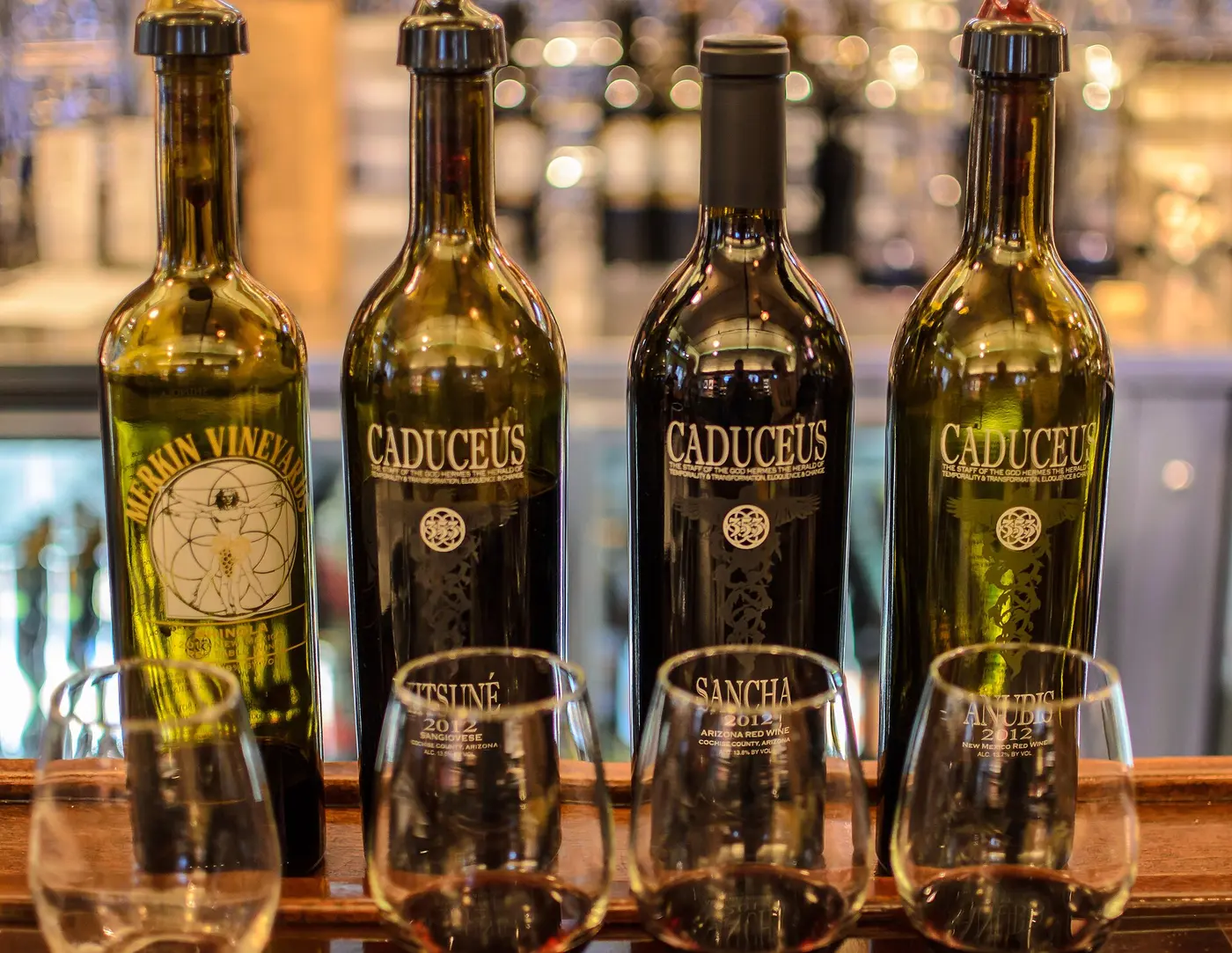
The tasting room at 158 Main Street sits on the southeast-facing slope of Jerome, the old copper town above the Verde Valley. It pours two labels from one owner: Caduceus Cellars and its sister label, Merkin Vineyards. A visitor can order a tasting flight of either or buy bottles from the shop. By the company’s 2021 account, bottles run from about $20 to more than $100. The list then leaned toward the grapes of Spain and Portugal: Tempranillo and Grenache among the reds, Alvarinho among the whites. That year Calvin Arnold, the national sales director, described a stop in Jerome where guests could “sip wine and get a haircut” from the in-house barber at Caduceus, or “pick up a vinyl or two” at Keenan’s record store, with other wineries’ tasting rooms on both sides of the street.
For a closer look, the winery offers a private 90-minute program by reservation. It includes a vineyard tour, a tour of the facility, and a guided tasting paired with what the winery calls Arizona tapas, made with produce from its estate gardens.
Six blocks in the valley and one in Willcox
The wine poured on Main Street comes from vineyards the company farms across Arizona. Six sites lie in the Verde Valley, and the Al Buhl Memorial Vineyard lies to the southeast in Willcox, at the eastern edge of the Sulfur Springs Valley. The plantings range from 3,300 to 4,900 feet in elevation and total 110 acres under vine. The winery describes its farming as low yield and high density. Across all its brands it makes about fourteen thousand cases a year. That is a large jump from the roughly 4,500 cases Grape Collective reported in 2017.
The highest site is the Judith Block above Jerome, at 4,900 feet. It holds less than half an acre each of Nebbiolo, Aglianico, and Tempranillo, “with a dash of Malvasia in between.” The Marzo block sits on Oak Creek, 2.5 acres of Sangiovese and Cabernet Sauvignon. In 2021 an Esquire writer rode out there with Keenan to a rustic house and a duck pond. Keenan got out of the truck and did a duck impression, and the ducks swam toward him. The Agostino block, named for his daughter, grows Monastrell, Albariño, Malvasia Bianca, and a white grape the winery lists as Lulienga or Lignan Blanc. In Old Town Cottonwood the Galileo Block grows Tempranillo, Garnacha, and Graciano for the company’s Ventura Room. In Willcox, according to the importer Modal Wines, the Buhl vineyard holds vines planted in 1982, among the oldest surviving post-Prohibition plantings in the state.
The two labels divide the work. In Modal’s account, Merkin draws largely on Buhl and makes the more immediate wines. These spend eight to ten months in concrete or barrel and are meant to be drunk young. Caduceus draws on the higher northern vineyards for structured, longer-aged wines and smaller experiments. Since 2014 all of the wine has come from Arizona fruit.
Accounts of the winery’s name differ slightly. Decanter says it comes from the staff carried by Mercury, messenger of the gods. Grape Collective calls the caduceus “the ancient symbol for commerce and staff of the Greek god Hermes.” Merkin, Decanter notes from the Oxford English Dictionary, is “a form of pubic wig, popularised in the 18th century.”
A bottle from Tori Amos
Keenan came to the valley in 1995. “My friend brought me here and I thought this is the place,” he told Esquire. “The next day I switched my license over and registered to vote.” He had formed Tool in Los Angeles, and he told the Arizona Republic in 2007 that the secluded country east of Jerome suited him better. “I’m not supposed to be in LA,” he said in 2021. “I’m not wired for that place.”
He found wine backstage. As the Republic told it, the band lived on Gatorade and packaged meats while managers and promoters drank wine. Keenan and his drummer took a few bottles, figuring the band paid for them anyway. “I thought, wow, there is something to this stuff,” he said. In 1997 he played a benefit concert with Tori Amos, and she gave him a bottle of 1992 Silver Oak Cabernet Sauvignon as thanks. He opened it with a meal. “Oh my, what just happened?” he recalled. “A little light went on.”
In 2000 he sat on his back porch over the river valley with a glass of Châteauneuf-du-Pape. “I thought, ‘I can make this here,’” he said. He bought a book and began planning a vineyard. A friend told him to talk to an expert first, so he became a regular at Echo Canyon Winery in Sedona. There he learned the business from the owner, Jon Marcus, and became friends with the young winemaker, Eric Glomski. “I had never heard of him,” Glomski said of the rock singer, “which is probably to both of our benefits.” Keenan hired Glomski as a consultant. When Glomski started his own winery, Page Springs, he agreed to make Keenan’s wine there.
Grape Collective tells the beginning differently. It says the idea came at a dinner with close friends, and adds that “rumor has it” one of them was Tori Amos. After he had already planted his vines, Keenan learned that his great-grandfather had kept vineyards in Italy. “I was going to find my way back here somehow,” he said.
Primer Paso and the first vintages
Caduceus was founded in 2004 with Glomski as partner. Its first bottle was the limited-edition Primer Paso, which sold out quickly. Grape Collective gives that first blend as Syrah, Malvasia Bianca, and Muscat. Modal gives the blend Keenan has made since 2004 as Syrah, Malvasia, and Petite Sirah. Early on, the wines were made at Page Springs and used partly California fruit.
In April 2007 Keenan released his 2005 vintage on his 43rd birthday. In the first week he sold $10,000 worth a day through his website: Primer Paso at $49.99 and the Naga at $69.69. Most buyers had never tasted it. “Isn’t it amazing?” Keenan said. “Because I wrote a song, apparently my wine is desirable.” Glomski sold his own Page Springs wines for $15 to $35, and he teased his partner about it. “Oh yeah, you have such a tough life,” he said he told Keenan. “You make a bunch of $100 bottles of wine and sell them all out in a few weeks.”
That spring the Republic’s reporter followed Keenan to Casey’s Corner general store in Cornville. Keenan filled up his black Crown Victoria Interceptor, a former police car. A man leaving the store asked how to get one, and Keenan tapped the trunk: “Cop’s in here.” The first harvest from his own Arizona vineyards was due that summer, while Tool toured arenas.
July 4 in a ghost town
In April 2009 Keenan announced Nagual del Judith, a Cabernet Sauvignon and the first Caduceus wine made only from his own Arizona grapes. He named it for his late mother, Judith Marie, who died in 2003. Grape Collective reported that he scattered her ashes over one of his vineyards. “With tears in my eyes,” his statement read, “I present to you the very first 100 percent Arizona Caduceus wine.”
Three months later, on July 4, 2009, the Caduceus Cellars & Merkin Vineyards tasting room opened in Jerome, planned to stay open 365 days a year. “Another in an endless series of complex puzzle pieces has fallen into place,” Keenan said. “We are many years away from our goal.”
The town around it had been a copper and gold mining camp in the late 1800s. In February 1903 the New York Sun called it “the wickedest town in the West.” Decanter reported that its population fell to about 50 in the late 1950s after the mines declined and a series of miners’ strikes. “It’s a magic spot,” Keenan said that summer. “It’s been voted a couple of times in different ‘ghost’ publications as being the most haunted town in the United States.” By then it was home to artists and writers. A documentary about Keenan and Glomski’s desert winemaking, Blood Into Wine, was in production for release in February 2010. The pair had also signed bottles at Whole Foods stores in 24 cities. Decanter later described Glomski as Keenan’s “then partner” and co-owner of Arizona Stronghold Vineyards in the Sulphur Springs Valley.
Frost, monsoon, and hail on the Eliphante Block
Early in 2012 the winery planted 30 acres outside Cornville, the Eliphante Block, mostly with Italian clones and a few Spanish and French ones. The weather at these elevations is hard on vines. Modal reports frosts of minus 12 to minus 9 Celsius as late as early May. Then comes strong sun, and then the summer monsoon, which can bring much of the year’s rain just before harvest. Grapes that did not suit the conditions were pulled out. “The only grapes that don’t work are Pinot, Zinfandel and Primitivo,” Keenan said in 2017.
In 2019 hail struck Eliphante. “We had beautiful fruit, everything was on track, then 20 minutes of a microburst of hail,” Keenan told Esquire. “We found 100 dead birds in the vineyards because it hit so fast they couldn’t get out of the way.”
In 2021 the Verde Valley was designated an American Viticultural Area after a campaign Keenan took part in. By that year Esquire counted seven vineyard sites, seven tasting rooms, three winemaking facilities, two restaurants, a barber shop, and a record store, with a hilltop trattoria under way. Asked whether he would run for office, Keenan declined: “No, I bowl with the mayor.”
Four years earlier, at a conference in New Zealand, he had described the work this way: “We have been absolutely on the edge, and then there’s another edge. We haven’t fallen off yet.”
Notable Events
- 1995Keenan has lived in Arizona since 1995; the secluded area east of Jerome suited him more than Los Angeles. caduceus.org
- 1997After a benefit concert, Amos gave Keenan a bottle of Silver Oak Cabernet Sauvignon, deepening his appreciation of wine. caduceus.org
- 2000On his back porch overlooking the river valley, Keenan decided he could make wine there. caduceus.org
- 2009Keenan announced Nagual del Judith, the first wine produced solely from grapes grown at his own vineyard, named for his late mother. blabbermouth.net
- 2012Thirty acres were planted just outside Cornville, primarily Italian clones with some Spanish and French clones. caduceus.org
- 2014Since 2014 the wines have been made entirely from Arizona fruit, and today virtually everything comes from vineyards under their own control. modalwines.com
- 2019Keenan says a microburst of hail devastated the entire vineyard site in twenty minutes. esquire.com
- 2021Keenan campaigned for the Verde Valley's certification as an American Viticultural Area, designated in 2021. caduceus.org
- Keenan opened a tasting room in his adopted hometown of Jerome; the Caduceus Cellars & Merkin Vineyards tasting room opened its doors on July 4. blabbermouth.net
People
- Eric Glomski, then partner in the 2004 founding; his Page Springs Cellars produced some of Keenan's earlier bottles (co-founded Caduceus with Keenan in 2004).
- Maynard James Keenan, owner and winemaker; makes his home in the Verde Valley (first visited the valley in 1995).
- Jon Marcus, Echo Canyon Winery owner who taught Keenan about the wine business.
- Tori Amos, Singer who gave Keenan a formative bottle of wine after a benefit concert (1997).
- Calvin Arnold, National Sales Director.