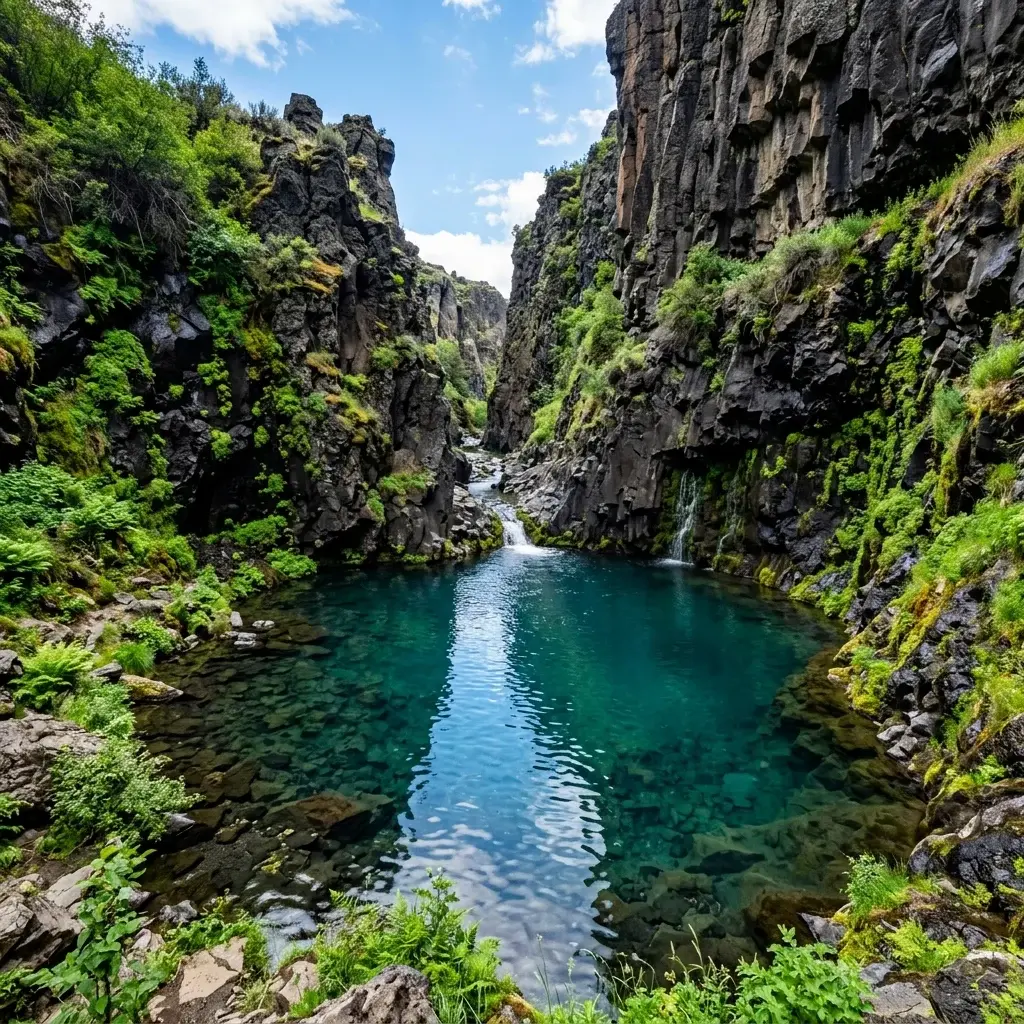
Box Canyon Springs Trailhead
Hagerman, Gooding County, Idaho. Nature Preserve; Year-round.
Details

- Where
- Hagerman, Gooding County, ID. No street address stated. Directions
- When
- 7am to 10pm year-round.
- Getting there
- Box Canyon State Park is located on W Point Road near Wendell, Idaho. Buhl, Idaho is also only fifteen minutes away! Either town will lead you to the parking lot that sits at the beginning of the trail head.
- Fees
- $7 vehicle fee at the parking lot; also covers the other Thousand Springs units if purchased at Malad Gorge.
- Access
- Paved road for about a mile from the parking lot to the canyon rim overlook; descend into the canyon requires sturdy shoes and high physical exertion.
- Phone
- (208) 837-4505
- Website
- parksandrecreation.idaho.gov
- Managed by
- Thousand Springs State Park.
- Coordinates
- 42.8632, -114.8516.
The road to Box Canyon runs through farm country on West Point Road, between Wendell and Buhl, and ends at a parking lot where each vehicle pays $7. A paved way leads from the lot toward the rim. Visit Southern Idaho puts it at about a mile; America’s State Parks lists a paved, wheelchair-accessible Rim Trail of 0.3 mile ending at an overlook. At the rim the ground drops away into a narrow canyon of black basalt, about 120 feet deep by the latter guide’s measure, its floor green with growth and its water an aqua blue. Seen from above, Visit Southern Idaho wrote, the spring pool is shaped like a mermaid’s tail.
The water rises from the Eastern Snake River Plain aquifer, which underlies 9,600 square miles, at the point where it meets the surface. The spring releases an estimated 180,000 gallons a minute, or about 10 cubic meters a second in the figure geologists use. The Nature Conservancy and a 2008 paper in Science both rank it the eleventh-largest spring in the United States. Visit Southern Idaho calls it the 11th largest in North America. The water stays at a constant 58°F. Accounts of its time underground differ. The Conservancy describes a century-long journey beneath an arid lava landscape. America’s State Parks says some of it fell as rain or snow more than 200 years ago. The state park’s master plan says the region’s spring water travels 200 miles underground over many decades. From the head, the creek runs down the canyon to the Snake River. The Conservancy calls the canyon a mile long, and the 2008 study measured it at about 2.68 kilometers.
The place is formally the Earl M. Hardy Box Canyon Springs Nature Preserve, one of six units of Thousand Springs State Park. It is open year-round from 7 a.m. to 10 p.m. Rangers work out of a visitor center at the Billingsley Creek unit, shared with Hagerman Fossil Beds National Monument.
Down the wall to the waterfall
The state calls the route into the canyon a primitive trail. Following the ledge from the overlook, a walker reaches a caved-in section where makeshift stairs lead down, some facing east and some west. Visit Southern Idaho says both require sturdy shoes and high physical exertion. About another mile along the ledge, a gentler path descends with a rail and rope for support. America’s State Parks lists the Canyon Descent Trail at 0.8 mile from the rim and warns that it is steep, rocky, and can be slippery.
On the floor, the sound of rushing water leads the way. A man-made staircase drops to a 20-foot waterfall that runs year-round. Past the falls the trail follows the water through lush growth and ends at a second blue pool, where visitors swim in the cold spring water. A giant tree lies fully submerged there, clear to see from above. The full Canyon Floor Loop measures 1.5 miles. There are no lifeguards, and currents run strong near the spring outlets. Poison ivy and stinging nettle grow along the trail edges. The canyon has no trash service, so visitors carry out what they bring.
The state names winter as the season for bald and golden eagles. The Nature Conservancy adds hawks, falcons, and owls to the birds that perch on the cliffs. America’s State Parks lists yellow-bellied marmots on the rocks, great blue herons along the outflow creek, rainbow trout in the pools, and the canyon wren, heard in spring and summer by its descending song against the basalt. The Conservancy notes that the springs of the Thousand Springs area support the Shoshone sculpin, a fish found nowhere else on Earth.
Boulders a spring could not carry
The canyon’s rounded head, sheer headwall, and lack of any drainage channel above it long made it a textbook case of groundwater sapping: a canyon cut slowly by the spring itself. An earlier interpreter, Stearns, reasoned that because spring flow could not move the canyon’s boulders, they must erode chemically where they lay.
In May 2008, Michael P. Lamb and his University of California, Berkeley colleagues William E. Dietrich, Sarah M. Aciego, Donald J. DePaolo, and Michael Manga made a different case in Science. The canyon is cut into the Sand Springs Basalt, which erupted about 95,000 years ago and filled an older canyon of the Snake. Its columnar walls break into boulders about a meter across. The spring moves no measurable sediment, and water samples showed no substantial dissolution. At the canyon head the team found three concentric semicircles of boulders that appear to be waterfall plunge pools. A notch in the center of the headwall rim carries flute-like scour marks from water that once spilled over. Scoured rock runs at least a kilometer upstream before windblown loess buries it.
By their calculation, moving the canyon’s bed would take more than 220 cubic meters a second, 22 times the spring’s flow. The flood that topped the rim ran between 800 and 2,800. They dated the carving to about 45,000 years ago. “It requires a lot of water to remove them,” Lamb told New Scientist, which reported that a giant lake probably stood at the canyon’s head until its containing walls gave way. The work reached beyond Idaho. The paper set Box Canyon beside Mamers Vallis on Mars, and Lamb said that if similar Martian canyons were cut in solid basalt, they “would have required a release of some large body of water.”
Later exposure dating of the scoured rim by Benjamin H. Mackey and Kenneth A. Farley also pointed to a flood around 45,000 years ago. Their work suggested that Box Canyon, Woody’s Cove, and Stubby Canyon may have formed together, ceasing about 46,000 years ago, apart from later reworking by backwater of the Bonneville Flood. By the master plan’s account, that flood carved the Hagerman Valley itself 15,000 years ago.
Long before the surveyors, the valley was a hunting, fishing, and wintering ground for Bannocks, Paiutes, and Shoshones. The name Thousand Springs dates from the Oregon Trail, whose emigrants marveled at the water pouring from the canyon walls.
The Hardy name, in perpetuity
On December 31, 1998, the State of Idaho entered a purchase agreement for Box Canyon Springs with Earl M. Hardy, LaVane M. Hardy, the Hardy Foundation, and the couple’s charitable remainder annuity trust. Paragraph II (4) of the agreement provided that the property “shall be named, in perpetuity, ‘Earl M. Hardy Box Canyon Springs Nature Preserve’.” According to the park’s master plan, The Nature Conservancy bought the land on behalf of the Idaho Department of Parks and Recreation, and it entered the state park system in December 1999. That period fell within the tenure of Kevin Lynott, manager of Malad Gorge and Niagara Springs from December 1989 to 2003.
When the legislature updated its list of state parks in 2003, the statute said only “Box Canyon,” under Malad Gorge State Park. On February 26, 2004, Speaker Bruce Newcomb told the House Ways and Means Committee that the Hardy sale carried a stipulation on the name. Six years had passed since the purchase, and his measure would carry out the terms of the contract. Rep. Jaquet moved to introduce it, and the motion passed by voice vote. As House Bill 774, it passed the House 67 to 0 and the Senate 32 to 0, with a fiscal impact listed as none. The governor signed it on March 26, 2004. Meanwhile Lonnie Johnson had taken charge of the Thousand Springs Park District in April 2003. On April 20 and 21, 2005, a planning team proposed the name Thousand Springs State Park, with the Hardy preserve as its Box Canyon unit.
The Nature Conservancy tells the ownership differently. It says it bought Box Canyon in 1999 with plans to pass it to the state, and that the transfer was completed in December 2016, when the canyon became part of Thousand Springs State Park.
Notable Events
- 1998The State of Idaho entered a real property purchase and sale agreement for Box Canyon Springs with the Hardys, their foundation and charitable remainder annuity trust. This records the agreement, not an inferred closing date. legislature.idaho.gov
- 1999The Nature Conservancy purchased Box Canyon on behalf of the Idaho Department of Parks and Recreation; the property joined the state park system and received the preserve name. idahodocs.contentdm.oclc.org
- 2003Box Canyon and Billingsley Creek were added to the state park property list in I.C. 67-4212. idahodocs.contentdm.oclc.org
- 2003Lonnie Johnson became manager of the Thousand Springs Park District. idahodocs.contentdm.oclc.org
- 2004I.C. 67-4212 was amended to reflect Earl M. Hardy Box Canyon Springs Nature Preserve; it remained a state park property under Malad Gorge State Park. idahodocs.contentdm.oclc.org
- 2004The governor signed the naming amendment as Session Law Chapter 348; its effective date was 03/26/04. legislature.idaho.gov
- 2004Rep. Jaquet moved to introduce RS 14197 and refer it to the Judiciary and Rules Committee; the motion passed by voice vote. legislature.idaho.gov
- 2016The transfer of Box Canyon from The Nature Conservancy to the State of Idaho was completed in December 2016; it became part of Thousand Springs State Park. nature.org
- The study's sediment transport constraints, dates, plunge pools and scoured rock indicate that a megaflood carved the canyon about 45,000 years ago. lamb.caltech.edu
- Exposure ages indicate that formation of Box Canyon, Woody’s Cove and Stubby Canyon may have been coeval, ceasing ∼46 ka, apart from later Bonneville Flood backwater reworking. pmc.ncbi.nlm.nih.gov
People
- Kevin Lynott, Manager of Malad Gorge/Niagara Springs whose tenure encompassed the addition of Box Canyon and Billingsley Creek and formation of the Thousand Springs Park District (December 1989–2003).
- Lonnie Johnson, Thousand Springs Park District manager during the master-planning process (April 2003 onward during the master-planning process).
- Donald J. DePaolo, Co-author of the Box Canyon megaflood study (2008 publication).
- Michael Manga, Co-author of the Box Canyon megaflood study (2008 publication).
- Michael P. Lamb, Co-author of the Box Canyon megaflood study (2008 publication).
- Sarah M. Aciego, Co-author of the Box Canyon megaflood study (2008 publication).
- William E. Dietrich, Co-author of the Box Canyon megaflood study (2008 publication).
- Bruce Newcomb, Speaker listed as contact for the preserve-naming legislation.
- Earl M. Hardy, Party to the state purchase agreement for Box Canyon Springs (December 31, 1998, as dated in the agreement statement's opening sentence).
- LaVane M. Hardy, Party to the state purchase agreement for Box Canyon Springs (December 31, 1998, as dated in the agreement statement's opening sentence).
- Noh, Senate floor sponsor of the preserve-naming bill.
- Stevenson, House floor co-sponsor of the preserve-naming bill.
- Rep. Jaquet, Moved to introduce the preserve-naming measure RS 14197 and refer it to committee (February 26, 2004).
- Benjamin H Mackey, Designed and performed the comparative canyon research, analyzed data and co-wrote the paper.
- Kenneth A Farley, Contributed analytic tools, analyzed data and co-wrote the comparative canyon paper.
- Stearns, Earlier interpreter of canyon erosion who reasoned that its boulders must chemically erode in place because spring flows could not move them.
- Michael Lamb, geomorphologist at the University of California, Berkeley, whose team found Box Canyon was carved by a megaflood.
Sources
- parksandrecreation.idaho.gov/state-park/thousand-springs-state-park
- visitsouthidaho.com/box-canyon-state-park-and-nature-preserve
- americasstateparks.org/state-park/box-canyon
- idahodocs.contentdm.oclc.org/digital/api/collection/p16293coll3/id/3583/download
- legislature.idaho.gov/sessioninfo/2004/legislation/H0774
- legislature.idaho.gov/sessioninfo/2004/standingcommittees/hwaymin
- lamb.caltech.edu/documents/19601/Lamb_et_al_Science_2008_rsKcImh.pdf
- pmc.ncbi.nlm.nih.gov/articles/PMC3890896
- nature.org/en-us/get-involved/how-to-help/places-we-protect/thousand-springs
- newscientist.com/article/1909725-earth-canyon-hints-at-ancient-megafloods-on-mars
- space.com/5382-ancient-flash-floods-sculpted-earth-mars.html
- nytimes.com/2008/05/27/science/27obflood.html