Bigfoot Scenic Byway
Willow Creek, Humboldt County, California. Scenic byway.
Details

- Where
- Willow Creek, Humboldt County, CA. No street address stated. Directions
- Getting there
- Take Highway 96 north from the junction with Highway 299 in Willow Creek. The byway follows the Klamath River and ends in Happy Camp.
- Fees
- None.
- Access
- Along the 80-mile, 2-hour route, camping, hiking, wildlife viewing , and river recreation abound.
- Phone
- 530-493-2900
- Managed by
- Department of Transportation.
A carved wood sign near the tourist information center in Willow Creek tells the story of Oh Mah, the Hupa name for Bigfoot. Leo Kepcke described the sign in Humboldt Geographic in 2021. It says Oh Mah’s footprints have been found countless times over the last 50 years, and that reports of the creature have been consistent and similar for a hundred. A few yards from a two-story redwood statue of the creature, visitors can buy a plaster cast of the original footprint. Murals and carved redwood statues stand around town. One mural covers the Ace Hardware, and The Early Bird serves the Bigfoot Burger. At the Willow Creek-China Flat Museum the displays hold Sasquatch photographs and supposed footprint casts. At the Bigfoot Steakhouse, breakfast is two pancakes topped with two eggs.
Willow Creek calls itself the gateway to Bigfoot country, and the byway starts here. Drivers take Highway 96 north from its junction with Highway 299 and follow the Klamath River to Happy Camp. The Federal Highway Administration gives the length as 89 miles, and the Six Rivers National Forest gives 80. Both allow two hours, and there is no fee.
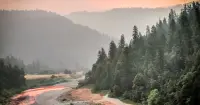
Highway 96 up the Klamath
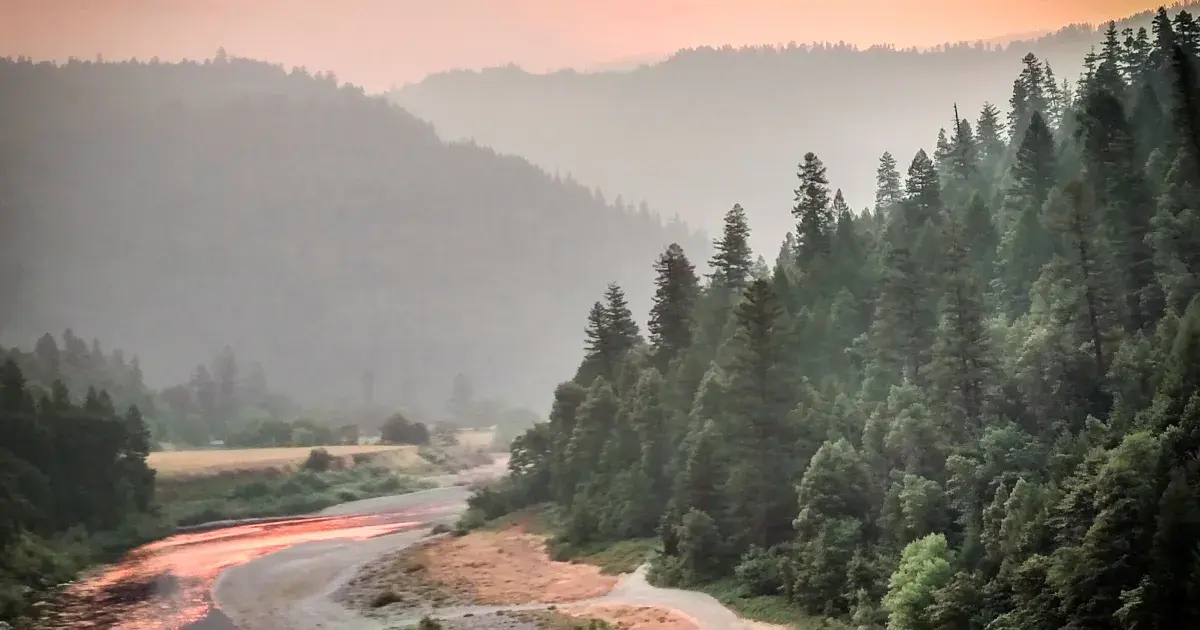
The Forest Service says the road runs near three wild rivers and three wilderness areas. The Federal Highway Administration adds two national recreation areas and Redwood National Park to the public lands it passes through or near. The Klamath, whose canyon the road follows, is the second largest and second longest river in California. It runs more than 200 miles through the Cascade and Coast ranges and carries Chinook and coho salmon and steelhead. Elk, deer, river otters, black bears, mink, bald eagles and peregrine falcons are seen often in the forests. The Forest Service warns that most of the Six Rivers National Forest has little or no cell reception, and that tire chains may be required from mid-fall through early spring.
Visit California’s itinerary for the route stops first at the Hoopa Valley Reservation. That guide says the Hoopa people have lived on the banks of the Trinity River for more than 1,000 years. The Hoopa Tribal Museum shows hundreds of artifacts, among them colorful baby baskets and shell capes. It also holds classes in traditional dress sewing and bow-quiver making.
Farther on, signs off the byway near the E-Ne-Nuk Campground mark the Bluff Creek Historic Trail. It climbs 1.25 miles to a view of the river. Kepcke went looking for Fish Lake, which he says has the greatest number of Bigfoot sightings. He turned left off Highway 96 and drove six miles west up a winding road. A trail through the pines led him to a small unnamed lake where a woodpecker made the only sound.
At Orleans a suspension bridge crosses the Klamath, and walkers look down for otters and running steelhead. Guests at Sandy Bar Ranch rent cabins and help milk the goats in the morning. Somes Bar is 8 miles north, across the line in Siskiyou County. A 2003 county plan counted about 540 people around Orleans and about 150 at Somes Bar. Most of Somes Bar was then off the electric grid, and many homes made their own power from solar or hydro systems. The Karuk Tribe calls the area around Somes Bar “the center of the world.”
At Clear Creek, locals swim in summer at a hole just off the byway, across from an old country store. A more secluded pool lies a mile’s walk along the river from the No Mans Trailhead, about 8 miles off the main road.
The byway ends at Happy Camp, where Indian and Elk creeks meet the Klamath. Just south of town, a pull-out at Wyman Gulch hides a roadside waterfall with a single stone bench. In town, Marble Mountain Gifts Co. sells a banana-bread latte and stands beside a 12-foot Sasquatch made entirely of scrap metal. Rockhounds hunt Happy Camp jade, and the government of the Karuk Tribe has its home here. The Marble Mountains Wilderness lies to the south, with eighty-nine glacial lakes and a stretch of the Pacific Crest Trail. Both ends of the road hold a festival on Labor Day weekend: Bigfoot Days in Willow Creek and the Bigfoot Jamboree, with its parades, in Happy Camp.
China Flat, Panamik, Murder’s Bar
According to the Willow Creek Community Services District, the town’s history begins with bands of the Hupa Tribe around Kimtu. They had a village where the South Fork joins the Trinity. The town was first called China Flat and served as the base for pack trains supplying gold rush mines. Farmers and orchardists followed. Orleans was first home to the Karuk and was called Panamik until miners renamed it in the mid-19th century. Its first post office opened in 1857.
At Happy Camp, the Karuk, whose name means the “upriver” people, have lived on the site since before history. Judy Bushy, writing in the Happy Camp News, records that trappers passed through, Jedediah Smith among them. She also records that Indian Ned, who lived to be 115, told of first seeing a white man as a teenager. Packers from an encampment on the Scott River came through next. Two men among them were murdered: William Mosier and a Mr. McGee, given by some as Mr. Reaves. The place became Murder’s Bar. In July 1851 a party of prospectors came up from downriver, made camp, and named it Happy Camp.
There are several versions of the naming. On June 11, 1947, H.C. Chester wrote down what Jack Titus had told him about 1882 or 1883. Titus kept a small store about fourteen miles downriver. James and Hile Camp came over the mountains from Eureka looking for level ground. The three men pitched a tent beside a large Indian village at the mouth of a big creek. James Camp declared, “This is the happiest day of my life.” Titus answered, “Then we shall call this particular spot ‘Happy Camp.’” They named the stream Indian Creek, then made and burned brick for a building that, Chester wrote, still stood. The handwritten letter is in the archives of the Siskiyou County Historical Society in Yreka. Bushy believes the account is wrong because the Camp brothers were not among the first miners. Readers of the paper have offered other versions in its comments. One remembered an 1881 county history placing the camp in the spring of 1850. Another said the town was named for a Karuk man called Happy.
Many gold camps became ghost towns. Indian Town, up Indian Creek Road, was once larger than Happy Camp, and little of it is left.
Mills, a road, and a Thursday revolt
When mining declined, lumber took its place. The Klamath National Forest founded its Happy Camp District in 1905. The town was known as the Steelhead Capital of the world, and travel became easier when the road was completed in 1928. In the 1940s, angered by the lack of state road maintenance and services, local people began a movement to form a “State of Jefferson” from parts of California and Oregon. Bushy writes that the “revolt” was held every Thursday. It ended on December 7, 1941, with Pearl Harbor, and the area’s mines and roads were then worked for the war effort.
By 1930 most miners had left Orleans, and sport fishing for salmon and steelhead brought visitors instead. A timber boom began after World War II. In Willow Creek, according to the services district, it was fed by the world’s largest forest of old-growth Douglas fir. At one time five or more mills ran near Happy Camp. Recession and environmental concerns cut harvests in the 1980s, and by the mid-1990s logging in the Orleans area had nearly stopped. The Stone Forest Mill at Happy Camp ran shifts around the clock until it closed in 1995. It was the last large mill in town.
Orleans and Somes Bar wrote community action plans in 1993, 1997 and 2002. The Orleans-Somes Bar Chamber of Commerce worked to win the byway designation as a way to bring in tourists. The designation for Highway 96 was accepted in August 2000, and the road became the Bigfoot Scenic Byway on April 1, 2001. In Willow Creek, Kepcke wrote, murals and carved redwood statues have replaced millions of board feet of redwood as the area’s main industry.
Tracks in a creek bed
The Los Angeles Times reported in 1989 that the creature had been part of Northern California Indian lore for centuries. At Thompson Creek, near Happy Camp, miners once saw a large, ape-like creature, and it frightened the Chinese miners so badly that they stayed away from work for days. In 1958 a road-building crew found 17-inch tracks, 55-gallon metal barrels tossed about like toys, a 700-pound tire thrown over a cliff, and large human-like droppings. The local paper ran the story, and the wire services picked it up. An expedition by a New York zoologist and several magazine investigations found no concrete evidence.
Kepcke dates the modern legend in Humboldt County to 1963. That year Albert Hodgson made a cast of a footprint he found on a little sandbar near Bluff Creek. In 1967 Roger Patterson and Bob Gimlin shot their film close by. Visit California describes it as footage of a supposed female Sasquatch that began a debate still going on.
By 1989, according to the Times, more than four dozen of Willow Creek’s 800 residents claimed to have seen the creature. The services district now counts 1,800 people. That year a visitor could shop at Bigfoot Lumber & Hardware, Sasquatch Second Hand and the Bigfoot Curio Shop, and play golf at the Bigfoot Country Club. Over four days on Labor Day weekend, the young woman who had sold the most raffle tickets was crowned Bigfoot Queen in Bigfoot Square. The chamber’s information booth stood two or three “Bigfoot steps” behind the redwood statue. “The legend has been fantastic for our town,” said Terri Castner, the chamber’s president. The same story quoted Al Hodgson, a variety store owner, who had once taken plastic impressions of large tracks in a creek bed. “All I can say is that the tracks were actually there. I couldn’t tell if they were fake or not,” he said. “One would think that by this time, there’d be some solid proof. A bone, a body, something.”
Notable Events
- 1905As mining declined and lumber became the chief occupation, the Klamath National Forest's Happy Camp District was founded at Happy Camp. happycampnews.com
- 1928The road reaching Happy Camp was completed, making travel to the Klamath River town at the end of today's byway easier. happycampnews.com
- 1941The movement to carve a new state from Oregon and California ceased with Pearl Harbor, and mines and roads in the area were worked for the war effort. happycampnews.com
- 1958A road-building crew discovered 17-inch tracks, 55-gallon barrels tossed about like toys, a 700-pound tire thrown over a cliff and large human-like droppings; the local newspaper story went out on wire services. latimes.com
- 1963Albert Hodgson made a cast of a Bigfoot footprint found near Bluff Creek on a little sandbar, which the article says started the modern legend of Bigfoot in Humboldt County. digitalcommons.humboldt.edu
- 1967Roger Patterson and Bob Gimlin made their famous and contentious Bigfoot film close to Willow Creek. digitalcommons.humboldt.edu
- 1995The last large lumber mill at Happy Camp closed and the community turned to small business and recreation. happycampnews.com
- 2000Scenic Byway Designation for Highway 96 was accepted. humboldtgov.org
People
- Albert Hodgson, made the 1963 cast of a Bigfoot footprint near Bluff Creek that began the modern Humboldt County legend (1963).
- Roger Patterson, with Bob Gimlin made the 1967 Bigfoot film close to Willow Creek (1967).
- Jack Titus, storekeeper who named Happy Camp and Indian Creek in H.C. Chester's account of the town's naming (about 1882 or 3).
- James Camp, store partner whose delight at the Klamath River site, in the version preserved by the Siskiyou County Historical Society, gave Happy Camp its name.
- Al Hodgson, Willow Creek variety store owner who took plastic impressions of large tracks found in a creek bed.
- Terri Castner, president of the Willow Creek Chamber of Commerce who credits the Bigfoot legend for the town's tourist trade.
Sources
- fhwaapps.fhwa.dot.gov/bywaysp/byway/62352
- fs.usda.gov/r05/klamath/recreation/opportunities/scenic-drives
- recreation.gov/camping/gateways/13577
- fs.usda.gov/r05/sixrivers/recreation/epic-adventures
- fs.usda.gov/r05/sixrivers/conditions
- fs.usda.gov/r05/sixrivers/offices
- fs.usda.gov/r05/klamath/offices
- happycampnews.com/the-story-of-happy-camp
- happycampnews.com/the-history-of-happy-camp-town
- happycampnews.com/origin-of-the-name-of-happy-camp
- willowcreekcsd.com/about-us
- latimes.com/archives/la-xpm-1989-02-19-me-224-story.html
- digitalcommons.humboldt.edu/cgi/viewcontent.cgi?article=1037&context=humboldtgeographic
- fs.usda.gov/r05/sixrivers/recreation/klamath-national-wild-and-scenic-river
- krisweb.com/biblio/klamath_usdafs_sixrivers_2003_lmkwa.pdf
- humboldtgov.org/DocumentCenter/View/295/2003-Orleans--Somes-Bar-Community-Action-Plan-PDF