Ancient Bristlecone Scenic Byway (Route 168)
Big Pine, Inyo County, California. Scenic Byways or Routes; Visitor center open in summer.
Details

- Where
- White Mountain Road Highway 168 Bishop, Big Pine, CA 93514. Directions
- When
- Open everyday 9 a.m. - 3:30 p.m.
- Getting there
- The byway begins on Highway 168 at the intersection of Interstate 395 in Big Pines, south of Bishop, California. The byway travels northeast on Highway 168 and then north on Forest Road 4S01 (White Mountain Road) through the Inyo National Forest, ending in Patriarch Grove. The byway crosses and can be accessed by Silver Canyon Road and Wyman Creek Road. Silver Canyon Road can be access north of Bishop and Wyman Creek Road is located north of Deep Springs off of Highwyay 168.
- Access
- The byway is paved to Schulman Grove and gravel for the remainder. Estimated driving time is 2 hours.
- Phone
- (760) 873-2500
- Website
- sierranevadageotourism.org
- Managed by
- Inyo National Forest.
- Established
- Designated a National Forest Scenic Byway July 13, 1992.
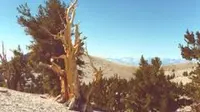
Route 168 leaves U.S. 395 at Big Pine, on the floor of the Owens Valley at about 4,000 feet, and climbs east into the White Mountains. Desert plants line the first miles, and in spring wildflowers bloom on the plains. Pinyon-juniper woodland follows, then mountain forest, then wind-carved alpine growth near the crest. The byway turns north onto Forest Road 4S01, White Mountain Road, and ends at the Patriarch Grove, 11,200 feet above sea level by the Sierra Nevada Geotourism guide’s figure. The route was designated a National Forest Scenic Byway on July 13, 1992. It is paved as far as Schulman Grove and gravel beyond, and the guide estimates two hours of driving.
The White and Inyo ranges form one fault block, and Route 168 runs through the narrow gap between them toward Deep Springs Valley and Nevada. Along the way the road crosses layers of hardened sediment holding fossils of prehistoric plants and animals, among them the oldest known trilobite imprints. White Mountain Road turns off to the left 13 miles from 395. Grandview Campground lies on the way up at 8,600 feet, with 23 first-come sites spaced well apart, and the Inyo County visitor guide reports a clear view of the Milky Way there in summer. It is the only camping on the climb, because camping and campfires are barred inside the Ancient Bristlecone Pine Forest. Farther on is the Sierra View Overlook. There is no water, fuel, or food on the mountain; the nearest is back in Big Pine. Road cyclists ride the pavement to the visitor center, a climb the county guide says is commonly ranked among the five hardest in California. A rougher way up, Silver Canyon Road, starts north of Bishop near the Laws Railroad Museum. Its 11.5 miles call for a low-range, high-clearance four-wheel drive and an experienced driver.
Schulman Grove and the hidden tree
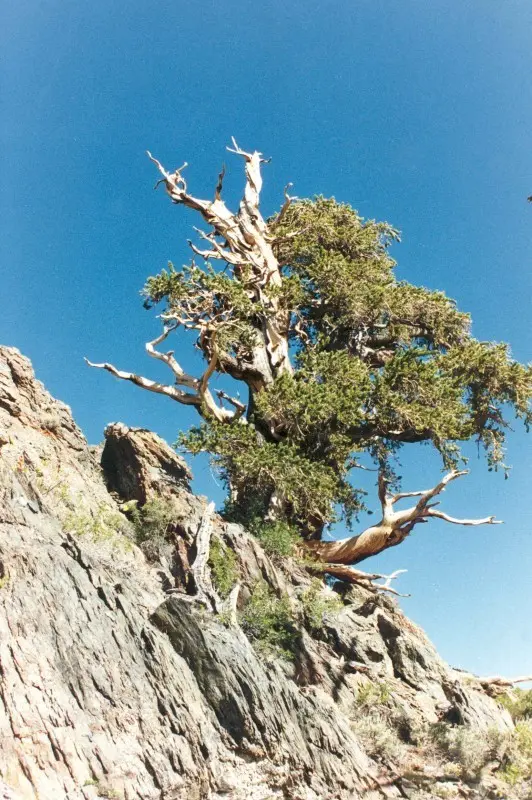
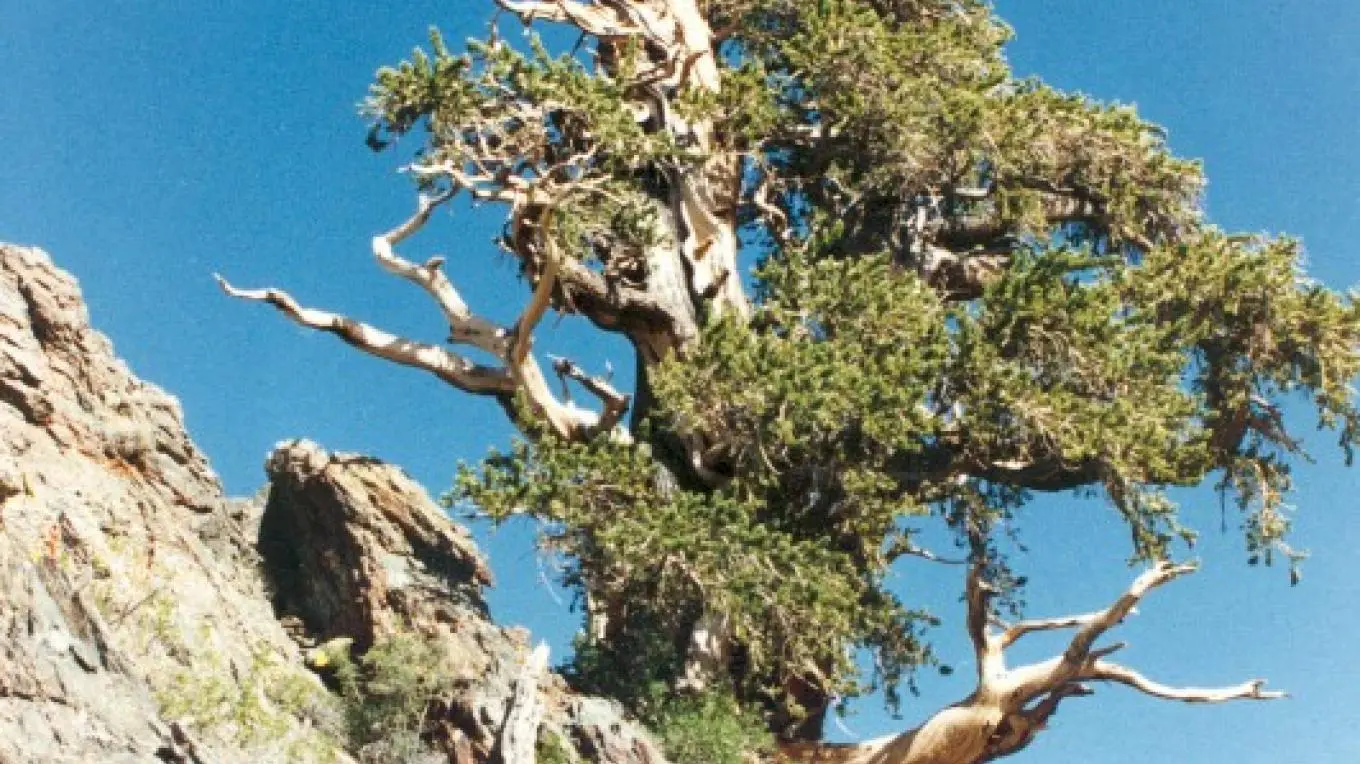
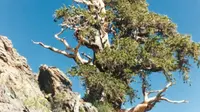
The bristlecones begin at around 9,000 feet. Ten miles up White Mountain Road, the pavement ends at Schulman Grove and the Ancient Bristlecone Pine Forest Visitor Center, open in summer, with gifts, information, and interpretive programs. The county guide puts the summer programs at 11 a.m. and 2 p.m., with weekend programs in spring and fall. Old trees stand within sight of the parking area, the deck, and the boardwalks. Their wood is weathered, twisted, and banded with color. Edmund Schulman called them “living ruins” in 1958. Their trunks, he wrote, were “little more than eroded stumps.” Each was kept alive by a strip of bark-covered tissue a few inches wide, running from partly bare roots to a thin crown. Bristle-tipped cone scales give the tree its name. In one season a single tree may hold last year’s dry brown cones, purple cones nearing maturity, and creamy male cones at the branch ends.
The Forest Service lists two self-guided trails from the grove, and the geotourism guide counts three. The forest historian Thomas J. Straka names the Discovery Trail, which leads into Schulman Grove, and the Methuselah Trail, which leads to Methuselah Grove. Methuselah stands somewhere along the latter. Its exact location is kept secret for the tree’s protection. Its age depends on whose figure is used. Schulman put it at more than 4,600 years when he found it. The geotourism guide says it is approaching 4,800. The Inyo County guide calls it confirmed at almost 5,000 and the oldest living thing on Earth. A note in Straka’s 2008 article says Methuselah has three trunks, and only one of them, the “Junior” stem, still lives. That stem is 50 feet tall, and a single strip of bark feeds its crown. Such trees, a 1958 caption explained, “cautiously add no more than an inch to their girth in a century.”
The groves are day-use only and close from 10 p.m. to 6 a.m. Hikers keep to the trails, dogs stay on leash, and collecting from the pines is prohibited.
Gravel to the Patriarch
The Forest Service gives the distance north to the Patriarch Grove as 13 miles of dirt road; Straka gave it as 12. The Historical Marker Database recommends a high-clearance vehicle. An early start allows both groves in one day. The road forms the upper boundary of the White Mountain Research Natural Area, a 2,303-acre tract established in 1953, where scientists have dated bristlecones since the early 1950s. A short trail with rest benches runs a few hundred meters into it. Bedrock beside the road ranges from Precambrian Reed dolomite and the calcareous Wyman formation to Jurassic quartz monzonite, and no Pleistocene glacier reached the area. Precipitation averages about 14 inches a year, and the mean annual temperature is about 34 degrees.
The Forest Service describes the Patriarch Grove’s appearance as a moonscape. It has two short trails, a picnic area, and a restroom. The Patriarch is a multistemmed bristlecone 37 feet around at the base, listed as the largest of its kind. Schulman described it as a single root system carrying a grove-like cluster of stems whose top had failed from starvation. A half-mile loop at 11,300 feet leads to a marker headed “In Memoriam to A.E. Noren.” The Big Pine Civic Club, the Forest Service, and the Inyo and Mono County boards of supervisors erected it in 1974. It stands on the Mono County side.
A ranger and a rumor
Al Noren, the White Mountain District Ranger, found the Patriarch in 1948, according to the marker. In 1951 the American Forestry Association added it to its List of Big Trees. Noren sent samples from the tree to the University of California, Straka writes, and word of the findings eventually reached Edmund Schulman in Arizona.
Schulman was born in Brooklyn in 1908. In 1932 he was hired as an assistant to Andrew E. Douglass, the University of Arizona astronomer who founded modern tree-ring dating. From 1939 on, Schulman spent every summer hunting the oldest living trees. He found an 860-year-old ponderosa pine in Bryce Canyon and a 975-year-old pinyon in central Utah. At the very end of the 1952 season, above Sun Valley, Idaho, he cored a limber pine with one side dead. That night, by flashlight at camp, he found some 1,400 rings in the 16-inch core; the tree proved almost exactly 1,650 years old. The next summer he returned with Frits W. Went of Caltech. They cut the pine down for laboratory study, loaded much of it into their truck, and set off for Pasadena. On the way they detoured into the White Mountains to check a rumor of old trees. “Often such rumors had turned out to be unfounded,” Schulman wrote. “But not this one!”
The Patriarch itself turned out to be about 1,500 years old, with the dull ring growth typical of upper timberline. On drier sites nearby, Schulman found trees of the same age that recorded drought years more clearly. Sampling them was hard, because the old stems were so distorted that the oldest wood could lie at right angles to the living strip. “The available borers were not designed to go around a bend!” he wrote. He solved the problem with a series of borings around the stem, moving through successively older wood. In November 1953, at Noren’s urging, the Forest Service declared 2,330 acres of the bristlecone forest a protected area. Noren retired the next year after 35 years with the Forest Service.
The B.C. barrier
By 1956 Schulman knew he had trees in the 4,000-year class. His precise dating reached back to A.D. 250, but the following winter’s laboratory work added only about 200 years. His team began calling the wall “the B.C. barrier.” With a National Science Foundation grant, he spent the summer of 1957 in the driest parts of the forest, assisted by the geologist M. E. Cooley, nicknamed “Spade.” There, where the dry forest edge met calcareous rock and rain probably came to no more than 10 inches a year, they found the slope Schulman named Methuselah Walk. They soon found Pine Alpha, the first tree measured at more than 4,000 years.
The team sorted the oldest trees into three rough forms. The “massive slab” was one great mass of wood, like Pine Alpha. The “eagle’s aerie” carried many spreading snags. The “pickaback” had several stems joined above the base, which the team read as a Junior-Dad-Granddad sequence. One evening Schulman put the long cores from a tree they had been calling Great-granddad Pickaback under the microscope. As he counted the rings, he realized it was older than 4,000 years, and he named it Methuselah. Prometheus, an older tree, was about 4,900 years old when it was felled in 1964.
Schulman died of a heart attack in January 1958, at 49. About two months later, National Geographic published his article “Bristlecone Pine, Oldest Known Living Thing.” In it he counted 17 trees dated at 4,000 years or more, nine of them on Methuselah Walk; Straka credits him with more than twenty. Soon after his death the natural area was enlarged to 27,160 acres and named the Ancient Bristlecone Pine Forest, with the Schulman Memorial Grove inside it. The Inyo County guide reports that bristlecone chronologies were later used to recalibrate radiocarbon dating. “It is said that these trees rewrote history,” the guide adds.
The 1958 article also records an exchange over a photograph of one of the trees. A friend of Schulman’s asked, “Don’t you wish we could all live to be that old?” His wife replied, “Who wants to be 4,000 years old, if she looks like that!” Schulman’s answer followed in print: “But beauty is as beauty does, and to me as a climatologist the bristlecones look good indeed.”
Notable Events
- 1948Al Noren discovered the Patriarch, subsequently listed as the largest bristlecone pine. hmdb.org
- 1951The Patriarch was added to the American Forestry Association's List of Big Trees as the largest bristlecone pine. hmdb.org
- 1953At the end of the summer of 1953 Edmund Schulman detoured to the White Mountains on his way home to view the rumored old pines. foresthistory.org
- 1953At Ranger Noren's urging the Forest Service declared the 2,330 acres of bristlecone forest on the Inyo National Forest a protected area. foresthistory.org
- 1953The county page states that Edmund Schulman discovered the trees while researching dendrochronology. inyocountyvisitor.com
- 1954Al Noren retired as White Mountain District Ranger after 35 years with the Forest Service. hmdb.org
- 1957Schulman spent the summer of 1957 in the driest parts of the bristlecone pine forest and discovered what would become known as Methuselah Walk. foresthistory.org
- 1957In short order Schulman discovered Pine Alpha, the first tree to measure more than 4,000 years of age. foresthistory.org
- 1958Schulman died from a heart attack at age 49, about two months before his National Geographic article appeared. foresthistory.org
- 1958Schulman's discovery of more than twenty 4,000-year-old trees and the publication of his article in National Geographic garnered broad public interest in the locality and its trees. foresthistory.org
- 1974Big Pine Civic Club, Forest Service and Inyo and Mono County Boards of Supervisors erected the memorial marker. hmdb.org
- 1992The byway follows California State Route 168 and Forest Service Road 4S01 (White Mountain Road) and was designated a National Forest Scenic Byway. sierranevadageotourism.org
People
- Alvin Noren, Forest ranger who identified the multistemmed bristlecone he named the Patriarch and sent samples from the tree to the University of California.
- Edmund Schulman, Brought to the area by Noren's efforts, leading to establishment of the natural area and forest.
- Al Noren, White Mountain District Ranger; discovered the Patriarch and helped bring Schulman to the area (retired in 1954 after 35 years with the U.S. Forest Service).