

Ancient Bristlecone Pine Forest (Schulman Grove Discovery Trail)
Big Pine, Inyo County, California. Day use only; Open during the summer only.
Details

- Where
- White Mountain Road Highway 168 Bishop, Big Pine, CA 93514. Directions
- When
- Open everyday 9 a.m. - 3:30 p.m.
- Getting there
- From Highway 395 just north of Big Pine, go east on CA 168 for 13 miles. Turn left north on White Mountain Road to the Bristlecone Pine Forest. In 10 miles, turn right to the Schulman Grove parking lot.
- Fees
- $3.00 per person with a maximum of $6.00 per car. Children under 18 are free. Interagency Passes are accepted.
- Access
- There are no services beyond Big Pine, so fill up on gas and bring water. This area does not have cell phone service; do not depend on cell service for navigation or communication.
- Phone
- (760) 873-2500
- Website
- fs.usda.gov
- Managed by
- Inyo National Forest.
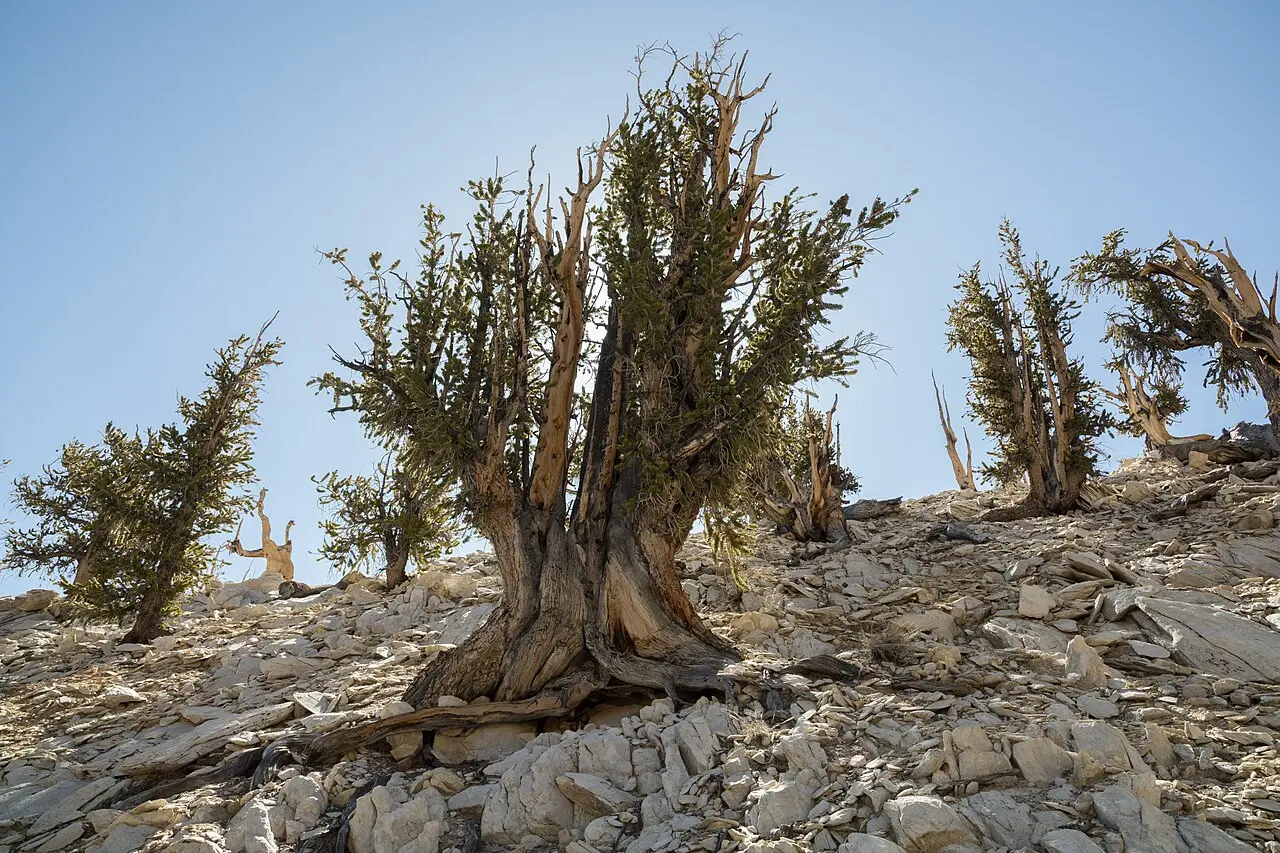
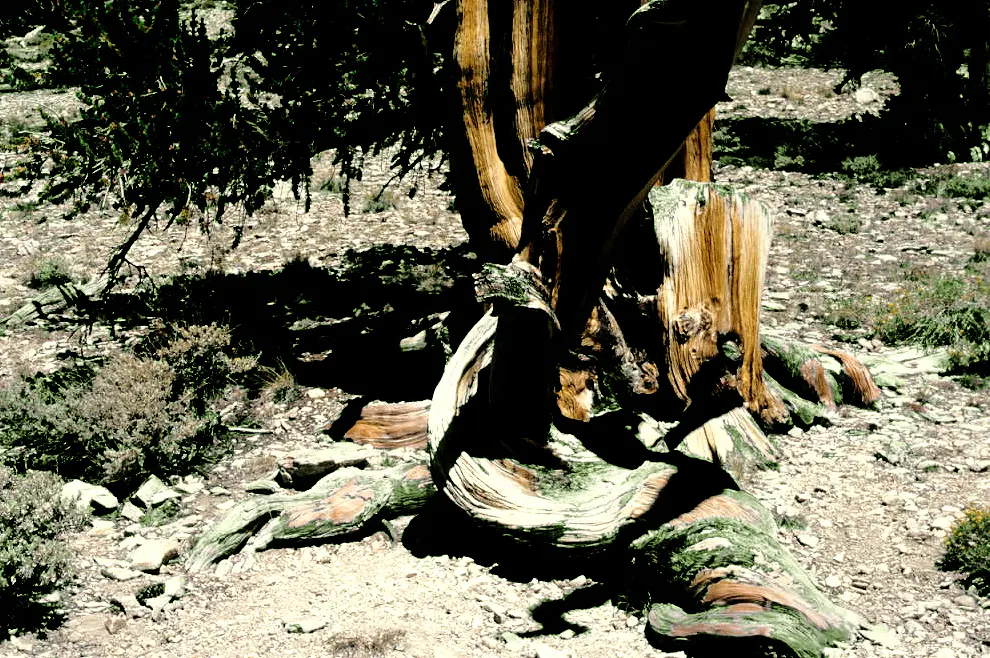
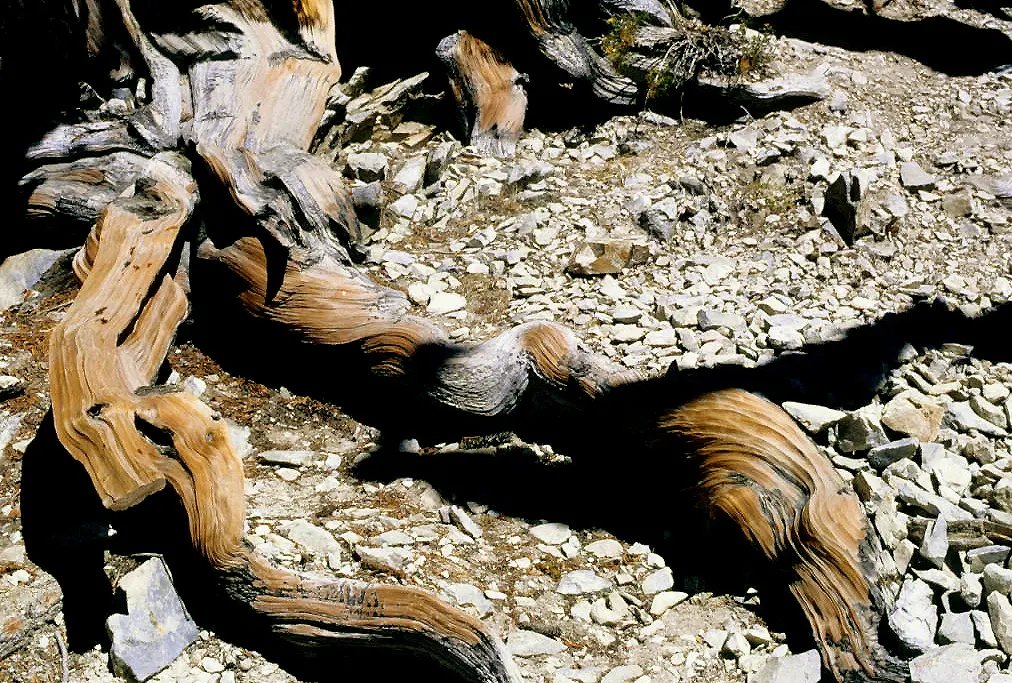
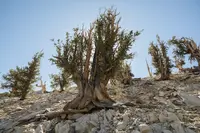
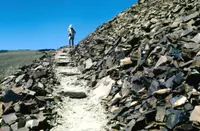
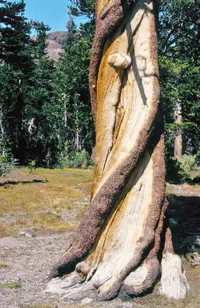
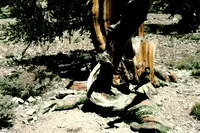
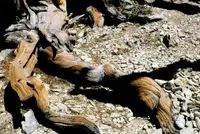
Bristlecone pines stand at the edge of the parking lot at Schulman Grove, close enough to see from the car door. They also line the boardwalks around the visitor center. Their wood is weathered and twisted, the tops spiky and bare, the branches gnarled and spiraling outward and upward. The grove sits at about 10,000 feet in the White Mountains of Inyo County. The range overlooks Owens Valley to the west and the Great Basin of Nevada to the east. It lies in the rain shadow of the Sierra Nevada, and Sierra Forever counts it among the driest places in the United States.
The road up starts on Highway 395 just north of Big Pine. It runs east 13 miles on CA 168, then north 10 miles on White Mountain Road to the grove turnoff. It is paved and winding, gains 6,000 feet, and takes about 45 minutes. There are no services past Big Pine and no dependable cell signal. The Inyo National Forest has stated it flatly: “No piped water. No natural water sources in this area.” The visitor center has no fountain or spigot, but the bookstore sells bottled water.
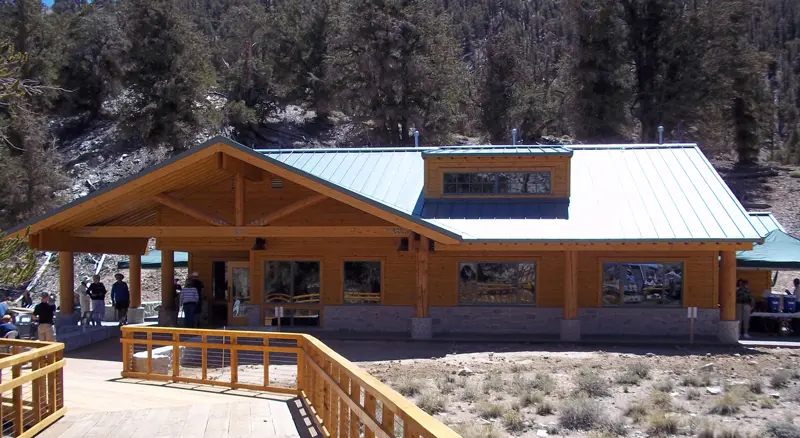
The visitor center is open in summer. It has exhibits and a film about the oldest trees on Earth and the researchers who worked out their ages. In summer, rangers and staff give interpretive programs, and in spring and fall the programs move to weekends. Sierra Forever runs the bookstore, which stocks books and maps of the region, and its sales help pay for the programs. The building is wheelchair accessible. There are picnic tables at the grove.
The grove is for day use only, open 6 a.m. to 10 p.m., typically from mid-May through September. Camping and campfires are not allowed anywhere in the forest. The nearest campground is Grandview, five miles below at more than 8,600 feet. In winter, snow closes White Mountain Road at the Sierra View Gates, and visitors hike, snowshoe, or ski the rest of the way. In summer, experienced cyclists ride the road up to the visitor center.
Three loops from the parking area
All three trails begin and end at the parking area. Each has interpretive signs and rest benches.
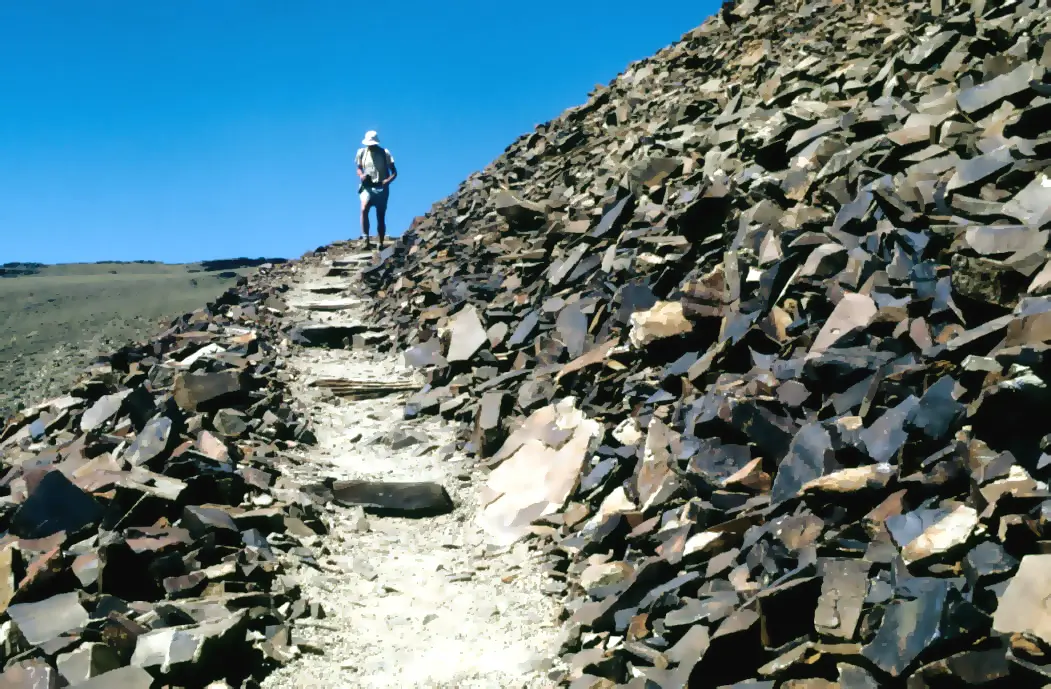
The Discovery Trail is a loop of about a mile through Schulman Grove; Sierra Forever puts it at a little under. On the left of the trail stands a Forest Service marker to Dr. Edmund P. Schulman. It says that the bristlecone tree-ring record, counting living and dead wood, “now extends back nearly 10,000 years,” and that the significance of his discovery “can scarcely be overstated.”
The Methuselah Trail is a 4.5-mile loop with 900 feet of cumulative elevation change. It passes through Methuselah Grove, and some of its benches face long views. The Methuselah Tree stands along this trail, but no sign points it out. Sierra Forever says it is left unmarked to protect its identity.
The Bristlecone Cabin Trail is a 3.5-mile loop. It passes the old miners’ cabins and mine entrances of the Mexican Mine, along with many bristlecones and limber pines. It connects with the Methuselah Trail.
Beyond Schulman Grove, a dirt road runs north to the Patriarch Grove. The Forest Service puts the distance at 13 miles; Sierra Forever and a 2008 article in Forest History Today put it at 12. The Patriarch Tree, the largest bristlecone pine, grows there. The grove has two short trails, a picnic area, and a restroom. The Forest Service describes its “moonscape appearance.” Sierra Forever advises carrying a spare tire, and notes that AAA will not tow a vehicle off pavement.
Purple cones and white dolomite
The trees grow in white, rocky dolomite. This soil is alkaline and lacks mineral nutrients many other plants need. The groves are scattered at or just below tree line along the California–Nevada border, in cold, dry soil, high wind, and short growing seasons.
Limber pines share the same slopes, and the two are easy to confuse. A bristlecone’s needles are about an inch long, grow in bundles of five, and can extend a foot or more back along the branch, like a bottle brush. Its new cones are purple and turn brown in two years. The tips of their scales carry claw-like bristles, which give the tree its name. Limber pine needles also come in fives, but they run 1.5 to 3 inches and cluster toward the branch ends, and the cones have no bristles. Limber pines can live up to 2,000 years.
California Watchable Wildlife lists the birds that perch in the branches: mountain chickadees, hermit thrushes, mountain bluebirds, and violet-green swallows. Clark’s nutcrackers, pinyon jays, and common ravens are abundant. Golden eagles and American kestrels hunt the slopes for jackrabbits, chipmunks, golden-mantled ground squirrels, fence lizards, and grasshoppers. Desert bighorn sheep and mule deer also range here. Bristlecones and limber pines are protected, and collecting downed wood is prohibited.
A detour from Sun Valley
Edmund Schulman was born in 1908 and raised in Brooklyn. In 1932 he was hired as an assistant to Dr. Andrew E. Douglass, a University of Arizona astronomer and the founder of modern dendrochronology. Douglass was studying tree rings for a link between sunspot cycles and climate. Schulman later took degrees at Harvard and returned to Arizona’s Laboratory of Tree-Ring Research. Thomas J. Straka, writing in Forest History Today in 2008, contrasts the two men: “Where Douglass was Victorian and intuitive, Schulman was modern and quantitative.”
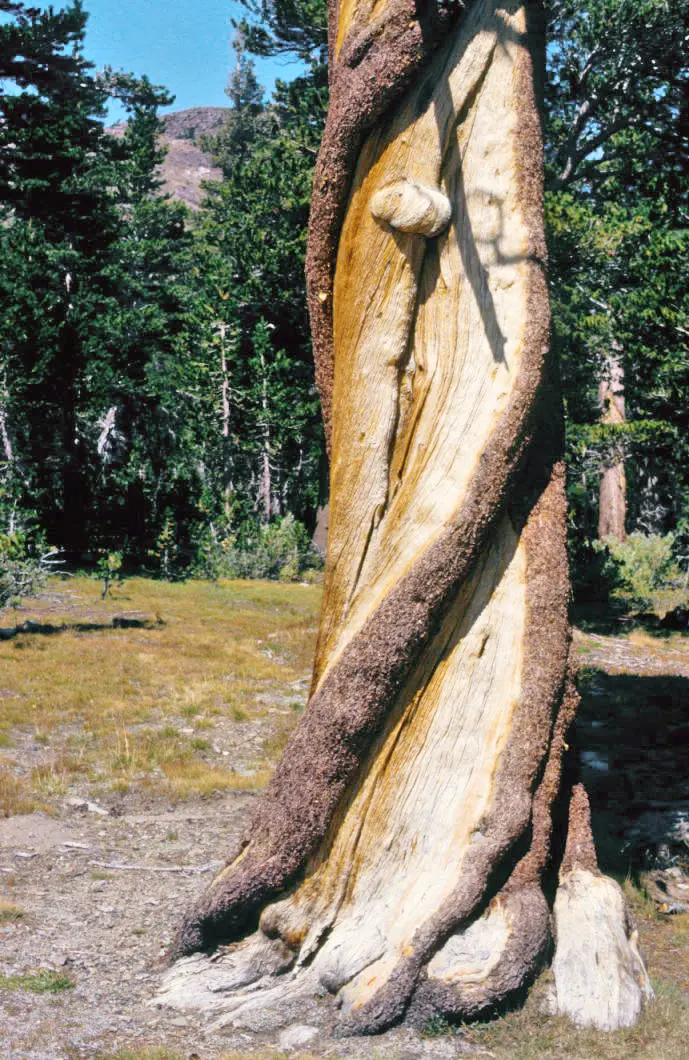
From 1939 on, Schulman spent every summer in the field looking for the oldest living trees. At first he advised researchers to avoid trees in “highly exposed places” and to look for straight, cylindrical trunks. He later found the opposite held on both counts. The oldest trees grew under the hardest conditions, and he could work with twisting trunks. He called the idea “longevity under adversity.”
A few years before 1953, Forest Ranger Alvin Noren found a many-stemmed bristlecone 37 feet around at the base. He named it the Patriarch and sent samples to the University of California. Word reached Schulman. At the end of the summer of 1953, on his way home from Sun Valley, Idaho, where he had found a 1,650-year-old limber pine the year before, he detoured to the White Mountains to see the rumored old pines. “Often such rumors had turned out to be unfounded,” he wrote later. “But not this time!” The Patriarch turned out to be about 1,500 years old, but the cores he took that summer kept him working in the range.
In November 1953, at Noren’s urging, the Forest Service set aside 2,330 acres of bristlecone forest as a protected area.
Great-granddad Pickaback
By 1956, Schulman knew the bristlecones could include trees more than 4,000 years old. Until then, Straka writes, researchers spoke of the “B.C. Barrier”: no known tree was older than the birth of Christ. Schulman spent the summer of 1957 in the driest parts of the forest, among calcareous rock outcrops at the far dry edge of the trees. There he found the stand later called Methuselah Walk.
The sources place the next find differently. The marker on the Discovery Trail says Schulman was searching this grove in 1953 and found Pine Alpha, the first tree documented at 4,000 years. Straka places Pine Alpha “in short order” after the 1957 season began.
Schulman’s team sorted the trees into three forms. The “massive slab” was one great mass of wood. The “eagle’s aerie” had many diverging snags. The “pickaback” had several stems of different ages, which the team called a Junior-Dad-Granddad sequence. One evening Schulman put the long cores from a tree they called Great-granddad Pickaback under the microscope. As he counted, he saw the tree was past 4,000 years. He later estimated it at more than 4,600 and named it Methuselah. Today, Sierra Forever gives its age as over 4,850 years, and the visitor center says the oldest of the species is more than 4,800.
Straka gives a few more details about Methuselah: it has three trunks, only one of them alive, and a single strip of bark feeds the crown. In 1964 a tree called Prometheus was felled, and it was about 4,900 years old.
Schulman died of a heart attack in January 1958, at 49. His article in National Geographic appeared that March, about two months later, and drew wide public attention to the trees. Straka notes that several bristlecone researchers died young. Michael P. Cohen suggests years of high-elevation work may have contributed.
On April 11, 1958, Forest Service Chief Richard McArdle designated 27,000 acres of the Inyo National Forest as the Ancient Bristlecone Pine Forest. Straka gives the figure as 27,160 acres, an expansion of what had been the White Mountains Natural Area. One section was named the Edmund Schulman Memorial Grove. A photograph shows McArdle signing the order beside Melville Bell Grosvenor.
Schulman’s successors kept extending the record using dead wood. Dr. Wesley Ferguson, who had worked under him, carried the continuous chronology back 8,000 years. Dr. Henry Michael searched the range for old wood to push it further.
Two buildings at Schulman Grove
The first visitor center was built in 1995 for $500,000. It was a log-cabin-style building with a theater. In September 2008, fire destroyed it. Tom Stienstra of the San Francisco Chronicle reported that week that a state fire marshal, a Forest Service special agent, and county investigators were working to determine whether it was arson. Jeff Hollowell, the county’s lead investigator, said the cause and starting point had not been determined. A man had been taken into custody but not charged. The forest itself did not burn, and the Discovery Trail stayed open.
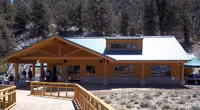
The new visitor center was dedicated on September 1, 2012. The California Native Plant Society’s Bristlecone Chapter reported the old building as lost to arson four years earlier. The grand opening included an art competition dedicated to the memory of Jeffrey Scott, an Eastern Sierra watercolorist who supported the forest.
At the ceremony, two Owens Valley Paiutes gave an invocation in Paiute, with an English translation. Malcolm Hughes of the University of Arizona’s Laboratory of Tree-Ring Research spoke on the trees’ value to science. Connie Millar of the Forest Service’s Pacific Southwest Research Station spoke on the threats to bristlecones as the climate warms.
Notable Events
- 1953At the end of the summer of 1953, on his way home from Sun Valley, Idaho, Schulman detoured to the White Mountains to view the rumored old pines. foresthistory.org
- 1953At Ranger Noren's urging, the Forest Service declared the 2,330 acres of bristlecone forest on the Inyo National Forest a protected area. foresthistory.org
- 1953Schulman searched the grove for old trees to extend his tree-ring chronology; discovery of Pine Alpha made him the first to document 4,000-year-old trees. hmdb.org
- 1957Schulman spent the summer of 1957 in the driest parts of the bristlecone pine forest, where he discovered what would become known as Methuselah Walk. foresthistory.org
- 1958Schulman's discovery of more than twenty 4,000-year-old trees and the publication of an article in National Geographic in March 1958 garnered broad public interest in the locality and its trees. foresthistory.org
- 1958The Ancient Bristlecone Pine Forest was designated to honor Schulman's scientific contributions. sierraforever.org
- 1995The log-cabin-style visitor center with a theater was built at a cost of $500,000. sfgate.com
- 2012The previous building was destroyed by an arson fire four years before the new center's dedication. bristleconecnps.org
People
- Connie Millar, USFS Pacific Southwest Research Station scientist who spoke at the dedication about climate threats to bristlecones.
- Malcolm Hughes, University of Arizona Laboratory for Tree Ring Research speaker at the dedication on the scientific value of bristlecones.
- Alvin Noren, Forest Ranger; identified and named the Patriarch, and urged protection of the bristlecone forest.
- Edmund P. Schulman, dendrochronologist; discovered Pine Alpha, the first tree to measure more than 4,000 years of age (1908-1958).
- Dr. Edmund P. Schulman, Searched this grove for old trees to extend his tree-ring chronology (1953).
- Jeff Hollowell, Lead investigator for Inyo County investigating the visitor-center fire; said the cause and starting place had not been determined.
- Andrew Ellicott Douglass, Referred to as the founder of modern dendrochronology; theorized that sunspot-driven weather changes could be recorded in tree rings (1867-1962).
- Dr. Edmund Schulman, First dendrochronologist to core a 4,000-year-old tree, located in Schulman Grove; the area is named in his honor (1908-1958).
- Dr. Henry Michael, Scientist in dendrochronology and anthropology who searched the White Mountains for old wood to extend the continuous tree-ring chronology.
- Dr. Wesley Ferguson, Worked under Schulman extending the bristlecone chronology back to 8,000 years; researched precipitation records (1922-1986).
- Richard McArdle, U.S. Forest Service Chief who designated the Ancient Bristlecone Pine Forest (1958).
- Jeffrey Scott, Eastern Sierra watercolor artist and forest supporter; opening art competition dedicated to his memory.
- John Louth, Inyo National Forest contact for the visitor-center opening art competition.
- Susie Fix, Eastern Sierra Interpretive Association contact for the visitor-center opening art competition.