Holbrook
Navajo County, Arizona. County seat.
Holbrook is the seat of Navajo County in northeastern Arizona, a railroad town that the Hashknife Outfit and its Texas cattle turned into a cow town.1,2
Details
Point at a dot to see the place.Tap a dot to see the place. Road map of Holbrook.
In Holbrook
- Rainbow Rock Shop DinosaursHolbrook · Dinosaur statues: seven brontosaurusesOwner Adam Luna built each dinosaur as a steel skeleton covered with rebar netting and coated with concrete skin.

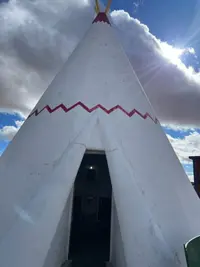
- Wigwam Village Motel #6Holbrook · MotelOne of the most iconic landmarks along historic Route 66; the motel offers a nostalgic journey back to the golden age of American road trips, with distinctive teepee-shaped units.
The Calendar

History
Horsehead Crossing and Berado’s Station
Holbrook, the seat of Navajo County, stands in northeastern Arizona 30 miles east of Petrified Forest National Park.1,2,5 The place was first known as Horsehead Crossing, a stopping point for travelers bound into the interior of the Arizona Territory.6 The 1940 Federal Writers’ Project guide says the first settler was said to have been Juan Padilla, who came with an ox team in 1879 and set up a saloon with a Spaniard, Berado, in charge.1 Berado and his wife added a store and an eating house, and when a busybody put up a sign reading “No Money, No Eat,” Senora Berado wrote underneath, “No money, eatie anyhow.”1 By the guide’s account, the partner of Henry Huning later got Berado drunk on his own whisky and carried the senora to Huning’s home at Show Low, and Berado soon abandoned his home and store and left the country.1 The Arizona Memory Project gives the trader’s name as Frayde Berado and says that by 1881 the first tracks ran west from what had become known as Berado’s Station.6
Named for the Railroad’s Engineer
The state transportation department’s account says the town was named for the railroad’s chief engineer, Henry Randolph Holbrook, on Sept. 24, 1881, the day the Atlantic and Pacific Railroad completed its line through town.2 The Arizona Memory Project instead says John W. Young renamed the station for H.R. Holbrook in 1882.6 The 1940 guide adds that the Atlantic & Pacific later became the Santa Fe.1 Holbrook had fought for the Union Army in the Civil War and worked as an engineer on the Kansas Pacific, the Southern Colorado, the Boulder Valley, and the Denver and South Park.2
The Hash Knife Outfit
The 1940 guide says that shortly after the railroad came in 1881 a company was formed to graze the right-of-way land grants, forty thousand head of cattle were turned loose on the plains to the west, and within a year Holbrook was a tough little cow town.1 The Aztec Land and Cattle Company, formed under the laws of New York state in 1884 according to a historic resource survey of the town, was called the Hash Knife outfit for the shape of its brand and drove cattle to Holbrook from Texas.1,7 The county’s history page calls the Aztec North America’s third largest ranch and says its Eastern backers bought 1 million acres from the railroad at 50 cents an acre and brought 33,000 longhorn cattle and 2,200 horses from Texas.3 In the guide’s telling, the cowboys galloped through Holbrook with blazing guns and shot out the lights at dances, and several Hash Knife men were known to be killers.1
Sheriff Owens at the Blevins House
On September 4, 1887, Sheriff Commodore Owens went alone to the Blevins house on Central Street, a white frame structure, and demanded the surrender of Andy Cooper, wanted on a warrant as a cattle rustler.1 Cooper, one of the Blevins brothers, had changed his name when he came to Arizona because he was wanted for murder in Texas.1 In the fight Cooper was mortally wounded, his 16-year-old brother Sam Houston Blevins and Mose Roberts of the household were killed, and John Blevins was wounded.1 The historic resource survey names the Blevins house as a prominent building in the oldest neighborhood, where few intact historic buildings remain.7
The Courthouse of 1898
Navajo County was formed on March 21, 1895, as the final act of the Territorial Assembly before it adjourned at midnight, and Holbrook became its seat.3,4 The 1940 guide says that until 1914 Holbrook was said to be the only county seat in the United States without a church.1 The courthouse at the northeast corner of East Arizona Street and Navajo Boulevard went up in 1898, three stories of rough stone in the Richardsonian Romanesque style, and held the county’s courts until 1976.4,8 Its basement jail cells came pre-assembled from St. Louis by train.4 George Smiley was convicted in 1899 of killing his railroad boss, and Sheriff Frank Wattron sent out invitations to the hanging that stirred such protest that President McKinley wired to delay it.4 Wattron answered with black-bordered follow-ups, and Smiley was hanged on January 8, 1900, by the city’s account the only hanging ever in Navajo County.4 Lloyd C. Henning, editor of the Holbrook Argus until it ceased publication on February 4, 1913, also acquired banks and telephone companies and served as clerk of the Superior Court and Mayor of Holbrook.9 The Holbrook News of December 29, 1922, hoped the coming year would bring the finding of oil, in an issue that carried a federal court bankruptcy notice in the matter of the Holbrook Oil Company.10 The courthouse has been on the National Register of Historic Places since 1978, and since 1981 the Navajo County Historical Society has kept a museum there, its old jail hung with inmate artwork.4,8
Within 30 Miles
Measured in a straight line from the town, nearest first.
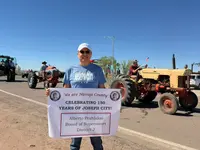
- Joseph City Founders DayJoseph City · Community eventAn evening at the Historical Joseph City Dam, a parade and Saturday activities.
- Jack Rabbit Trading PostJoseph City · Trading postA Route 66 souvenir post west of Joseph City, Arizona, whose yellow "HERE IT IS" billboard has faced the old highway on the same boards since 1949.

- Snowflake Pioneer DaysSnowflake · Community organizationAn Inheritance of Faith. This video provides a narration of the founding of Snowflake Arizona, detailing the Pioneers arriving to the area around the 24th of July.

All the towns of Arizona. More of Arizona: Fairs & Rodeos and Roadside Attractions.
Sources
- Arizona: A State Guide (1940), p. 312 archive.org/details/arizonastateguid00writmiss/page/312
- How the town of Holbrook got its name azdot.gov/adot-blog/how-town-holbrook-got-its-name
- Navajo County History navajocountyaz.gov/496/Navajo-County-History
- Step Back in Time at the Navajo County Museum holbrookaz.gov/step-back-in-time-at-the-navajo-county-museum
- Celebrate 100 Years of Route 66 holbrookaz.gov/celebrate-100-years-of-route-66
- Arizona Memory Project azmemory.azlibrary.gov/nodes/view/247337?showbacklinknav=328273
- A historic resource survey of Holbrook, Arizona azmemory.azlibrary.gov/nodes/view/108355?highlights=eyIwIjoic3RhdGUiLCIxIjoiaGlzdG9yaWMiLCIyIjoicHJlc2VydmF0aW9uIiwiMyI6Im9mZmljZSIsIjUiOiJhcml6b25hIn0%3D&keywords=arizona+state+historic+preservation+office
- Navajo County Historic Courthouse & Museum holbrookaz.gov/things-to-do/holbrook-museum
- Arizona Memory Project azmemory.azlibrary.gov/nodes/view/20456?keywords=&type=all
- The Holbrook News, 1922-12-29 azmemory.azlibrary.gov/nodes/view/131200?highlights=WyJNYXN0ZXIiLCJsaXN0Iiwib2YiLCJzdGF0ZSIsImdvdmVybm1lbnQiLCJwcm9ncmFtcyJd&keywords=Master+list+of+state+government+programs&type=all