_10.jpg)
_07.jpg)
.jpg)
.jpg)

Jack Rabbit Trading Post
Joseph City, Navajo County, Arizona. Trading post; Open since 1949.
Details

- Where
- 3386 Historic U.S. 66, Joseph City, AZ. Directions
- When
- Monday-Saturday 10:00 am - 4:00 pm; Sunday 12:00 pm - 4:00 pm.
- Access
- Walk-in trading post; novelties, keepsakes, and souvenirs; family-operated trading post.
- Phone
- 928-288-3230
- Managed by
- Cindy & Tony Jaquez.
- Established
- 1949.
The billboard and the saddled rabbit
Across Historic U.S. 66 from the store stands a double-sided billboard that greets traffic from the east and from the west. It shows a black jackrabbit in profile on a yellow field, and in red letters, HERE IT IS. The boards are the ones put up in 1949. The family has repainted them many times, and most of its work has gone into the underside, reinforcing the old lumber so it would not have to be replaced. The trading post’s own souvenir magazine explains the spelling: the sign was there to tell travelers they had arrived.
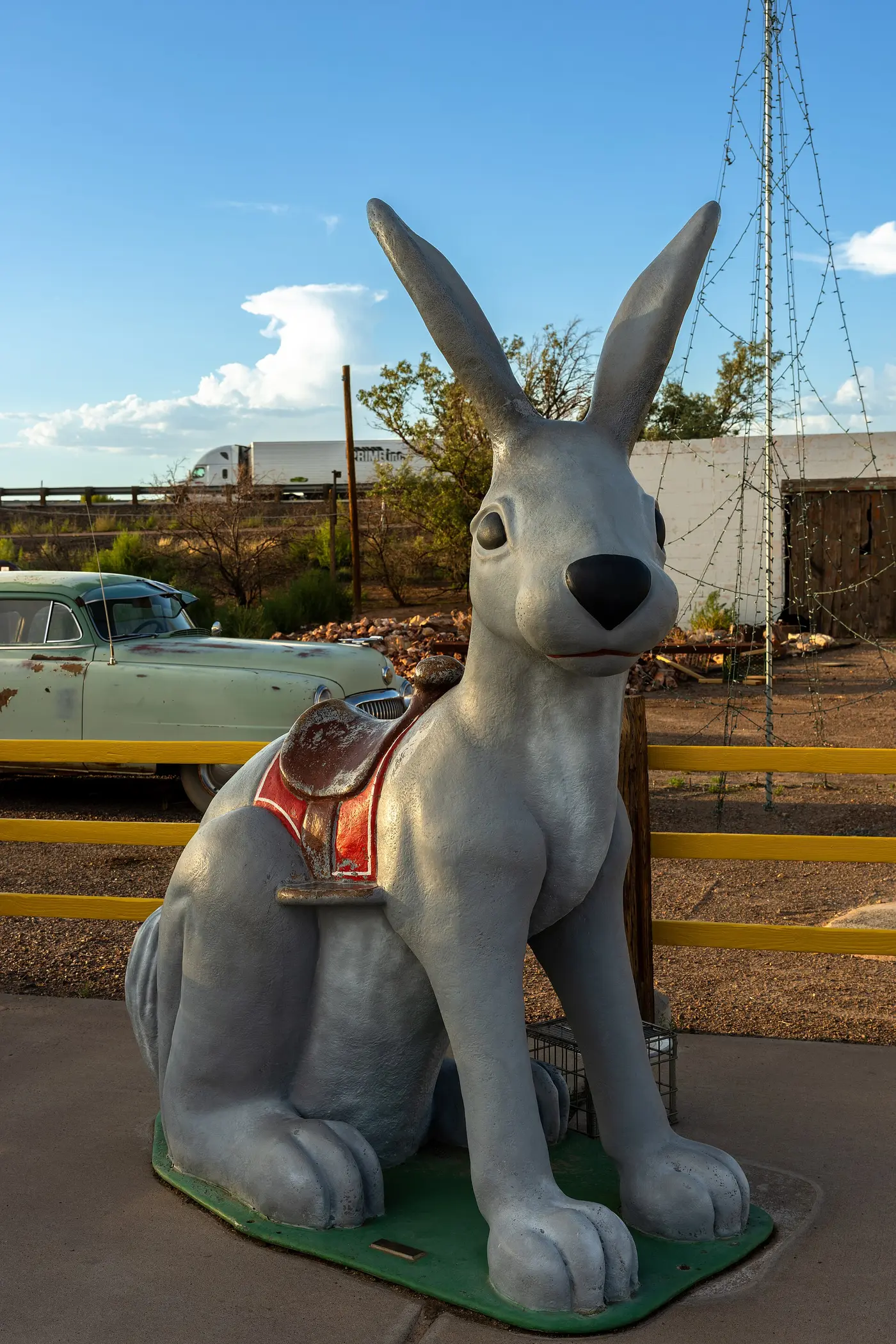
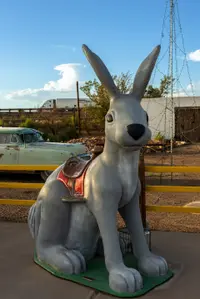
The Jack Rabbit Trading Post sits off Exit 269 of Interstate 40, about five miles west of Joseph City, between Winslow and Holbrook. Out front, a giant fiberglass jackrabbit wears a saddle and sits in a concrete alcove. Roger Naylor, writing for the Historic Route 66 Association of Arizona in 2022, noted its hint of a smile and called it “the Mona Lisa of overgrown jacks.” Visitors climb side steps to the saddle. In June 2019 those steps were rebuilt and the 34-year-old rabbit was repainted during a week-long restoration, ahead of the post’s 70th-anniversary party on July 6.
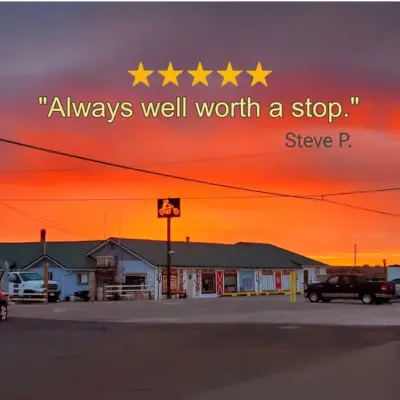
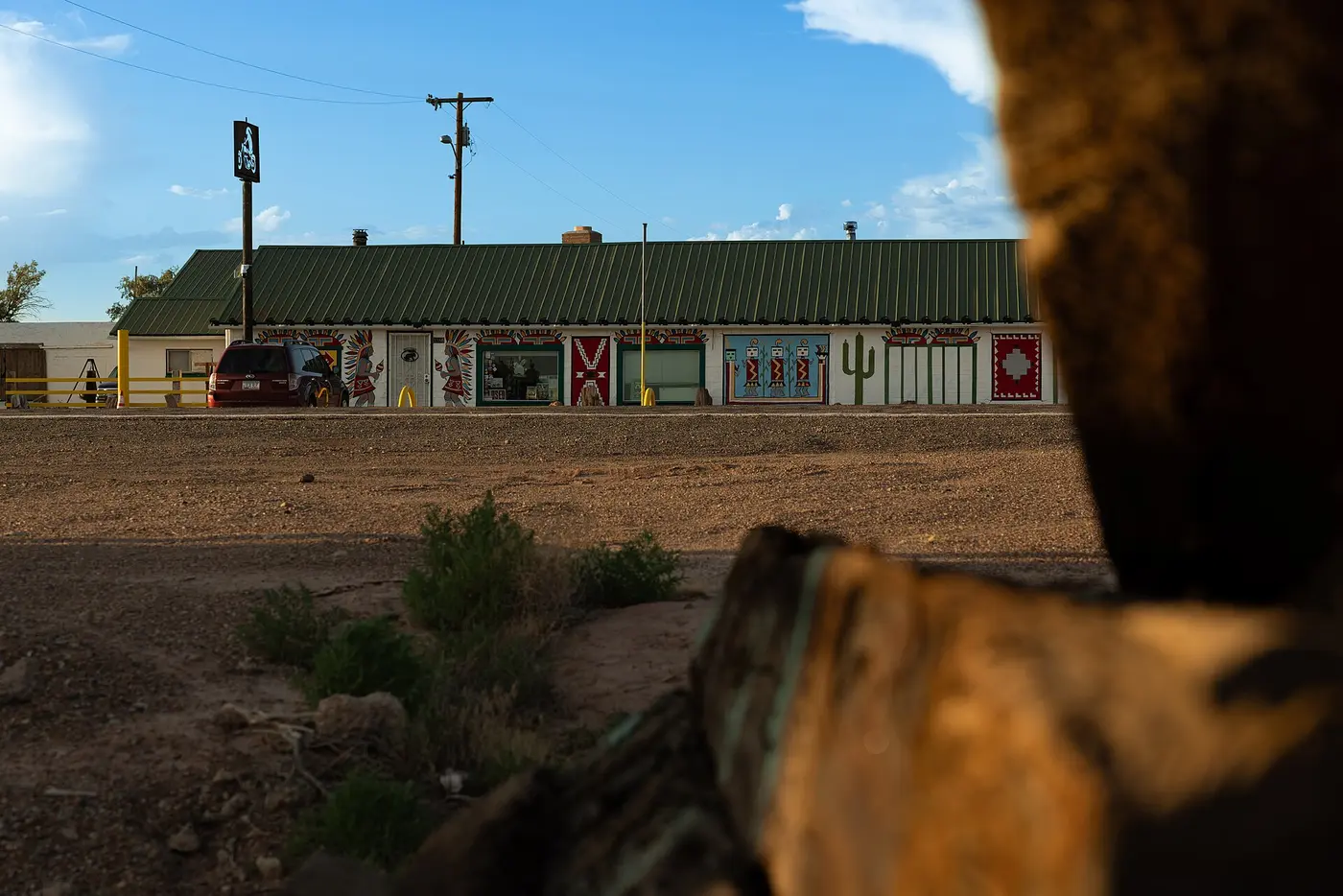
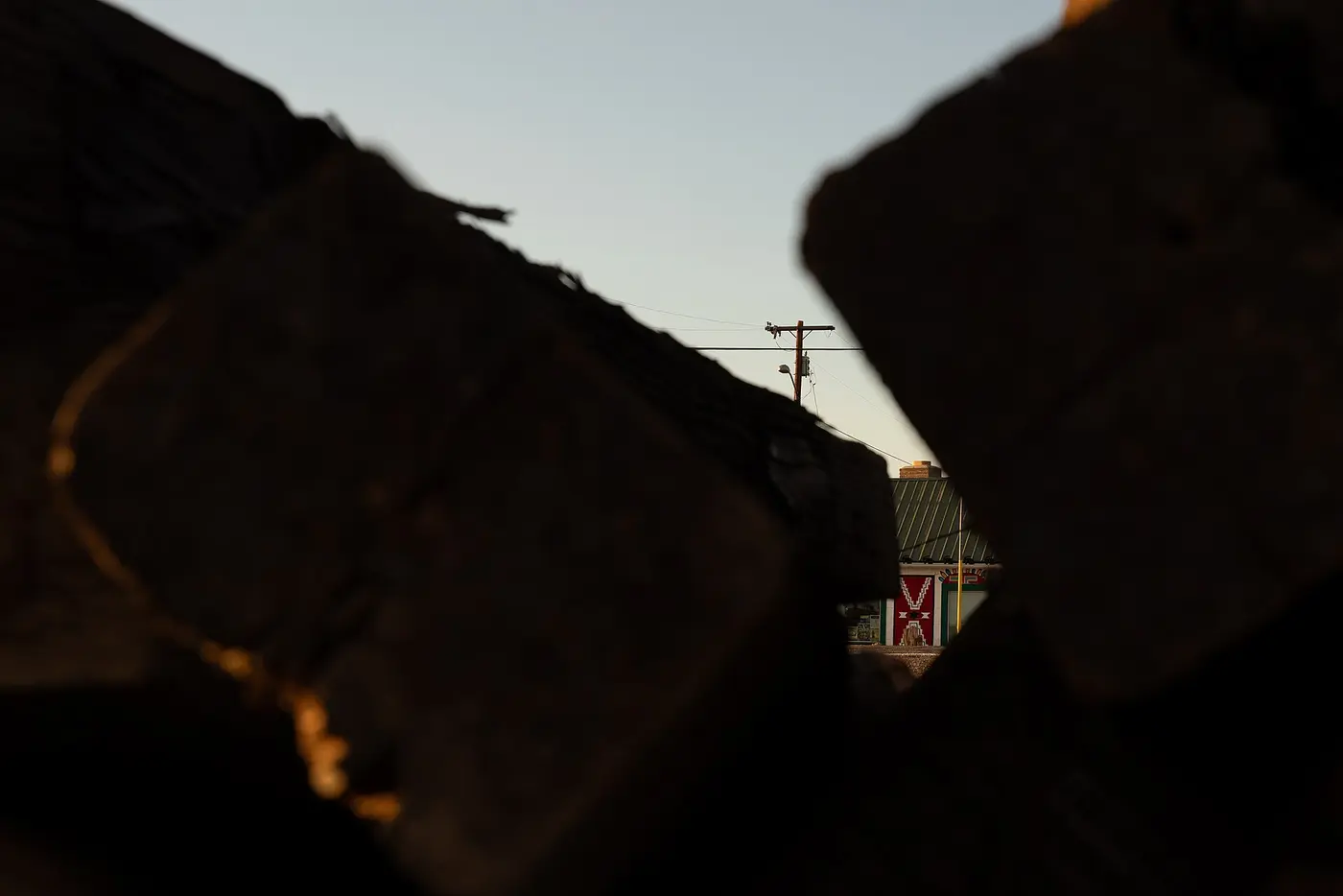
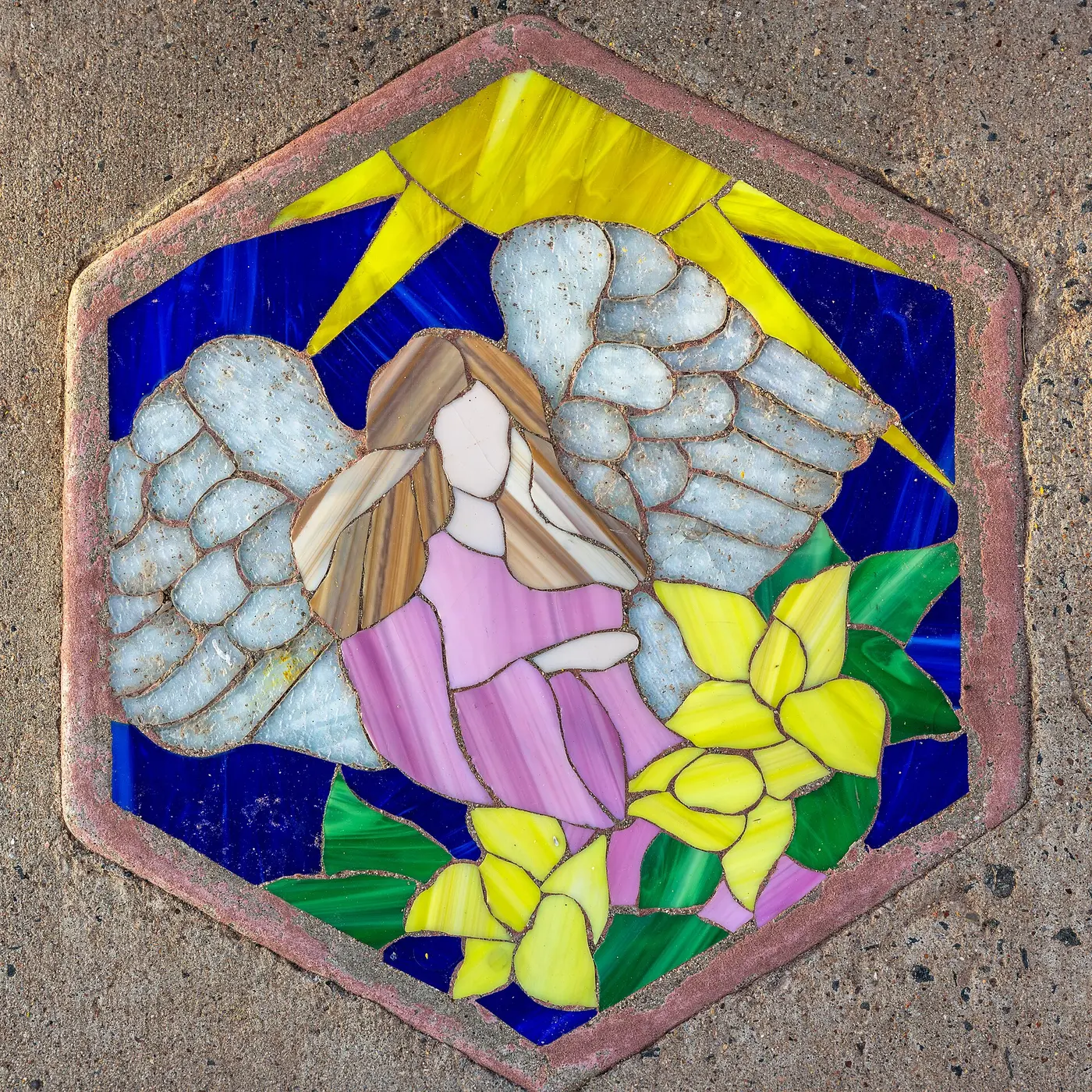
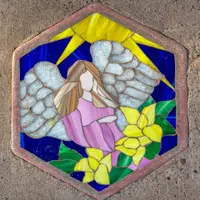
A weathered De Soto sedan at the back of the property draws nearly as many cameras as the rabbit. It belonged to Tony Jaquez’s father, who left it there when he moved back to Mexico after Tony’s mother died. Another small car turned up in storage a day or two after Michael Wallis and a Pixar group stopped by with drawings for the 2006 film Cars. It matches the car on the film’s version of the sign, where a Ford Model T stands in for the rabbit. Photographs taken in 2026 also show a sign of a rabbit riding a motorcycle, glass mosaics of angels, and stacks of weathered railroad ties beside the building.
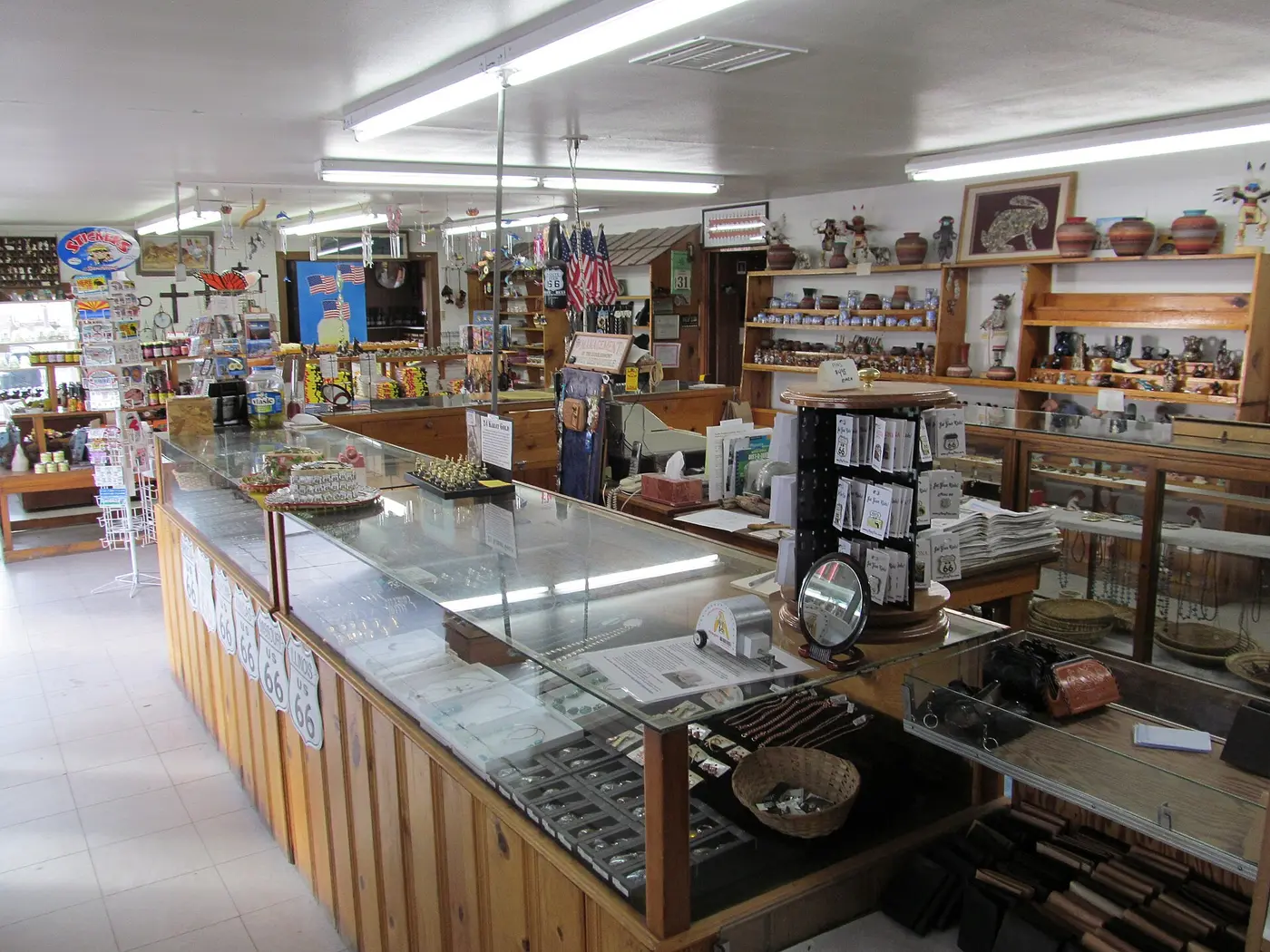
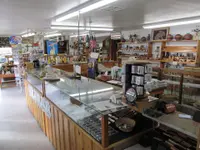
Inside are Route 66 souvenirs, Native American crafts, and a small back-room museum of memorabilia. The counters and shelving are old. In 2006 Cindy Jaquez said the family had thought about modernizing, “but it doesn’t seem right.” The store sells prickly pear hard candy, and Tony makes mileage signs by hand, personalized and signed, in wood at 11 by 36 inches or in metal at 4 by 18. Cindy photographs each buyer with the sign in front of the rabbit and posts the picture online. Cold cherry cider was sold here until the very early 1980s, and she says people still come in asking for it.
A furred rabbit from Tijeras Canyon
The building’s early years are told several ways. The railroad used the site first, and three sources call the building a Santa Fe Railroad structure; ROUTE Magazine says “purportedly.” ROUTE puts a snake farm, the Arizona Herpetarium, in the complex in the late 1930s. The post’s 2019 souvenir magazine instead has a World War II veteran buying the property in 1946 on the GI Bill to start the Arizona Herpetorium. Next came a restaurant and dance hall run by the Rockwell family, which the magazine names the Lucky Mee and dates to April 1948.
James H. Taylor came next. He was born in Brandon, Texas, in 1909, and in the early 1940s he was a flight instructor and airport manager at Clovis, New Mexico. In January 1947 he and his wife, Inez, bought just over half an acre on Highway 66 near Sedillo Hill, east of Tijeras. There they opened the Canyon Trading Post, which had two rental cabins and sold Conoco gas, souvenirs, and taxidermy Taylor made himself. A large jackrabbit covered in real fur, likely one of his own pieces, stood by the road. For 25 cents a child’s picture taken on it was printed as a postcard. Sandra Walton Lee rode it as a girl and, in her mid-80s, told the East Mountain Historical Society that it “smelled funny” and was shedding fur.
Taylor left Tijeras Canyon in 1949. The post’s website says he bought the Arizona building, while ROUTE says he leased it. According to the website, he made the move with a black rabbit statue in the back of a convertible, and so many people admired and photographed it along the way that he set it in the ground for visitors to sit on. Cindy Jaquez told ROUTE a different sequence. She said three rabbits have stood here: a gray, furred one when the store opened in 1949, a second that arrived in a convertible in 1956, and the one standing now. The souvenir magazine says travelers kept asking where the statue was going, and Taylor started answering “Jackrabbit, Arizona.” Legend also has him turning the snake farm’s snakes loose, a story the magazine’s own timeline calls another urban legend.
Taylor needed something to set his store apart from the other roadside posts near Holbrook and Joseph City. He found a partner in Wayne Troutner of Winslow, whose men’s clothing store advertised with the silhouette of a cowgirl and the slogan “For Men Only.” The two men took to the road putting up signs for both businesses. On each Jack Rabbit sign, the distance to the store was painted in as the sign went up. Accounts of how far the signs reached differ: to Springfield, Missouri, nearly 1,000 miles, by the East Mountain Historical Society’s count; from Illinois to California, by ROUTE’s; into every Route 66 state and as far as New York, by Naylor’s. The souvenir magazine says it has found no photographs of the original signs. Smaller copies became keepsakes and turned up in barracks on Guam and in Germany, in restaurants in Philadelphia and New York, and, purportedly, in a bar in the Yukon. Taylor leased the store to others through much of his ownership. He died in Sun City, Arizona, in 1989, and his obituary called him “a retired owner of a curio shop.”
Twine, decals and cherry cider
In 1961 Taylor leased the post to Glenn and Hattie Belle Blansett, hoteliers who had come from Arkansas and built a motel and the Pacific Restaurant in Joseph City. Glenn was an Arizona state senator. That year the couple hired 10-year-old Glen Jones, along with his aunt, Mary Jo Hodgeson, and his 13-year-old sister, Phyllis. It was the start of a connection to the place that Jones counted at 57 years.
“My job was to tie on bumper signs; they were made from cardboard, had four holes in them and had to be attached to a car’s bumper with two lengths of heavy twine,” Jones told ROUTE. “I believe I was paid two and a half cents per sign.” Phyllis posed on the old black rabbit for Japanese tourists. Jones also recalled a day when a large group of bikers roared into the lot. His aunt and Hattie Belle grabbed the cash box and locked themselves in the apartment, forgetting Phyllis at the counter. The bikers turned out to be bankers, lawyers, and doctors up from Phoenix for the weekend, and most bought something, knowing she could not make change. Jones remembered “the smell of the cars - you could smell the bugs cooking on the hot radiators and the Desert King canvas water bags [that] hung on the front bumpers.”
The Blansetts bought the post in 1967. That same year they added cold cherry cider and enlarged the building. “Thanks to his Senate ties he was able to get us an exit off the highway during the I-40 bypass in 1967,” Cindy said. In 2006 she put it more starkly: “If there wasn’t an exit, I don’t believe we would have still been here.”
In 1969 Glenn’s son Philip and his wife, Patricia, moved from Phoenix and bought the business. Their daughter Cindy was not quite four. In Jones’s memory, Phillip stocked jewelry and pottery made by local tribes, Minnetonka moccasins, petrified wood, rattlesnake eggs, jack rabbit milk, and resurrection plants, and sold cold beer and gasoline. The children fed the live jackrabbits kept in a cage outside and helped mix the cherry cider. By then the tied-on cards had given way to water decals. Cindy recalled cleaning and drying bumpers so she could fix a decal on before the owners came back out of the store. Home from the Navy in the early 1970s, Jones helped Phillip pour a concrete floor in the east end and found hundreds of snake skeletons under the old boards.
The boards after the storm
Tony Jaquez grew up at Goodwater, about 15 miles east of Holbrook, where his family worked for a ranch. He and Cindy met in 1984, married in 1988, and went to manage convenience stores in the mountains. “He was going to sell [The Jack Rabbit Trading Post] so I offered to run the store for him and Cindy just kind of went with it - it wasn’t planned at all,” Tony said of a dinner with his father-in-law. They bought the post in 1995 and raised their children there, and the children learned soccer, baseball, and softball on the gravel and concrete driveways.
Rumors later spread online that the post had closed. In April 2018 Cindy posted a picture of a replica mileage sign Tony had made for a customer, and it went viral across the Route 66 community.
On Monday, July 20, 2026, a monsoon storm brought what Cindy called three inches of rain, “which we usually don’t get.” The wind drove sand across the wet ground and loosened the billboard. One side fell, and chunks broke off the other. The shop was closed at the time, and no one was hurt. “I had to hurry up and get out here to put some wire on it,” Tony said. He and Trent Larson of the Wayside Soda Shop in Holbrook worked in the rain until 1 a.m. to keep the standing half upright. The couple’s daughter, Isabelle, started a GoFundMe with a goal of $6,500. More than 350 donors gave $23,541 before donations were paused on July 27, and she said any surplus would go to Route 66 preservation. By the end of that week the sign was back up, with major repairs still ahead, and the family meant to keep as much of the original wood as it could.
“Those boards, my dad touched, my grandpa touched,” Cindy said. “We want to save as much of it as we can. If it will work, we will do it.”
Notable Events
- 1930sIn the late 1930s the complex was home to the Arizona Herpetarium, a glorified snake farm and gift shop. routemagazine.us
- 1946A WWII veteran bought the property using his GI Bill and started the Arizona Herpetorium snake farm. motherroadenterprises.com
- 1948RE & Irene Rockwell turned the building into a diner and dance hall named Lucky Mee. motherroadenterprises.com
- 1949Tourists were drawn to stop and see what "here it is" was all about; the marketing campaign placed mileage signs counting down the distance to the oversized jackrabbit. hmdb.org
- 1949The HERE IT IS sign still has its original boards from 1949; it has been repainted many times and reinforced underneath. jackrabbittradingpost.com
- 1949James Taylor bought the property in 1949 and made it the Jack Rabbit Trading Post, putting up the first HERE IT IS billboard and a rabbit statue for photos. motherroadenterprises.com
- 1949Taylor left Tijeras Canyon in 1949; his roadside rabbit attraction's popularity traveled with him. nm.news
- 1956The second rabbit arrived in a convertible in 1956; the third rabbit is the one there today. routemagazine.us
- 1961In 1961 Taylor leased the store to James Glenn Blansett, an Arizona state senator, who bought it a few years later. historic66az.com
- 1967Glenn Blansett bought the store in 1967. jackrabbittradingpost.com
- 1969Cindy moved to Jack Rabbit as a child in 1969. archive.library.nau.edu
- 1969In 1969 Blansett passed the business to his son Philip and his wife Patricia, Cindy's father and mother. routemagazine.us
- 1989Taylor died in Sun City, Arizona; his obituary described him as a retired curio-shop owner. nm.news
- 1995Antonio and Cindy Jaquez have owned the post since 1995. azfamily.com
- 1995Phil and Pat's daughter and son-in-law Cindy and Tony Jaquez bought the store in 1995 and still own and operate it. jackrabbittradingpost.com
- 2006The Pixar film Cars referenced the sign with a Ford Model T in place of the rabbit. travel.yahoo.com
- 2018Cindy posted a picture of a souvenir mile marker Tony had made for a customer; it went viral in the Route 66 community and put the Jack Rabbit back on the map. routemagazine.us
- 2019The current fiberglass rabbit, strong enough to sit on, was restored ahead of the 70th-anniversary party in July. motherroadenterprises.com
- 2026A monsoon storm split the sign and knocked out chunks of original wood. azfamily.com
- Cindy recalled the I-40 bypass already being through when the family moved there. archive.library.nau.edu
People
- Cindy Jaquez, Co-owner since 1995 with Tony (1995).
- Glenn, Cindy's grandfather who leased the store with her grandmother (1961).
- Jim Taylor, Original owner who devised the mileage billboards to advertise the ride-on statue.
- Patricia, Cindy's mother; surname unclear in transcript.
- Phillip, Cindy's father.
- Antonio Jaquez, Owner with Cindy since 1995 (1995).
- James Glenn Blansett, Arizona state senator who leased the store from Taylor and bought it a few years later (1961).
- Glenn Blansett, Cindy's grandfather, who first leased the post in 1961 (1961).
- Pat, Glenn Blansett's daughter-in-law who bought the business with her husband Phil (1969).
- Phil, Glenn Blansett's son who bought the business with his wife Pat (1969).
- Tony Jaquez, Co-owner and usual billboard-maintenance worker.
- James H. Taylor, Creator of the advertising signs and opener of the Joseph City trading post (1909).
- Sandra Walton Lee, Childhood rider of the Tijeras rabbit who remembered family visits to the Taylors at the new Joseph City post.
- Wayne Troutner, Winslow man who joined Taylor in devising the roadside sign campaign.
- Glen Jones, Hired at age 10 to help run the store; the first of a 57-year relationship with the Jack Rabbit (1961).
- Hattie Belle Blansett, Hotelier and Cindy's grandmother who leased the trading post with Glenn Blansett (1961).
- James Taylor, Original owner who operated the post for all but the first 12 years of the family's ownership (1949).
- Philip Blansett, Son of Glenn Blansett who took over the business with his wife Patricia (1969).
- Isabelle Jaquez, Owners' daughter who organized fundraising for sign restoration.
- Pat Blansett, Daughter-in-law who bought the post with Phil after Glenn's purchase.
- Phil Blansett, Son who bought the post with Pat after Glenn's purchase.
- Trent Larson, From Wayside Soda Shop in Holbrook, helped Tony stabilize the billboard.
Sources
- jackrabbittradingpost.com/about
- jackrabbittradingpost.com
- commons.wikimedia.org/wiki/Category:Jack_Rabbit_Trading_Post
- jackrabbittradingpost.com/about
- routemagazine.us/stories/here-it-is
- historic66az.com/newsletter-january-2022
- route66news.com/2019/06/13/big-jackrabbit-restored-at-jack-rabbit-trading-post
- hmdb.org/m.asp?m=192859
- motherroadenterprises.com/wp-content/uploads/2019/11/MagJackRabbit.pdf