Yacolt Freedom Parade
Yacolt, Clark County, Washington. Parade.
Details

- Where
- RR Ave and W Hoag St, Yacolt, WA. Directions
- When
- Last held July 4, 2026; next year’s date not yet stated.
- Getting there
- Starts at RR Ave and W Hoag St, follows Hoag to W Yacolt Rd, then west to Amboy Ave, ending behind Yacolt Primary School.
- Phone
- 360-686-3922
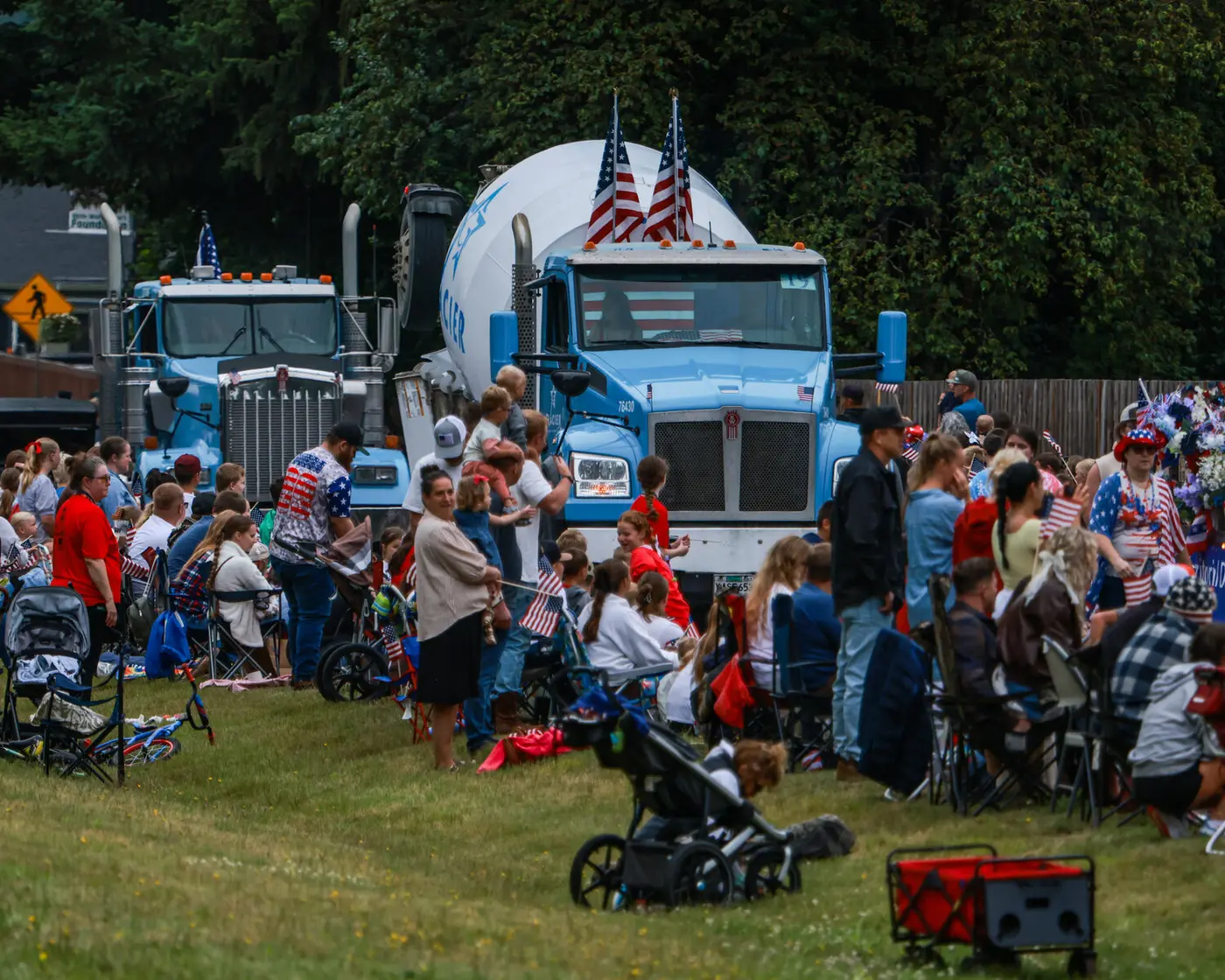
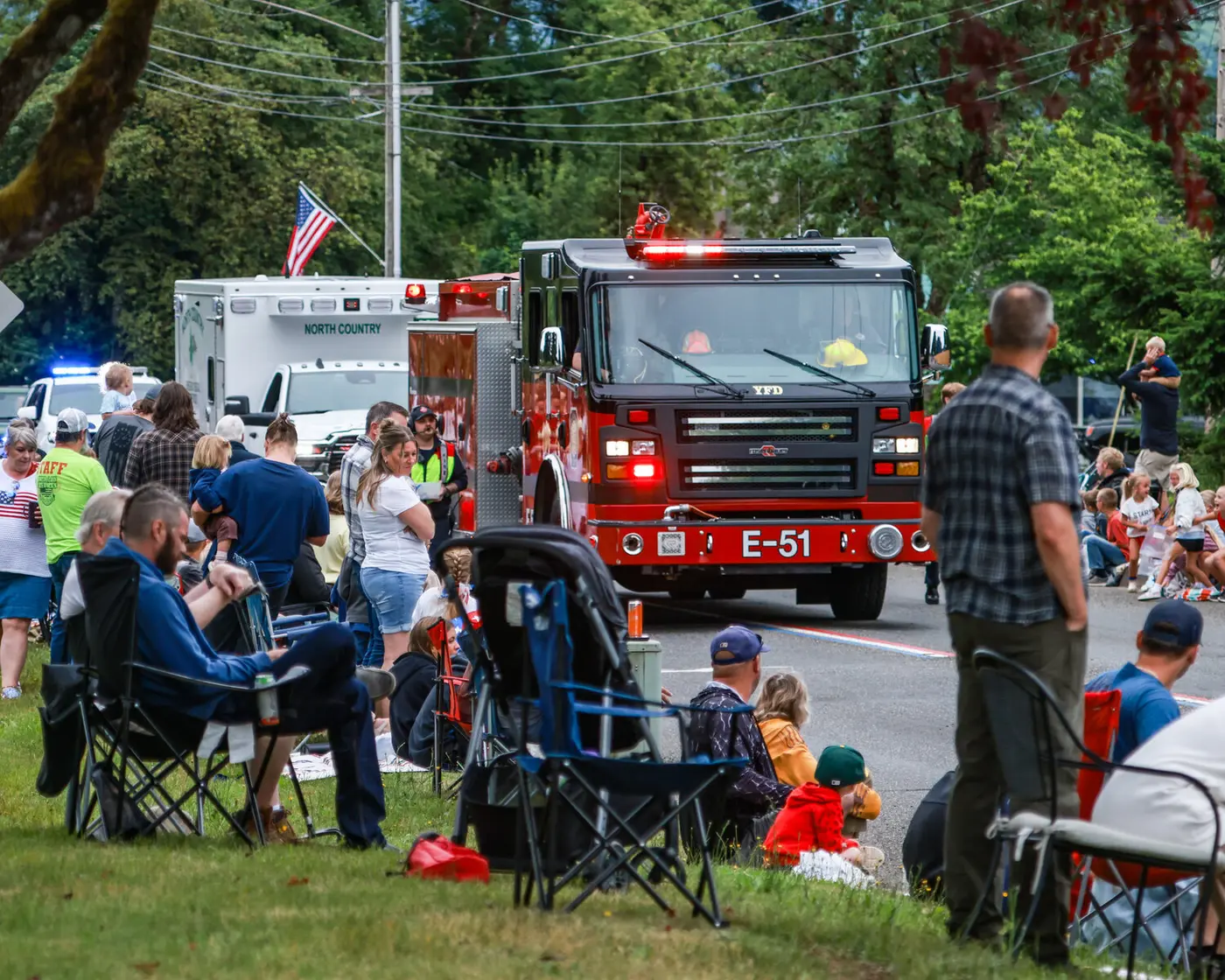
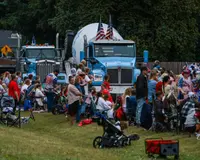
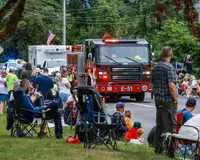
At ten in the morning on Saturday, July 4, 2026, Engine 51 of Clark County Fire District 13 pulled away from the corner of Railroad Avenue and West Hoag Street at the head of the Yacolt Freedom Parade. The published route ran up Hoag to West Yacolt Road, then west to Amboy Avenue, and ended behind Yacolt Primary School. That summer the town had painted its centerline striping red, white and blue to open its observance of the nation’s 250th anniversary, and the parade followed the stripe. The Reflector reported hundreds of residents and visitors packed along Railroad Avenue and Yacolt Road, waving flags and dressed in patriotic clothes.
Candy on Railroad Avenue
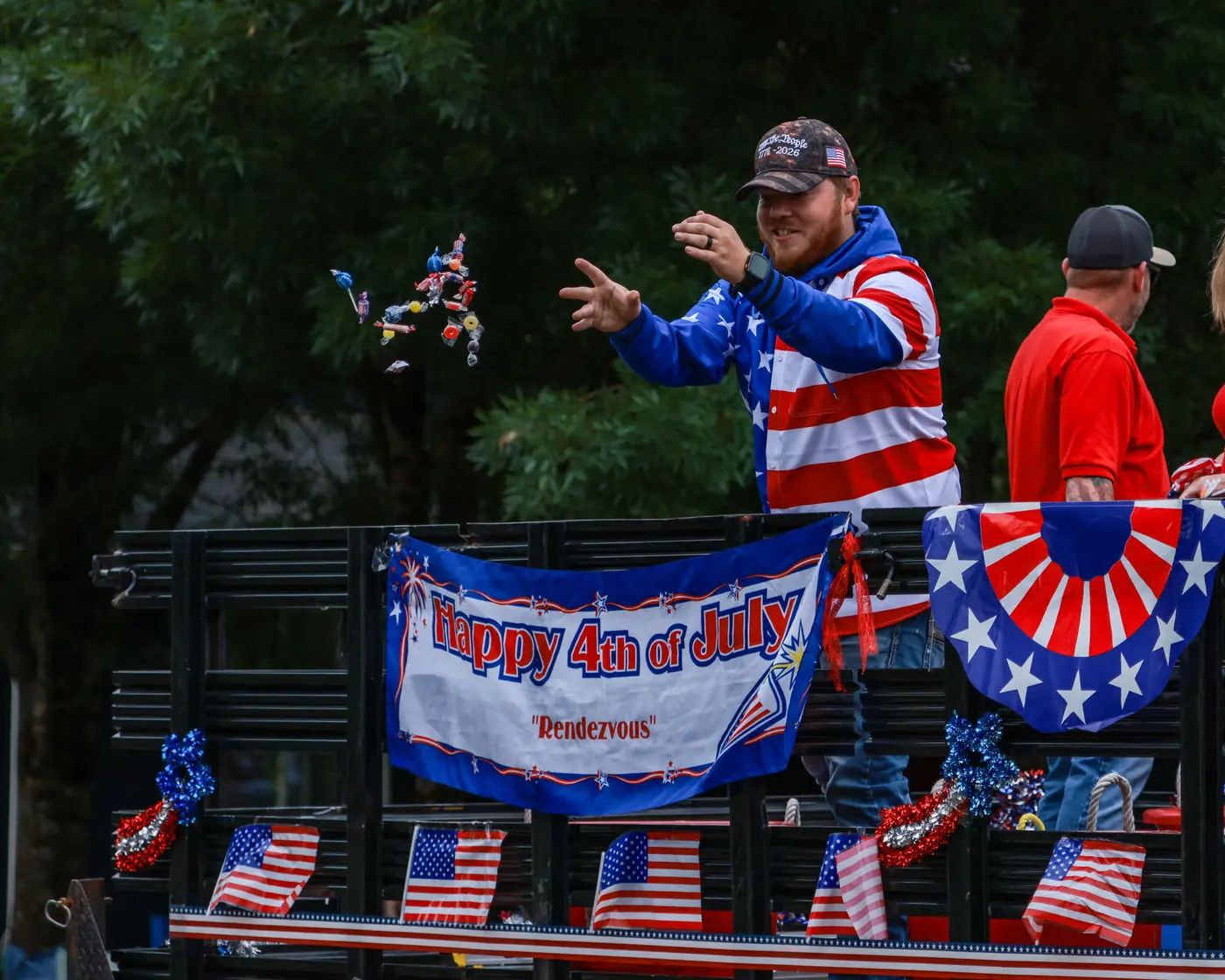
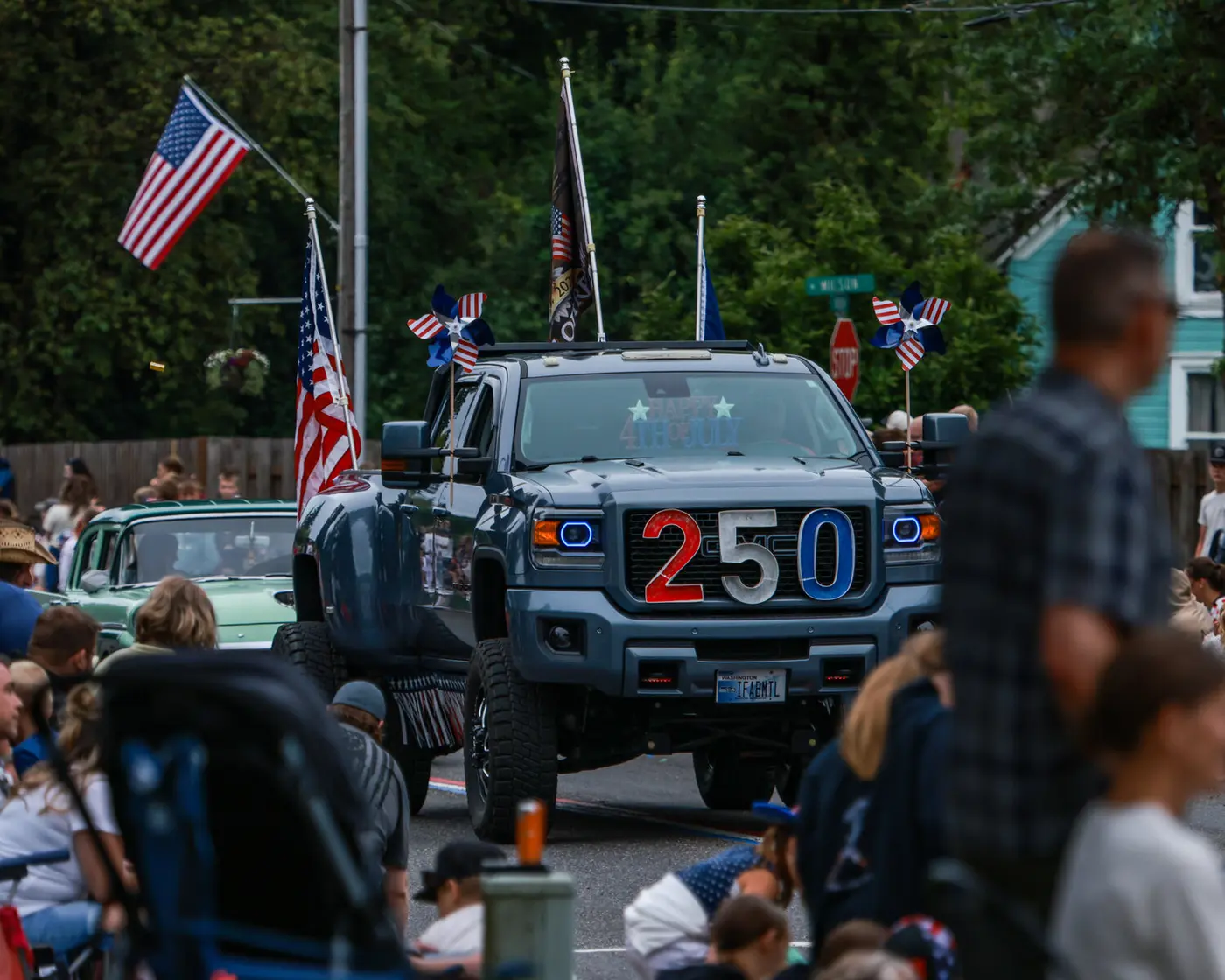
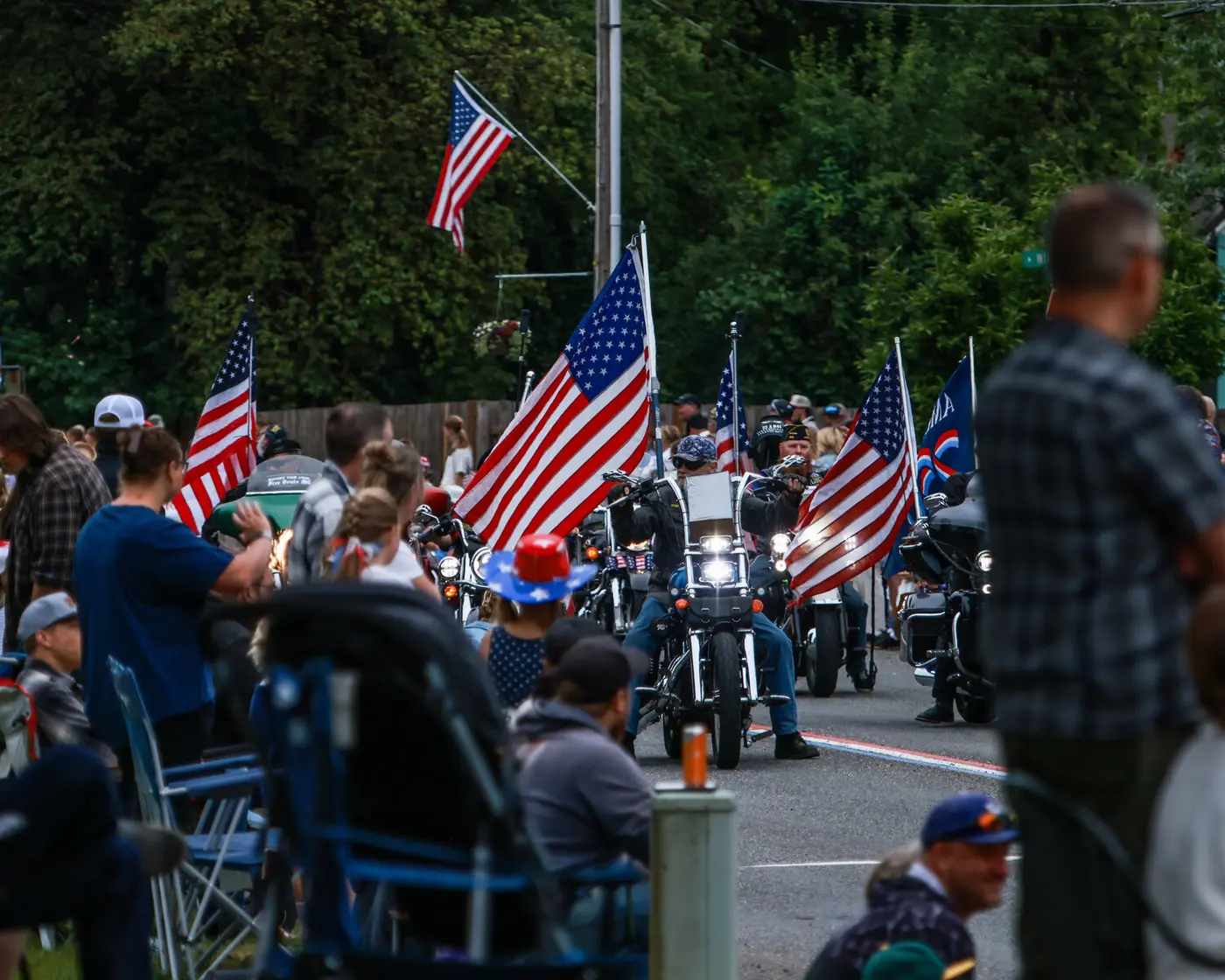
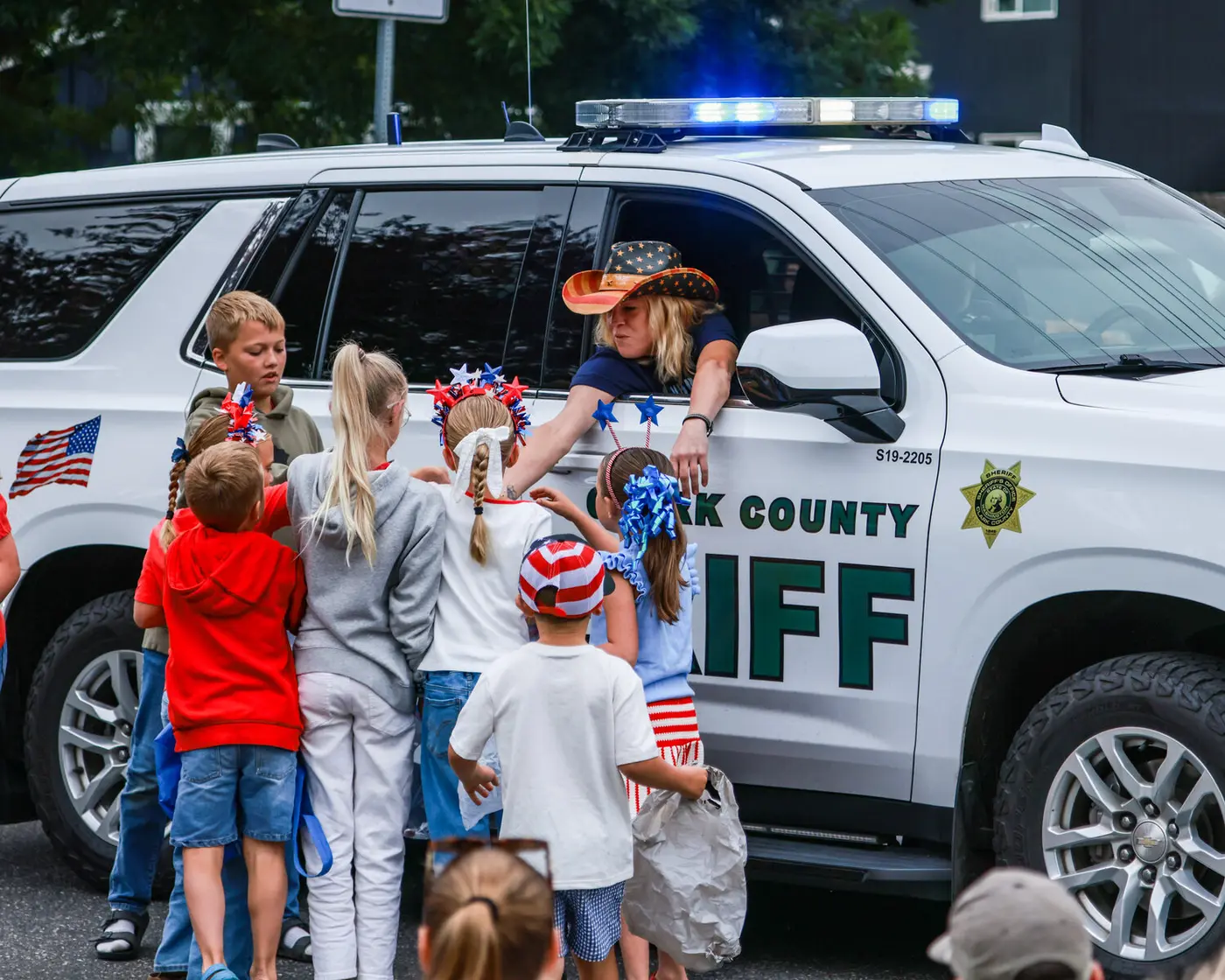
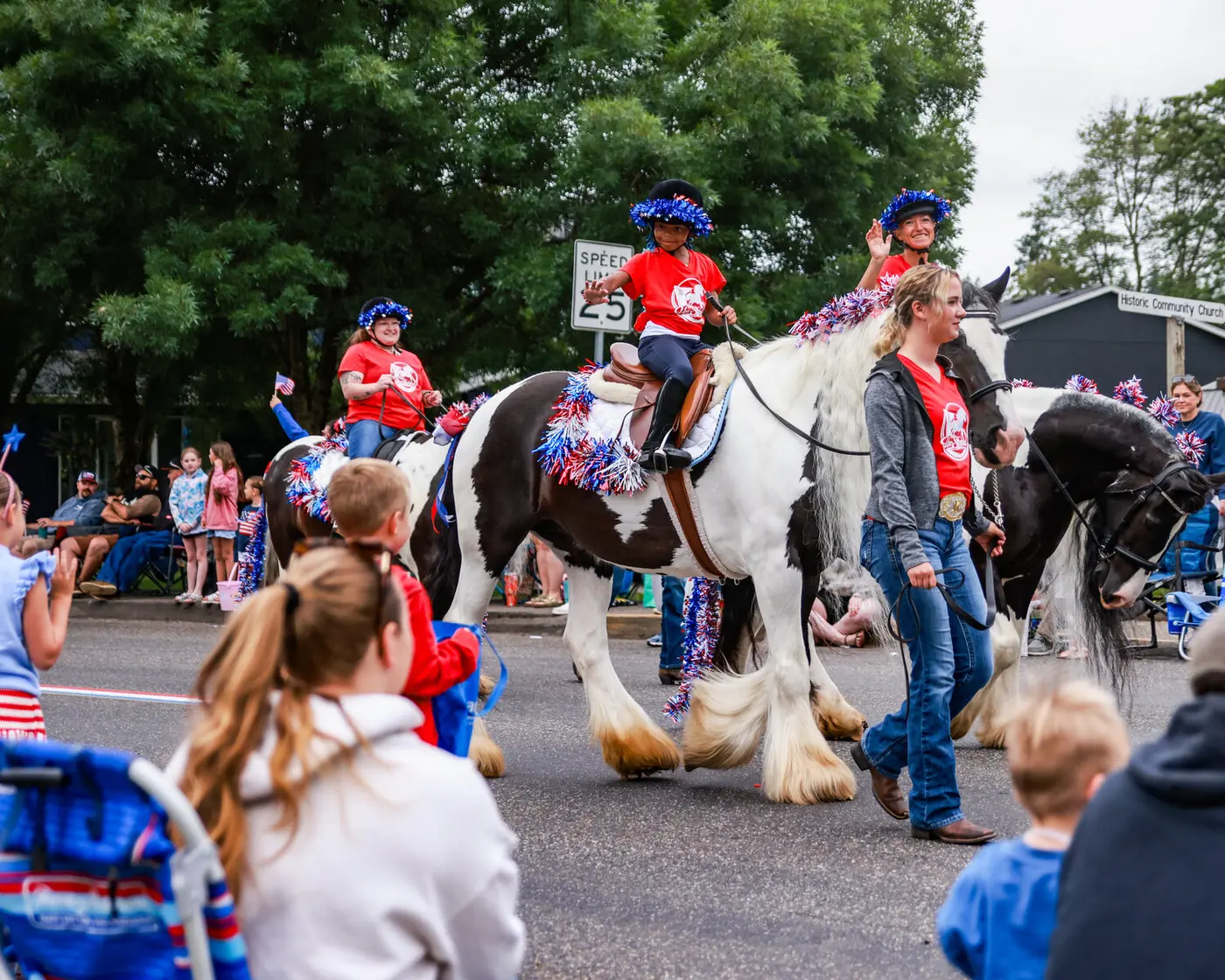
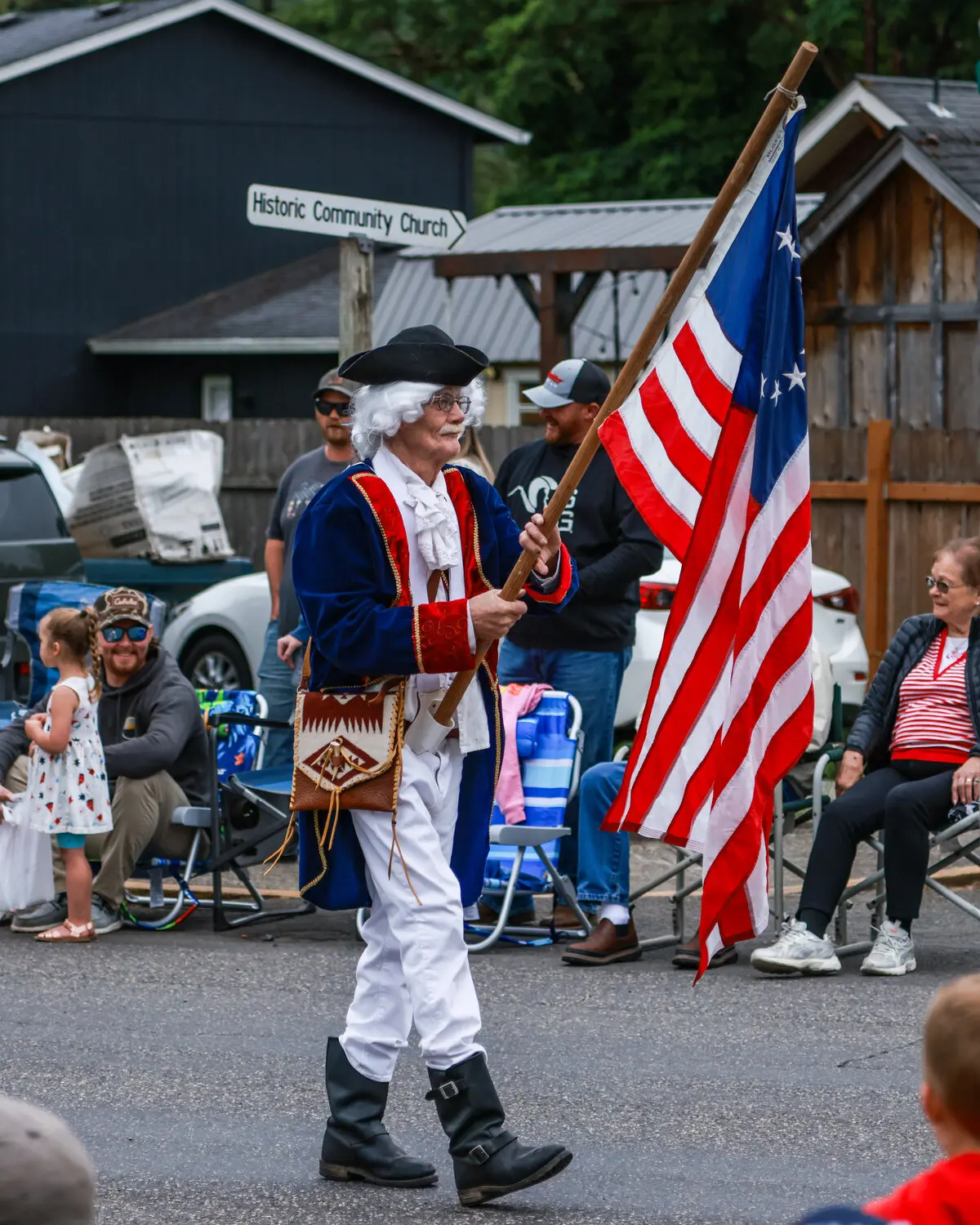
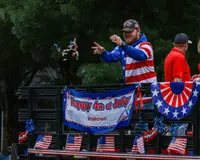
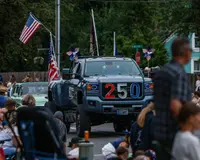
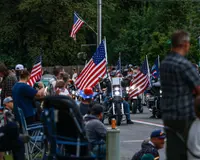
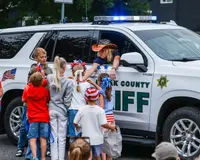
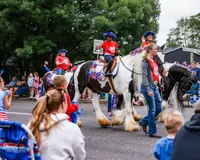
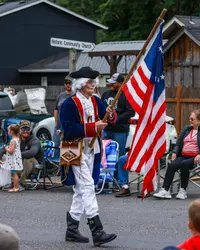
Cade Barker’s photographs of the 2026 parade for The Reflector show Mayor Ian Shealy tossing candy to children. A passenger in a Clark County Sheriff’s Office vehicle hands out more. A horse rider waves to the curb, a large pickup is dressed in decorations for the 250th, a marcher wears the costume of a Revolutionary War soldier, and the motorcycles of American Legion Riders Chapter 168 roll past. The town’s notice told families to bring a bag for the candy and to keep children back from horses and vehicles. Animal entries march with a pooper-scooper following behind.
The Reflector’s list of entries for 2022 included Amboy Hardware, local real estate agents, the Model A Ford Club of America, and a logging truck. Katie Listek, mayor that year, explained the truck to the paper: “Last year, we had a really big log truck, because the theme of our town is that we’re a logging town. The reason Yacolt was founded was because we have a logging theme. The train provided that, and now a majority of people out here are loggers, so we always try to incorporate the history of the town into our celebration.” Listek rode in the 2021 parade on a lawnmower. “I don’t want to just sit in the back of a fancy car and wave,” she said.
When the last entry has passed, the judges give their awards. In 2026 the town presented them in the school parking lot in six categories: Most Patriotic, Most Original, Best Animal Entry, Best Performance Entry, Mayor’s Choice, and Overall Judges’ Choice. In 2022 the winners were announced at 11 a.m. at the Little League fields.
Chalk, watermelon, and the ballfields
From the school the crowd moves to Central Park. The 2026 program there included a sidewalk chalk art contest, a vendor market, a watermelon-eating contest, a kids’ zone, yard games, and train rides at 1, 2:30, and 4 p.m. The day ended with fireworks at the Ballfields. Yacolt did not always end that way. In 2022, according to The Reflector, the town set off no fireworks during the festival and lit up the town square instead, as it does at Christmas.
Listek said the chalk contest is what first drew her into the life of the town. She used to organize it. The contest is divided by age group, and the judges have no personal tie to the artists. She named the watermelon-eating contest, along with the kickball tournament, as her favorite events, calling them “extremely fun to watch.” In 2022 the watermelon contest was held at 7 p.m. on the Saturday before the Fourth. That year’s afternoon also had sprinklers and a bounce slide.
Rendezvous Days and the Bigfoot run
The parade is the last morning of Rendezvous Days. In 2026 the festival opened at 5:30 p.m. on Friday, July 3, with ceremonies and a kickball tournament at the North Clark Little League fields on North Amboy Avenue. At 8 a.m. on the Fourth, before the parade, runners set out in the Bigfoot 5K and 10K from the recreation park. In 2022 the run’s trail reached Bells Mountain. The kickball tournament began in 2021. By 2022 it had grown to two divisions, one for families and one for competitive players, and the festival ran four days, July 1 through 4.
“Typically, (Rendezvous Days) was spread out over time,” Listek told The Reflector in 2022. “It was days that the community could gather and do some fun things, but I know that it has transitioned over the years, and I really think that it’s come together in the last couple of years.” She said she wanted the event kept simple and its traditions carried on. That same summer a new restaurant, Backroads, held its grand opening during the festival and sold pizza by the slice. For the 2026 weekend the town also pointed visitors to the Kids’ Fest at Pomeroy Farm on Lucia Falls Road, held July 4 and 5. Its program included face painting, pony rides, and tours of the farm’s historic buildings.
The haunted place
The town’s name is older than any of this. Wikipedia derives Yacolt from the Klickitat word “Yahkohtl,” meaning “haunted place” or “place of (evil) spirits,” and notes the area was also known as “the valley of lost children.” John Caldbick’s HistoryLink essay gives the root word as “Yalicolb.” The essay counts at least four irreconcilable accounts of how the name came about. The one most often repeated holds that Indian children gathering berries at the site disappeared into thin air and were thought to have been taken by evil spirits. A second tells of a love-struck maiden who walked into the woods and never returned after her father rejected her suitor. A fourth holds that parts of the town were built on a burial ground.
The third came from J. P. Banzer, an early settler, in 1901: “The Klickitat Indians claimed the field and made their annual pilgrimage here to gather berries. On one occasion they found a number of Wilamie Indians, as they called them. A fight started and all the Wilamies were massacred, as they thought, but an Indian girl escaped. The next year, when the Klickitats returned, they heard someone singing the Wilamie death song and saw a maiden disappear in the distance.”
HistoryLink describes the area as a gathering place, where Klickitat and Cowlitz people traded with tribes from the coast and from east of the Cascades. Joseph and Charlotte Eaton, the first documented non-Indian settlers, homesteaded on Rock Creek in 1873. They had come from Wisconsin by way of a Lewis River claim that a flood took from them that year. Joseph Eaton opened a post office in his home in 1876 and named it Yacolt. In 1887 a family named Garner settled a mile off and opened a post office named Garner. For eight years the community went by either name. Federal authorities closed the Garner office in 1895. Charles and Catherine Landon divided their 160-acre homestead into 16 lots, and that plat later became downtown Yacolt.
Paint that blistered in 1902
By the count HistoryLink cites, Yacolt in early 1902 had 50 residents and 15 buildings. The town’s history page says the Yacolt Burn began September 8, 1902, ran 30 miles in 36 hours, and burned 238,920 acres. The total was eventually estimated at 500,000 acres. HistoryLink gives 350 square miles across Clark, Cowlitz, and Skamania counties. In that account rains put the fire out on September 13, after it had killed 38 people and taken the homes of at least 148 families. Stewart Holbrook described the town’s escape in Burning an Empire in 1945: “The fire tore down the hill and paint began to blister on the fifteen buildings that comprised Yacolt. Some of the elder folk looked at the spectacle and said it was the end of the world, sure enough.” Holbrook wrote that the whole population spent the night in a creek. HistoryLink corrects him: the Coles, who ran the dairy beside the school, buried their valuables and fled on horseback to Camas, some 20 miles south. The Burn stood as the largest wildfire in Washington’s history until 2014.
Under the charred bark, most of the timber was still good. Weyerhaeuser set up headquarters in Yacolt to salvage it, through two subsidiaries, the Clark County Timber Company and the Twin Falls Logging Company. Workers came, and so did the railroad. The first plat was filed in 1903, and Yacolt was incorporated on July 31, 1908. HistoryLink says the boom did not last, and for decades the town grew slowly or lost people until about 1990. In 1913 James and Mary McCutchen donated land for the Yacolt Cemetery. Their son Cal, killed in a logging accident in 1917, was the first of the family buried there. “Many family names from the early days are still recognizable around town,” the town’s history page notes.
Notable Events
- 1873The first homesteaders in the Yacolt area, the Eaton family, arrived in 1873. historylink.org
- 1902The Yacolt Burn began September 8, 1902 and quickly traveled 30 miles in 36 hours, burning 238,920 acres along the way. townofyacolt.com
- 1903An influx of workers and the coming of the railroad encouraged the filing of the first plat in 1903, and the town voted to incorporate in 1908. historylink.org
- 1908In 1908 the Town of Yacolt was incorporated, after a flux of workers and families moved to Yacolt to support the huge timber salvaging project, resulting from the wildfire. townofyacolt.com
- 2022Rendezvous Days is also known for its Fourth of July parade, which will feature Amboy Hardware, local real estate agents, the Model A Ford Club of America, and a logging truck. It's scheduled to take place at 10 a.m. on Monday, July 4. thereflector.com
- 2026The parade begins at 10 a.m., July 4, at Railroad Ave., and West Hoag Street, working its way through downtown. clarkcountytoday.com
People
- Joseph and Charlotte Eaton, first homesteaders in the Yacolt area (1873).
- Ian Shealy, Mayor of Yacolt who tossed candy to kids along the Yacolt Freedom Parade route (2026).
- Katie Listek, Mayor of Yacolt (2022).