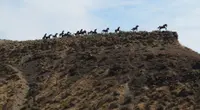
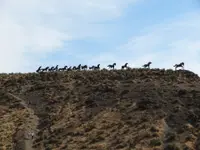


Wild Horse Monument
George, Grant County, Washington. Sculpture.
Details

- Where
- Vantage Bridge, George, WA 98824. Directions
- Getting there
- Seen from viewpoints along I-90 about two miles east of the Vantage Bridge over the Columbia River; from the eastbound off-ramp a rough path leads a quarter mile to the monument.
- Fees
- free.
- Access
- Westbound traffic has only a distant view; do not walk across the freeway. Instead, make a 10-mile loop by driving down to the freeway exit at the east end of the Vantage Bridge, then drive east to the George exit to turn around.
- Phone
- 509-754-2011
- Website
- grantcountywa.gov
- Managed by
- Grant County.
- Established
- 1989.
- Coordinates
- 46.9646, -119.9643.
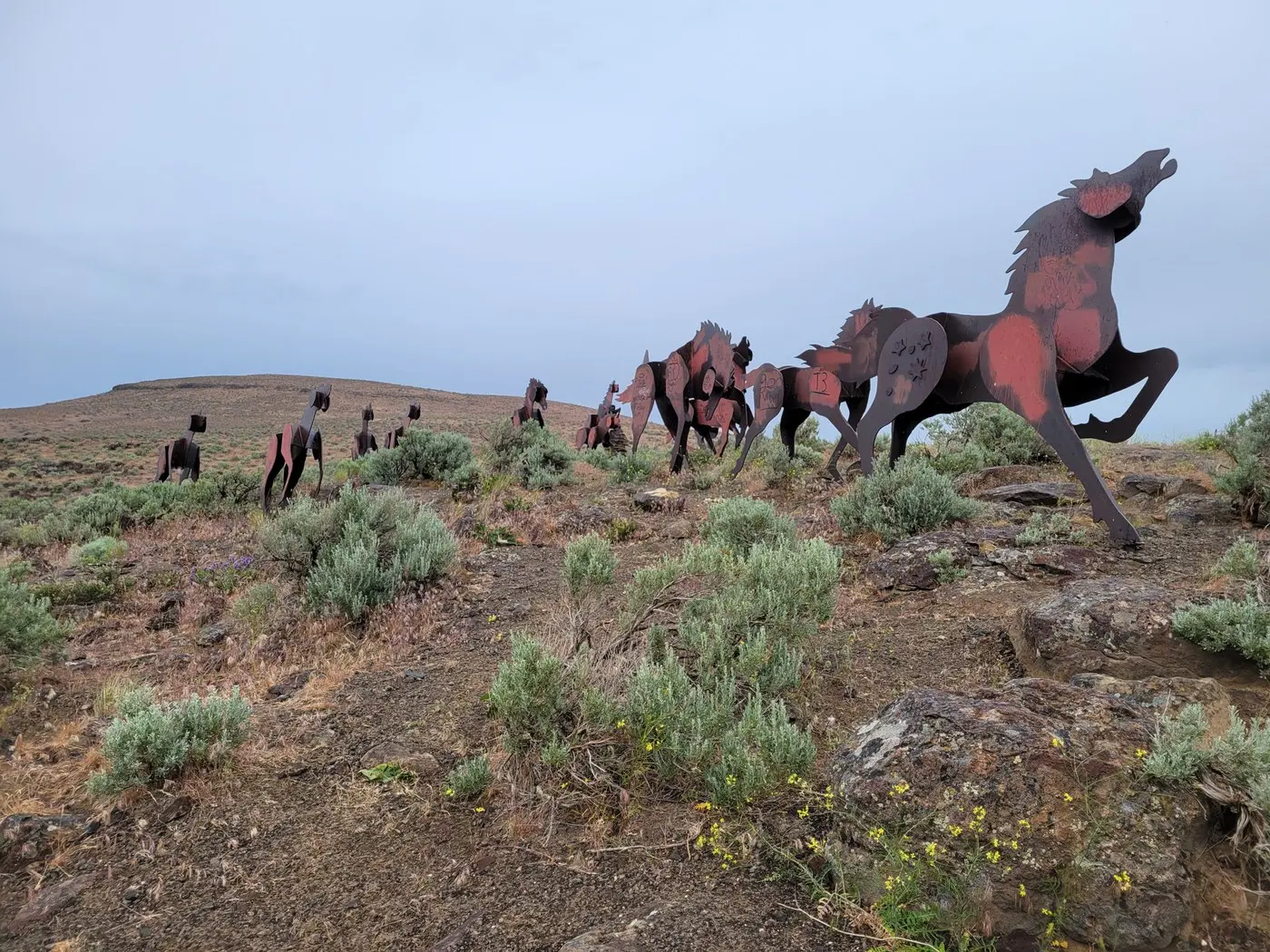
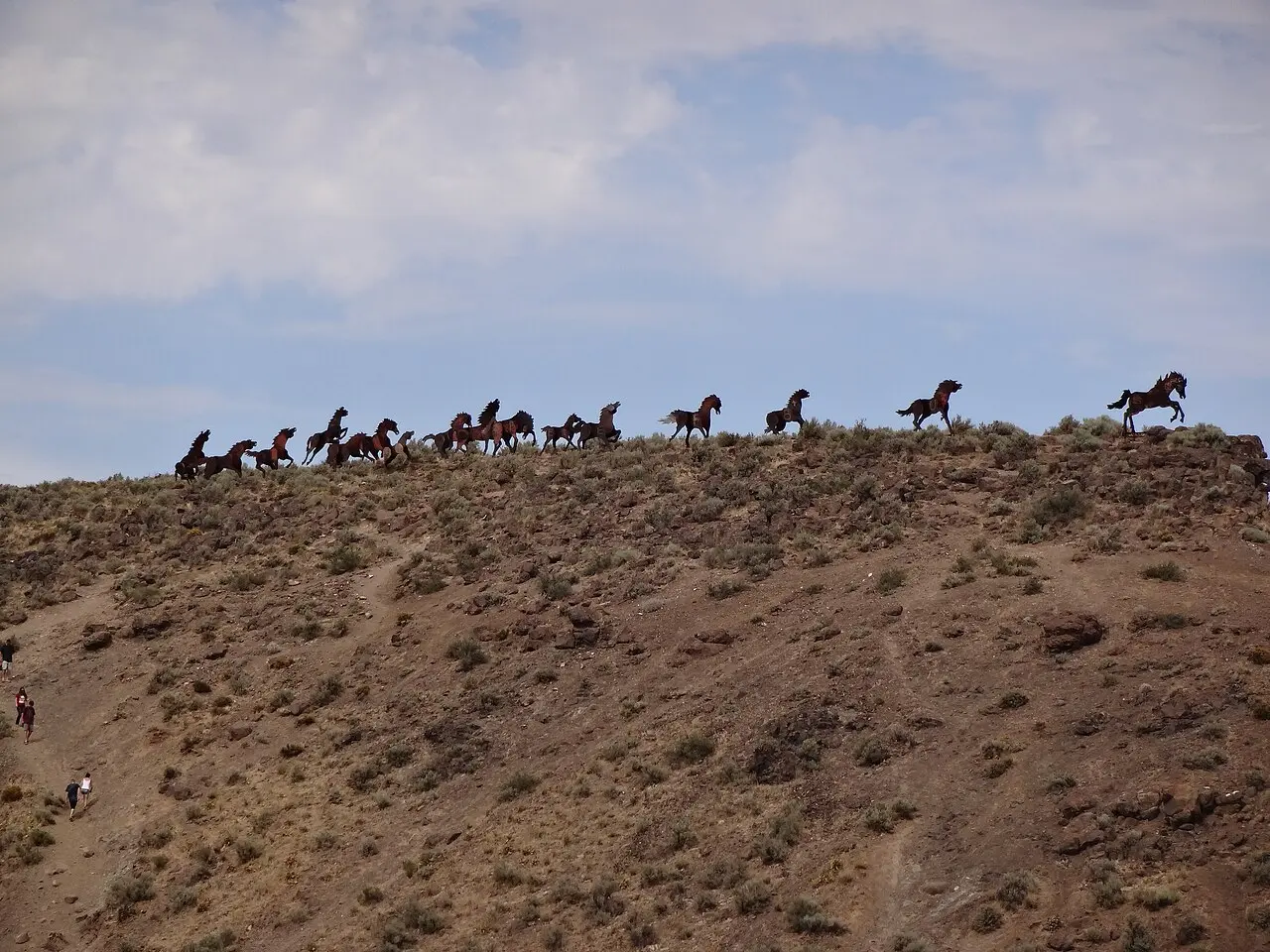
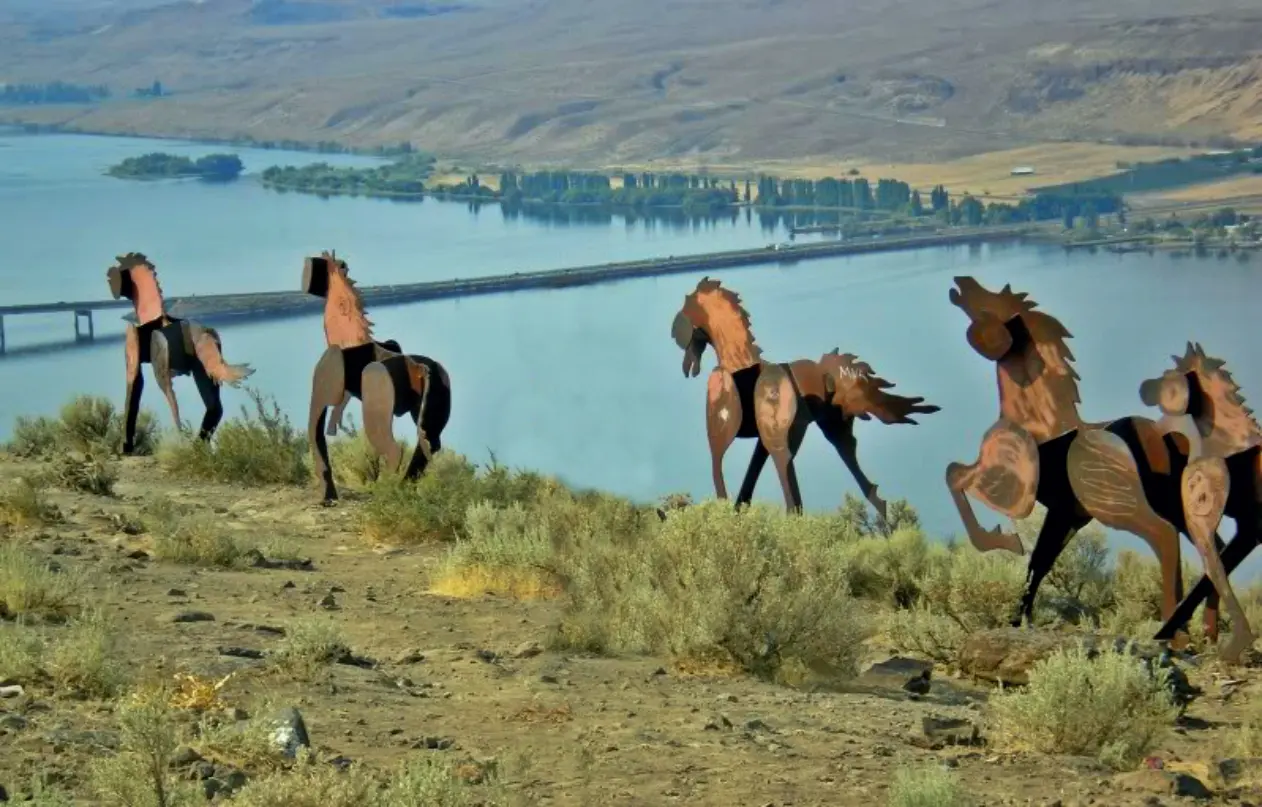
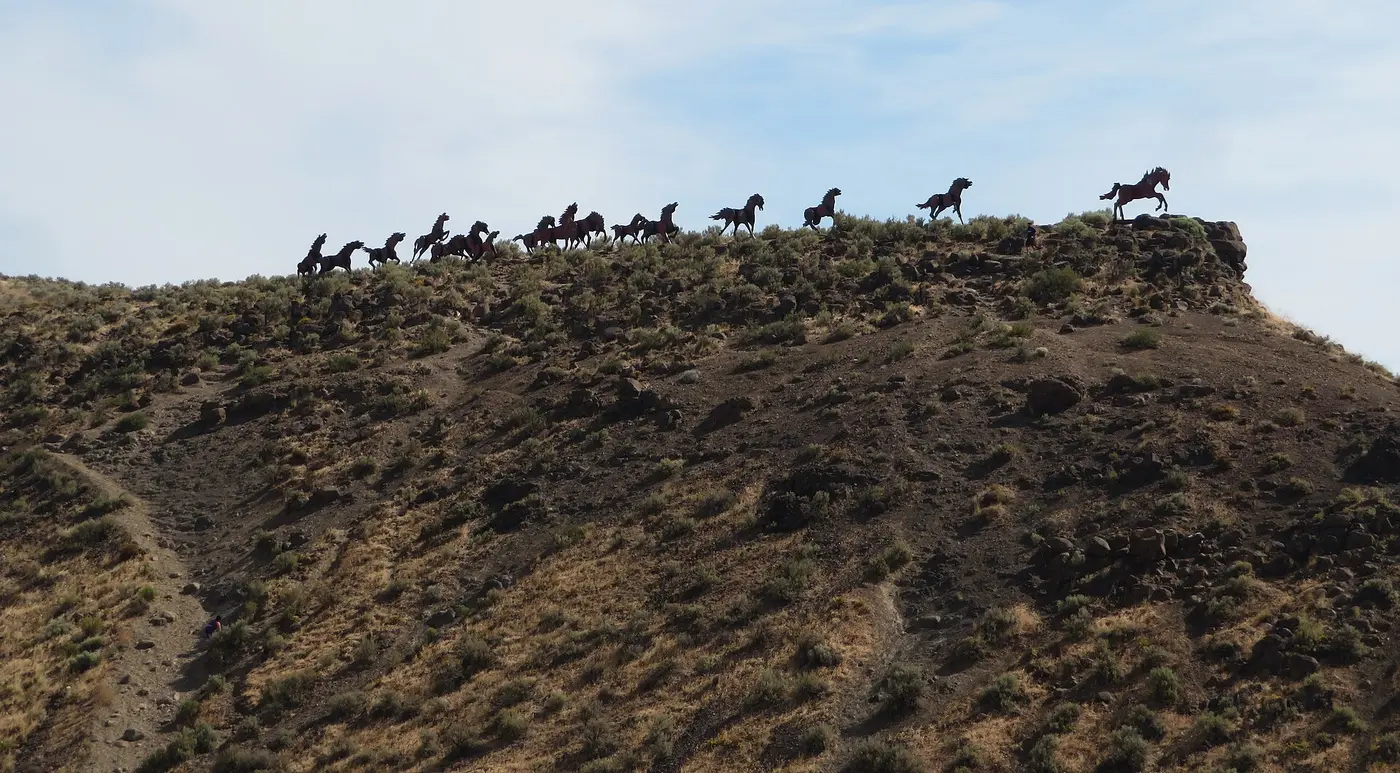
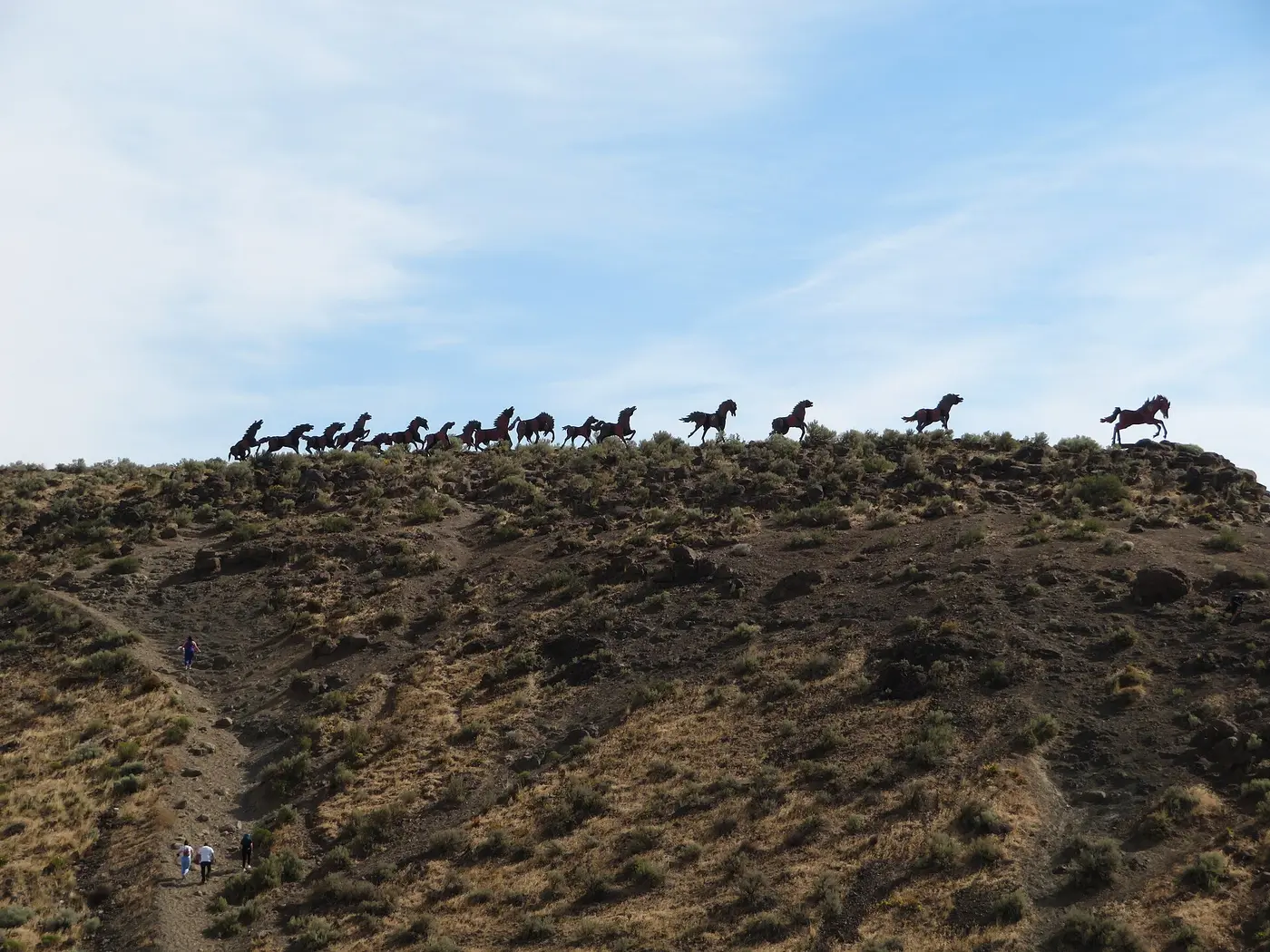
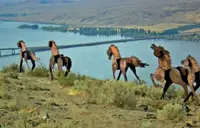
Eastbound on Interstate 90, about two miles past the Vantage Bridge, a line of horses crosses the skyline to the right. There are fifteen, life-size, strung across 200 feet of ridge above the Columbia, which here is Wanapum Lake. The road sign calls the place the Wild Horses Monument. The sculptor, David Govedare of Chewelah, titled it “Grandfather Cuts Loose the Ponies.” Grant County holds the land and maintains the work.
Most people see it at highway speed. In 2008 the Seattle Times counted more than 5 million vehicles a year going past, and state Department of Transportation figures put the total since installation at some 100 million. Govedare imagined their reaction: “Holy cow! Holy dang! Look at them horses running! … That… that to me is all it needs to be. A split second.” Karen Mobley, who once ran public art projects for the city of Spokane, said “almost everyone that drives back and forth to Seattle looks up there to make sure it’s still there.” The guidebook Washington Curiosities names Wanapum Vista, three miles east of Vantage, as the best place to see the whole line from a distance.
Exit 139 and the path to the ridge
The approach is from the eastbound lanes. Exit 139 lets off just after the river crossing, and a paved road runs half a mile to a lot that holds about 25 vehicles and a couple of buses. There is no fee and no parking pass. The Washington Trails Association reports no amenities, and the interpretive signs have been vandalized. Westbound drivers have no exit and only a distant view. The county warns against crossing the freeway on foot and recommends looping around by the Vantage and Gorge exits, 136 and 143.
The main trail leaves the far end of the lot and climbs to the left of the sculpture, two-tenths of a mile on sand and loose rock, about 150 feet of gain to a top near 1,300 feet. Faint side paths branch off, and the Trails Association asks walkers to keep to the main one to slow erosion. Accounts of the distance vary: the county says a quarter mile from the off-ramp, the Seattle Times “a few hundred feet,” and a Yakima Herald-Republic writer in 2018 a mile of steep terrain. Govedare and his friends cut the trail up the hillside themselves. He wanted the site kept as it was. “The sculpture itself is eminently wild like the wild grasses and the sage, the basaltic rock and the river,” he told his friend Don Hamilton in 2018. “If people pull up here and they saw a gift store, bathrooms and guard railings, and all kinds of things, then the piece would instantly lose much of what it says about wild horses.”
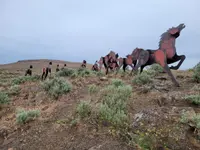
From the plateau the river spreads below, with the small settlement of Vantage on the far bank. The Trails Association advises viewing the horses in profile from the back side, with the lake as a backdrop, or in silhouette against a sunset. From the right angle the lead stallion appears to leap toward the Columbia far below. When Christopher and Margaret Stehr of Centralia climbed up with their four children in 2008, they were surprised to find the horses swaying in the wind, though they are bolted into the rock. “I thought they were really amazing, bigger than I thought they’d be,” Margaret Stehr said. Klaus, a visitor from Denmark who made the climb in 2017, told KOMO News, “I think it’s pretty damned special to see some horses out in nowhere.”
Half-inch steel, rusted by design
Each horse is cut from half-inch panels of COR-TEN steel, an alloy that rusts on the surface and keeps its strength underneath. Oxidation has turned the herd red. The Seattle Times in 2017 put each horse at about 1,000 pounds; the same paper in 2008, and the Associated Press, said 1,200. The Chewelah Independent gives the herd’s total as seven and a half tons. The horses are welded to four-foot metal poles set into the ridge. Govedare bent the steel to suggest an animal in motion. “I pulled off an illusion in a way,” he said in 2018.
The rust was intended. His friend and collaborator, the musician Cary Fly, recalled Govedare saying such pieces had “a lifespan of over 500 years. He goes, by then, they’re going to look really cool, as they rust away.” Graffiti was not intended. On a hot day in 2017 a KOMO crew followed Govedare, 66, long gray hair pulled back, up the trail with a can of spray paint. He covered the marks on the horses, then walked among them, patting rusty necks. He had named some. At one he bent and kissed it on the nose. “Living steel,” he said.
A centennial gift on $65,000
Govedare grew up in California and was studying architecture at California Polytechnic when he came to the Spokane area for an architect’s internship during Expo ‘74. “He never left,” said Greg Coleman, a longtime Chewelah friend. Along the way Govedare had surfed in Southern California and hauled hay in Montana. He had no formal art training. In 1984 he installed “The Joy of Running Together,” a field of life-size steel runners honoring Bloomsday in Spokane’s Riverfront Park.
He said the horse idea came to him in the mid-1980s, after reading that organizers of the 1989 Washington State Centennial were looking for ideas; Wikipedia gives the year as 1986. “I pulled into this site here, and I knew that Washington was having its Centennial in 1989,” he recalled in 2017, “and I looked up there and I thought, ‘This is wild horse country.’” The last grand roundup of wild horses had taken place in this area in 1906, and he meant the work as an homage to them.
The Grant County Centennial Committee endorsed the proposal in March 1987. The centennial committees of Spokane, Adams, Lincoln and Kittitas counties followed, and members of the Washington Centennial Commission wrote in support that November. Govedare’s version was quicker: he took officials to the site and heard five days later that it was approved. “I missed all the barbed wire,” he said. The Department of Transportation ceded the ridge to Grant County, which pledged to maintain the sculpture. A Thundering Hooves Centennial Sculpture Committee set out to raise $250,000 in private money. Coleman remembered the terms as raising it in a year, building in a year and installing in a month, with sponsors sought at $15,000 a horse. “The state, the counties, WASDOT – they said, ‘You’ve got to build it but we’re not giving you any money.’”
Money came slowly. Many corporate donors balked at paying for a sculpture outside their own communities. County officials, businesspeople and schoolchildren together raised at least $60,000, according to the Seattle Times in 2008; Govedare later put the cost of what was built at about $65,000. Building the horses took two years of his life.
The sources disagree on how the herd reached the ridge. The Seattle Times and the Associated Press reported that the first horse was bolted into place in August 1989. Wikipedia says only the lead stallion was finished by then and was unveiled in Riverfront Park as part of the fund drive, that the first six horses went onto the ridge in October 1990, and that nine more followed over the next months. Govedare told KOMO he first set the herd up in a field on his Chewelah ranch to get the spacing right, then took it down in 1991 and rebuilt it above the gorge.
The basket that was never built
The fifteen horses were meant to be spilling from a great woven steel basket, tipped on its side by Grandfather, Govedare’s symbol for the Great Spirit. Accounts of its size differ: 36 feet tall in the county’s, the Trails Association’s and the 2017 Seattle Times descriptions, 36 feet in diameter in others, including Govedare’s own 2018 remarks. They also differ on its weight: 12 tons, 13 tons, or 25,000 pounds. Most sources give the finished herd as 18 horses. Wikipedia describes two still inside the basket and sixteen running free. In 1988 Govedare described local artists decorating the basket with people, leaping salmon and running deer, “a sort of futuristic Noah’s Ark.” In his story, Grandfather Spirit speaks as he tips it: “Creatures of this planet, behold, a Great Basket! I send this basket, bearing the gift of life, to all corners of the universe. Now, take these ponies, I am cutting them loose. They will inspire a spirit of free will.”
The Seattle Times noted in 2008 that the Grandfather Spirit might seem to come from Native American tradition but was Govedare’s own invention, and that he was of European descent. The Yakima Herald-Republic called the work “a Native American-style creation story,” and Spokane Public Radio said he often drew on Native American themes. Govedare told the Quincy Valley Post-Register, “The basket represents the positive nature of the universe, the hand of creation. It’s not a religious piece, it’s spiritual.” A statement quoted by the Chewelah Creative District gives the basket a different figure: “The basket is meant to be the Earth Mother, tossing the horses to the four directions… A gift to the people.”
Attempts to pay for it went on for decades. In 2008 the cost was estimated at $350,000. State Sen. Chris Marr of Spokane wanted state money but asked for a formal request from a nonprofit. “Artists are not the best business people in terms of submitting funding requests,” he said. John Roskelley, a former Spokane County commissioner who had tried for years to find funding, said one opposing senator told him the basket looked like a satellite dish. Roskelley conceded the likeness, “only if you’re as old as I am.” By 2017 Govedare put the cost at about $500,000. In 2018 he said it would take close to a million dollars for engineering, fabrication, hauling and helicopter time, and he started an online drive for that amount. “It has to take 100-mile-an-hour winds and be 36 feet in diameter and follow my artistic vision,” he said.
The KOMO crew first saw him in 2017 in the parking lot below the ridge, lifting a welded steel basket from his car and hoisting it over his head before setting it back. Up among the horses he said, “I have a lifetime that’s given to me. However long I live I have this to be a part of my life. And to complete it would be nice.”
The lead stallion in Chewelah
Govedare died in November 2021, just before Thanksgiving, at 71. Fly said he left small models of the basket and full dimensions and instructions for whoever builds it. “Maybe his son; he taught his son how to do that.” Friends began raising money to preserve his Chewelah home and workshop and to build the basket in his honor.
On June 6, 2024, the original lead stallion, which the Chewelah Creative District describes as the prototype for the Vantage herd, was unveiled in Chewelah City Park. Voodoo Church of Blues played, fire dancers performed, and Fired Up Pizza sold out within an hour after serving more than 400 tacos. Coleman read Govedare’s story of the Grandfather Spirit to the crowd, and Govedare’s son, Forest, sat in on guitar with the band. Councilwoman Tracy Ling called the sculptor “David Govedare, AKA Whirling Horse.” The stallion rears a few yards from Highway 395, facing the house and studio where Govedare built it.
Notable Events
- 1906The source says this was the area of the last grand roundup of wild horses; Govedare thought he would honor them. seattletimes.com
- 1980sGovedare says he conceived the horse idea after reading that organizers of the upcoming Washington State Centennial sought ideas. seattletimes.com
- 1989The intended Centennial gift was not completed because funding ran short. grantcountywa.gov
- 1989The first metal horse was bolted into place. seattletimes.com
- 1989Govedare was commissioned to make the sculpture as part of the statehood centennial. spokesman.com
- 1991Govedare first assembled the horses in a field on his Chewelah ranch to get the distances and spacing right, then in 1991 took them down and began re-constructing them above the Columbia River gorge. komonews.com
- David Govedare, artist behind the Wild Horse Memorial in central Washington, died just before Thanksgiving. knkx.org
People
- Greg Coleman, longtime Chewelah resident and close friend of David Govedare who recounted the project's fundraising history: corporate sponsors at $15000 per horse and a requirement to raise $250000 in a year, build in a year, install in a month.
- Don Hamilton, Supplied interviews with Govedare undertaken before his death in hopes of completing Grandfather Cuts Loose the Ponies.
- Chris Marr, State senator who wanted state funding to finish the project.
- Christopher Stehr, Centralia visitor who climbed to the horses with his family on a road trip.
- John Roskelley, Former Spokane County commissioner and Eastern Washington Growth Management Hearings Board member who had tried for years to find funding for the basket.
- Margaret Stehr, Centralia visitor who climbed to the horses with her family on a road trip.
- Cary Fly, Hoped the unfinished sculpture would be completed someday.
- David Govedare, Chewelah sculptor who designed and created Grandfather Cuts Loose the Ponies (1950-2021).
- Forest, Govedare's son, mentioned only as a possible future builder of the basket: 'Maybe his son; he taught his son how to do that.'.