White Bird Rodeo
White Bird, Idaho County, Idaho. Rodeo.
Details

- Where
- US Hwy 95 at Twin Bridges. 6 miles south of, White Bird, ID. Directions
- When
- June 19 - June 20.
- Getting there
- Highway 95 @ Twin Bridges.
- Hours
- 5:00pm PDT.
- Access
- The Rodeo Arena is open to the public year round. All we ask is to keep it clean, pick up your garbage& all gates must be CLOSED when you are done.
- Walk-in or reserve
- tickets available at the gate.
- Phone
- (208) 983-7701
- Website
- whitebirdrodeo.com
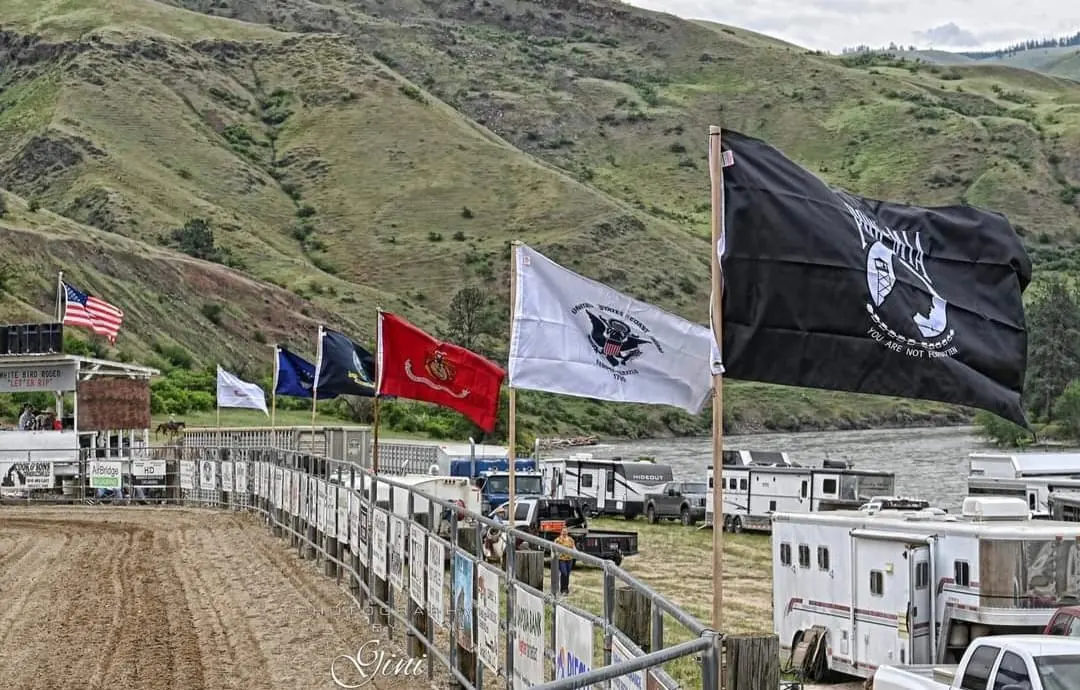
The White Bird Rodeo arena stands off U.S. Highway 95 at Twin Bridges, six miles south of the town of White Bird, Idaho. Visitors exit onto Rodeo Drive. The grounds hold bucking chutes, pens, bleachers, an office, storage and a parking area, all on land the rodeo leases from the Bureau of Land Management along the Salmon River. “We have a beautiful location,” vice president Shelley Neal told the Idaho County Free Press in 2014. “We have a wonderful setup, plenty of parking, easy in and out, and it’s visible from the highway.” Tickets are sold at the gate. The rodeo runs on the Friday and Saturday of Father’s Day weekend, and both performances begin at 5 p.m. Pacific time. The Idaho Cowboys Association flyer for the 2026 rodeo carried a short note: “NO SLACK- no lights.”
Two evenings at Twin Bridges
The rodeo is sanctioned by the Idaho Cowboys Association. The 2026 card listed bareback, saddle bronc and bull riding with $800 added to each purse, and ranch bronc riding with $1,000 added. Steer wrestling, team roping and the other timed events carried $500, and novice riding events carried $100. Tri-State Rodeo Company supplied the stock, and Randall Eschler announced. The winner of each event except the novice classes receives a buckle. An all-around buckle goes to the contestant who wins the most money in two events. Timed-event contestants ride in when their names are called and make no warm-up laps, and the gates stay closed during every event. Monty Baker, one of the organizers, said in 2020 that the rodeo had drawn around 100 contestants in each of the preceding few years.
Children compete on both days. They ride mini bulls and mini ponies and enter junior ranch bronc riding. Pee wee barrels are for riders 10 and under, and youth barrels for ages 11 to 17. A local team roping is limited to residents of the surrounding counties. Rick Miller, the rodeo’s president, has said the youth events grew out of a plain conviction: “You have to start somewhere, you have to get experience.” The 2014 program shows how the evenings were built in those years. Calf scrambles for ages 3 to 7 and 8 to 12 ran both days, and steer riding led into the rodeo at 6:15 p.m. Friday and 4:45 p.m. Saturday. Adult tickets were $8, children 6 to 12 paid $6, and programs cost $1. The Eh Capa Bareback Riders rode at the Saturday performance.
The rodeo reported “lots of action even in 90 plus weather” at the 2026 edition. Two days before that post, it noted that a fire camp had moved onto the arena grounds: “so glad that we got to have the rodeo before they moved in.”
Stars, stripes and canyon life downtown
The rodeo is part of White Bird Days, the town’s annual celebration, and each year carries a theme. In 2026 the theme was “Stars, Stripes, and Canyon Life.” Brooke Myers, Shauyna Pierstorff-House, Velma Trivett and Charlotte Sickels hosted the 2026 program. On the Friday, five food trucks set up downtown next to the Silver Dollar Bar around 2 p.m. Andrew Chappell played there that night from 8:30 until midnight.
Saturday began with a cowboy breakfast at Hoots Shop and Stay off Highway 95. Downtown there was an egg toss, a parade, Pies in the Park, a craft fair, an art show, and a car, tractor and motorcycle show where the band Burning Wheel played. The Idaho County Sheriff’s Department brought two cruisers and a drone for children to look over, and fire trucks and an ambulance stood nearby. The day also held children’s games, a treasure hunt and a Queens Luncheon. At 8:30 p.m. High Mountain Country played beside the Silver Dollar Bar.
Beers at Mac’s Bar
According to the Free Press, rodeos were held near Slippy Creek during the 1930s, close to where the arena stands now. Those rodeos faded. The idea returned one night when a group of young local ranchers and cowboys gathered for beers at Mac’s Bar. Shelley Neal, then Shelley Gill, was among them. “It was just a group of us, cowboys, ranchers, friends, all sitting around deciding we could have a rodeo,” she said. “There were probably 10 or 15 there, and we gathered up a few more as we started going along. Lonnie Keeler was a big part of it, and so was Mike Heath.” Josephine Parsons owned and operated Mac’s at the time. She was the first to sponsor a chute gate and a belt buckle.
In 1990 the group put on its first rodeo at the old mill site on Deer Creek Road, leased from Neal and Evelyn Dewitt. The Free Press reported that the early rodeos cost about $10,000 to stage, in a town of perhaps 100. The next year, with help from a Bureau of Land Management man, the rodeo moved to the Hammer Creek Recreation Area. That site had two problems. During the mid-June surge of meltwater the Salmon River lapped at the back pens. And because the site lay within the Wild and Scenic Salmon River corridor, the arena had to come down every year. Volunteers set it up for the Friday and Saturday shows and tore it down by Sunday. At that point the committee owned bucking chutes and about 40 panels, and it rented the rest. “There weren’t many of us volunteering at the time,” Miller said. “And we wanted to get away from renting the arena.” Neal remembered how close they came to stopping. “It became so much work we were about ready to call it quits because nobody had the time to put it up every year.”
The two accounts credit different people with the move to Twin Bridges. Neal names LuVerne Grussing, the BLM’s recreation manager: “A big player all along helping us was LuVerne Grussing.” Miller describes more than two years of his own work on the approval. “I drove the people at the BLM crazy,” he said. “I’d stop by their office every day on my way home from Lewiston, where I was working at the time.” Some worried the new site was too far from town. An archaeological survey covered 20 acres, with test sections dug 10 meters square and four feet deep, and found no artifacts. Volunteers started leveling the ground in February. They pulled out boulders and hauled hundreds of loads of dirt and sand. “There were rocks the size of Volkswagens,” Miller recalled. “We worked through weekends right up to rodeo time.” The Free Press gives 2006 as the year the rodeo found its permanent home.
Since then the arena has stayed open to the public year round. A notice from the rodeo asks only that users pick up their garbage and close every gate. Locals use the grounds for horse training, barrel racing and roping practice, and the winters there are often milder than in the surrounding country. The site has also hosted District III high school rodeo. “The spot we’re in now, we can leave it up so the 4-H kids and other people can use the arena,” Neal said. “That’s what it’s for. It’s for the whole community.”
Six or seven volunteers
Miller has been president since the late 1990s. He estimates that a core group of about six people has carried most of the work. His wife, Mickie, serves on the committee. Shelley Neal kept the rodeo’s records, and her husband, Garrett, has helped for more than 20 years. Monty and Toni Baker have each given around three decades. In 2014 Neal said Keeler still supported the rodeo and that Heath had become chute boss. Andrew Morgan joined more recently, partly because his daughter used the arena, and brought the group to seven. “We kind of laughed about it 10 years ago, how we were all getting old,” Miller said. “Now we’re finally to the age where some of us can’t do what we used to do.” He would like a committee of 10 to 15.
Families run through the rodeo’s royalty. Miller’s daughters and granddaughters have served as rodeo queens. His granddaughter Bella Klapprich was White Bird Rodeo Queen in 2016. Neal’s family goes back five generations in Idaho County. They settled at Gill Point near Tolo Lake, and the Gills have run cows at Cow Creek, near Lucile, for four generations. As a girl she competed in high school rodeo. Once, team roping with her older brother Marty, she fell off her horse, got up, climbed back on and caught both heels.
In May 2020 the White Bird City Council canceled White Bird Days because of the COVID-19 pandemic, and there was to be no parade. The organizers still planned to hold the rodeo June 19 and 20, under the rodeo’s slogan “Let ‘er rip.” Baker expected rodeo contestants shut out of Oregon and Washington to double the usual field. “There’s plenty of room to move around out there,” he said of the grounds. “We’ll have sanitizers around the office, but the food booths — I don’t know.”
By 2014, Neal said, the rodeo cost $12,000 to $15,000 to stage. Sponsors’ advertising and ticket sales paid for it, and sponsor signs hung on the freshly painted chutes.
Notable Events
- 1930sRodeos were held near Slippy Creek, near where the rodeo is held today. idahocountyfreepress.com
- 1990The group put on a rodeo of their own at the old mill site, leased from Neal and Evelyn Dewitt, on Deer Creek Road. idahocountyfreepress.com
- 2006The rodeo found a permanent home, again thanks to the BLM; organizers since added an office, storage, bleachers and parking. idahocountyfreepress.com
- Rick Miller spent more than two years working with the Bureau of Land Management to secure the site; an archaeological dig covering 20 acres found no artifacts, clearing the way for development. iclp.coop
- White Bird organizers planned to stage the rodeo along the Salmon River despite the COVID-19 pandemic; the report describes plans, not proof the performances occurred. washingtontimes.com
People
- Bella Klapprich, White Bird Rodeo Queen (2016).
- Garrett Neal, volunteer organizer (more than 20 years).
- Monty and Toni Baker, volunteer organizers, each with around three decades of service.
- Rick Miller, rodeo president, who secured BLM approval for the current site (since the late 1990s).
- Josephine Parsons, owner and operator of Mac's, first to sponsor a chute gate and a belt buckle.
- Lonnie Keeler, founding organizer.
- LuVerne Grussing, BLM recreation manager who helped the rodeo.
- Mike Heath, founding organizer, later chute boss.
- Shelley Neal, White Bird Rodeo vice president and record keeper, with the founding group at Mac's.
- Matt Askew, Idaho Cowboys Association president discussing the unsettled rodeo season.
- Monty Baker, White Bird Rodeo organizer anticipating increased contestant turnout.
Sources
- whitebirdrodeo.com
- icarodeo.com/uploads/1/1/3/5/113538347/untitled_document__63_.pdf
- facebook.com/p/White-Bird-Rodeo-100057374775105
- idahocountyfreepress.com/news/white-bird-rodeo-s-silver-anniversary-neal-recounts-rodeo-s-25-year-history/article_c6ec42a9-60f3-5368-acd1-f44d96afd33a.html
- iclp.coop/news-releases/june-2026